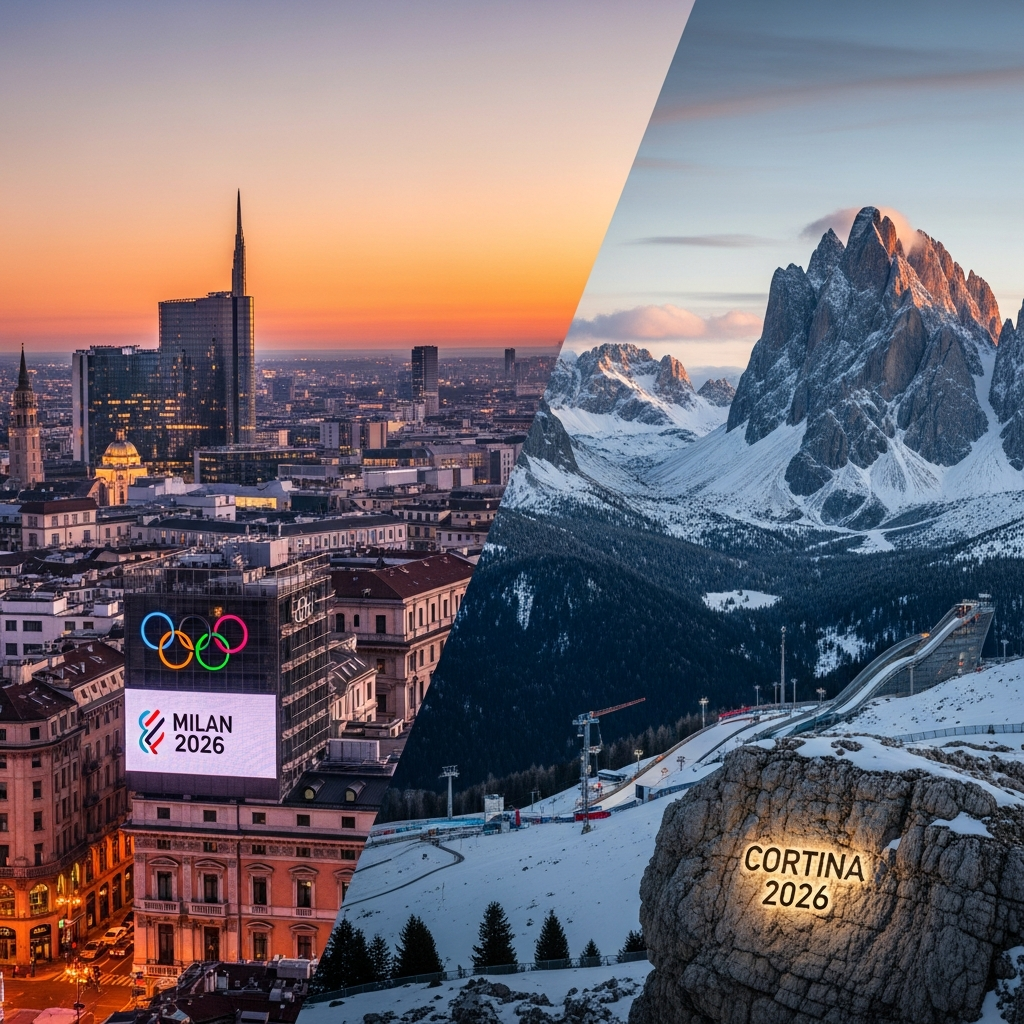
The Milan-Cortina 2026 Winter Olympics represented a significant shift in the hosting paradigm for the global sporting spectacle. Spanning an unprecedented 8,500 square miles across Italy’s Lombardy and Veneto regions, these Games adopted a highly decentralized model. This approach aimed to leverage existing infrastructure and showcase Italy’s diverse landscapes, from the bustling cityscapes of Milan to the stunning Dolomite peaks surrounding Cortina d’Ampezzo. Yet, this innovative strategy also sparked considerable debate, particularly concerning its environmental footprint and the true cost of “sustainability.”
As the Olympic flame was virtually extinguished, signifying the conclusion of weeks of intense competition, the Milan-Cortina 2026 Winter Olympics left behind a legacy of both athletic triumphs and complex questions about the future of global sports events.
A New Era: The Distributed Olympic Model
The 2026 Winter Games, officially known as Milano Cortina 2026, were notable for their expansive geographical spread. Events were meticulously distributed across various Italian locales. Milan, a vibrant economic hub, hosted ice sports. Meanwhile, biathlon events took place in Anterselva, near the Austrian border, and snowboarding, alongside men’s downhill skiing, found its home in Valtellina, close to the Swiss frontier. Cross-country skiing captivated audiences in Val di Fiemme, while co-host Cortina d’Ampezzo presented women’s downhill, curling, and various sliding sports.
This scattered approach was championed as a blueprint for future Olympic Games. Its primary goal was to circumvent the exorbitant costs typically associated with constructing new, purpose-built facilities. Organizers hoped to demonstrate that existing venues, often scattered across a broader region, could successfully host a world-class event without massive new investments. This strategy aims to foster a more sustainable and economically viable model for the Olympics moving forward.
The Grand Finale: Closing Ceremony in Verona
The climax of the Milan-Cortina 2026 Winter Olympics unfolded with a vibrant Closing Ceremony. On Sunday, February 22, the historic Verona Arena, a remarkably preserved ancient Roman amphitheater, played host to this momentous event. This iconic venue, renowned for its first-century origins and modern-day opera festivals, offered a powerful backdrop. Its central location also symbolically linked the Games’ widely dispersed sites.
Filmmaster, the creative company behind the ceremony, orchestrated an unforgettable spectacle. The event embraced a theme designed to celebrate Italy’s rich cultural tapestry while simultaneously looking towards the future of the Olympic movement. Audiences witnessed a “tapestry of music, art, and storytelling,” showcasing Italian creativity and passion.
A Celebration of Sport, Culture, and the Future
The Closing Ceremony, running for approximately two and a half hours, was a blend of tradition and modern flair. It featured a diverse array of Italian and international performers. Ballet star Roberto Bolle graced the stage. Popular Italian singer Achille Lauro and acclaimed DJ Gabry Ponte also delivered captivating performances. International electronic music acts Diplo and Major Lazer injected high energy, getting athletes and attendees dancing. The artistic director, Alfredo Accatino, emphasized that the athletes were the true stars, envisioning the event as a colorful, celebratory conclusion.
A profound environmental message resonated throughout the ceremony. Accatino starkly declared, “If the climate continues to change, there won’t be Winter Olympics anymore.” This made climate change a central theme, woven alongside the celebration of athletic excellence. A powerful performance sequence depicted a journey through water, symbolizing the delicate connection between humans and nature. The stage itself, representing a “drop of water,” was constructed using 80% wood, 90% LED lighting, and costumes made from recycled materials, reinforcing the commitment to ecological awareness.
Honoring Athletic Excellence: Team USA & Global Stars
Around 1,500 Olympians, representing over half of the total competitors, paraded into the Verona Arena. Flag bearers from each of the 92 participating nations led their contingents. For Team USA, hockey star Hilary Knight and ice dancer Evan Bates proudly carried the flag. Knight, captain of the gold-medal-winning U.S. women’s hockey team, set a U.S. record with her 15th career Olympic goal. Bates secured a gold in the figure skating team event and a silver in ice dance with his partner and wife, Madison Chock.
Team USA concluded the Games with an impressive performance, securing 33 total medals. Notably, the U.S. achieved a record-breaking 12 gold medals in a single Winter Games, their most ever. Successes spanned freestyle skiing, alpine skiing, figure skating, speed skating, hockey, and bobsled. The U.S. was also one of only two nations, alongside host Italy, to compete in all 16 sport disciplines. USOPC CEO Sarah Hirshland commended Team USA’s “resilience, unity and a relentless pursuit of excellence.” Beyond Team USA, Norway’s Johannes Høsflot Klæbo shone brightly, becoming the most decorated gold medalist in a single Winter Games with six wins in cross-country skiing, bringing his career Olympic gold total to 11.
Beyond the Glitter: The Environmental Debate
Despite the innovative distributed model and the ceremony’s overt environmental messaging, the Milan-Cortina 2026 Winter Olympics faced significant criticism regarding their actual ecological impact. Environmental organizations and activists argued that the International Olympic Committee’s (IOC) assertions of sustainability were a “great lie.” They pointed to a pattern of ecological destruction and questionable practices that contradicted the green narrative.
A particularly contentious issue was the felling of the Bosco di Ronco, a unique 150-year-old monocultural larch forest in Cortina. This destruction made way for a new bobsleigh track, despite the IOC’s claim of using 85% existing or temporary venues. Critics highlighted that many “existing” venues required demolition and rebuilding with larger footprints. New facilities, like a snowpark, were gouged out of mountains even when alternatives existed.
Sacrificing Nature for Sport?
The impact of climate change on the region underscored these concerns. Average February temperatures in Cortina have reportedly risen by 3.6°C in two decades. Snow depth has fallen by 15cm over 50 years. This necessitates the creation of a staggering 2.3 million cubic meters of artificial snow to achieve the required 1.5m depth for ski runs. To supply this, four high-altitude reservoirs were constructed, filled by pumping water from local rivers already suffering from drought conditions.
Financially, only a fraction – 13% – of the 98 construction projects were directly essential for the Games. The remaining 87% was allocated to broader infrastructure like roads, rails, and car parks, many slated for completion after the Olympics. Compounding these issues, the Italian government waived Environmental Impact Assessments for 60% of these projects, all within a UNESCO World Heritage site and a highly fragile ecosystem. Environmental organizations like WWF Italia withdrew from discussions, feeling their input was merely “window dressing.” Activists, such as Luigi Casanova, decried the “Olympic sacrileges” that impacted various natural areas, emphasizing that less impactful alternatives were ignored.
A New Olympic Paradigm? Legacy and Future Games
The Milan-Cortina 2026 Winter Olympics, with their distributed venue strategy, were intended to set a precedent. This approach directly influenced the planning for the upcoming French Alps 2030 Winter Olympics. France has already confirmed that its speed skating events will be held outside the host nation, potentially in Turin, Italy, or Heerenveen, Netherlands. This decision, agreed upon with the IOC, directly aims to avoid constructing new venues without a definite long-term legacy.
This willingness to host events in entirely different, independent nations marks a significant departure from traditional models. It reflects a growing recognition of the financial and environmental pressures facing large-scale sporting events. While the core of the French Alps 2030 Games will be spread across south-east France (Nice, Briancon, Savoie, and Haut-Savoie), this external hosting arrangement could become a standard practice for future Games.
The Road Ahead: French Alps 2030 and Beyond
The French Alps 2030 organizing committee is still finalizing venue details for other sports like figure skating, curling, and ice hockey, tentatively planning them for Nice. The future of Nordic combined and the confirmation of ski mountaineering as a medal event are also under review. Despite internal challenges and budget cuts, the French committee aims to deliver the Games successfully, prioritizing “serenity, continuity” in their vision.
Beyond 2030, the Olympic movement continues to evolve its hosting strategy. Los Angeles, USA, is set to host the 2028 Summer Olympics, followed by Brisbane, Australia, for the 2032 Summer Games. Looking ahead, Salt Lake City, USA, will host the 2034 Winter Olympics, signaling a return to a familiar winter sports destination. Before these, the Milan Cortina 2026 Paralympic Winter Games are slated to commence on March 6 in Verona, with the theme “Life in Motion” and substantial investment in accessibility improvements.
Frequently Asked Questions
What was unique about the Milan-Cortina 2026 Winter Olympics’ venue strategy?
The Milan-Cortina 2026 Winter Olympics were unique due to their highly distributed model, spanning an unprecedented 8,500 square miles across Italy. Events were held in multiple cities and regions, including Milan for ice sports, Cortina d’Ampezzo for sliding and downhill, Anterselva for biathlon, and Val di Fiemme for cross-country. This strategy aimed to utilize existing infrastructure to reduce costs and avoid building new, costly venues, setting a potential blueprint for future Olympic Games.
Where was the Milan-Cortina 2026 Closing Ceremony held and how can I learn more?
The Milan-Cortina 2026 Closing Ceremony was held at the historic Verona Arena in Verona, Italy, on Sunday, February 22. Viewers in the United States could watch the event live on NBC and stream it via Peacock and other NBC digital platforms. The ceremony featured cultural performances, an environmental message, and honored athletes. To learn more about specific highlights, team performances, or the environmental discussions, you can refer to official Olympic news outlets or sports media archives from the event dates.
What are the main environmental criticisms leveled against the Milan-Cortina 2026 Winter Olympics?
Despite a stated commitment to sustainability, the Milan-Cortina 2026 Winter Olympics faced significant environmental criticism. Key issues included the felling of the Bosco di Ronco forest for a new bobsleigh track, extensive rebuilding of “existing” venues, and the construction of high-altitude reservoirs for artificial snow, draining drought-stricken rivers. Critics also highlighted that a large percentage of construction was for non-essential infrastructure, and Environmental Impact Assessments were waived for many projects within a UNESCO World Heritage site, leading to accusations of a “great lie” regarding sustainability.
The Milan-Cortina 2026 Legacy
The Milan-Cortina 2026 Winter Olympics conclude as a pivotal moment in Olympic history. They demonstrated a bold attempt to redefine how the Games are hosted, embracing a distributed model to foster economic viability and environmental responsibility. Yet, they also ignited crucial conversations about the genuine ecological cost of such mega-events, even with “green” intentions. The paradox of the 2026 Games — an innovative model facing profound environmental challenges — will undoubtedly shape how future host cities approach their bids, emphasizing the ongoing tension between sporting ambition and planetary preservation. The torch has been passed to France for 2030, with a clear mandate to build upon these lessons.