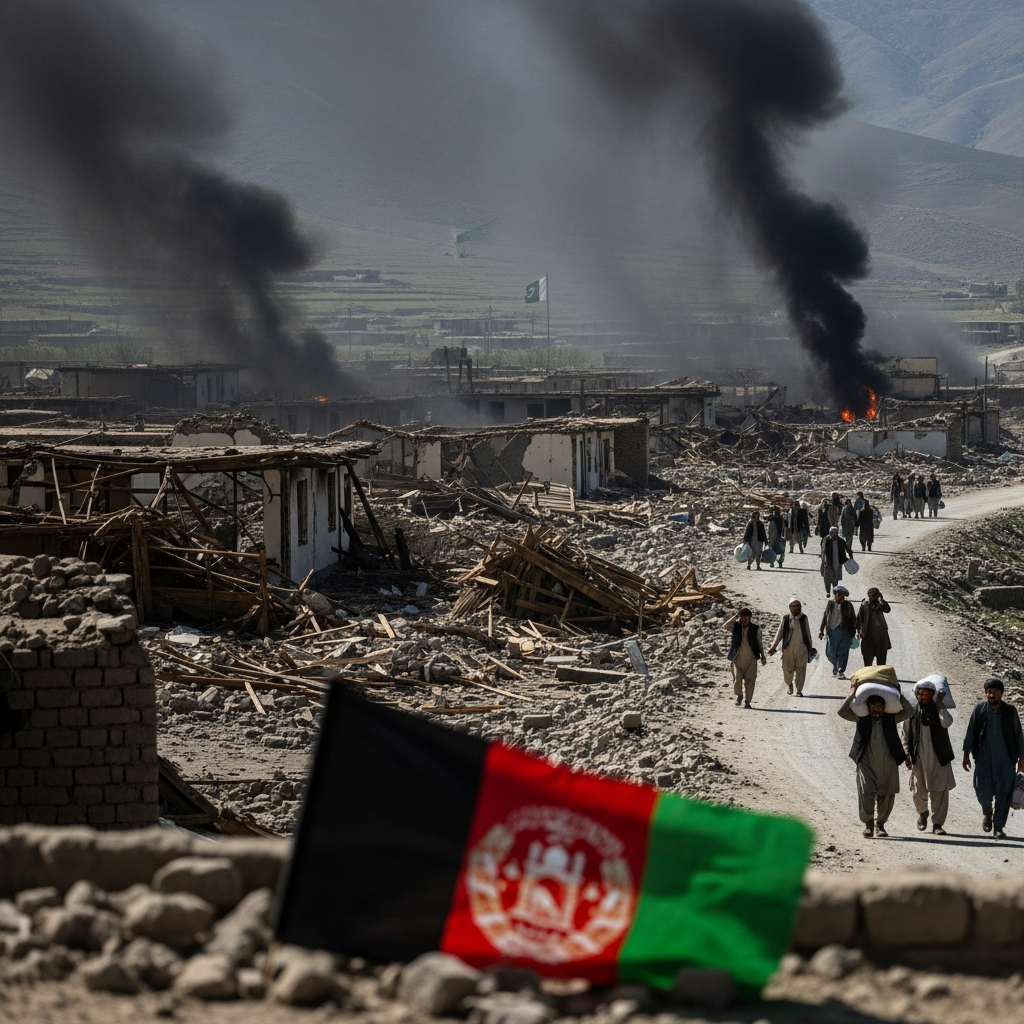
A dangerous escalation has erupted between neighboring Pakistan and Afghanistan, as Pakistan launched multiple overnight air strikes deep inside Afghan territory. Islamabad asserts these actions targeted militant hideouts responsible for a recent surge of suicide bombings within Pakistan. However, the Taliban government in Afghanistan vehemently condemns the attacks, reporting significant civilian casualties, including women and children, and labeling the strikes a blatant violation of its sovereignty and international law. This latest confrontation threatens to shatter an already fragile ceasefire and plunges cross-border relations into a deeper crisis.
Pakistan’s Justification: A “Retributive Response” to Militant Violence
Pakistan’s Ministry of Information and Broadcasting officially confirmed the strikes, describing them as “intelligence-based selective targeting of seven terrorist camps and hideouts” near the Pakistan-Afghanistan border. Islamabad explicitly stated these operations were a “retributive response” to a series of deadly suicide bombings on Pakistani soil, which they attribute to terror groups harbored by Kabul. The government cited “conclusive evidence” that these attacks were orchestrated by militant leadership based in Afghanistan.
Targets for these strikes reportedly included members of the banned Tehreek-i-Taliban Pakistan (TTP), also referred to by the Pakistani government as “Fitna al Khawarij,” along with their affiliates and elements of the Islamic State-Khorasan Province (ISKP). Pakistan highlighted several recent incidents fueling its decision:
An attack on a Shia mosque in Islamabad earlier this month, which killed at least 31 worshippers and wounded 170. The ISKP later claimed responsibility for this deadly assault.
Other attacks occurring since the start of the holy month of Ramadan in the north-western Khyber Pakhtunkhwa province.
A suicide bomber killing two soldiers, including a lieutenant colonel, in Pakistan’s Bannu district just hours before the air raids.
An earlier incident where 11 soldiers and a child were killed in Bajaur, with authorities identifying the attacker as an Afghan national.
Pakistan has consistently accused the Afghan Taliban of failing to curb militant groups using Afghan territory to launch attacks into Pakistan. Islamabad reiterated its calls for the international community to pressure the Taliban to uphold its 2020 Doha agreement commitments, which included preventing Afghan soil from being used by any country’s enemies.
Civilian Carnage: Afghanistan’s Stark Condemnation
In stark contrast to Pakistan’s narrative, the Afghan Taliban’s defence ministry unequivocally condemned the air strikes as a “blatant violation of Afghanistan’s territorial integrity” and a “clear breach of international law.” They reported that the attacks targeted civilian areas in Nangarhar and Paktika provinces, resulting in dozens of deaths and injuries, disproportionately affecting women and children.
Heartbreaking accounts emerged from affected regions. In Girdi Kas village, within Nangarhar’s Bihsud district, a man named Shahabuddin recounted that only five of his 23 family members survived the attack on his destroyed home. Local Taliban spokesman Sayed Taib Hamd confirmed that 18 members of this single family were among the deceased, buried in a mass grave. Eyewitness Nezakat, a 35-year-old farmer, detailed his house being “completely destroyed,” resulting in the deaths of his father and sons. Residents described the victims as “ordinary people,” denying any militant affiliations.
Afghan officials specifically noted that a religious school and civilian homes were hit. While a guesthouse and another religious school in Paktika province’s Bermal and Urgun districts were targeted, local reports indicated they were empty at the time, preventing further casualties there. However, homes in Balish village in Paktika were also destroyed. The Afghan Ministry of Foreign Affairs promptly summoned Pakistan’s ambassador to Kabul to protest the attacks.
Escalating Tensions and a Failed Ceasefire
These air strikes mark a significant and perilous escalation in the already strained relationship between Pakistan and Afghanistan since the Taliban regained power in 2021. The two nations share a lengthy, 1,600-mile (2,574 km) mountainous border, which has historically been a flashpoint for cross-border militant activity and disputes.
The recent attacks follow a period of fragile calm. A tentative ceasefire was agreed upon last October after deadly cross-border clashes, which represented the worst fighting since the Taliban’s return to power. However, subsequent skirmishes have continued to plague the border region. The UN mission in Afghanistan previously reported that Pakistani military actions had killed 70 Afghan civilians between October and December of the preceding year, underscoring the severe human cost of these ongoing conflicts.
Diplomatic efforts to de-escalate have largely proven insufficient. Despite several rounds of negotiations, including those brokered by Qatar and Türkiye, a lasting agreement has remained elusive. The current strikes occurred just days after Saudi Arabia successfully mediated the release of three Pakistani soldiers captured by Afghanistan during border clashes last October, highlighting the precarious nature of any truce. The deteriorating relationship has also had severe economic impacts, with crucial land border crossings largely shut for months, further harming civilians and trade.
The Path Forward: Uncertainty and a Vow of Response
The Afghan Taliban’s defence ministry did not just condemn the strikes; it issued a stern warning. “An appropriate and measured response will be taken at a suitable time,” their statement on X declared. They further asserted that “attacks on civilian targets and religious institutions indicate the failure of Pakistan’s army in intelligence and security.” This vow of retaliation raises serious concerns about potential counter-attacks from Afghanistan, potentially spiraling the conflict into a broader regional instability.
The international community now faces renewed pressure to mediate between the two nuclear-armed neighbors. Both nations claim to prioritize peace and stability, yet their actions and accusations paint a picture of deep mistrust and unresolved grievances. The immediate aftermath of these deadly strikes leaves civilians reeling and the future of Pakistan-Afghanistan relations hanging precariously in the balance.
Frequently Asked Questions
Why did Pakistan launch airstrikes into Afghanistan, and what were the immediate impacts?
Pakistan launched air strikes into Afghanistan, citing recent suicide bombings on its territory attributed to militant groups allegedly harbored by Kabul, including the Tehreek-i-Taliban Pakistan (TTP) and IS-Khorasan. Islamabad described these as “intelligence-based selective targeting” and a “retributive response.” The immediate impacts included significant civilian casualties in Afghanistan, with reports of dozens killed and injured, including women and children, particularly in Nangarhar and Paktika provinces. Afghanistan vehemently condemned these strikes as a violation of its sovereignty and international law.
What is the historical context of Pakistan-Afghanistan border tensions and militant activity?
Pakistan and Afghanistan share a long, often volatile border, frequently plagued by cross-border militant activity. Pakistan has historically accused successive Afghan governments, and more recently the Taliban, of failing to prevent militant groups like the TTP from using Afghan territory as a safe haven to plan attacks on Pakistan. These tensions intensified after the Taliban regained control of Afghanistan in 2021. Despite previous ceasefires, like the one in October last year, skirmishes and deadly clashes have been common, highlighting deep-seated mistrust and conflicting security priorities between the two nations.
How might these recent strikes affect future relations and regional stability?
These recent strikes represent a severe escalation, significantly threatening the already strained relationship between Pakistan and Afghanistan. The Afghan Taliban’s vow of “an appropriate and measured response” suggests the potential for further military engagement, raising concerns about regional stability. Such actions undermine diplomatic efforts, including recent Saudi-mediated prisoner releases, and exacerbate humanitarian crises, as crucial border crossings remain largely shut. Without international mediation and a commitment to de-escalation from both sides, the conflict risks spiraling, with severe consequences for peace in South Asia.