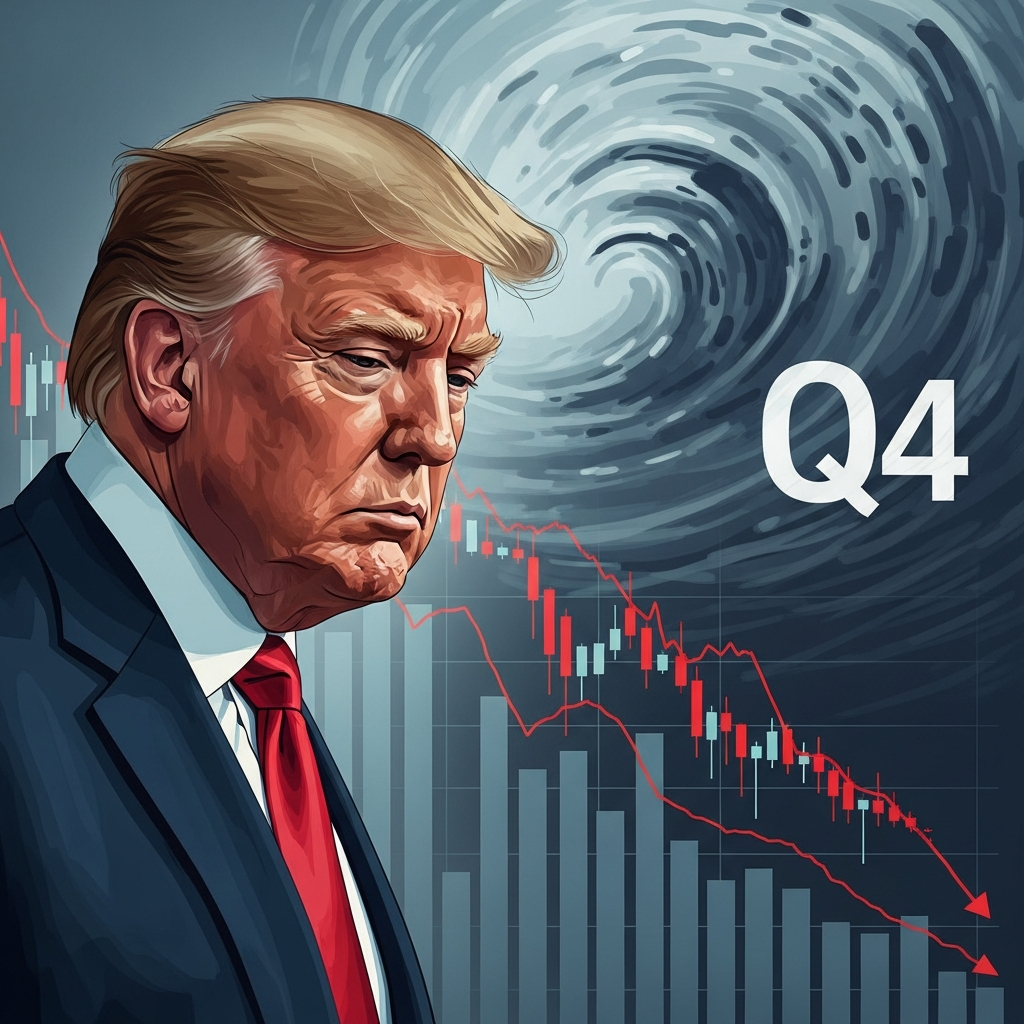
The U.S. economy faced significant headwinds in the fourth quarter of 2025, marked by a sharp deceleration in growth. This period challenged the administration’s narrative of robust prosperity, as key indicators like Gross Domestic Product (GDP) revealed a sputtering momentum. A prolonged government shutdown, coupled with shifting consumer spending patterns and a critical Supreme Court decision regarding tariffs, defined a complex economic landscape. This analysis delves into the core factors contributing to the slowdown, the political responses, and the emerging challenges and opportunities for the American economy.
The Alarming Q4 2025 Economic Deceleration
The Commerce Department’s preliminary estimates painted a stark picture for late 2025. The U.S. economy grew at an annualized rate of just 1.4 percent during the fourth quarter. This figure fell dramatically short of economists’ projections, which had anticipated around 3.0% growth. It also represented a steep drop from the brisk 4.4% growth rate recorded in the third quarter. Several factors contributed to this concerning deceleration. A record-breaking government shutdown and a noticeable cooling in consumer spending emerged as primary culprits, significantly impacting the overall economic pulse. Furthermore, the nation’s trade deficit widened to a five-month high in December, adding another layer to the economic challenges.
Unpacking the Government Shutdown’s Cost
The 43-day government shutdown profoundly impacted Q4 GDP. The non-partisan Congressional Budget Office (CBO) estimated that this political impasse alone subtracted a substantial 1.5 percentage points from fourth-quarter GDP. This adverse effect stemmed from reduced federal services, decreased government spending on goods, and a temporary cut in benefits like the Supplemental Nutrition Assistance Program. While the CBO projected that much of this lost output would eventually be recovered, it also anticipated an unrecoverable loss ranging between $7 billion and $14 billion. Amidst this, former President Donald Trump placed the blame squarely on Democrats, claiming the “Democrat Shutdown” cost the U.S.A. “at least two points in GDP.”
Consumer Behavior Shifts and the ‘K-Shaped’ Economy
Beyond the shutdown, American households pulled back on spending during the final months of the year. This moderation in consumer activity, a crucial driver of economic growth, contributed significantly to the slowdown. Expert analysis, including comments from Joel Kan, a vice president and deputy chief economist at the Mortgage Bankers Association, described a “K-shaped” economy. This phenomenon highlights a divergence where upper-income households, possessing sufficient income and wealth, continued to drive most consumer spending. In stark contrast, lower-income consumers faced mounting pressure from higher costs, longer unemployment spells, and escalating consumer credit balances. Their purchasing power eroded, often pushing them to draw down personal savings.
The Affordability Crisis: A Deeper Dive
These challenging conditions gave rise to what economists and political commentators termed an “affordability crisis.” This crisis manifested as persistent high inflation, exacerbated by import tariffs, coupled with stalling wage growth for many Americans. Despite these concerns, President Trump publicly claimed to have “solved” the affordability problem, attributing its origins to political opponents. However, the data suggests that many households continued to struggle with the rising costs of everyday essentials, deepening the divide within the economy.
A Job Market Under Strain
The job market also reflected the broader economic downturn. Only 181,000 jobs were added throughout the past year. This marked the fewest job additions outside of the pandemic since the 2009 Great Recession, a significant reduction from the 1.459 million additions seen in 2024. This “jobless economic expansion” narrative contradicted the White House’s assertion of a resilient economy driven by private sector growth. While officials like acting Council of Economic Advisers Chair Pierre Yared pointed to “hard data” like unemployment figures as proof of health, the stark reality of job creation presented a different picture.
Supreme Court Delivers Major Blow to Trump’s Tariff Strategy
In a pivotal development, the Supreme Court struck down President Trump’s extensive “Liberation Day” tariffs on February 20, 2026. This 6-3 decision, authored by Chief Justice John Roberts, ruled that the President lacked the broad authority he claimed under the 1977 International Emergency Economic Powers Act (IEEPA) to impose such tariffs through a national emergency declaration. Roberts noted the absence of historical precedent for such an application of IEEPA. Justice Neil Gorsuch, in a concurring opinion, underscored that the power to impose tariffs fundamentally belongs to Congress, emphasizing the deliberative legislative process for decisions impacting the American people.
President Trump reacted with outrage, labeling the decision a “personal betrayal.” Despite his anger, he swiftly announced the imposition of new 10% global tariffs under Section 122 of the Trade Act of 1974. However, these new tariffs are temporary, set to expire in 150 days unless extended by Congress, and require a “more complicated” implementation pathway. The ruling injects fresh uncertainty into the U.S. economy. J.P. Morgan economists estimated that without the IEEPA tariffs, the average effective tariff rate would fall significantly, though they anticipate the administration will seek new ways to maintain tariff levels. This ruling also carries substantial fiscal implications. The U.S. could face refunding between $120 billion and $200 billion in IEEPA tariff revenues. Furthermore, the CBO’s prior projection of tariffs reducing deficits by $3 trillion over 10 years is now moot, with an estimated loss of about $1.5 trillion due to the ruling.
The Future of Trade Policy: Uncertainty Ahead
The Supreme Court’s decision means tariffs will likely remain a contentious issue. President Trump’s insistence on rebuilding his tariff structure faces limitations and potential new legal challenges. With narrow Republican majorities in Congress and broad opposition to tariffs, even among some Republicans, securing congressional support for sweeping tariffs appears unlikely. Lawmakers are also expected to hesitate on new tariff legislation ahead of upcoming elections. While the ruling is a significant setback for Trump’s signature trade policy, its overall impact on the economy remains complex and uncertain, with the President’s options now considerably more constrained.
Political Blame Game and Economic Narratives
Throughout this period, the President consistently blamed the soft GDP report on Democrats and Federal Reserve Chair Jerome Powell. Trump repeatedly targeted Powell for refusing to lower interest rates, claiming a “Two Late” Powell was “the WORST!!!” The White House, however, offered a different perspective. Officials, including Kush Desai, a White House spokesperson, highlighted the resilience of Trump’s economy, emphasizing robust private sector-led growth with strong consumption and investment. They argued that despite the government shutdown, GDP growth for 2025 “smashed” expert predictions from the Federal Reserve, Congressional Budget Office, and International Monetary Fund. White House officials also suggested that consumer pessimism was influenced by memories of past inflation surges, urging focus on “hard data” like unemployment and consumer spending. Despite these defenses, President Trump faced record-low approval ratings concerning his handling of the economy in various polls.
Glimmers of Hope: AI Investment and Tax Refunds
Despite the slowdown, two key factors offered support for future economic activity. Anticipated larger tax refunds, resulting from previous tax cuts, were expected to provide a boost to consumer pockets. More significantly, substantial investment in artificial intelligence (AI) emerged as a powerful economic driver. Economists estimated that AI-related sectors, including datacenters, semiconductors, software, and research and development, accounted for a remarkable one-third of GDP growth in the first three quarters of 2025. This AI-driven expansion played a crucial role in mitigating the negative economic impacts stemming from tariffs and reduced immigration, offering a potential path to renewed growth.
Frequently Asked Questions
What were the primary reasons for the U.S. economic slowdown in Q4 2025?
The U.S. economy experienced a significant slowdown in Q4 2025, with GDP growing at only 1.4%. The main culprits were a record 43-day government shutdown, which subtracted an estimated 1.5 percentage points from GDP, and a moderation in consumer spending. Additionally, a widening trade deficit and a “K-shaped” economy, where lower-income households struggled with inflation and stalling wages, contributed to the overall deceleration.
How did the Supreme Court ruling impact Trump’s tariff policies?
On February 20, 2026, the Supreme Court struck down President Trump’s extensive “Liberation Day” tariffs. The ruling stated that the President lacked the authority under the 1977 International Emergency Economic Powers Act to impose such sweeping tariffs unilaterally. This decision forced the administration to impose new, temporary 10% global tariffs under the Trade Act of 1974, which are set to expire in 150 days without congressional extension, injecting significant uncertainty into future trade policy.
What does the “K-shaped” economy mean for different American households?
A “K-shaped” economy describes a situation where different parts of the economy recover or grow at different rates. In Q4 2025, this meant upper-income households continued to thrive, driving much of the consumer spending. Conversely, lower-income households faced increasing financial strain due to higher costs, persistent inflation, stalling wage growth, and rising consumer credit balances, leading to an “affordability crisis” for many.
The economic landscape of late 2025 revealed a complex interplay of political decisions, consumer behavior, and evolving technological drivers. The Trump economy slowdown, while significant, was met with both political blame and claims of resilience. The Supreme Court’s ruling on tariffs introduces new fiscal challenges and uncertainties, demanding strategic adjustments. As the nation looks ahead, the influence of AI investments and potential tax refunds offers glimmers of hope for future growth, yet the underlying issues of affordability and a divided economic experience for American households remain critical areas for focus. Understanding these dynamics is essential for navigating the path forward in a rapidly changing global economy.