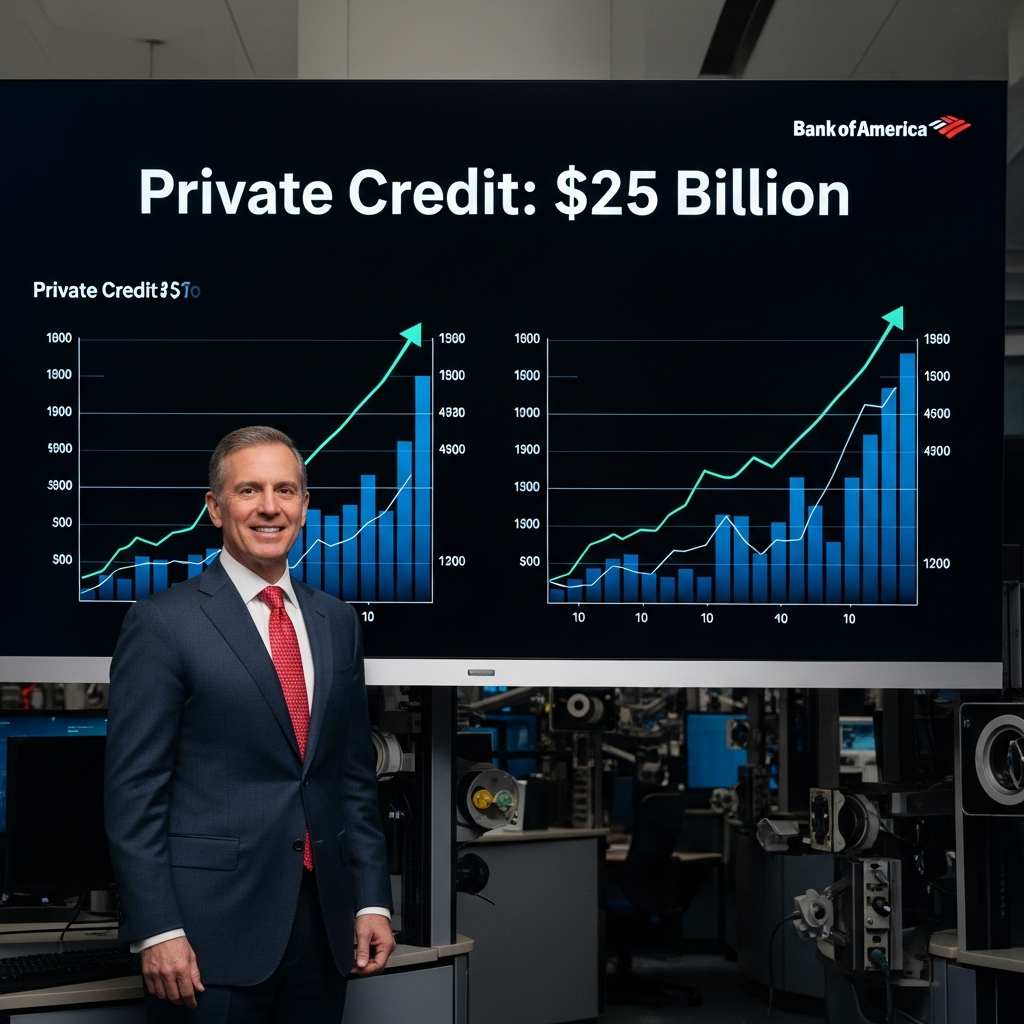
Bank of America is making a powerful move into the burgeoning private credit market, reportedly earmarking a substantial $25 billion for new transactions. This bold strategic decision, initially reported by Bloomberg, signals a significant pivot for the financial giant, aligning it with other major Wall Street players aggressively deploying their balance sheets to capitalize on the rapidly expanding landscape of direct lending. For investors and market observers, this commitment underscores a broader trend: traditional banking institutions are increasingly eyeing private markets for growth, yield, and diversification in a dynamic economic environment.
Bank of America’s Strategic Deep Dive into Direct Lending
The core of Bank of America’s latest initiative involves committing its own substantial capital to private credit investments. This isn’t merely an incremental adjustment; it represents a notable expansion of the bank’s existing direct-lending platform. The expectation is that these new transactions will be originated primarily through the firm’s robust capital markets unit, embedded within its powerful investment banking division. This integrated approach allows Bank of America to leverage its extensive network and financial acumen, fostering a seamless pipeline for deal flow and execution in a market segment that demands sophisticated structuring and patient capital.
Why Private Credit is Attracting Wall Street’s Billions
The surge in interest from titans like Bank of America isn’t arbitrary. Private credit, which involves direct lending from non-bank lenders to companies, has grown exponentially, fueled by a retreat of traditional banks from certain lending areas post-2008 financial crisis and a strong demand from middle-market companies for flexible financing solutions. This asset class offers attractive yields, often floating-rate, and can provide valuable diversification away from public markets. As institutional investors increasingly seek dependable returns, private credit has emerged as a cornerstone of sophisticated portfolios.
The trend isn’t isolated to Bank of America. A similar move was recently seen with Goldman Sachs, which secured a commitment of up to $25 billion from the Qatar Investment Authority (QIA) for its managed funds and co-investment projects. QIA CEO Mohammed Saif Al-Sowaidi specifically highlighted private credit as a strategic sector for premium deal flow. This parallel commitment from two of the world’s leading financial institutions underscores a collective recognition of private credit’s growing importance and potential for robust returns.
Navigating the Broader Private Market Landscape
Bank of America’s $25 billion play unfolds against a backdrop of incredibly active private markets. A November 2025 report by Dakota highlighted robust fundraising across all private asset classes, with institutional limited partners (LPs) increasingly making fewer, larger commitments. Notably, private credit fundraising remained healthy, characterized by significant closes in stressed credit, real estate debt, and specialized lending platforms. Major players like Blackstone and Millennium are also reportedly preparing new large-scale direct lending vehicles, signaling sustained institutional appetite and market expansion.
Institutional Appetite and Economic Underpinnings
Institutional capital flow into private markets remains strong. Pension funds, for instance, are making substantial allocations, with one of the largest recorded in November 2025 reaching $1.6 billion from CalPERS into Ares Special Opportunities III. Private credit received significant total inflows, second only to private equity, reflecting strong demand for income, floating-rate exposure, and opportunistic strategies.
This institutional conviction is supported by underlying economic resilience. Despite a rise in early delinquency rates for mortgage and student loans in Q4 2023, overall household financial health remains largely good. Consumer spending has continued to reach record levels, indicating robust spending capabilities among American consumers. While the household debt service payment ratio has shown a deteriorating trend, it remains strong in absolute terms, demonstrating an ongoing capacity to manage debt obligations. This relative stability in household finances provides a healthy foundation for the broader economy and, by extension, the companies seeking private credit financing.
Capitalizing on Innovation: AI, Industry, and Dealmaking
The private credit market isn’t just about traditional lending; it’s increasingly intertwined with innovation and strategic growth sectors. J.P. Morgan Private Bank highlights a new, transformative phase in AI evolution — “services as a software” — presenting a $3 trillion to $5 trillion private market investment opportunity. This shift sees traditional business services delivered through intelligent, AI-powered software platforms, creating immense demand for patient capital and specialized financing solutions.
Private credit can play a vital role in funding companies within these cutting-edge domains. From AI and U.S. reindustrialization efforts to the development of agentic AI, vertical AI software, and AI-enabled horizontal software, these innovative enterprises often seek private capital to fuel their growth and long R&D cycles. The surge in private market dealmaking, with AI-related deals soaring to over $140 billion in 2024, demonstrates a clear connection between technological advancement and the need for flexible private financing.
M&A Activity and Market Dynamics
Robust M&A activity further underscores the need for private credit. Across IT, healthcare, financials, industrials, and energy sectors, multi-billion dollar transactions are commonplace. These deals often require significant financing, which private credit providers can supply, either through direct loans or as part of larger syndicated packages. For example, major acquisitions like Global Payments acquiring Worldpay for $24.3 billion or Chevron’s acquisition of Hess Corporation for $53 billion, while not solely private credit deals, illustrate the scale of capital required in today’s M&A landscape. Bank of America’s expanded private credit platform positions it perfectly to participate in and benefit from this intense dealmaking environment.
Understanding the Risks and Future Outlook
While the allure of private credit is strong, the financial sector as a whole faces persistent challenges. Regulatory changes, such as a proposed 10% cap on credit card interest rates, could pressure bank profit forecasts. Broader market volatility, exacerbated by geopolitical factors and tariff threats, also creates an environment where traditional trading and dealmaking revenues can be irregular.
In this context, Bank of America’s strategic emphasis on private credit can be seen as a calculated move to diversify revenue streams and seek more consistent, fee-heavy growth in asset management, offsetting the inherent volatility in other divisions. The shift towards private markets also reflects companies staying private longer due to abundant capital, making direct lending an increasingly important avenue for investment banks to engage with high-growth enterprises.
Frequently Asked Questions
Why are major financial institutions like Bank of America increasing their focus on private credit?
Major financial institutions are expanding into private credit primarily for higher yields, diversification, and growth opportunities. Traditional banking faces regulatory pressures, such as potential credit card interest rate caps, and market volatility that can impact trading and dealmaking. Private credit offers attractive returns, often with floating interest rates, and fills a gap left by banks after the 2008 crisis, providing flexible financing to middle-market companies and innovative sectors like AI. This strategic shift allows banks to deploy capital more efficiently and generate more consistent, fee-based revenue.
How does Bank of America’s $25 billion private credit investment align with broader private market trends?
Bank of America’s $25 billion investment aligns perfectly with robust private market trends. Data indicates healthy fundraising across private equity, venture capital, and particularly private credit, with significant institutional commitments. LPs are increasingly allocating large sums to private credit for income and opportunistic strategies. Furthermore, private credit is crucial for financing M&A activity across technology, healthcare, and energy sectors, and it supports the massive growth in AI-driven innovation, where private capital is essential for long-term development.
What are the potential implications of Bank of America’s private credit strategy for the bank and the broader financial market?
For Bank of America, this strategy could enhance profitability, diversify revenue streams away from more volatile areas, and strengthen its position in the alternative investments landscape. It allows BAC to capture a larger share of the growing direct lending market. For the broader financial market, this move signifies the ongoing institutionalization of private credit, potentially increasing competition, fostering new financing models for companies, and further solidifying private markets as a crucial component of the global financial system, complementing traditional public markets.
Conclusion: A New Era for Bank of America’s Capital Deployment
Bank of America’s reported $25 billion investment in private credit marks a significant strategic maneuver, reflecting a broader trend among financial giants to redefine their roles in a rapidly evolving market. By leveraging its capital markets expertise and committing substantial resources, BAC is positioning itself at the forefront of a dynamic asset class that promises compelling returns and critical financing solutions for a diverse range of companies, including those at the cutting edge of AI and industrial innovation. This move is not merely an investment; it is a calculated expansion into a resilient and growing segment of the financial world, underscoring private credit’s integral role in today’s economy.
Word Count Check: 1198