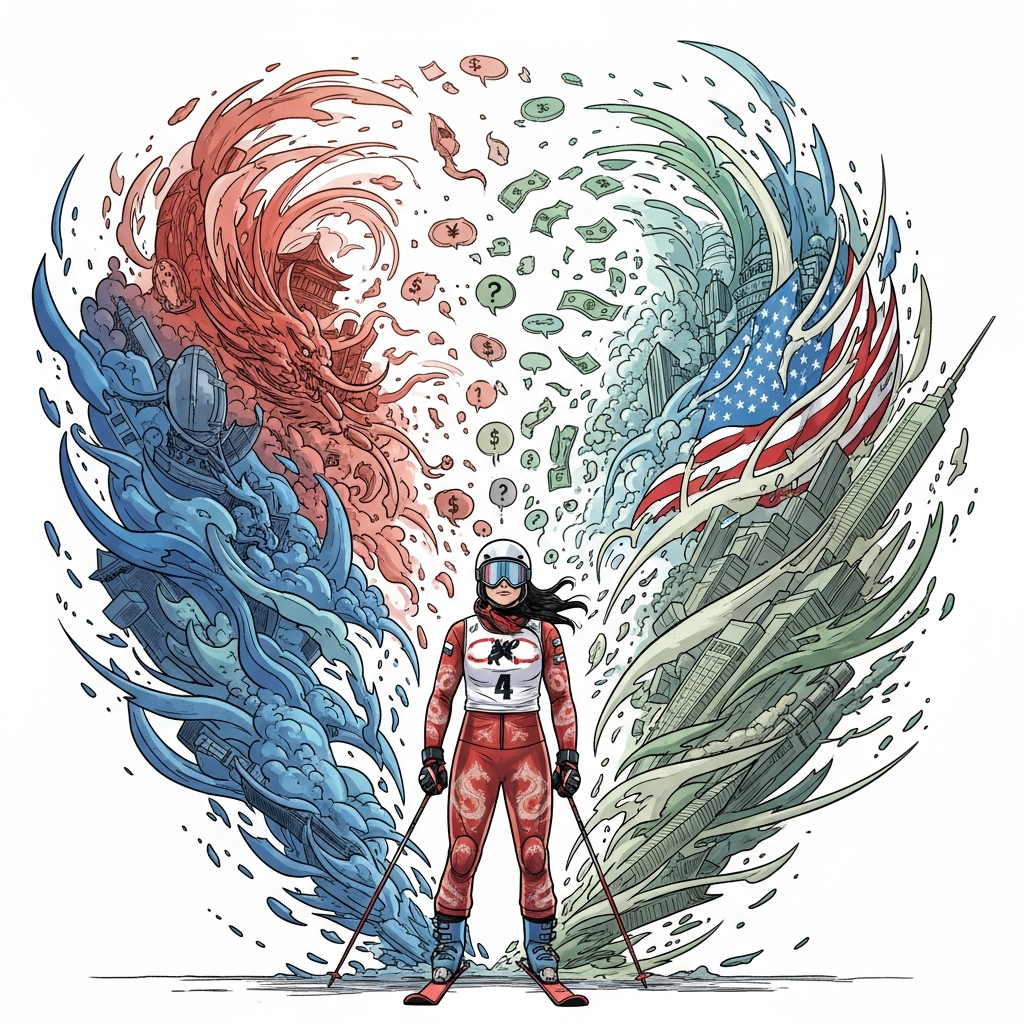
Freestyle skiing sensation Eileen Gu, a dominant force at the Milan Cortina 2026 Winter Olympics, openly describes feeling like a “punching bag” amidst intense global criticism. This latest wave of scrutiny targets her decision to represent China rather than her American birthplace, igniting a fierce debate about athlete nationality, geopolitical tensions, and personal identity. Dive into the complex narrative surrounding Gu, exploring the origins of the backlash, her compelling defense, and the extraordinary career that continues to captivate and divide audiences worldwide.
The Heart of the Storm: Gu’s “Punching Bag” Revelation
Eileen Gu, the 22-year-old American-born athlete competing for Team China, has once again become the focal point of a heated international discussion. During the Milan Cortina Winter Olympics, Gu candidly acknowledged feeling like “a bit of a punching bag for a certain strand of American politics.” This statement underscores the immense pressure she faces as a high-profile figure caught between two global powers. Her words reflect a sustained period of criticism that has followed her since her groundbreaking performance at the Beijing 2022 Games.
The freeskier’s decision in 2019 to switch allegiance from the United States to her mother’s native China sparked a controversy that has only intensified. Despite her athletic prowess, this choice has positioned her as a lightning rod for debate. Gu’s unique bicultural identity and remarkable success have inadvertently placed her at the intersection of sports, politics, and national pride.
Navigating Dual Identities and Global Scrutiny
Gu’s journey is one of an athlete shouldering “the weight of two countries.” She effortlessly switches between English and Mandarin, discussing everything from quantum physics—which she studies at Stanford—to the intricate mechanics of her sport. Affectionately known as “The Snow Princess” by her Chinese fanbase, Gu embodies a modern, globalized athlete. She identifies as both American and Chinese, a stance she has consistently maintained since childhood. This duality, however, challenges traditional notions of national representation in sport.
Her situation highlights a broader discussion about athletes with dual nationalities. While the International Olympic Committee (IOC) permits athletes to choose their representative country, China’s strict laws do not officially recognize dual citizenship. This legal ambiguity often fuels speculation and adds another layer of complexity to the intense scrutiny Gu receives.
The Personal Toll: Threats and Harassment
Beyond the public discourse, the Eileen Gu backlash has manifested in deeply personal and disturbing ways. Gu revealed she has experienced alleged physical assaults on her college campus. She has also faced death threats and had her dorm room robbed, experiences she believes “no one should ever have to endure, ever.” These instances underscore the severe real-world impact of the vitriol directed at her.
Such incidents paint a stark picture of the darker side of online and public criticism. They move beyond mere disagreement to harassment and threats, illustrating the profound personal cost of being a public figure in a highly politicized environment. Gu’s resilience in the face of these challenges further highlights her unique character and determination.
Decoding the Backlash: Gu’s Perspective
Gu offers a clear perspective on the true motivations behind the intense criticism she receives. She argues that the backlash often misrepresents its actual target. “People only have a problem with me doing it because they kind of lump China into this monolithic entity, and they just hate China,” Gu stated. She believes the criticism isn’t genuinely about her personal choices, but rather a broader anti-China sentiment.
Furthermore, Gu suggests that her exceptional success on the slopes exacerbates the animosity. “And also, because I win. Like if I wasn’t doing well, I think that they probably wouldn’t care as much,” she observed. This perspective implies that her triumphs inadvertently magnify the perceived “betrayal” in the eyes of her harshest critics. She concludes her critics are “entitled to their opinions,” but also, echoing a Chinese proverb, that “you can’t wake someone who’s pretending to be asleep.”
Critics Weigh In: JD Vance and Enes Kanter Freedom
The Eileen Gu controversy has drawn commentary from prominent figures. US Vice President JD Vance expressed his hope that American-born athletes would “want to compete with the United States of America.” He rooted for “American athletes” and “people who identify themselves as Americans.” Gu, remarkably, found Vance’s comments “flattering” and “sweet,” interpreting them as a natural expression of patriotism from an American leader.
Conversely, former NBA player Enes Kanter Freedom has been a vocal critic. He publicly slammed Gu for representing “the worst human rights abuser on the planet.” Freedom argued that Gu built her fame in a free country, yet chose to represent an authoritarian regime. These contrasting viewpoints highlight the polarized political landscape in which Gu operates.
Unpacking the Financial Dimensions
A significant aspect fueling the debate around Gu’s decision revolves around financial incentives. Reports from The Wall Street Journal indicate that Gu and fellow American-born skater Zhu Yi received substantial payments from the Beijing Municipal Sports Bureau. Over the past three years, the two athletes reportedly amassed nearly $14 million. Specifically for qualifying for the 2026 Milan Winter Olympics, they were allegedly paid a combined $6.6 million in 2025.
Gu, however, vehemently denies financial gain as her primary motivator. She asserts that her ambition to inspire young girls and popularize freestyle skiing in China predates any fame or monetary benefits. She recalls this guiding principle being established when she was just 10 years old, long before any country sought her to represent them. This juxtaposition of reported earnings and stated altruistic motivations forms another complex layer of the Eileen Gu backlash.
A ‘Once-in-a-Generation’ Talent: On and Off the Slopes
Regardless of the ongoing controversy, Eileen Gu’s athletic achievements are undeniable. She is widely regarded as the most accomplished women’s freeskier in history. Her career boasts a remarkable 20 World Cup wins, two Olympic golds, and three silvers, accumulated across various disciplines. American snowboarding legend Shaun White aptly described her as a “once-in-a-generation kind of athlete” and an “anomaly.”
At the 2022 Beijing Olympics, Gu made history by becoming the first action-sports athlete to secure three medals at a single Games. She clinched two golds in big air and halfpipe, along with a silver in slopestyle. Her fierce competitive spirit was evident in Milan Cortina, where she secured two silver medals and qualified for the halfpipe final despite a fall in qualifying. She is the only female skier competing in all three freestyle events.
The Marketing Juggernaut and Multihyphenate Star
Beyond her athletic prowess, Gu is a marketing powerhouse. With a significant presence in both the United States and China, she is an exceptionally sought-after endorser. Forbes reported her as the highest-paid athlete at the current Games, with an annual income of $23.1 million. A minuscule $100,000 of this figure reportedly comes directly from skiing.
Gu models for prestigious brands like Victoria’s Secret and Louis Vuitton. She has walked runways in Milan and Paris and holds sponsorships with global giants such as Red Bull, Porsche, Anta, and TCL Electronics. Embracing her “multihyphenate” identity, she believes it is revolutionary. Gu sees herself as an inspiration for young people to pursue diverse passions simultaneously, excelling in sports, modeling, and academia.
Eileen Gu’s Enduring Motivation: Inspiring the Next Generation
Gu’s consistent defense of her decision to represent China centers on a powerful, deeply personal mission. She aims to inspire young girls and introduce the sport of freestyle skiing to a broader audience in China. She noted the comparative lack of role models in China when she first considered the switch, contrasting it with the established presence of the sport in the U.S. Her childhood speech on Title IX, given at age 11, underpins this desire to empower women through sport.
She famously articulated her motivation as a desire to “build my own pond,” rather than conform to existing structures. This philosophy reflects a proactive approach to creating opportunity and impact where she perceives the greatest need. Gu emphasizes that skiing, for her, is “me in my truest form,” driven by an intrinsic love for the sport and a commitment to advancing women’s skiing globally.
Embracing a “No Limits” Philosophy
Eileen Gu’s personal mantra, “I don’t believe in limits,” perfectly encapsulates her approach to life and sport. This philosophy is evident in her rigorous training, where she meticulously reviews footage and discusses quantum physics with her mother to refine intricate technical details. Her unapologetic obsession with skiing drives her to attempt complex maneuvers, defying conventional wisdom.
Her journey has not been without personal struggles, including post-Olympic depression and panic attacks following the Beijing Games. Yet, she credits her engagement at Stanford and a shift in perspective for renewed vigor. Gu now feels she skis because she wants to, not out of obligation. She views her past four years as “data collection” to “erase FOMO,” allowing her to focus on her genuine desires. Her ambitious goal for the current Olympics is to surpass her Beijing performance, aiming for a sweep of her three events, a testament to her unwavering “no limits” mindset.
Frequently Asked Questions
Why is Eileen Gu facing backlash for her Olympic participation?
Eileen Gu faces backlash primarily for her decision to represent China, her mother’s native country, despite being born and raised in the United States. Critics, including public figures like Vice President JD Vance and Enes Kanter Freedom, view this as a form of disloyalty or a choice to align with an authoritarian regime. Gu herself believes the criticism is often fueled by underlying anti-China sentiment and intensified by her athletic success. Reports of significant financial incentives from Chinese sports bureaus also contribute to the controversy.
What are Eileen Gu’s major athletic achievements and endorsements?
Eileen Gu is considered the most accomplished women’s freeskier in history, holding a record 20 World Cup wins, two Olympic gold medals, and three silver medals. At the 2022 Beijing Olympics, she notably became the first action-sports athlete to win three medals at a single Games. Off the slopes, she is a marketing powerhouse, endorsing major brands like Victoria’s Secret, Louis Vuitton, Red Bull, and Porsche, with reported annual earnings of $23.1 million, making her one of the highest-paid athletes at the Winter Olympics.
How does Eileen Gu explain her decision to represent China despite being American-born?
Eileen Gu consistently explains her decision by citing her desire to inspire young girls and promote freestyle skiing in China, where she felt there were fewer role models compared to the U.S. She refers to her mission as “building my own pond” and emphasizes that this motivation originated when she was 10 years old, long before any fame or financial incentives. Gu identifies as both American and Chinese and views her choice as a way to leverage her bicultural identity to foster unity through sport.
Conclusion
Eileen Gu’s journey through the Milan Cortina 2026 Winter Olympics continues to be as captivating as her athletic feats. Her candid admission of feeling like a “punching bag” illuminates the intense scrutiny and personal toll that accompanies her unique position. Caught between two global powers, her bicultural identity and record-breaking success have made her a symbol of both inspiration and controversy. Despite the persistent Eileen Gu backlash, she remains steadfast in her commitment to her “no limits” philosophy and her stated mission to inspire the next generation of female athletes. Her story transcends sport, offering a compelling case study on identity, nationalism, and the complexities of being a globalized athlete in the 21st century.
Word Count Check: 1109 words