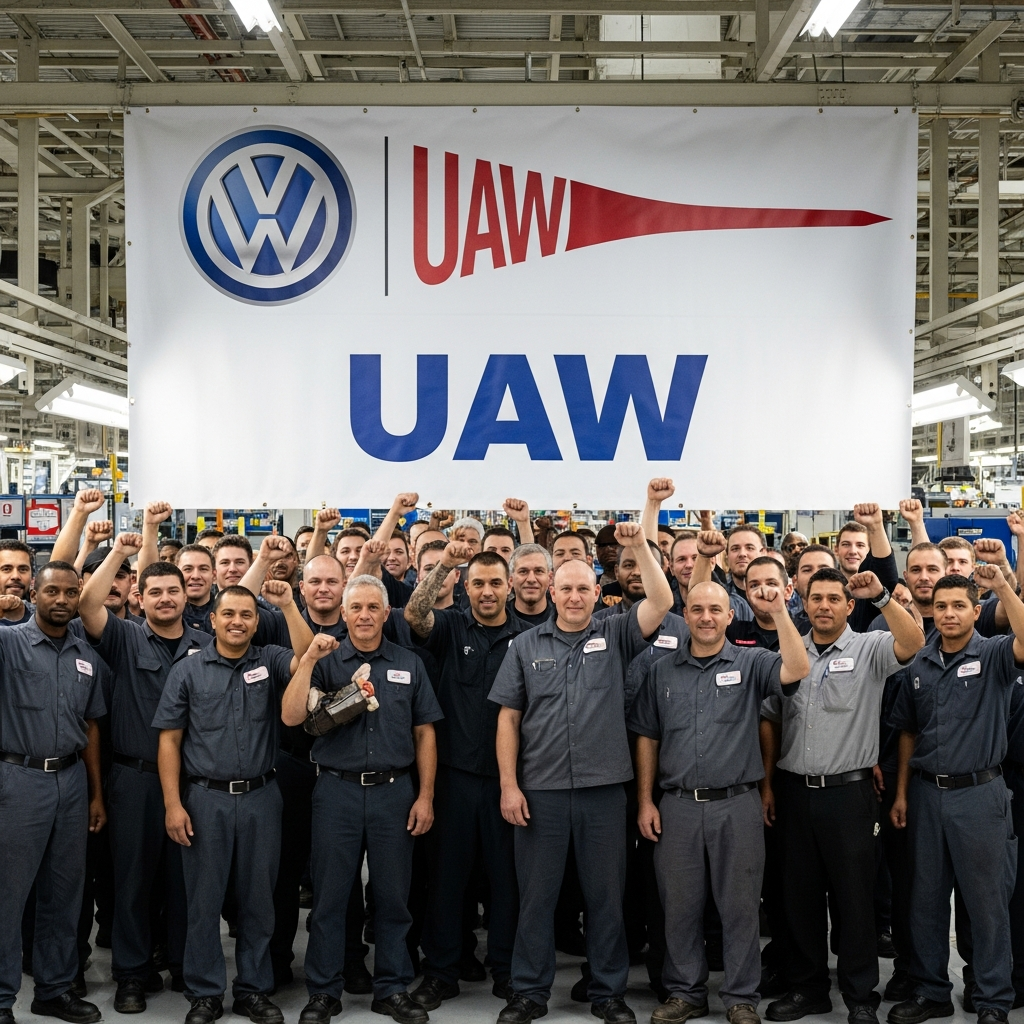
In a landmark decision, workers at Volkswagen’s Chattanooga, Tennessee assembly plant have overwhelmingly ratified their inaugural collective bargaining agreement with the United Auto Workers (UAW). This historic vote, which passed with a resounding 96% approval on February 19, 2026, secures substantial wage increases, improved benefits, and unprecedented job security for over 3,000 employees. The UAW Volkswagen contract not only transforms working conditions in Chattanooga but also sets a powerful precedent for unionization efforts across the historically non-unionized American South, marking a pivotal moment in the nation’s labor movement.
A Decisive Mandate for Change in Chattanooga
The ratification culminates a decade-long organizing campaign by UAW members at the Volkswagen Chattanooga facility. After two previous unsuccessful attempts to unionize in 2014 and 2019, workers achieved a significant breakthrough in April 2024 by voting 3-to-1 to join the UAW. This success positioned the Volkswagen plant as the first major foreign-owned automotive plant in the U.S. South to successfully unionize, a testament to the persistent efforts of its workforce and the strategic shift of the UAW labor movement.
Negotiations for the UAW Chattanooga contract were extensive, spanning nearly two years. They intensified significantly in October 2025 when workers authorized a potential strike, demonstrating their resolve to secure a fair deal. This pressure ultimately led to a tentative agreement in early February 2026, paving the way for the historic ratification vote. The agreement, effective February 24, 2026, will run through February 2030, promising stability and enhanced conditions for the plant’s production of Atlas, Atlas Cross Sport, and ID.4 SUVs.
Unpacking the Transformative Volkswagen UAW Contract
The newly ratified UAW Volkswagen contract delivers a comprehensive package of benefits designed to significantly improve the financial well-being and job security of the Chattanooga workforce. These gains go far beyond Volkswagen’s previous offers and are being hailed as a monumental victory for collective bargaining.
Key provisions of the agreement include:
Substantial Wage Increases: Employees will receive an immediate 20% wage increase, with compounded raises totaling 21.6% over the life of the contract. This elevates the top hourly rate for production workers to approximately $39.41 by 2030 and for skilled trades workers to nearly $49.86, excluding cost-of-living adjustments.
Generous Bonus Structure: The contract includes a $4,000 ratification bonus, followed by four annual $2,550 bonuses throughout the agreement’s term. Additional financial incentives include profit-sharing and an attendance bonus, recognizing employee contributions.
Reduced Healthcare Costs: A critical win for workers, healthcare premiums will be cut by at least 20%, depending on the plan chosen, and will remain frozen for the next four years, directly addressing a primary concern for many families.
Enhanced Job Security: The agreement guarantees 80% base pay during temporary layoffs and establishes a voluntary attrition program for indefinite layoffs. Crucially, it commits that “core work currently performed by UAW-represented employees will not be outsourced,” providing robust protection against external contracting.
Increased Paid Time Off: Workers will receive two additional paid days off, offering more flexibility and work-life balance.
Enforceable Workplace Protections: The contract establishes an enforceable grievance procedure, legally binding fair pay, safer working conditions, and clear protections against favoritism, ensuring dignity and fairness on the job.
A Defining Moment for the UAW Under Shawn Fain
This success is a crowning achievement for UAW President Shawn Fain, who also led the union through the impactful “Stand Up” strikes against the Detroit Three automakers in 2023. Fain lauded the Chattanooga workers, stating they “moved yet another mountain” and are “leading the way for the entire labor movement and non-union autoworkers everywhere.” This victory provides significant momentum for his leadership and the union’s broader strategy.
The UAW’s strategic focus has increasingly shifted to the American South, where foreign automakers have expanded their manufacturing footprint. UAW Region 8 Director Tim Smith emphasized this, anticipating that “many more [southern autoworkers] will follow Volkswagen’s lead,” signaling the union’s clear intent to expand organizing efforts throughout the region. Volkswagen spokesperson Michael Lowder also acknowledged the agreement as a “milestone,” reflecting a “shared commitment to competitive wages, strong benefits, and the long-term success of our employees and operations.”
The Road Ahead: Opportunities and Obstacles in the South
While the UAW Chattanooga contract is a significant win, the path to broader unionization across the South remains complex. Southern states have historically attracted automakers with substantial incentives, such as tax breaks, creating tens of thousands of well-paying jobs. Non-union companies in the region often pre-empt unionization efforts by offering competitive wages, sometimes matching or nearly matching union-negotiated rates. For instance, Hyundai announced a 25% wage increase by 2028, positioning its top production worker rate just seven cents below Volkswagen’s 2028 rate under the new UAW contract.
The momentum from the Volkswagen victory also faced challenges. Just a month after the Chattanooga vote, workers at a Mercedes plant in Alabama voted against unionizing, with reports indicating anti-union tactics unlike Volkswagen’s more neutral approach. Other promising UAW campaigns, such as at a Hyundai plant in Montgomery, Alabama, subsequently fizzled. Furthermore, the political and economic landscape is constantly shifting, with potential impacts from administration changes, EV tax credits, and tariffs on automakers’ costs, which could limit their flexibility in future negotiations. Experts like A.J. Jacobs from East Carolina University express skepticism about immediate dramatic changes in other auto plants, given the current climate.
Despite these hurdles, the tangible gains enshrined in the Volkswagen UAW contract serve as a powerful talking point for organizers. Worker Quinton North, a nine-year veteran at the VW battery plant, viewed the contract as a good deal, though he reflected a common sentiment among workers by wishing for additional paid days off and an hourly wage above $40. His perspective underscores the continuous desire for improvement that fuels labor movements.
Frequently Asked Questions
What are the specific wage and benefit increases in the new UAW Volkswagen contract?
The UAW Volkswagen contract includes significant financial gains for workers. Wages will see an immediate 20% increase, with compounded raises totaling 21.6% over the contract’s four-year term, pushing top hourly rates for production workers to nearly $40 and skilled trades to almost $50 by 2030. Additionally, workers receive a $4,000 ratification bonus, annual $2,550 bonuses, profit-sharing, and an attendance bonus. Healthcare premiums will be reduced by at least 20% and frozen for four years, and workers gain two extra paid days off.
Why is the UAW’s contract ratification at Volkswagen Chattanooga considered a historic win?
The ratification of the UAW contract at Volkswagen Chattanooga is historic because it marks the first time a major foreign-owned automotive plant in the American South has successfully unionized. This achievement comes after two previous failed attempts and a decade of organizing, demonstrating unprecedented worker solidarity in a region traditionally resistant to labor unions. It signifies a major breakthrough for the UAW’s strategy to expand its influence beyond the traditional “Big 3” automakers and across the South, setting a powerful precedent for other non-union auto facilities.
What are the key challenges facing the UAW’s efforts to unionize other Southern auto plants?
Despite the Volkswagen victory, the UAW faces significant challenges in unionizing other Southern auto plants. Many Southern states offer substantial incentives to attract automakers, creating a strong economic counter-argument to unionization. Non-union companies often proactively raise wages to deter organizing, matching or nearing UAW-negotiated rates. Additionally, some manufacturers actively employ anti-union tactics, and a shifting political landscape with less pro-union federal support can create a more difficult environment for organizers.
Conclusion
The ratification of the first UAW Volkswagen contract in Chattanooga stands as a monumental achievement for both the United Auto Workers and the workers of the Tennessee plant. This agreement, securing substantial wage increases, improved benefits, and robust job security, demonstrates the undeniable power of collective bargaining. It represents a significant step forward in the UAW’s strategic efforts to expand its presence in the American South, challenging decades of anti-union sentiment. While the road to broader unionization in the region remains complex, the Chattanooga victory provides a compelling blueprint and renewed hope for autoworkers seeking a stronger voice and fairer treatment across the nation.