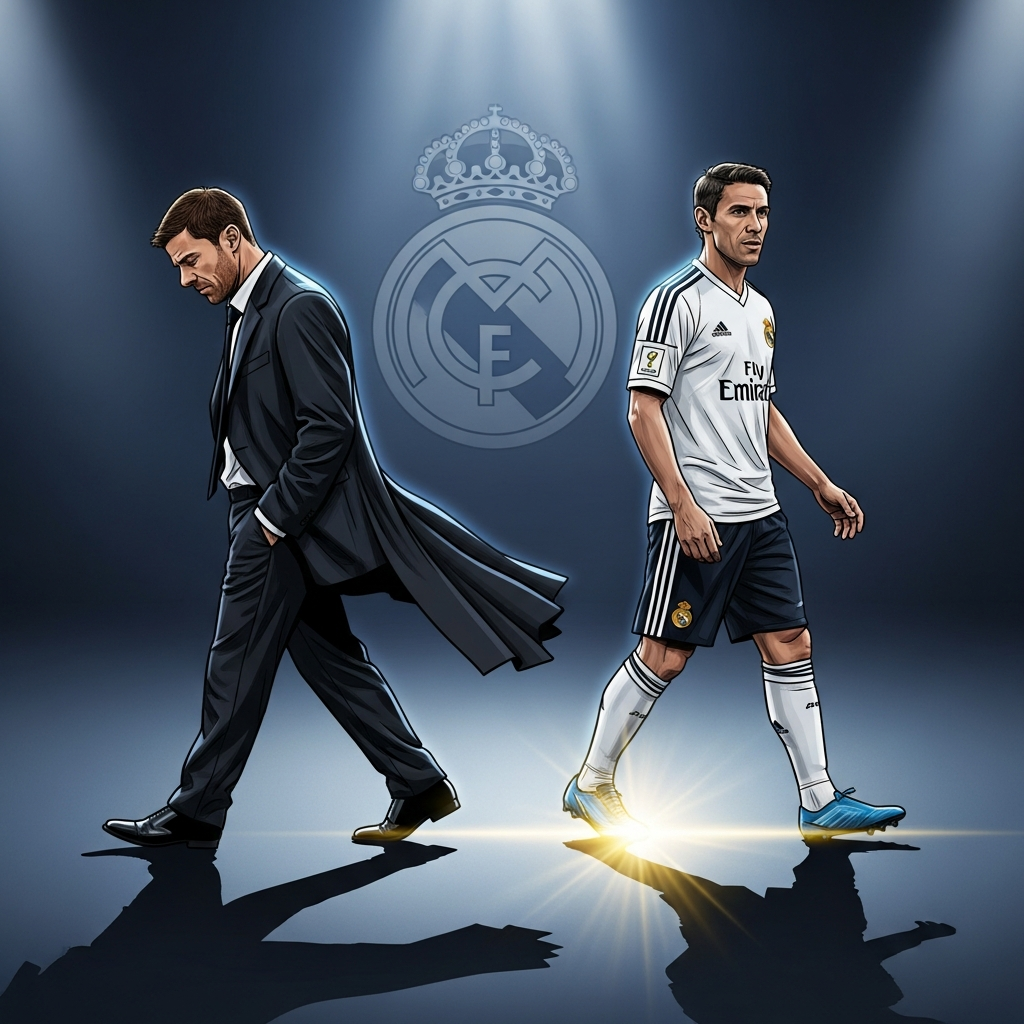
Real Madrid, a club synonymous with unparalleled success and relentless pressure, has once again made a high-profile managerial change. In a move that shocked many, Xabi Alonso has departed from his role as head coach after a tumultuous seven-month tenure. His exit, described by the club as a “mutual agreement” on January 12, 2026, marks the end of a difficult period where a clash of coaching philosophies met Real Madrid’s entrenched culture of player power and presidential authority. Álvaro Arbeloa, a revered club legend and former B team manager, steps into the hot seat, tasked with stabilizing a squad that has shown glimpses of brilliance but struggled for consistent identity.
This article delves into the complexities behind Alonso’s departure, the pivotal moments that led to his exit, and what his successor, Álvaro Arbeloa, brings to the demanding role at the Santiago Bernabéu.
The Sudden Departure: A Tumultuous Tenure Ends
Xabi Alonso arrived at Real Madrid in May 2025 with immense expectations, fresh off leading Bayer Leverkusen to an unprecedented German league and cup double. He was envisioned as a “systems coach,” poised to implement a more structured and collective style of play, a necessary change after a preceding season of “laissez-faire failure.” However, his tenure, which spanned just 232 days and 34 matches, quickly became a testament to the unique challenges of managing Los Blancos. Despite a respectable record of 24 wins, 4 draws, and 6 losses, the underlying issues proved insurmountable.
High Hopes to Early Exit: Alonso’s Brief Madrid Odyssey
Alonso’s initial period, including a pre-season tour in the US, showed brief flashes of his desired structure and identity. Yet, the team struggled to consistently adopt his ideas. Major defeats early in the season, including a 4-0 thrashing by Paris Saint-Germain and a 5-0 loss to Atlético Madrid, quickly put him under immense pressure. While a crucial 2-1 victory against Barcelona in the October Clásico offered a momentary reprieve, Madrid’s form soon deteriorated. The team plummeted from five points clear at the top of La Liga to four points behind their fierce rivals, fueling calls for a change. His last match, a 3-2 defeat to FC Barcelona in the Spanish Super Cup final, served as the final nail in the coffin, despite a performance some felt warranted more time.
The Clash of Philosophies: Alonso vs. Club Culture
At the heart of Alonso’s struggle was a profound clash between his coaching philosophy and Real Madrid’s unique culture. Alonso, a proponent of a cohesive, high-pressing team, found himself constantly undermined. The club’s hierarchy, led by President Florentino Pérez, has a long-standing tradition of prioritizing individual stars over strict managerial control. This environment, where influential players often hold significant sway, proved difficult for Alonso to navigate. His attempts to implement a patient, systemic approach were often at odds with the club’s singular focus: “win, win, win, and win again,” a sentiment echoed by his successor.
Cracks in the Foundation: Player Power and Presidential Authority
Alonso’s authority was repeatedly challenged by influential players, leading to reports of a lost locker room and spats with key figures. These incidents highlight the precarious position of any coach attempting to reshape the dynamics of Real Madrid.
Vinícius Júnior & The Clásico Incident
A pivotal moment that severely eroded Alonso’s authority occurred during the October Clásico victory. After substituting Vinícius Júnior, the Brazilian star reacted furiously, publicly expressing his anger and reportedly threatening to leave the team. Crucially, the club’s response privately backed the player, effectively blaming Alonso for the substitution. Publicly, the manager received no support. Vinícius’s subsequent apology notably omitted Alonso, and reports surfaced that the player would not renew his contract as long as Alonso remained in charge. This incident vividly demonstrated the club’s prioritization of star players’ egos over the coach’s disciplinary power, a stark reality for any manager at Real Madrid. Fede Valverde also made similar public complaints, further illustrating the managerial challenge.
Mbappé’s Influence & The Guard of Honour Snub
Mbappé, who had scored an impressive 29 goals under Alonso, often provided the individual magic that secured wins, sometimes overshadowing the systemic struggles. A final, damaging image of Alonso’s lost control unfolded after the Super Cup final loss. Alonso reportedly attempted to get his players to form a guard of honour for Barcelona during the awards ceremony, a gesture of sportsmanship. However, Kylian Mbappé and other key players publicly refused and walked away, a direct challenge to the manager’s authority in his final moments. Notably, seven players, including Vinícius, remained tellingly silent on social media after Alonso’s sacking, a significant departure from customary support.
Tactical & Squad Struggles: Unmet Demands and Injury Woes
Beyond player relations, Alonso faced significant resistance in reshaping the squad to fit his vision. This, combined with physical preparation concerns, compounded his difficulties.
Unresponsive Transfers and Fitness Conflicts
Alonso’s requests for a holding midfielder, such as Martín Zubimendi, were reportedly rejected. This forced him to adapt existing players like Arda Güler, compromising his tactical plans. Former Real Madrid president Ramón Calderón also weighed in, attributing Alonso’s struggles to “poor planning,” arguing that the club failed to adequately strengthen its midfield after the departures of stalwarts Toni Kroos and Luka Modrić, despite high-profile attacking and defensive signings.
Adding to the woes were “endless” injuries, particularly in defense, which led to internal criticism about the team’s physical preparation. A major conflict arose when Alonso resisted re-integrating fitness coach Antonio Pintus, a figure highly favored by President Florentino Pérez. This resistance was seen as crossing a “red line,” with Pérez reportedly pushing for Pintus’s return due to concerns about the squad’s physical condition. Pintus, known as “The Devil” for his intense methods, was eventually brought back to the first team, further signaling a lack of complete control for Alonso.
The Aftermath: Arbeloa’s Ascent and Future Prospects
With Alonso gone, the immediate focus shifted to his successor. Real Madrid moved swiftly to appoint Álvaro Arbeloa, a decision that carries significant implications for the club’s immediate future and long-term strategy.
From Castilla to the Bernabéu: Arbeloa’s Blueprint
Álvaro Arbeloa, 42, steps up from coaching Real Madrid’s B team, Real Madrid Castilla, where he had been since 2025. His appointment, effective January 13, 2026, has been confirmed as a permanent role, quelling initial uncertainty. Arbeloa is a familiar and revered figure at the Bernabéu, having played alongside Alonso for both Real Madrid and the Spanish national team. As a player, he won eight titles with Madrid, including two Champions Leagues.
Arbeloa’s coaching philosophy is notably influenced by former Real Madrid manager José Mourinho. He has praised Mourinho’s “meticulous, relentless style,” emphasizing 100% effort, tactical preparation, and “verticality.” Arbeloa is known for his “frank and uncompromising character,” suggesting a return to a more disciplined, results-driven approach. The club reportedly sees him as offering a “continuity-based profile,” echoing the pragmatic style of Carlo Ancelotti, who himself had previously tipped Arbeloa for the role. His first competitive match will be a Copa del Rey clash against second-tier Albacete.
The Shadow of Klopp and Maresca
Despite Arbeloa’s appointment, the managerial carousel at Real Madrid is rarely without speculation. Jurgen Klopp, the former Borussia Dortmund and Liverpool manager, was a prominent name linked with the position. However, Klopp, currently Global Head of Soccer for Red Bull, has unequivocally dismissed any interest, stating, “Real Madrid? Red Bull is the right place for me. What’s happening at Real Madrid does not concern me at all.”
With Klopp out of contention, a new favorite has emerged for future consideration: Enzo Maresca. Reports suggest Real Madrid is internally considering Maresca, who recently became available after departing Chelsea, making him an attractive option for clubs across Europe. For now, however, all eyes are on Arbeloa’s performance in upcoming crucial competitions, including La Liga, the Champions League, and the Copa Del Rey.
Reflections on a Managerial Mismatch
Xabi Alonso’s brief tenure at Real Madrid serves as a stark reminder of the unique pressures and expectations that come with the job. Even a coach of his pedigree, with a clear vision and recent success, can struggle when their philosophy clashes with the powerful internal dynamics of the club. His departure underscores the difficulty of implementing deep structural change in an environment where individual brilliance and presidential authority often overshadow managerial autonomy. Alonso himself had acknowledged the need to “adapt” to the club’s culture rather than change it, a realization that perhaps came too late. The challenge for Álvaro Arbeloa will be to harness the immense talent at his disposal while navigating these complex internal currents, proving that a “continuity-based” approach, infused with his own demanding style, can deliver the consistent success Real Madrid craves.
Frequently Asked Questions
Why did Xabi Alonso leave Real Madrid after such a short tenure?
Xabi Alonso’s departure from Real Madrid after less than eight months was due to a complex interplay of factors. Despite a “mutual agreement” announcement, his tenure was marked by a clash between his systemic coaching philosophy and Real Madrid’s culture of player power and presidential influence. Key incidents, such as the club backing Vinícius Júnior after a public substitution spat, a guard of honour refusal by Kylian Mbappé, resistance to his transfer requests (e.g., Martín Zubimendi), and a conflict over fitness coach Antonio Pintus, all eroded his authority. The team’s inconsistent form, including significant defeats and slipping four points behind Barcelona in La Liga, ultimately sealed his fate.
Who has been appointed as the new Real Madrid head coach, and what is known about his philosophy?
Álvaro Arbeloa, a revered Real Madrid legend and former B team manager, has been appointed as the new permanent head coach. Arbeloa, who previously coached Real Madrid Castilla, brings a “continuity-based profile” to the senior squad, with his philosophy heavily influenced by former Real Madrid manager José Mourinho. He emphasizes meticulous preparation, relentless effort, tactical “verticality,” and an uncompromising character. Having been a player at the club for many years, Arbeloa understands the unique demands and culture of Real Madrid, aiming to instill discipline and a clear, direct style of play.
How might Xabi Alonso’s departure impact Real Madrid’s season and future transfer strategy?
Xabi Alonso’s departure introduces both uncertainty and a fresh start for Real Madrid. While his exit was tumultuous, it allows the club to realign its tactical direction under Álvaro Arbeloa, potentially bringing renewed focus and discipline. On the transfer front, former president Ramón Calderón criticized the club’s “poor planning” for not adequately replacing midfield stalwarts like Kroos and Modrić. Arbeloa’s influence, particularly his “continuity-based” approach, might suggest a more integrated strategy with the club’s existing vision. However, the club’s consistent linking with other high-profile managers like Enzo Maresca suggests that while Arbeloa is currently permanent, future performance will dictate long-term decisions regarding player acquisitions and managerial stability.