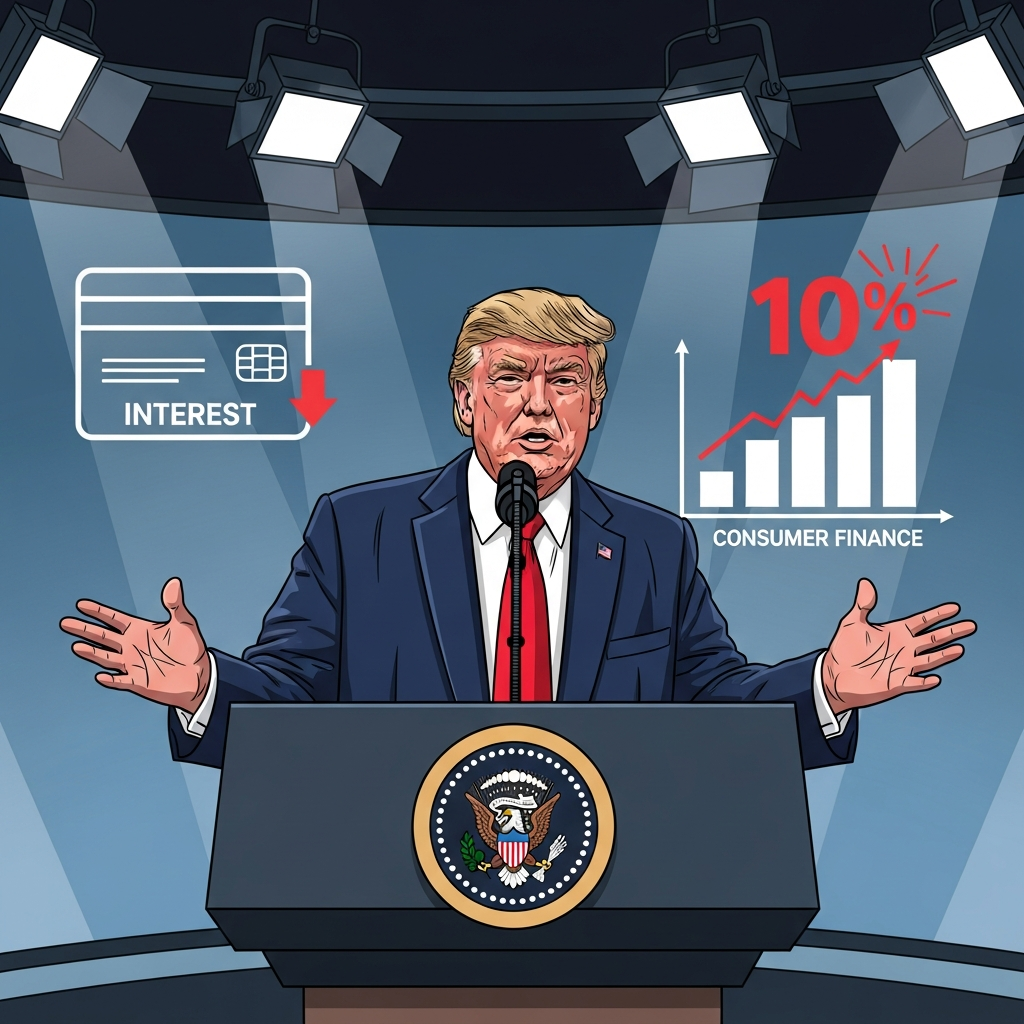
Former President Donald Trump has reignited a contentious debate in consumer finance, proposing an aggressive 10% cap on credit card interest rates for one year. This unexpected announcement, made via social media, aims to combat what Trump describes as consumers being “ripped off” by soaring credit card charges. The proposal puts major banking institutions and millions of American cardholders on high alert, promising significant shifts if implemented. This move, echoing previous campaign pledges, has drawn immediate strong reactions from both sides of the political and financial spectrum.
Unpacking the 10% Cap Proposal
Trump’s plan calls for an immediate one-year limit, setting credit card interest rates at a maximum of 10%. He indicated this restriction would ideally take effect by January 20th. His rationale stems from the belief that current rates, often ranging from 20% to 30% or more, are exploitative. These high rates, he argues, have “festered unimpeded.” Such a cap would be a dramatic departure from the current landscape.
The Alarming State of American Credit Card Debt
The proposal arrives amidst a backdrop of escalating credit card debt in the United States. Americans currently shoulder a record-high $1.23 trillion in credit card debt. This figure has surged significantly in recent years. Approximately 195 million people hold credit cards, collectively incurring an estimated $160 billion in interest charges annually. Average credit card interest rates hover between 19.65% and 21.5%. These rates, despite slight recent central bank adjustments, remain near historic highs since the mid-1990s. They are also markedly higher than the roughly 12% average seen a decade ago. For context, carrying a $10,000 balance at 21% interest accrues over $3,500 in interest alone over three years. This starkly contrasts with a typical 30-year fixed mortgage rate, which sits just above 6%.
Banking Industry’s Strong Opposition and Justifications
The banking industry, including major players like JPMorgan Chase, Capital One, and Citigroup, vehemently opposes such a cap. Industry groups like the Bank Policy Institute (BPI) and Consumer Bankers Association acknowledge the goal of affordable credit. However, they warn of severe consequences. Banks traditionally justify high credit card rates by citing the unsecured nature of the debt. Unlike a car or house, there is no asset to repossess if a borrower defaults. Historical data supports this. For example, charge-off rates on credit cards exceeded 10% after the financial crisis, while residential real estate loans remained below 3%.
Warnings of Reduced Credit and Costly Alternatives
While banks argue higher rates cover risk, credit card lending has become exceptionally lucrative. JPMorgan, for instance, reported a net yield of 9.73% on its over $200 billion in card loans in 2024. This significantly boosted its card services and auto unit’s revenue to $25.5 billion, despite approximately $7 billion in card-related charge-offs.
A 10% cap, critics contend, would severely curtail credit availability. This would disproportionately impact “riskier borrowers” or those with lower credit scores. Banks would likely terminate or retool credit lines, raise minimum monthly payments, or impose additional fees. A 2019 Federal Reserve data analysis by the BPI suggested a 10% cap could curtail credit lines for 14.3 million people and families. Lenders specializing in these segments, such as Capital One and Synchrony Financial, would be most affected. Credit unions have also voiced concerns, stating they could not offer credit cards to most consumers at such a low rate. Experts suggest a 10% cap would “erase their margins,” effectively ending credit cards for all but the most creditworthy consumers. The fear is that vulnerable consumers would be pushed towards less regulated, high-cost alternatives like payday lenders or pawn shops, some of which charge over 300% annual interest.
Potential Impact on American Consumers
If implemented, a 10% interest rate cap could save Americans an estimated $100 billion in interest annually. This potential financial relief for working families is a significant draw for proponents. It could alleviate some of the financial strain associated with revolving credit. For consumers diligently paying off balances, a lower interest rate means more of their payments go towards the principal.
The Double-Edged Sword for Borrowers
However, the benefits are not uniform. While some consumers would see substantial savings, others might lose access to credit entirely. Banks, needing to maintain profitability and manage risk, would likely become far more selective. This could mean fewer promotional offers, scaled-back rewards programs, and higher annual fees for existing cardholders. Those with credit scores below 600 would likely find it harder to obtain new credit. Historically, examples like Arkansas’s strictly enforced 17% interest rate cap showed that less creditworthy individuals were cut out of consumer credit markets when banks couldn’t price risk effectively.
Navigating Implementation and Political Crosscurrents
The exact mechanism for implementing Trump’s proposed cap remains unclear. He has not specified whether it would be through executive action or legislation. He appears to be leveraging his “bully pulpit” to pressure the industry. Republican Senator Roger Marshall stated he would work on a bill with Trump’s “full support.” This underscores a potential legislative path.
A History of Failed Cap Efforts
The idea of interest rate caps is not new. Senators Bernie Sanders (I-Vt.) and Josh Hawley (R-Mo.) previously introduced a bill for a five-year, 10% cap. Representatives Alexandria Ocasio-Cortez (D-N.Y.) and Anna Paulina Luna (R-Fla.) have also proposed similar legislation. This signals a rare bipartisan consensus on the issue of high interest rates. However, prior attempts have consistently failed in Congress. The formidable lobbying power of the banking industry, often arguing against measures by claiming they would restrict credit, has historically been a significant barrier. Moreover, Trump’s administration had previously been notably friendly to the credit card industry, offering little resistance to mergers and weakening the Consumer Financial Protection Bureau (CFPB).
Broader Economic Implications for the Credit Market
An abrupt 10% cap could trigger “regulatory whiplash” for bank shareholders. While the KBW Bank Index had recently soared, such a cap could immediately impact bank margins. Beyond curtailing credit for certain segments, banks might respond by reducing generous rewards programs, which many consumers value. Zero-interest promotional periods could also become a relic of the past. Other potential changes include less leniency on late payment penalties or increased costs for balance transfers and cash advances.
Skepticism from Financial Experts
Skeptics, including billionaire hedge fund manager Bill Ackman, warn that a 10% cap is a “mistake.” They argue it would cause millions of Americans to have their cards cancelled. Lenders would lose the ability to adequately price “subprime credit risk.” Senator Elizabeth Warren also voiced skepticism, questioning Trump’s authority to implement such a cap without Congressional approval. She highlighted Trump’s past actions to “shut down the [Consumer Financial Protection Bureau],” suggesting a lack of genuine concern for affordability. Critics argue the president lacks the unilateral authority for such a broad financial restriction without legislative approval.
Frequently Asked Questions
What exactly is Trump’s proposed credit card interest rate cap?
Donald Trump’s proposal calls for a one-year cap on credit card interest rates, limiting them to a maximum of 10%. He announced this measure via social media, with an stated aim for implementation by January 20th. His rationale is to prevent consumers from being “ripped off” by current rates, which often exceed 20%. This is a significant reduction from the average rates of 19.65% to 21.5% currently seen in the market. The specific mechanism for implementation, whether through executive order or legislation, remains undefined.
How could a 10% credit card interest cap impact American consumers?
A 10% cap could offer substantial financial relief, potentially saving Americans an estimated $100 billion in interest annually. For those carrying balances, more of their payments would go toward principal. However, the banking industry warns it would severely curtail credit availability, especially for “riskier borrowers” or those with lower credit scores. Millions could see their credit lines reduced or terminated, potentially pushing them towards less regulated, high-cost alternatives like payday lenders. Banks might also scale back rewards programs and promotional offers.
What are the arguments for and against a credit card interest rate cap?
For: Proponents argue a cap would provide much-needed financial relief to working families by reducing the burden of high interest charges, which currently contribute to record credit card debt. They suggest banks are already highly profitable and can absorb the change.
Against: Opponents, primarily the banking industry, contend a cap would make it impossible to price risk effectively for unsecured debt, leading to a drastic reduction in credit availability for vulnerable populations. They warn it would force consumers towards predatory lenders and undermine the current credit ecosystem, potentially eliminating rewards programs and other consumer perks.
Looking Ahead: Uncertainty in Consumer Finance
The debate over a 10% credit card interest rate cap is complex, pitting consumer relief against banking industry stability and credit availability. While the proposal aims to alleviate the burden of record credit card debt, its implementation faces significant hurdles and potential unintended consequences. The political and financial landscapes are now grappling with this bold move. The coming months will reveal if this proposal gains traction, potentially reshaping the future of consumer credit in the United States.