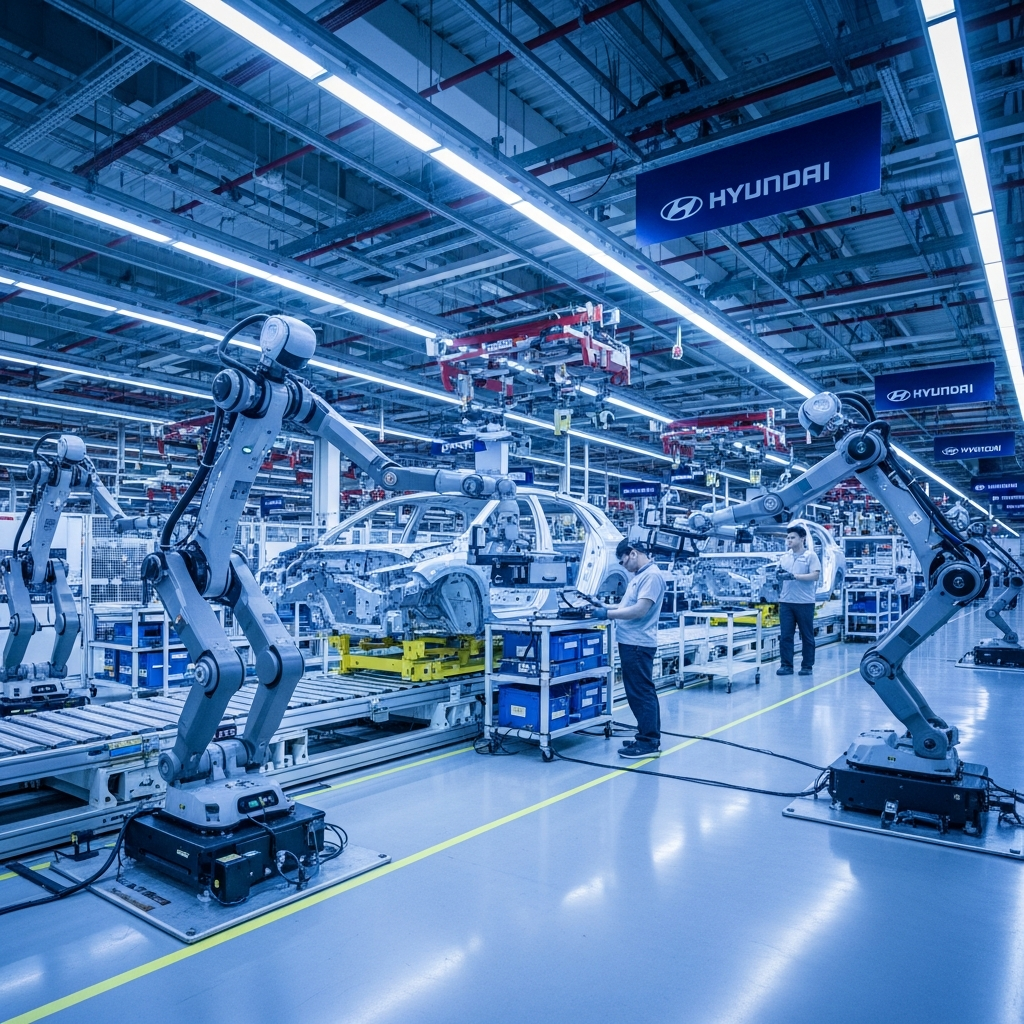
Prepare for a manufacturing revolution: Hyundai Motor Group is launching an ambitious plan to deploy 30,000 advanced humanoid robots in its factories annually by 2028. This bold move, spearheaded by its subsidiary Boston Dynamics, signifies a pivotal moment in the integration of artificial intelligence and robotics into real-world industrial settings. From the advanced capabilities of the Atlas robot to strategic partnerships with AI giants like Google DeepMind, Hyundai is positioning itself at the forefront of the “Physical AI” industry, promising enhanced efficiency, safety, and a transformative future for global manufacturing.
The Dawn of Physical AI: Hyundai’s Vision Unveiled
Hyundai Motor Group, a global industrial powerhouse encompassing car brands like Hyundai, Kia, and Genesis, has embarked on a groundbreaking journey into the future of manufacturing. At CES 2026 in Las Vegas, the company unveiled a sweeping AI Robotics Strategy, emphasizing a shift from hardware-centric robotics to adaptive, AI-driven systems. This initiative, themed ‘Partnering Human Progress,’ aims to expand human potential through intelligent automation. Hyundai envisions leading the Physical AI sector, which integrates robotics, smart factories, and autonomous driving, by leveraging its extensive value chain and product portfolio. This strategy is not just about building cars; it’s about building the future of work itself.
From Concept to Concrete: Atlas Takes the Industrial Stage
At the heart of Hyundai’s vision is the Atlas humanoid robot, developed by Boston Dynamics. For over a decade, Atlas has been a research marvel, demonstrating incredible agility and balance. Now, it’s ready for its industrial debut. This latest version of Atlas is fully electric and battery-powered, boasting 56 degrees of freedom (DoF) for highly fluid and precise movements. It features human-scale hands with advanced tactile sensing, enabling it to lift up to 110 pounds (50 kg) with ease. Designed for the demanding factory environment, Atlas can operate in extreme temperatures, from -4°F to 104°F (-20°C to 40°C), and is robust enough to be hosed off, making it suitable for diverse industrial conditions.
Key capabilities that make Atlas a game-changer include:
Autonomy: It can operate independently and even replace its own battery for continuous work.
Rapid Learning: Most tasks can be taught and mastered within a single day.
Precision: Advanced rotational joints and AI-driven learning ensure high accuracy for complex operations.
Durability: Built to withstand harsh industrial settings, ensuring long-term reliability.
Hyundai’s Strategic Roadmap: Mass Production and Global Deployment
Hyundai’s ambitious plan involves mass-producing Atlas humanoid robots at a new U.S. facility. This factory will have the capacity to build 30,000 robot units annually by 2028. The initial deployment of these cutting-edge Hyundai humanoid robots will begin in 2028 at the Hyundai Motor Group Metaplant America (HMGMA) in Savannah, Georgia. This state-of-the-art facility, where Hyundai builds electric and hybrid vehicles like the Ioniq 5 and Ioniq 9, will serve as Atlas’s proving ground.
The deployment will occur in phases:
By 2028: Atlas will tackle simpler tasks like parts sequencing and arranging components for vehicle assembly, focusing on areas with proven safety and quality benefits.
By 2030: Its capabilities will expand to include more complex component assembly and other intricate operations, enhancing overall worker safety by handling repetitive and heavy-load tasks.
This strategy allows Hyundai to closely monitor, refine, and continuously improve Atlas’s performance in a real-world, high-stakes manufacturing environment. The ultimate goal is to widely deploy the Atlas product model as a production-ready solution across various industrial sites globally.
Powering the Revolution: Key Partnerships and Investments
To realize its ambitious vision, Hyundai is forging powerful alliances and making significant investments. A cornerstone of this strategy is the strategic partnership between Boston Dynamics and Google DeepMind, Google’s cutting-edge AI research lab. This collaboration aims to accelerate the development of next-generation humanoid robots by combining Boston Dynamics’ robotics expertise with Google DeepMind’s sophisticated AI foundation models, including Gemini Robotics. Gemini, a powerful multimodal generative AI model, is designed to enable robots to perceive, reason from, and interact with the physical world, offering a crucial advantage in developing truly intelligent robots.
Furthermore, Hyundai is strengthening its strategic partnership with NVIDIA, leveraging its AI infrastructure and simulation frameworks. The company plans to establish a $3 billion physical AI cluster in South Korea, demonstrating its commitment to advanced AI development. Internally, Hyundai is consolidating capabilities across its vast group:
Hyundai Mobis is developing high-performance actuators for robots.
Hyundai Glovis is optimizing logistics for robot deployment.
The Software-Defined Factory (SDF) platform, already at HMGICS and HMGMA, integrates real-world production data for continuous robot learning.
The Robot Metaplant Application Center (RMAC), opening in the U.S. in 2026, will be a crucial ‘engine’ for AI Robotics, where robots learn human collaboration through behavioral datasets.
These initiatives are backed by substantial financial commitments: over $26 billion in the U.S. through 2028 for collaborations and a new robotics facility, and KRW 125.2 trillion (approximately $92 billion USD) in South Korea over five years for AI robotics and green energy.
Beyond Atlas: A Comprehensive Robotics Ecosystem
While Atlas represents the “Holy Grail” of humanoid robotics, Hyundai’s strategy extends far beyond. The company is actively developing a broader robotics ecosystem. Boston Dynamics’ existing robots, Spot (a four-legged robot for data collection and monitoring) and Stretch (a wheeled box-unloading robot), are already enhancing safety and efficiency in various industrial settings, including Hyundai factories.
Hyundai also plans to produce robots under its own name, such as the MoBed concept delivery robot, which won the CES 2026 Best of Innovation Award. The company envisions integrating its robotics advancements across its vast global empire, including logistics, auto supplier networks, shipbuilding divisions, and even developing consumer-facing robots. This comprehensive approach recognizes diverse opportunities for cost reduction and revenue generation through specialized robotics, not just humanoids.
The “Robot Battle” and Hyundai’s Competitive Edge
The race to develop functional, commercially viable humanoid robots is intensifying, often dubbed the “robot battle.” Hyundai’s Atlas is a direct competitor to high-profile projects like Tesla’s Optimus robot, Xpeng’s Iron humanoid, and initiatives from Toyota. Industry analysts predict significant growth in this sector, with Goldman Sachs forecasting a $38 billion market by 2035 and Morgan Stanley projecting up to $5 trillion by 2050, potentially leading to billions of humanoids in use globally.
Hyundai, however, holds a unique advantage among its competitors. Its decades of experience in high-precision manufacturing, coupled with the proven robotics leadership of Boston Dynamics, provides an unparalleled foundation. The newly solidified AI strategy, featuring partnerships with Google DeepMind and NVIDIA, further strengthens its position. This potent combination of manufacturing expertise, established robotics, and cutting-edge AI integration gives Hyundai a formidable edge in translating impressive lab demonstrations into scalable, real-world industrial applications.
Addressing the Human Element: Collaboration, Not Replacement
The prospect of robots entering the workforce often raises concerns about job displacement. Hyundai, however, emphasizes a philosophy of “human-centered automation” and “harmonious collaboration between humans and robots.” The initial deployment of Atlas will focus on tasks that are repetitive, physically demanding, or dangerous for human workers, thereby enhancing worker safety and improving ergonomic conditions. By freeing human employees from these strenuous tasks, Hyundai aims to allow them to focus on higher-value activities such as robot training, oversight, and complex problem-solving.
Hyundai’s significant investments in the U.S., projected to create 14,000 direct and over 100,000 indirect jobs by 2028, demonstrate its commitment to fostering economic growth alongside technological advancement. Furthermore, the company plans to offer its robotics solutions through a “Robotics-as-a-Service (RaaS)” model, providing subscription plans that reduce upfront costs and ensure continuous performance improvements through over-the-air software upgrades and remote monitoring. This approach facilitates a smooth transition and ensures that human ingenuity remains central to the evolving manufacturing landscape.
Frequently Asked Questions
What is Hyundai’s ambitious strategy for deploying humanoid robots in its factories?
Hyundai Motor Group plans a transformative AI Robotics Strategy, aiming to mass-produce 30,000 Boston Dynamics’ Atlas humanoid robots annually by 2028. This initiative, unveiled at CES 2026, focuses on integrating these advanced robots into its factories to enhance efficiency, safety, and create a “human-centered automation” environment. The strategy leverages Hyundai’s extensive manufacturing expertise and strong partnerships with AI leaders like Google DeepMind and NVIDIA to lead the “Physical AI” industry, expanding beyond traditional mobility into smart factories and autonomous systems.
What are the specific capabilities of Boston Dynamics’ Atlas robot, and where will it first be deployed?
The latest Atlas humanoid robot is fully electric, boasts 56 degrees of freedom, and features human-scale hands with tactile sensing, allowing it to lift up to 110 pounds. It’s designed for demanding industrial environments, operating in extreme temperatures and autonomously replacing its own battery. Atlas can learn most tasks within a single day. Its initial deployment will be at the Hyundai Motor Group Metaplant America (HMGMA) in Savannah, Georgia, starting in 2028 for tasks like parts sequencing, with more complex assembly work targeted by 2030.
How will Hyundai’s Atlas humanoid robots transform manufacturing and address concerns about human jobs?
Hyundai’s Atlas robots are poised to transform manufacturing by taking over repetitive, heavy-load, and dangerous tasks, thereby significantly enhancing worker safety and operational efficiency. The company emphasizes a “human-centered automation” approach, where robots collaborate with humans, allowing people to focus on higher-value activities like training and oversight. While concerns about job displacement exist, Hyundai’s strategy is linked to substantial investments creating new jobs, and its “Robotics-as-a-Service” model aims for broad, cost-effective integration, positioning Hyundai as a leader in the evolving industrial landscape.
The Future of Manufacturing is Here
Hyundai Motor Group’s bold move to mass-produce and deploy humanoid robots like Atlas represents a significant leap forward in industrial automation and the broader field of Physical AI. By combining Boston Dynamics’ pioneering robotics with cutting-edge AI from Google DeepMind and NVIDIA, Hyundai is not just building cars; it is building the infrastructure for a more efficient, safer, and intelligent manufacturing future. The journey from lab to factory floor is fraught with challenges, but Hyundai’s comprehensive strategy, substantial investments, and commitment to human-robot collaboration position it to lead this exciting new era. The year 2028 will mark a pivotal moment as thousands of Hyundai humanoid robots begin to reshape the very foundations of global production.