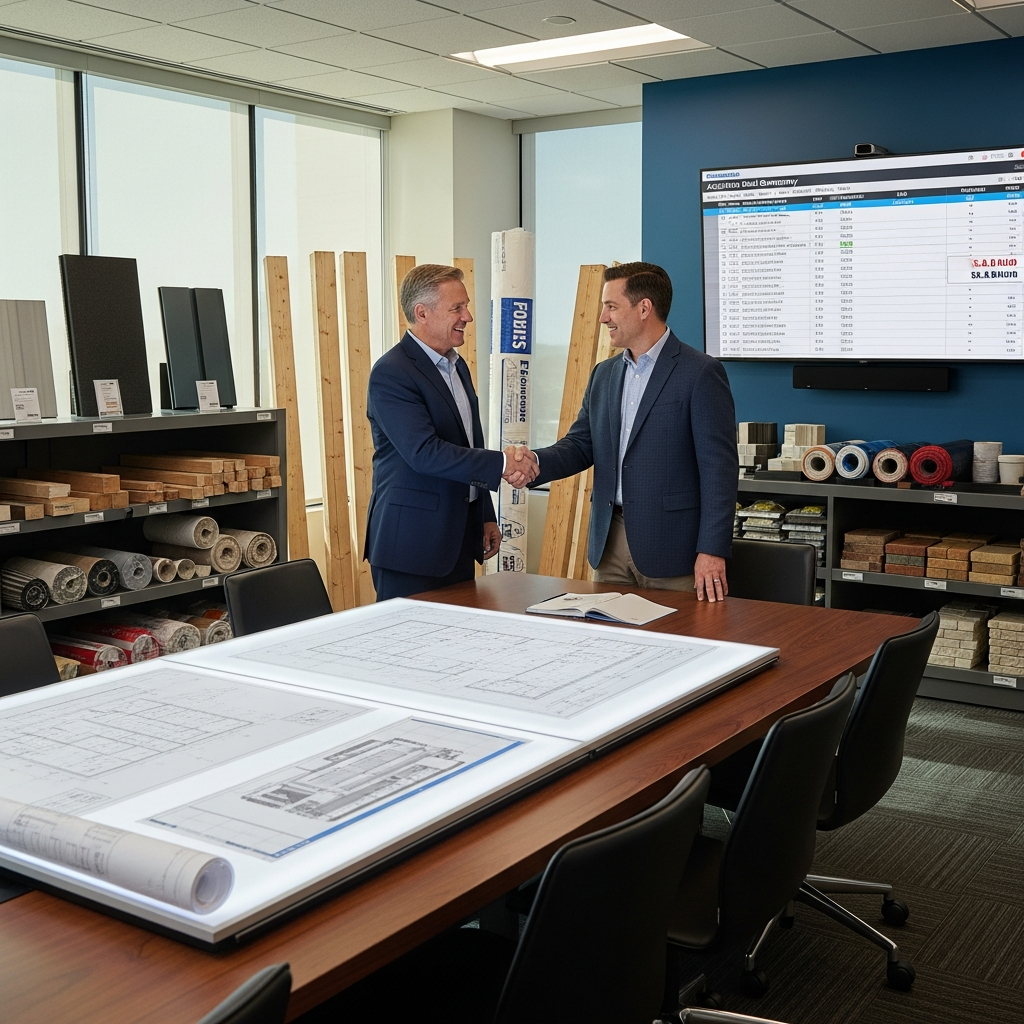
Home improvement giant Lowe’s has completed a monumental $8.8 billion acquisition of Foundation Building Materials (FBM), marking a pivotal moment in its strategy to dominate the professional contractor market. This significant deal, finalized in October 2025 after initial announcements in August, solidifies Lowe’s position and expands its offerings for large-scale construction projects. It underscores a crucial shift in the home improvement sector, as major retailers increasingly target professional customers amidst evolving market dynamics.
Lowe’s $8.8 Billion Strategic Move into Pro Sales
The acquisition of Foundation Building Materials (FBM) by Lowe’s represents a substantial investment of $8.8 billion. This major financial commitment highlights Lowe’s dedication to accelerating its “Total Home strategy.” The goal is clear: to become the premier destination for professional contractors and builders. FBM, a leading distributor of building materials, brings a robust network and specialized product portfolio directly to Lowe’s. This move is one of two key acquisitions made by Lowe’s in 2025, demonstrating an aggressive expansion plan.
Understanding Foundation Building Materials (FBM)
California-based FBM, established in 2011, has rapidly grown into a powerhouse in the building materials sector. It operates an extensive network of over 370 locations across both the United States and Canada. FBM is renowned for supplying a diverse range of critical construction products, catering to approximately 40,000 professional customers.
Its comprehensive product offerings include:
Drywall and metal framing
Ceiling systems and insulation
Commercial doors and hardware
Fasteners and power tools
This broad selection makes FBM an essential supplier for various construction and home repair projects. Despite the acquisition, FBM will continue to operate as a distinct entity. Its founder, Ruben Mendoza, will remain at the helm, ensuring continuity and leveraging FBM’s proven track record of profitable growth.
Accelerating the “Total Home” Strategy
Marvin R. Ellison, Lowe’s chairman, president, and CEO, emphasized the strategic importance of the FBM acquisition. He described it as a critical step in serving “large Pro customers” within a vast $250 billion total addressable market. This acquisition significantly enhances Lowe’s existing capabilities, especially following its earlier purchase of Artisan Design Group (ADG). ADG specializes in design, distribution, and installation services for interior surface finishes. Together, these acquisitions create a powerful ecosystem designed to meet the complex needs of professional builders.
Expanding Market Penetration and Future Growth
With FBM’s integration, Lowe’s is poised for substantial market penetration. Ellison pointed to an anticipated recovery in the housing market. He cited a projection of 16 million new homes needed in the U.S. by 2033. This forecast creates a massive opportunity for growth. By deepening its engagement with the professional segment, Lowe’s expects to achieve more sustainable sales and profit expansion. Ultimately, this strategy aims to deliver enhanced long-term shareholder value. The company’s focus on the professional market is a calculated move to capitalize on these future trends.
The Competitive Landscape and Market Shift
The home improvement sector is witnessing an “escalating urgency of acquisition in the pro distributors market.” This competitive pressure is a direct response to intensifying competition. It also reflects weaker demand in the do-it-yourself (DIY) category. DIY currently accounts for about 70 percent of Lowe’s annual revenue. The professional segment, by contrast, offers robust growth opportunities. Lowe’s rival, Home Depot, has also made a significant move in this arena. Home Depot agreed to acquire specialty building products distributor GMS for roughly $4.3 billion. This parallel activity underscores a broader industry trend. Retail giants are diversifying revenue streams and strengthening their competitive positions by capturing a larger share of the lucrative professional market.
Financial Outlook and Investor Confidence
The announcement of the FBM deal was met positively by the market. Lowe’s shares rose 2 percent following the news. The company also updated its financial outlook. It raised its annual sales forecast to a range of $84.5 billion to $85.5 billion. This was an increase from previous expectations of $83.5 billion to $84.5 billion. Furthermore, Lowe’s reported strong second-quarter results, surpassing profit estimates. The company earned $4.33 per share on an adjusted basis, outperforming estimates of $4.24. Lowe’s plans to finance the $8.8 billion acquisition through a mix of short-term and long-term debt. This strategic investment is expected to bolster the company’s financial health and long-term prospects.
Integrated Capabilities for Professionals
FBM brings several specific capabilities that will greatly benefit Lowe’s professional offerings. These include a robust trade credit platform and enhanced digital tools. More efficient fulfillment processes are also part of the package. These new assets will complement Lowe’s existing product and service portfolio. The goal is to provide a seamless and comprehensive experience for contractors. Serving an estimated 16 million customers weekly across approximately 1,700 U.S. stores, Lowe’s aims to leverage FBM’s expertise. This integration will significantly enhance its Pro offering, making Lowe’s a more attractive partner for large-scale projects.
Frequently Asked Questions
What is Lowe’s “Total Home strategy” and how does the FBM acquisition support it?
Lowe’s “Total Home strategy” aims to make the company the complete destination for all home improvement needs, particularly for professional contractors. The FBM acquisition is crucial because it significantly expands Lowe’s offerings and reach within the professional segment. FBM’s extensive network of over 370 locations and specialized building materials portfolio directly caters to large-scale construction projects, filling gaps in Lowe’s existing pro services and accelerating its ability to serve this high-value market.
How will the acquisition of Foundation Building Materials benefit professional contractors?
Professional contractors will benefit from increased access to a broader range of specialized building materials and construction products. FBM brings a robust trade credit platform, enhanced digital tools, and more efficient fulfillment processes, which complement Lowe’s existing services. This integration means professionals can expect a more streamlined purchasing experience, a wider selection of materials like drywall, metal framing, and commercial doors, and potentially better support for their project needs across the combined network.
What impact will this $8.8 billion deal have on the overall home improvement market?
This $8.8 billion acquisition signifies a major consolidation and strategic pivot in the home improvement market. It intensifies competition among major retailers like Lowe’s and Home Depot, pushing them to expand their focus beyond DIY customers to the lucrative professional segment. The deal will likely lead to increased market penetration for Lowe’s in the pro space, influencing pricing, product availability, and service levels across the industry, especially as both companies position themselves for an anticipated housing market recovery and the need for new homes.
The Future of Home Improvement
The acquisition of Foundation Building Materials is more than just a large financial transaction. It signals a powerful strategic direction for Lowe’s. By embracing the professional contractor market, Lowe’s is preparing for future growth. This is a clear response to evolving industry trends and housing demands. With FBM’s specialized expertise and extensive network, Lowe’s is well-positioned. It aims to deliver significant value to both its professional customers and its shareholders in the years ahead. The future of home improvement appears increasingly tailored to the needs of the trade.