Southeast Asia grapples with a deepening humanitarian crisis as Thailand and Cambodia agree to fresh diplomatic talks aimed at de-escalating a deadly border conflict. The renewed hostilities have shattered a previously brokered ceasefire, prompting urgent appeals for regional stability and a sustainable resolution. With nearly a million people displaced and dozens killed, international powers and regional blocs are intensifying efforts to bring a lasting peace to the disputed frontier.
A Fragile Peace Shattered: The December Resurgence
The latest round of intense fighting, now in its third week, marks a devastating collapse of a ceasefire agreement signed earlier in July. This month has seen a dramatic escalation in the Thailand Cambodia border conflict, characterized by heavy artillery exchanges along the 800-kilometer (500-mile) frontier and even reported air strikes by Thailand against Cambodian positions. Both nations vehemently blame each other for reigniting the violence, fueling a cycle of retaliation that has pushed the region to the brink.
The human cost has been staggering. Since the renewed fighting erupted this month, at least 41 lives have been lost, and officials estimate close to one million individuals have been displaced from their homes on both sides of the border. This widespread displacement underscores the severe humanitarian impact, with families uprooted and communities shattered by the relentless violence. Cambodia even took the drastic step of officially shutting its border crossings with Thailand, further isolating affected populations and complicating relief efforts.
Roots of Discord: A Century-Old Border Dispute
The deep-seated animosity between Thailand and Cambodia traces its origins back over a century, stemming from poorly defined colonial-era maps drawn by French cartographers in 1907. This historical grievance has fueled sporadic clashes for decades, claiming the lives of soldiers and civilians alike. While tensions simmered for years, a significant escalation occurred in May after a Cambodian soldier was killed in a border confrontation.
The situation dramatically worsened on July 24, following a Cambodian rocket barrage into Thailand, which was met with immediate retaliatory Thai air strikes. This initial eruption triggered five days of intense fighting, resulting in dozens more casualties. The dispute extends beyond territory to cultural heritage, notably involving sites like the Khmer temple Prasat Ta Moan Thom, near the border, where past incidents, such as Thai police preventing Cambodian tourists from singing their national anthem, have further inflamed nationalist sentiments.
The July Ceasefire: A “Rushed” Attempt at Resolution
In a bid to halt the deadliest conflict in over a decade, an “immediate and unconditional ceasefire” was brokered in July. Malaysian Prime Minister Anwar Ibrahim hosted the talks in Putrajaya, with significant intervention from then-US President Donald Trump. Trump reportedly threatened to halt tariff negotiations with both countries and impose a 36 percent US tariff from August 1 if the hostilities continued, demonstrating a strong coercive diplomatic approach.
President Trump later oversaw the signing of what he publicly dubbed “the Kuala Lumpur peace accord” in October. However, Thailand notably refused to use this title, instead referring to it as a “Joint Declaration.” Thailand’s Foreign Minister, Sihasak Phuangketkeow, later critically assessed the July agreement, describing it as “rushed.” He suggested the urgency was driven by the US’s desire to have the declaration signed in time for Trump’s visit, implying it lacked the thoroughness needed to address the complex situation on the ground effectively and ensure a lasting peace. “Sometimes we really just have to sit down, trash things out… make sure that the ceasefire reflects… the situation on the ground. And the ceasefire is one that really holds,” Phuangketkeow stated, highlighting the perceived shortcomings.
Despite the initial hopes, this ceasefire ultimately crumbled in December, with both sides once again accusing each other of violations and reigniting the Thailand Cambodia border conflict.
Regional and International Diplomacy in Play
The escalating Thailand Cambodia border conflict has drawn significant regional and international concern, underscoring the broader ramifications for Southeast Asian stability.
ASEAN’s Credibility Test
At a recent Association of Southeast Asian Nations (ASEAN) meeting, Malaysia’s Foreign Minister, Mohamad Hasan, urged all member states to give the matter their “most urgent attention.” He warned of the “wider ramifications of the continued escalation of the situation for the people we serve.” This conflict represents the worst between ASEAN member states since the association’s founding in 1967, posing a serious challenge to the bloc’s credibility and its core principle of regional peace. The failure to contain it risks undermining ASEAN’s role as a central pillar of security and cooperation in the region.
Global Powers Step In
Both the United States and China have also been actively attempting to mediate the border dispute. China, a major economic partner to both nations and a close political ally of Cambodia, has positioned itself as a potential peacemaker. China’s special envoy for Asian affairs, Deng Xijun, visited Phnom Penh recently, with Beijing reaffirming its commitment to playing a constructive role. China’s Foreign Minister Wang Yi framed the dispute as a legacy of Western colonialism, subtly presenting China as a non-colonial problem-solver and encouraging ASEAN’s mediating role. Beijing’s activism is driven by several motives, including safeguarding its Belt and Road Initiative (BRI) corridors and Chinese-funded industrial zones in the Mekong subregion, as well as boosting its international stature and Global Security Initiative (GSI) agenda.
However, China faces obstacles, as some observers note that Thailand has expressed suspicion that China’s support might have emboldened Cambodia’s recent border claims. Thailand has also historically preferred bilateral talks, wary of external mediation. Conversely, the US’s direct involvement through President Trump’s phone calls and tariff threats significantly influenced the July ceasefire, illustrating its willingness to employ coercive diplomacy. The US even reduced tariffs on Thailand, Cambodia, and Malaysia as a reward for the initial agreement. While both global powers seek influence, their visible cooperation as supporters of ASEAN-led negotiations signals a pragmatic approach to regional stability.
The Path Forward: New Talks and Lingering Challenges
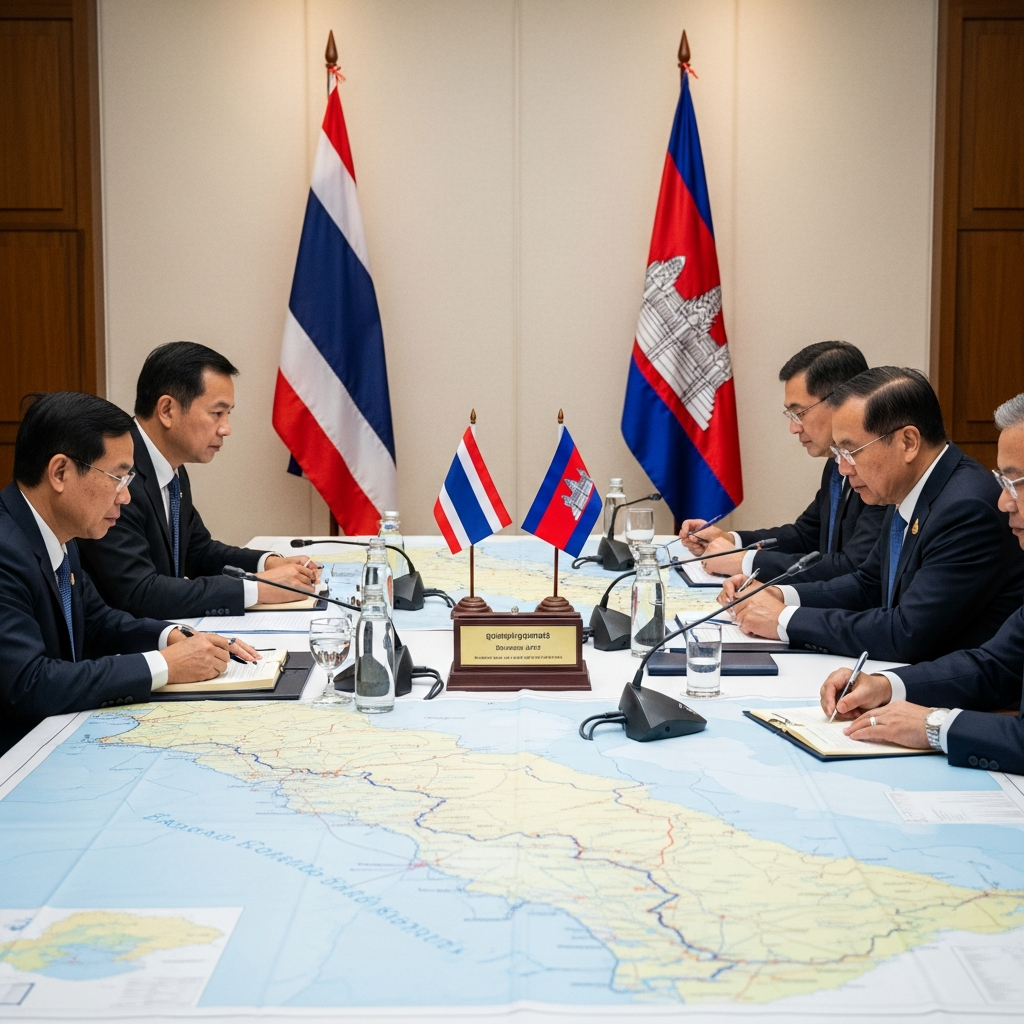
Following a summit in Malaysia, top officials from Thailand and Cambodia held their first face-to-face meeting since fighting resumed. Thailand’s Foreign Minister Sihasak Phuangketkeow announced that a crucial meeting between military officials from both countries is scheduled for December 24. He emphasized that this military-level discussion is a necessary prerequisite before any new, comprehensive ceasefire agreement can be reached.
Cambodia has yet to issue an official comment regarding these proposed talks, reflecting the ongoing complexities and distrust. The diplomatic efforts face significant challenges, including overcoming entrenched historical grievances, rebuilding trust, and ensuring that any future agreement is robust enough to reflect the “situation on the ground” and truly hold. The urgent need for a more meticulous approach, as advocated by Minister Phuangketkeow, is paramount to prevent yet another fragile peace from collapsing.
Frequently Asked Questions
What sparked the recent escalation in the Thailand-Cambodia border conflict?
The recent escalation in the Thailand Cambodia border conflict stems from the collapse of a previously brokered ceasefire in December. While a ceasefire had been agreed upon in July, with US President Donald Trump and Malaysian PM Anwar Ibrahim as key mediators, it proved unsustainable. Both nations blame each other for reigniting hostilities. The conflict’s roots run deeper, tracing back over a century to disputed colonial-era maps and ongoing territorial claims, which saw an initial dramatic escalation in July following a Cambodian rocket barrage into Thailand.
Who are the main international actors attempting to mediate the Thailand-Cambodia border dispute?
Several key international and regional actors are actively attempting to mediate the Thailand Cambodia border dispute. These include the United States, which, under former President Donald Trump, used tariff threats to push for the initial ceasefire. China, a strategic partner to both nations, has also offered its “objective and fair” good offices through special envoys and its Foreign Minister. Regionally, Malaysia’s Prime Minister Anwar Ibrahim played a crucial role in brokering the July agreement, and the Association of Southeast Asian Nations (ASEAN) has called for urgent attention to the matter, stressing the importance of regional solutions.
Why has achieving a lasting peace in the Thailand-Cambodia border region proven so challenging?
Achieving a lasting peace in the Thailand Cambodia border conflict is challenging due to several interconnected factors. Historically, the dispute is over a century old, rooted in contentious colonial-era maps and deeply held nationalistic claims. Distrust is profound, with both sides frequently blaming each other for renewed aggression and treaty violations. Geopolitical competition also plays a role, with major powers like the US and China vying for influence, adding layers of complexity. Furthermore, past ceasefires, like the one in July, have been criticized for being “rushed” and not adequately addressing the intricate realities on the ground, leading to their rapid collapse and continued cycles of violence.
Conclusion
The latest agreement by Thailand and Cambodia to engage in renewed talks offers a flicker of hope amidst the devastating Thailand Cambodia border conflict. The human toll, marked by widespread displacement and loss of life, demands an urgent and effective resolution. The international community, from regional blocs like ASEAN to global powers like the US and China, is keenly invested in stabilizing this volatile frontier. For a truly sustainable peace to emerge, future diplomatic efforts must move beyond temporary ceasefires to address the deeply rooted historical grievances and foster genuine trust. The stakes for regional stability and humanitarian well-being could not be higher, making these upcoming discussions absolutely crucial.