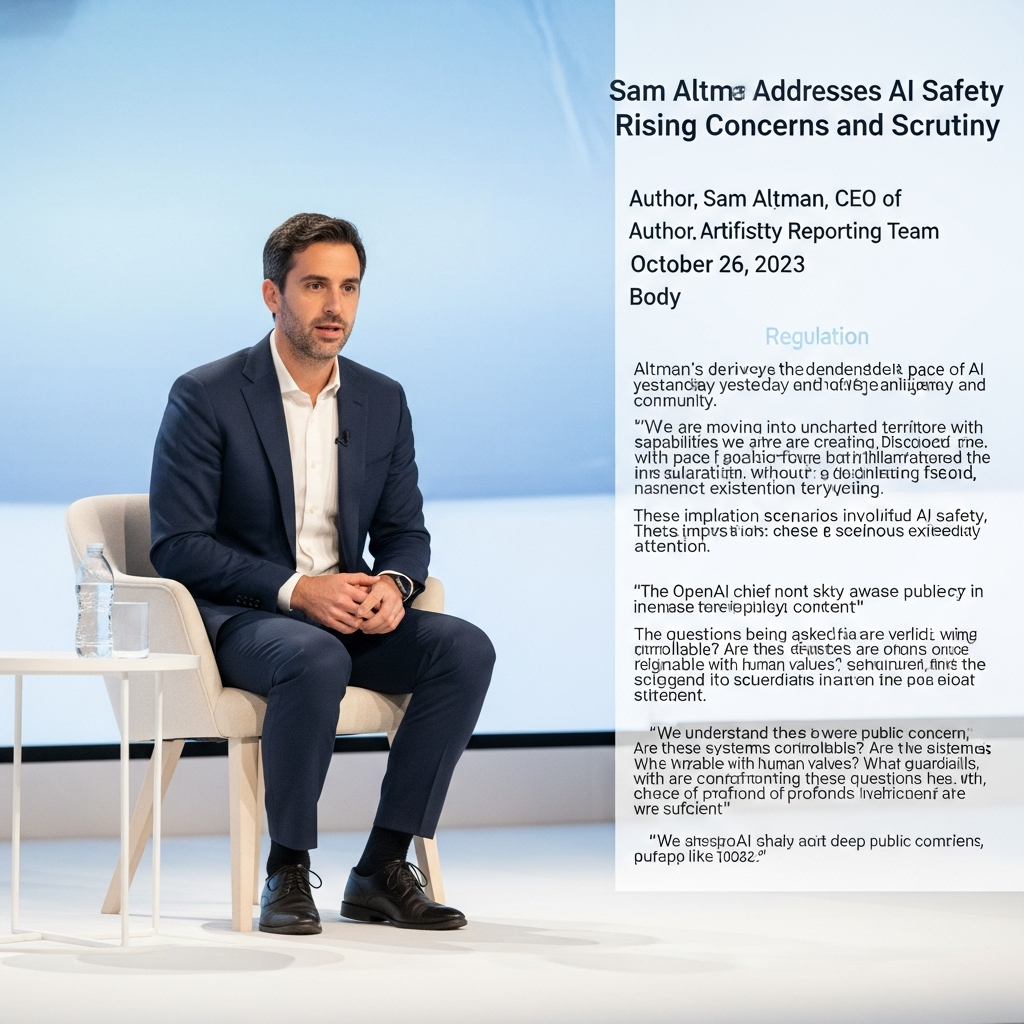
In a stunning turn of events that underscores the intense public scrutiny surrounding artificial intelligence, OpenAI CEO Sam Altman recently faced a terrifying incident at his San Francisco home. An individual allegedly launched a Molotov cocktail at his residence, followed by threats made at OpenAI’s headquarters. This alarming episode prompted Altman to share deep personal reflections on a blog post, where he connected the attack to a recent critical investigation by The New Yorker and the escalating global anxiety about AI. His remarks offer a rare glimpse into the mindset of a tech leader grappling with immense power and profound responsibility.
A Night of Turmoil: Attack on Sam Altman’s Home and OpenAI HQ
The tranquility of early Friday, April 10, 2026, was shattered for OpenAI CEO Sam Altman. Around 3:45 AM PT, an incendiary device, identified as a Molotov cocktail, was allegedly thrown towards his home in San Francisco’s North Beach neighborhood. Fortunately, the device bounced off the house, causing no injuries and only minimal damage to an exterior gate before extinguishing itself. San Francisco police swiftly responded to the scene, launching an immediate investigation into the attempted arson.
Within an hour of the incident at Altman’s residence, the same individual, later identified as Daniel Alejandro Moreno-Gama, a 20-year-old male, was apprehended near OpenAI’s headquarters in the Mission Bay area. He was reportedly making threats to set the company building ablaze. OpenAI confirmed both incidents, expressing profound gratitude to the San Francisco Police Department (SFPD) for their rapid response and the city’s support in ensuring employee safety. The company is actively cooperating with law enforcement in their ongoing investigation.
A Troubling Pattern of Threats Against OpenAI
This incident is not an isolated event but rather another disturbing episode in a series of security challenges faced by OpenAI and its employees. In recent months, the company’s San Francisco offices have been the target of various threats and protests. These include a temporary office lockdown in November of the previous year due to alleged violent threats and arrests in February 2025 of activists who locked the company’s front doors. This escalating pattern highlights the unique and heightened vulnerability faced by prominent artificial intelligence companies and their executives in an era of intense public concern.
Sam Altman’s Candid Response: The Potent Power of Words
Hours after the Molotov cocktail attack, Sam Altman took to his personal blog to address the incidents. He shared a poignant photograph of his husband, Oliver Mulherin, and their child, explaining his decision to go public. “Normally we try to be pretty private,” Altman wrote, “but in this case I am sharing a photo in the hopes that it might dissuade the next person from throwing a Molotov cocktail at our house, no matter what they think about me.” This gesture underscored the deeply personal impact of the attack.
Altman’s blog post revealed that the physical assault was intertwined with the emotional fallout from a recent “damning investigation” by Ronan Farrow and Andrew Marantz published in The New Yorker. He confessed that the events had forced him to confront the profound “power of words and narratives.” Initially, he used the word “incendiary” to describe The New Yorker article, admitting he might have underestimated its impact, particularly amidst growing public anxiety about AI. He later walked back this specific word choice on X, acknowledging it was a “bad word choice” made during a “tough day.” His reflections highlight a leader grappling with the magnified scrutiny and potential real-world consequences of public discourse surrounding advanced AI.
Shaping the Future: Altman on AI Safety and Democratization
Beyond the immediate crisis, Altman used his platform to delve into his fundamental beliefs about the artificial intelligence industry and its future trajectory, including artificial general intelligence (AGI). He candidly acknowledged that the widespread rollout of world-changing AI tools would not always proceed smoothly, stating, “the fear and anxiety about AI is justified.” He described AI as “the largest change to society in a long time, and perhaps ever.” This perspective underpins his urgent call to action.
Altman emphasized the critical need to “get safety right,” arguing that this responsibility extends far beyond merely aligning AI models. It necessitates a “society-wide response to be resilient to new threats,” including developing new policies to navigate what he predicts will be a “difficult economic transition” towards a potentially much better future. A core tenet of his philosophy is that “AI has to be democratized; power cannot be concentrated.” He believes it is unacceptable for a select few AI labs to unilaterally make “the most consequential decisions about the shape of our future,” advocating for broader participation in AI governance.
Navigating Internal Conflicts and Personal Growth
In his remarkably open blog post, Altman also addressed his controversial past conflicts with OpenAI’s previous board, which famously led to his temporary firing and subsequent re-hiring. He offered a sincere apology for his conduct, admitting he was “not proud of handling myself badly in a conflict with our previous board that led to a huge mess for the company.” He further acknowledged making “many other mistakes throughout the insane trajectory of OpenAI,” describing himself as “a flawed person in the center of an exceptionally complex situation.” Altman expressed regret for causing hurt and wished he had “learned more faster,” recognizing the serious costs of these “bitter conflicts.” This personal reflection reveals a leader striving for growth amidst unprecedented challenges.
OpenAI’s Monumental Achievements Amidst Scrutiny
Despite the profound personal and corporate challenges, Altman conveyed immense pride in OpenAI’s accomplishments. He highlighted the company’s ability to deliver on its ambitious mission, against considerable odds. OpenAI has successfully built powerful AI, amassed significant capital for essential infrastructure, evolved into a robust product company, and delivered “reasonably safe and robust services at a massive scale.” Altman confidently asserted, “A lot of companies say they are going to change the world; we actually did.”
This statement is backed by OpenAI’s impressive growth metrics. The company recently announced an $852 billion valuation following a substantial funding round, underscoring its significant market presence. Its flagship product, ChatGPT, continues to dominate the consumer AI landscape, boasting over 900 million weekly active users and approximately 50 million subscribers. Furthermore, the company reported a tripling of its search feature usage over the past year, indicating strong product engagement and continuous innovation. However, this success also comes with ongoing scrutiny, including concerns about its collaboration with the US Department of Defense and mixed public perceptions, as reflected in polls where AI is viewed even less favorably than some controversial government agencies.
Broader Implications: AI Anxiety and Societal Impact
The attack on Sam Altman’s home can be seen as a stark symbol of the escalating societal tensions surrounding artificial intelligence. As Shaun Fletcher, an associate professor of public relations, suggests, the incident may reflect a “growing discontent with the rapid adoption of artificial intelligence.” For many, AI is not merely a theoretical concept but an “existential threat” impacting their daily lives, livelihoods, and economic security. In this context, high-profile tech leaders like Sam Altman often become the visible embodiment of these grievances.
This dynamic creates a volatile environment where frustrations can intensify, sometimes leading to extreme actions. While no injuries occurred in this specific incident, the underlying societal anxieties show no signs of diminishing. The attacks on OpenAI’s leader and facilities highlight a crucial intersection where technological advancement meets deep-seated public fears, demanding not just technological solutions but also thoughtful societal engagement and robust policy frameworks.
Frequently Asked Questions
What exactly happened at Sam Altman’s home on April 10, 2026?
In the early hours of Friday, April 10, 2026, an individual allegedly threw a Molotov cocktail at the North Beach residence of OpenAI CEO Sam Altman in San Francisco. The incendiary device bounced off the house, causing no injuries and minimal damage to an exterior gate before extinguishing. Shortly after this incident, the same suspect reportedly made threats against OpenAI’s headquarters in Mission Bay, leading to a rapid response from San Francisco police and the suspect’s arrest.
Who was arrested in connection with the Molotov cocktail attack and OpenAI threats?
A 20-year-old male, identified as Daniel Alejandro Moreno-Gama, was arrested by San Francisco police in connection with both incidents. He was apprehended near OpenAI’s headquarters after allegedly threatening to burn down the building, following the Molotov cocktail incident at Sam Altman’s home earlier that morning. OpenAI confirmed the arrest and is fully cooperating with law enforcement in the ongoing investigation.
How is Sam Altman addressing concerns about AI safety and its future impact?
Sam Altman acknowledges that “the fear and anxiety about AI is justified” and views AI as potentially the “largest change to society… ever.” He stresses the urgent need to “get safety right,” advocating for a broad “society-wide response” that includes new policies to navigate the economic transition AI will bring. Crucially, Altman believes AI must be democratized, arguing that power cannot be concentrated among a few labs, and that decision-making about our future shape should be widely distributed.
Conclusion: A Leader’s Reflection in Tumultuous Times
The Molotov cocktail attack on Sam Altman’s home, coupled with the ensuing threats against OpenAI headquarters, represents a stark manifestation of the volatile sentiment surrounding artificial intelligence. Altman’s candid response, linking the physical assault to the power of public narratives and AI anxieties, offers a rare and critical perspective from the heart of the AI revolution. His reflections on AI safety, democratization, and even his own past missteps underscore the immense responsibility he and OpenAI bear. As AI continues its rapid ascent, the incident serves as a potent reminder that the path forward demands not only technological innovation but also profound societal dialogue, robust governance, and a concerted effort to address legitimate public concerns. The future of AI, as Altman implies, hinges on more than just code; it relies on trust, transparency, and a collective commitment to navigate its world-altering implications responsibly.