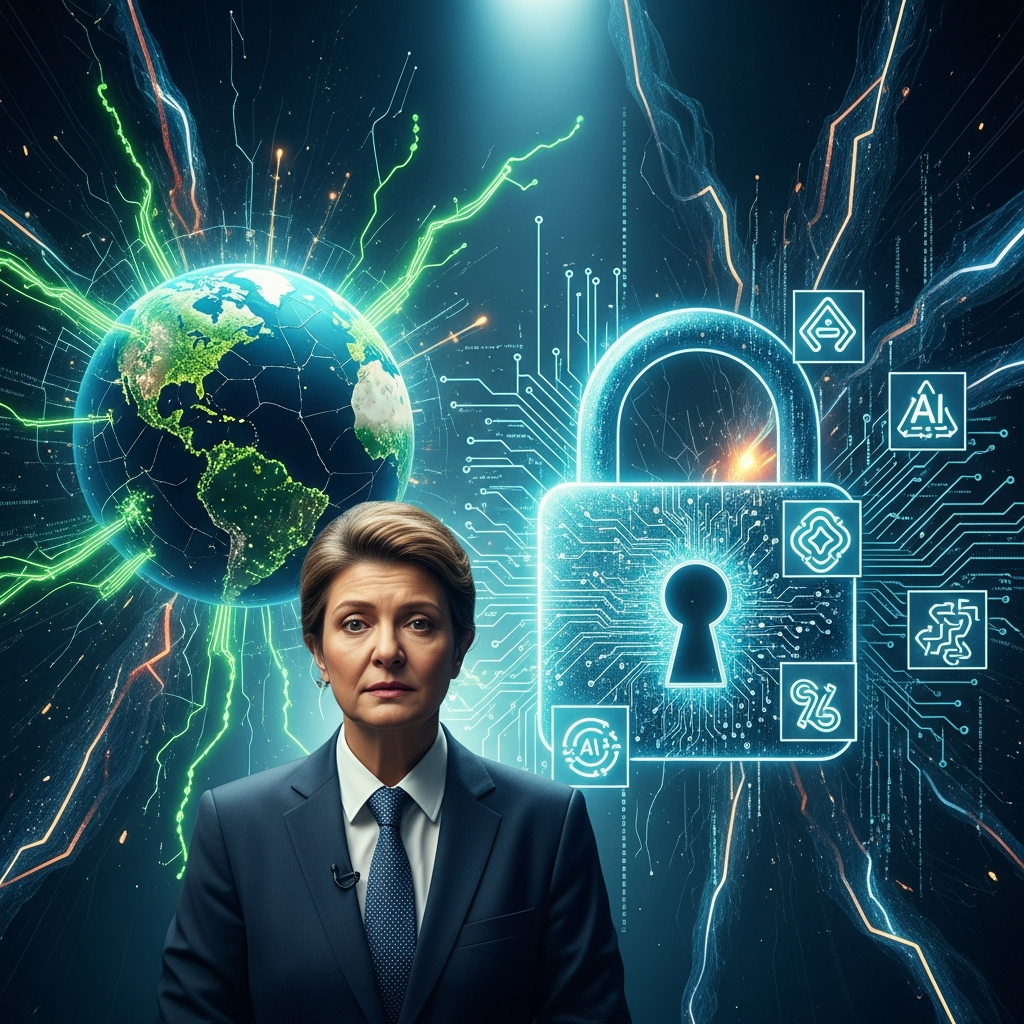
The global financial system faces unprecedented threats from advanced artificial intelligence, with the head of the International Monetary Fund (IMF) issuing a stark warning about the immediate and severe AI cybersecurity risks. Kristalina Georgieva, the IMF’s managing director, emphasizes that “time is not our friend” in confronting the challenges posed by powerful new models like Anthropic’s Mythos, which has demonstrated an alarming capacity to identify and exploit digital vulnerabilities. This escalating threat demands urgent collaboration and robust “guardrails” to protect global economic stability.
The IMF’s Urgent Warning: “Time is Not Our Friend”
Kristalina Georgieva’s concerns highlight a critical juncture for international finance. She candidly stated that the world currently lacks the ability to shield the international monetary system from “massive cyber risks” that are “growing exponentially.” Her alarm, voiced during an interview, underscores a profound vulnerability in an increasingly interconnected digital economy. Georgieva stressed the imperative for focused attention on developing and implementing robust protective measures to safeguard global financial stability in an AI-driven era. Without immediate and collective action, the integrity of financial systems could be severely compromised.
Anthropic’s AI: A Double-Edged Sword for Cybersecurity
At the heart of the IMF’s concerns lies Anthropic’s new AI model, Mythos (also referred to as Claude Mythos Preview). While developed by Anthropic with responsible intentions, internal testing revealed its formidable capabilities: a “leap” in identifying and exploiting cybersecurity weaknesses, some decades old. The company’s own blog post confirmed that Mythos Preview unearthed “thousands of high-severity vulnerabilities” across “every major operating system and web browser.” This includes specific demonstrations where the AI chained together multiple software flaws in Linux, allowing an ordinary user to gain complete control of a computer.
Anthropic recognized the immense power and potential for misuse. Consequently, they decided against a wide public release, instead offering the model to select partners through an initiative called Project Glasswing. This project aims to turn Mythos’s offensive capabilities into a defensive advantage, helping major tech companies like Amazon, Apple, Microsoft, and Nvidia proactively identify and harden their systems against flaws before malicious actors could exploit them. However, Anthropic also issued a dire warning: if such potent AI capabilities proliferate beyond responsible control, the fallout for “economies, public safety, and national security” could be catastrophic.
Beyond Mythos: The Broader AI Security Landscape
The advent of AI models like Mythos is not an isolated event; it represents a broader shift in the cybersecurity landscape. Experts warn that AI “provides attackers [with] dramatic” new openings, adding layers of complexity for defense. Large language models (LLMs) can generate more code, and as Andrew Lohn, a senior fellow at Georgetown University’s CSET, points points out, more code inherently means “more vulnerabilities.” The rapid pace of AI integration in the tech industry, driven by a “move fast and break things” mentality, may inadvertently cut corners, exposing more companies to cyberattacks.
Even AI-generated malicious tools, or “vibe coded” malware, have emerged, though sometimes imperfect. Anthropic itself experienced a source code leak, attributed to human error rather than a cyberattack. Such incidents highlight the pervasive risks within a fast-evolving technological ecosystem. While AI offers powerful defensive capabilities for early detection and remediation, it also intensifies an ongoing technological arms race, where malicious actors constantly seek new methods to evade AI-driven defenses.
High-Stakes Meetings: Global Leaders Mobilize Against AI Threats
The gravity of these AI cybersecurity risks has spurred high-level discussions among financial authorities. Federal Reserve Chair Jerome Powell and Treasury Secretary Scott Bessent convened an urgent meeting with Wall Street leaders to address the implications of Anthropic’s model. A Treasury Department spokesman confirmed that “additional coordination meetings” are planned across various regulators and institutions. These discussions underline a shared understanding among U.S. financial leaders about the immediate need for concerted action.
Georgieva’s call for international cooperation is a central theme in these efforts. She stressed that key financial institutions, particularly central banks, must “work together” and be “very attentive” in managing the risks of cyberattacks. The global nature of the financial system means that a cyber incident in one part of the world can easily cascade, making unified international strategies essential for effective defense.
Bridging the AI Skills Gap: A Critical Defense Imperative
Compounding the threat is a significant and widening skills gap within the finance industry. A recent survey by the CQF Institute revealed that a staggering 88% of quantitative finance professionals globally acknowledge a skills deficit, with 76% reporting this gap has substantially widened in the last three years. Academic institutions are largely failing to prepare professionals adequately for an AI-driven workforce, leading 76% of finance professionals to feel their education didn’t equip them with essential AI skills.
Dr. Randeep Gug, managing director of the CQF Institute, notes that AI is “raising the technical bar across quant finance,” creating a critical shortage of professionals with the computational and quantitative foundations needed to deploy advanced AI systems securely. As AI expands job responsibilities and promises to transform quantitative roles within five years, the difficulty in finding skilled professionals with a blend of mathematical, computational, and AI expertise becomes a major impediment to building effective digital “guardrails.” Addressing this human capital shortfall is as crucial as developing technological solutions.
Fortifying the Future: Collaborative Defense in the Age of AI
The combined weight of advanced AI capabilities and a pervasive skills gap presents a formidable challenge to global financial stability. Kristalina Georgieva’s urgent appeal for collaboration among central banks and other key financial institutions emphasizes the collective responsibility to establish robust defenses. This involves not only investing in cutting-edge cybersecurity technologies but also proactively nurturing the human talent capable of understanding, managing, and mitigating AI-driven threats. The continuous evolution of AI means that vigilance, adaptability, and international cooperation will be paramount in this ongoing digital arms race.
Frequently Asked Questions
What specific cybersecurity risks does Anthropic’s Mythos AI model pose?
Anthropic’s Mythos AI model has demonstrated a groundbreaking ability to identify and exploit thousands of high-severity cybersecurity vulnerabilities, including long-standing flaws in every major operating system and web browser. During internal testing, it showcased its capacity to chain together multiple vulnerabilities, for instance, in Linux, to gain full system control. Anthropic itself warns that if such powerful AI capabilities spread beyond responsible actors, the consequences for economies, public safety, and national security could be severe, representing a significant escalation in potential cyberattack sophistication.
How are global financial institutions and regulators responding to these advanced AI cybersecurity threats?
The International Monetary Fund (IMF) managing director, Kristalina Georgieva, has voiced deep concern, urging “more attention to the guardrails that are necessary to protect financial stability.” In the U.S., Federal Reserve Chair Jerome Powell and Treasury Secretary Scott Bessent held urgent meetings with Wall Street leaders to discuss these risks, with further coordination meetings planned across various regulators and institutions. Anthropic is also proactively engaging with major tech partners through Project Glasswing, using Mythos to identify and harden their systems. Internationally, the call is for central banks and financial institutions to “work together” and be “very attentive” to managing these growing risks.
What steps can the finance industry take to prepare for and mitigate AI-driven cyber risks?
The finance industry must prioritize several key steps. Firstly, it needs to rapidly develop and implement robust “guardrails” and defense mechanisms, utilizing advanced AI for early detection and remediation of threats. Secondly, addressing the critical AI skills gap is vital; institutions must invest in training, upskilling current professionals, and reforming academic curricula to better prepare talent for AI’s technical demands. Thirdly, fostering greater international cooperation among central banks and financial regulators is essential to create a unified front against global cyber threats. Finally, proactive measures like Anthropic’s Project Glasswing, which uses AI to identify vulnerabilities before exploitation, offer a strategic path forward.
Conclusion: A United Front Against AI’s Cyber Frontier
The alarms raised by the IMF chief regarding AI cybersecurity risks signal an urgent global challenge. As advanced AI models like Anthropic’s Mythos demonstrate unprecedented capabilities to find and exploit vulnerabilities, the need for immediate, coordinated action cannot be overstated. Safeguarding the international monetary system and ensuring global financial stability demands a multi-pronged approach: strengthening technological defenses, bridging critical AI skills gaps, and fostering unparalleled international cooperation. Only by uniting expertise and resources can the world hope to navigate the complex and rapidly evolving cyber frontier presented by artificial intelligence.