The world watched as NASA’s Artemis II crew safely returned to Earth, marking a monumental achievement for humanity’s renewed push into deep space. After a historic journey around the Moon, astronauts Reid Wiseman, Victor Glover, Christina Koch, and Jeremy Hansen (representing the Canadian Space Agency) completed their 10-day mission with a precision splashdown off the coast of San Diego. This triumphant return wasn’t just the culmination of years of training; it was a crucial validation of the Orion spacecraft and a vital step toward sending humans back to the lunar surface.
This article unpacks the dramatic final moments of the Artemis II mission, the intricate science behind a safe splashdown, and offers a glimpse into NASA’s ambitious plans for the future of lunar exploration with Artemis III and beyond.
Artemis II’s Triumphant Return to Earth
The Artemis II mission, launched on April 1, 2026, from Kennedy Space Center, Florida, saw the Orion spacecraft complete a 694,481-mile journey. As the crew of four approached Earth, anticipation grew for the complex sequence of events designed to bring them home safely.
The Final Approach: Setting Course for Home
On Flight Day 9, Commander Reid Wiseman, Pilot Victor Glover, and Mission Specialists Christina Koch and Jeremy Hansen were 147,337 miles from Earth, having left the Moon 174,000 miles behind. Their final tasks included configuring the Orion cabin for re-entry: stowing equipment, securing cargo, and adjusting seats. Crucially, a second return trajectory correction burn was executed to fine-tune Orion’s path, ensuring perfect alignment for its descent. The crew also reviewed weather briefings and recovery force status, preparing for their highly anticipated splashdown.
The Fiery Plunge: Enduring Extreme Re-entry
The most perilous phase of the mission began as the Orion capsule, affectionately named “Integrity,” plunged into Earth’s atmosphere. Hurtling at an incredible speed of nearly 24,000 mph (38,600 kph), the spacecraft had to withstand extreme conditions.
At 7:33 p.m. EDT, the crew module separated from its European Service Module. Just four minutes later, at 7:37 p.m. EDT, a brief raise burn further distanced the module, aligning the heat shield for optimal atmospheric entry. The spacecraft’s heat shield faced temperatures soaring up to an astonishing 5,000 degrees Fahrenheit (2,760 degrees Celsius) as it encountered the upper atmosphere at 400,000 feet. This friction transformed kinetic energy into thermal energy, forming a superheated plasma around the capsule.
During this intense period, the astronauts experienced up to 3.9 Gs, feeling nearly four times the force of gravity. A planned six-minute communications blackout, from 7:53 p.m. to 7:59 p.m. EDT, occurred as the plasma temporarily severed radio contact. This critical 13-minute plunge required flawless execution from every system on board.
Precision Parachutes & Pacific Splashdown
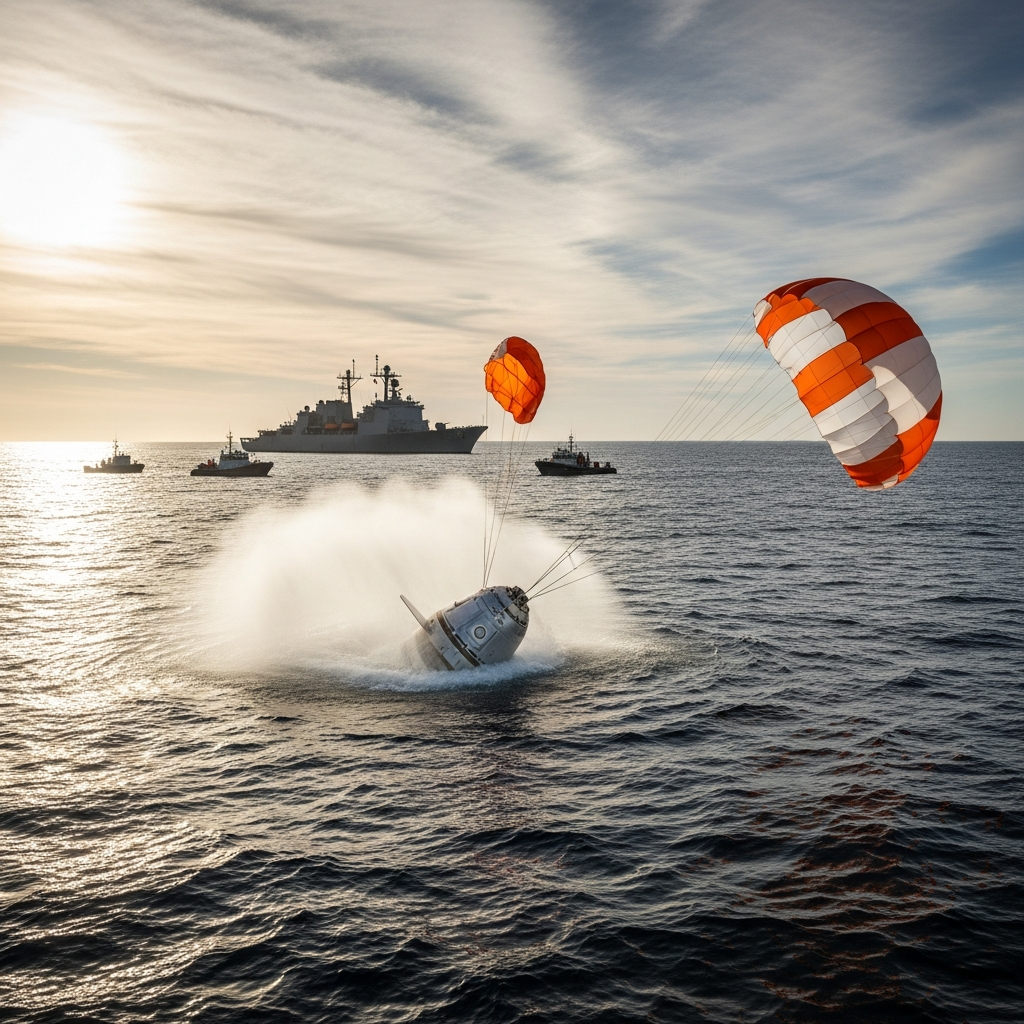
Emerging from the blackout, the final stages of descent rapidly unfolded. At an altitude of 22,000 feet, two drogue parachutes deployed, slowing Orion to about 200 mph (320 kph). Just moments later, at 6,000 feet, the three massive main parachutes unfurled, further reducing the capsule’s speed to a gentle 20 mph (32 kph).
At precisely 8:07 p.m. EDT (5:07 p.m. PDT), the Orion “Integrity” capsule achieved a flawless splashdown in the Pacific Ocean off the coast of San Diego, California. This moment marked the first direct ocean splashdown for astronauts returning from the Moon since Apollo 17 in 1972.
Swift Recovery: Bringing the Crew Home
Immediately following splashdown, a joint NASA and U.S. military recovery team sprang into action. Teams from the U.S. Navy ship USS John P. Murtha, aided by MH-60 Seahawk helicopters from Helicopter Sea Combat Squadron (HSC) 23, swiftly approached the capsule. Within two hours, the four astronauts were extracted, assisted onto an inflatable raft, and then transported by helicopter to the USS John P. Murtha for initial medical evaluations.
Their journey concluded with transport to NASA’s Johnson Space Center in Houston, Texas, where they would undergo comprehensive post-mission health checks and debriefings. This efficient recovery process underscored decades of refined procedures for astronaut retrieval.
A Historic Milestone: Beyond Apollo
The Artemis II mission was far more than a test flight; it was a profound historical moment. It represented the first crewed mission to venture beyond low Earth orbit since 1972, reigniting humanity’s direct exploration of the lunar vicinity. This mission validated the integrated performance of the Space Launch System (SLS) rocket and the Orion spacecraft in deep space, pushing the boundaries of human endurance and technological capability.
Lessons Learned from Deep Space Flight
Artemis II entry flight director Rick Henfling emphasized the invaluable “lessons learned” from the mission. “We learned a bunch on how to fly people in space, both from a vehicle operations, but also from how to run a control room with a deep space mission,” Henfling stated. These insights will be critical for refining future missions, ensuring greater safety and efficiency as NASA aims for sustained lunar presence. The crew’s direct interaction with the spacecraft systems provided crucial data for subsequent deep-space endeavors.
The Science of a Safe Splashdown
Why do spacecraft land in the water? The answer lies in the fundamental principles of physics and decades of engineering experience.
Decades of Expertise: Evolution to Orion
From the Mercury capsules of the early 1960s to today’s Orion and SpaceX Dragon capsules, water landings have proven to be the most reliable method for bringing astronauts home from space. Early researchers quickly discovered that landing on hard surfaces was catastrophic. The evolution of spacecraft design, particularly after incidents like the near-fatal 1961 Liberty Bell 7 splashdown involving Gus Grissom, has led to increasingly sophisticated and resilient capsules. Modern vehicles, including Orion, undergo rigorous “crashworthiness phenomena” testing to ensure crew survival.
The Heat Shield Challenge: Artemis I Insights
A critical element of any re-entry is the heat shield. During the uncrewed Artemis I mission, the heat shield experienced more wear than anticipated. This prompted extensive engineering investigations. For Artemis II, NASA implemented a modified, shorter “skip” trajectory during atmospheric re-entry to mitigate excessive wear and better protect the crew and spacecraft. This adaptation highlights NASA’s commitment to continuous learning and safety improvements.
Why Water? Superior Shock Absorption
Water is an ideal landing medium because of its unique properties. Its low viscosity allows it to deform quickly under stress, making it an excellent shock absorber. Compared to rigid land, water significantly cushions the impact, preventing structural damage to the capsule and injury to the crew. Additionally, covering over 70% of Earth’s surface, oceans provide vast, flexible landing zones, greatly increasing the probability of a successful landing location. The target splashdown velocity, around 20 mph (32 kph), is carefully calculated to allow the capsule to absorb the impact safely. Modern splashdowns, even those by private companies like SpaceX, continue to prove the efficiency and safety of this method, often allowing for capsule reuse.
Looking Ahead: The Artemis Program’s Future
With the successful return of Artemis II, NASA and its international partners are now fully focused on the ambitious next phases of the Artemis program. The ultimate goal is not just to visit the Moon, but to establish a long-term human presence there, paving the way for eventual missions to Mars.
Artemis III: Lunar Lander Testing and New Frontiers
The immediate next step is the Artemis III mission, currently targeting a 2027 launch. This mission will be historic, aiming to return humans to the lunar surface for the first time since 1972. Before that, Artemis III will involve critical testing of a human lunar lander from either SpaceX or Blue Origin (or potentially both) while in Earth’s orbit. These tests are vital to ensure the systems are robust and reliable enough for Moon landings. The “lessons learned” from Artemis II, particularly regarding deep space operations and control room management, will directly inform the preparation and execution of Artemis III.
Artemis IV & Beyond: Toward a Sustainable Lunar Presence
Looking further ahead, NASA is planning the Artemis IV mission for early 2028. This mission is envisioned to support the establishment of the Gateway lunar orbiting outpost and deliver additional capabilities for sustained lunar surface operations. The long-term vision of the Artemis program includes building a permanent lunar base by 2032, leveraging the Moon as a proving ground for technologies and strategies necessary for future human missions to Mars. The success of Artemis II lays a solid foundation for these monumental endeavors, validating Orion’s safety and deep-space capabilities.
Frequently Asked Questions
What was the primary goal of the Artemis II mission?
The primary goal of the Artemis II mission was to conduct the first crewed flight test of NASA’s Orion spacecraft and Space Launch System (SLS) rocket in deep space. It sent four astronauts on a 10-day journey around the Moon, validating the spacecraft’s systems, life support, and crew operations beyond low Earth orbit. This mission was a critical precursor to future human lunar landings, proving the capabilities required for longer-duration spaceflight and re-entry from lunar distances.
Where did the Artemis II crew splash down and how were they recovered?
The Artemis II crew splashed down in the Pacific Ocean off the coast of San Diego, California, at 8:07 p.m. EDT (5:07 p.m. PDT) on April 10. A joint NASA and U.S. military recovery team, primarily from the U.S. Navy ship USS John P. Murtha, was on standby. After splashdown, rescue helicopters extracted the astronauts from the Orion capsule, transferred them to an inflatable raft, and then flew them to the USS John P. Murtha for initial medical checks before their final transport to NASA’s Johnson Space Center in Houston.
What are the next major milestones for NASA’s Artemis program?
Following the successful Artemis II mission, the next major milestone is Artemis III, targeted for a 2027 launch, which aims to land humans on the lunar surface for the first time since 1972. This mission will also involve testing a human lunar lander in Earth’s orbit. Beyond that, Artemis IV, planned for early 2028, will further expand lunar capabilities and support the Gateway lunar orbiting outpost, progressing toward NASA’s long-term goal of establishing a sustainable human presence on the Moon by 2032.
Conclusion: Paving the Way for Humanity’s Lunar Future
The successful splashdown of the Artemis II crew is a resounding testament to human ingenuity and perseverance. It not only brought four brave astronauts home safely after a historic lunar flyby but also provided indispensable data and insights that will shape the future of deep space exploration. With Artemis II validated, the stage is now set for Artemis III to return humans to the lunar surface, continuing humanity’s journey back to the Moon and onward to Mars. The future of space exploration is bright, built upon the triumphs and lessons of missions like Artemis II. Stay tuned as NASA prepares for the next giant leaps for mankind.