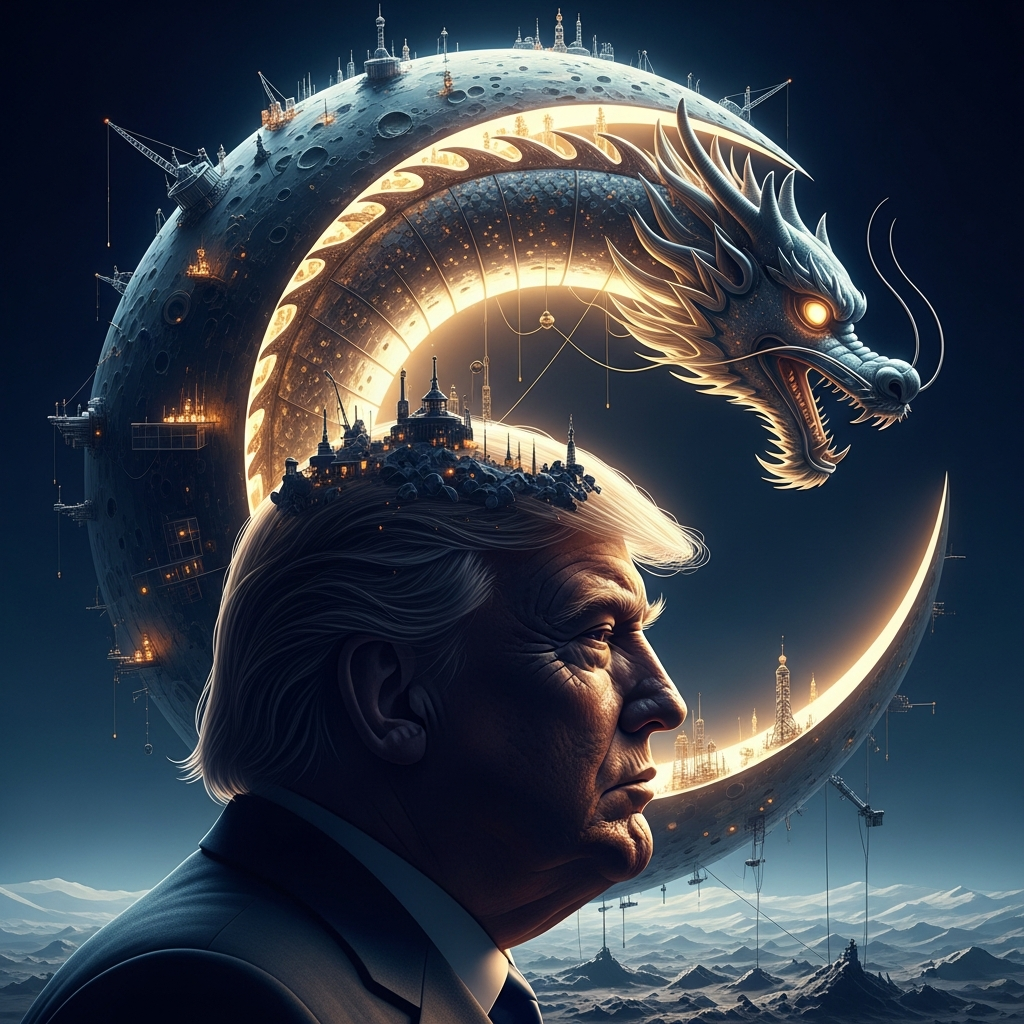
America’s renewed push for lunar exploration, championed by President Donald Trump, is rapidly redefining global space policy. With the Artemis II mission recently completing its historic lunar flyby in April 2026, the rhetoric surrounding the moon race has shifted dramatically from pure discovery to assertive geopolitical dominance, especially concerning China. This high-stakes US-China space race is driven by ambitions for strategic control, valuable lunar resources, and national prestige, even as funding for other critical scientific initiatives faces unprecedented cuts.
A New Era of Lunar Ambition
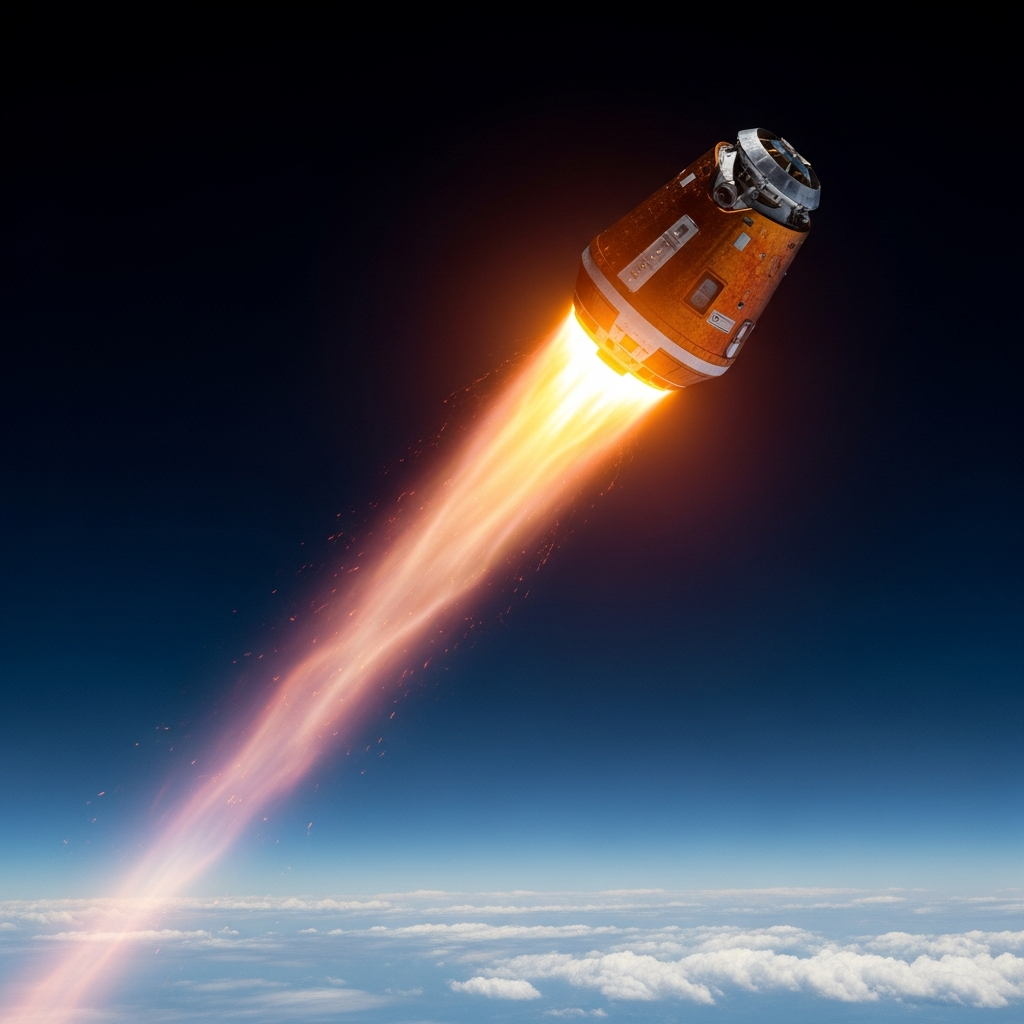
On April 9, 2026, the Artemis II crew splashed down after their historic 10-day lunar flyby. President Trump quickly celebrated this achievement as a significant patriotic triumph. “America is going back to the Moon,” he declared on Truth Social on April 1. “America doesn’t just compete, we DOMINATE, and the whole world is watching.” Speaking with the astronauts, Trump reiterated that the mission made the U.S. “the hottest country in the world,” asserting future American leadership “in space and everything else.”
This nationalistic fervor, however, extends beyond scientific success. It clearly signals the President’s vision for U.S. space dominance, with a specific focus on the Moon. The administration’s 2027 budget proposal underlines these priorities, allocating $8.5 billion to the Artemis program. This funding aims to land Americans on the Moon by 2028. Notably, this sum mirrors proposed cuts to K-12 educational programs, sparking debate over the administration’s priorities.
The Lunar Base Camp Strategy
The budget plan details significant investment, calling for hundreds of millions of dollars to establish a “lunar base camp” near the Moon’s south pole. This endeavor is not solely for scientific research. The budget explicitly states its purpose: to “establish U.S. dominance on the Moon” and facilitate “more intensive use of lunar resources by NASA and U.S. companies.” This indicates a strategic shift towards commercial and geopolitical exploitation of the Moon.
A comprehensive three-phase, $30-billion strategy outlines the path to this lunar dominance between 2026 and 2036. Initially, the U.S. will identify suitable landing sites and rigorously test various technologies on the lunar surface. This includes advanced vehicles, drones, and small nuclear reactors. The subsequent phases involve building critical infrastructure for a moon base and conducting semi-regular manned missions. Ultimately, a permanent settlement will serve as a forward operating base for deeper space expeditions. Such a successful plan could solidify America’s image as a leading space power and unlock vast mining access to valuable lunar minerals and elements.
Navigating International Space Law
The concept of “dominance” in space raises crucial questions about international law. Andrea Harrington, co-director of McGill University’s Institute of Air and Space Law, notes that establishing a permanent moon presence is not inherently unlawful. She suggests that “dominance” might be mere rhetoric. However, the interpretation and execution of this ambition are critical.
Harrington warns that if “dominance” translates to excluding other nations, it would explicitly violate the 1967 Outer Space Treaty. This cornerstone document, signed by President Lyndon Johnson, mandates that all nations explore and use the Moon “exclusively for peaceful purposes.” It also expressly bans any claims of sovereignty over celestial bodies and prohibits nuclear weapons or weapons of mass destruction on the Moon or in Earth’s orbit. For nearly six decades, these principles have guided international space cooperation. Yet, Harrington points to gray areas regarding non-WMDs. She speculates that major powers might argue for the legality of keeping certain conventional weapons on the Moon. This, she cautions, could significantly heighten international tensions and lead to dangerous escalation.
The Intensifying US-China Space Race
These geopolitical tensions are already palpable, fueling a new US-China space race. China has rapidly advanced its space capabilities, demonstrating remarkable progress. It became the third country to land a rover on Mars and operates the Tiangong space station, a direct competitor to the International Space Station, which NASA plans to decommission by 2030. In 2018, China launched its Yutu-2 rover, which achieved the unprecedented feat of reaching the Moon’s far side, becoming the longest-lived lunar rover.
China’s ambitions also encompass military defense. Since testing an anti-satellite weapon in 2007, Beijing has invested heavily in anti-satellite missile systems and orbital defense capabilities. These are designed to deter attacks and enhance space surveillance. A 2025 Air Force report from the China Aerospace Studies Institute cautioned that offensive use of these technologies “could threaten U.S. military superiority.” Senator Ted Cruz, R-Texas, underscored the urgency in September 2025, stating, “We are in a new space race with China. And if we fail, there will be a bad moon on the rise.”
In response to this growing competition, President Trump issued an executive order in December 2025, titled “Ensuring American Space Superiority.” This directive called for “creating a responsive and adaptive national security space architecture” through strengthened allied cooperation and private sector investment. Steven Mirmina, a former senior attorney at NASA, highlights China’s structural advantage. Its one-party system allows for consistent, long-term space goals, unlike the U.S. democratic process, where political shifts can alter budgets and priorities every four years.
The High Stakes of Lunar Resources
Beyond geopolitical prestige, the new Moon race carries vast economic implications. Former NASA administrator Sean O’Keefe has pointed to the Moon’s valuable resources. These include significant amounts of Helium-3, a rare isotope that could fuel efficient nuclear fusion reactors and trades at over $20,000 per gram. The Moon also holds water ice, crucial for rocket propulsion and astronaut sustenance, alongside rare earth minerals like lithium and platinum, vital for modern electronics and clean energy. China currently dominates the global market for many of these critical minerals on Earth, making lunar resources a key strategic concern for the U.S. administration. Clayton Swope, a former CIA adviser, likened this potential “lunar gold rush” to the Lewis and Clark expedition, where the full value of new territories was anticipated but not yet quantified.
Chad F. Wolf argues that a durable, scalable, and defensible presence on the Moon is paramount. He criticizes the current U.S. Space Launch System (SLS), citing its 1980s origins, a $4.2 billion per launch cost, and $64 billion already spent for limited operational flights. In contrast, Chinese firms are rapidly developing fully reusable heavy-lift rockets, mimicking SpaceX’s Starship architecture. Wolf warns that if China controls the “ultimate high ground” on the Moon, it could establish a “moon-based counter-command” capable of disrupting U.S. space systems and controlling vital resources.
Budget Cuts and Future Challenges
Despite the administration’s strong focus on the Artemis program, its 2027 budget proposes significant cuts across other scientific initiatives. Over $3 billion would be slashed from “wasteful” projects, including an unmanned Mars sample mission and climate change research. Space technology projects, including those focused on “in-space sustainability goals,” face nearly $300 million in reductions. Additionally, STEM engagement initiatives for students, labeled “woke” and “misguided,” would lose $143 million. Overall, NASA’s budget is projected to decrease by $5.6 billion in 2027.
NASA administrator Jason Isaacman defended these cuts, emphasizing that the agency’s budget remains larger than all other space agencies worldwide combined. However, Steven Mirmina views these reductions as “short-sighted.” He questions how the U.S. can develop essential space technology or inspire future STEM professionals with such decreased funding. These cuts, he argues, could severely undermine America’s ability to win the new space race and retain highly skilled personnel. The drive for “dominance” risks compromising the foundational elements — innovation, scientific inquiry, and talent development — essential for long-term leadership in space.
Broader Implications for National Unity
Amid deep national divisions, the Artemis mission is also seen as a powerful opportunity for national unity. Donald Trump’s generation vividly remembers the 1969 Apollo 11 Moon landing, an event that provided a rare moment of collective national pride during a tumultuous era. Experts like Esther Brimmer of the Council on Foreign Relations suggest the Artemis mission could replicate this unifying effect. Astrophysicist David Gerdes expressed hope that a more diverse group of American astronauts returning to the Moon could “really help bring the country together,” transcending partisan divides. The White House affirms its “America-First policies” aim to lead humanity into a new era of groundbreaking space achievements. However, the underlying tensions between geopolitical aims, scientific advancement, and budget realities continue to shape this critical chapter in space exploration.
Frequently Asked Questions
What are the primary motivations behind the current US push to return to the Moon?
The U.S. drive to return to the Moon is fueled by a complex mix of motivations. While scientific discovery remains a stated goal, the Trump administration explicitly frames it as a quest for geopolitical dominance over China. This “US-China space race” aims to solidify American leadership in space, secure access to valuable lunar resources like Helium-3 and rare earth minerals, and enhance national prestige. These strategic objectives are seen as critical for national security and economic prosperity in the 21st century.
How does the Outer Space Treaty impact claims of lunar dominance or resource use?
The 1967 Outer Space Treaty is the foundational document governing international space law. It mandates that all nations use the Moon “exclusively for peaceful purposes” and prohibits claims of national sovereignty over celestial bodies. While establishing a permanent presence is not inherently unlawful, the treaty’s interpretation of “dominance” is crucial. If U.S. actions lead to the exclusion of other nations from lunar activities or resources, it could violate the treaty. The treaty also has “gray areas” regarding the legality of non-WMDs, which could become a source of future international tension.
What are the potential long-term consequences of budget cuts to NASA’s broader scientific and educational programs?
Despite prioritizing the Artemis program, the administration’s budget proposals include significant cuts to other NASA scientific and educational initiatives, totaling $5.6 billion in 2027. These cuts impact climate change research, Mars sample missions, space technology development, and STEM engagement programs for students. Experts like Steven Mirmina warn these are “short-sighted.” They could hinder the development of crucial future space technologies, reduce America’s ability to inspire and train the next generation of scientists and engineers, and ultimately undermine the long-term sustainability and competitiveness of the U.S. space program.