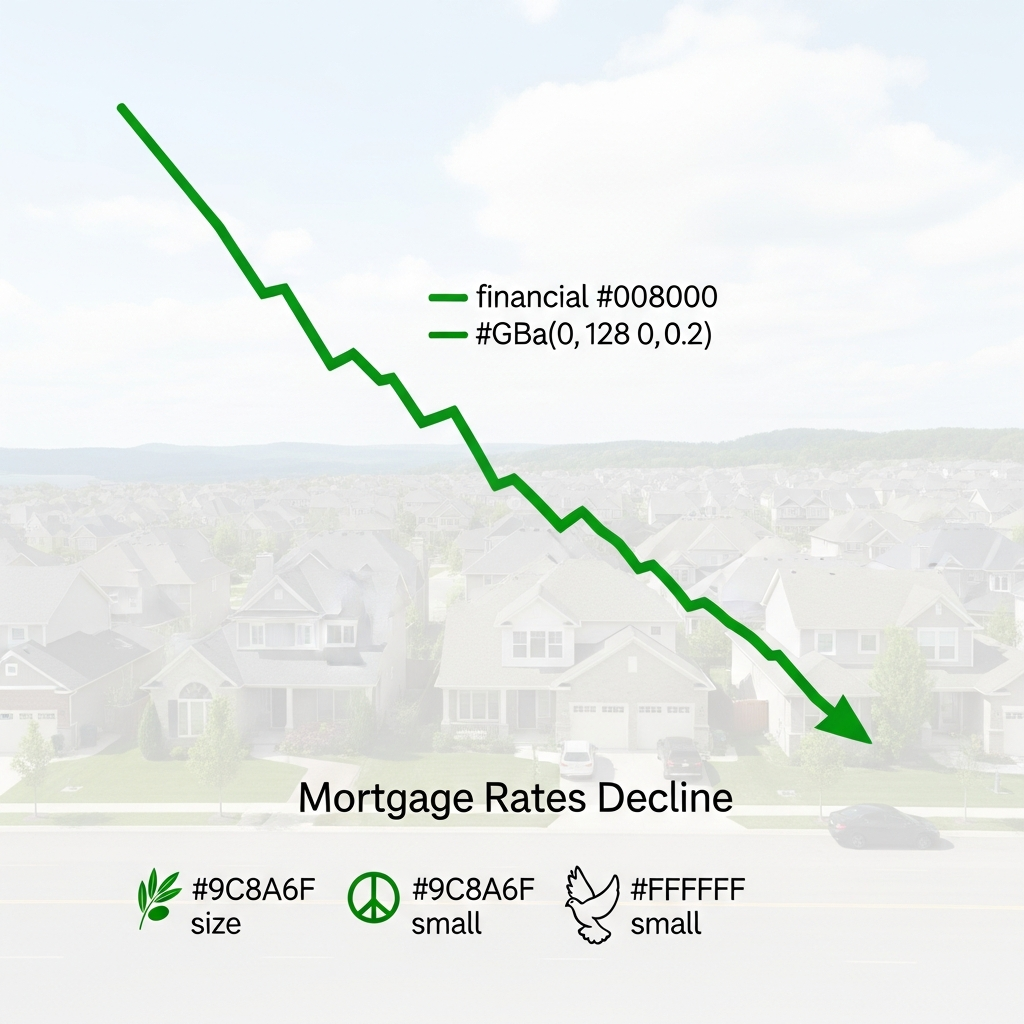
In a significant turn for the housing market, mortgage interest rates have seen their first notable decline in over a month, offering a glimmer of hope for prospective homebuyers and those considering refinancing. This unexpected dip, particularly in 30-year and 15-year fixed mortgage rates, comes directly on the heels of a two-week ceasefire announcement between the U.S. and Iran. While the news provides some immediate relief, experts offer a mixed outlook, urging caution as geopolitical uncertainties continue to shape the financial landscape. Discover what this shift means for today’s rates and your homeownership goals.
Current Mortgage Rates See First Dip in Weeks
Mortgage rates experienced a welcome decrease this week, with the average rate on a benchmark 30-year fixed mortgage falling to 6.37%. This figure, reported by Freddie Mac’s latest Primary Mortgage Market Survey on Thursday, April 9, 2026, marks a notable reduction from 6.46% just last week. It’s even lower than the 6.62% average observed a year ago. Similarly, the average rate for a 15-year fixed mortgage also ticked down, reaching 5.74% from 5.77% the previous week.
This positive movement is primarily attributed to a recently brokered two-week ceasefire between the U.S. and Iran. The White House framed this agreement as an initial step toward broader negotiations. Consequently, U.S. strikes on Iran halted following the announcement by President Donald Trump. This geopolitical shift swiftly impacted financial markets, bringing temporary relief to the cost of borrowing for homes.
The Ceasefire’s Immediate Market Impact
Mortgage rates are closely tied to a combination of factors, including global events. The easing of tensions in the Middle East led to a dip in the 10-year Treasury yield, which mortgage rates closely track. As of Thursday afternoon, the 10-year yield hovered around 4.26%. This immediate reaction in the Treasury market directly contributed to the decline in mortgage rates. Sam Khater, Freddie Mac’s chief economist, welcomed the rate decrease, suggesting it “represents a positive development for prospective homebuyers.” He believes it “could spark a more favorable spring homebuying season than last year.”
However, the impact isn’t just on new loans. According to the Mortgage Bankers Association (MBA), mortgage applications had fallen by 0.8% from the prior week. This decline reflected elevated mortgage rates and ongoing economic uncertainty, with many potential refinance borrowers feeling “frozen out” by recent rate increases. The ceasefire, however, caused the 10-year Treasury to fall by nearly 10 basis points, signaling potential for further rate drops if the situation holds.
Today’s Average Mortgage & Refinance Interest Rates
Understanding current rates is crucial for both buyers and homeowners. Here are national average mortgage rates, as of early April 2026, according to Zillow data:
For Purchase:
30-year fixed: 6.10%
20-year fixed: 6.11%
15-year fixed: 5.62%
5/1 ARM: 6.17%
7/1 ARM: 6.29%
30-year VA: 5.79%
15-year VA: 5.42%
5/1 VA: 5.59%
For Refinance:
30-year fixed: 6.21%
20-year fixed: 5.97%
15-year fixed: 5.66%
5/1 ARM: 6.07%
7/1 ARM: 5.87%
30-year VA: 5.62%
15-year VA: 5.38%
5/1 VA: 5.42%
It’s worth noting that refinance rates are often, though not always, slightly higher than purchase rates.
Exploring Loan Types: Fixed vs. Adjustable Rates
When securing a mortgage, you’ll generally encounter two primary types:
Fixed-rate mortgage: The interest rate remains constant for the entire loan term, providing predictable monthly payments. For example, a 6% rate will stay the same for all 30 years. These loans offer stability against market fluctuations.
Adjustable-rate mortgage (ARM): These loans feature an initial fixed interest rate period (e.g., 5 years for a 5/1 ARM). After this initial period, the rate adjusts periodically based on market factors. While ARMs can offer lower initial rates, the variability introduces potential for higher payments later.
Comparing common terms, a 30-year fixed mortgage typically offers lower monthly payments due to the extended repayment period. However, you’ll generally pay more interest over the life of the loan. In contrast, a 15-year fixed mortgage usually comes with a lower interest rate overall, resulting in significantly less interest paid and a quicker payoff. The trade-off is higher monthly payments. Essentially, 30-year loans are more affordable month-to-month, while 15-year loans are cheaper in the long run.
Expert Outlook: A Temporary Reprieve or Lasting Trend?
While the recent dip is positive, many experts approach the situation with caution. Jiayi Xu, an economist at Realtor.com, suggests that “any relief to mortgage rates may prove short-lived – a temporary pause rather than a true turning point.” She emphasizes that “until a more permanent resolution emerges, the fog of uncertainty is unlikely to fully lift from the housing market.” The consensus among several economists is that the ceasefire is “tenuous at best,” with reports of continued strikes and threats from Iran to close the Strait of Hormuz.
Lisa Sturtevant, Chief Economist at Bright MLS, called it “premature to call this a pivot point for the spring housing season.” She anticipates “continued turbulence” due to persistent market skepticism regarding a permanent resolution for the Strait of Hormuz. Sturtevant further warned that with “energy and shipping costs keeping inflation figures ‘sticky,’ a substantial drop in rates appears unlikely for the foreseeable future.” Kara Ng, a Zillow senior economist, also cautioned that this “slight reprieve” might be short-lived, as Treasury yields and oil prices began to tick up again by midday Thursday due to renewed doubts about the agreement’s stability.
Despite these warnings, some aspiring homeowners appear to be adapting. Zillow’s March figures indicated one of the busiest months for newly pending home sales since late 2022. This suggests demand might be sustained by buyers acting on “finite timeline of rate locks secured when rates were near 6%.”
Broader Economic & Global Impacts
The ceasefire’s initial effect on markets stemmed from the potential easing of oil prices. Brent crude oil, which had peaked at $115.85 a barrel in late March, fell to around $90 a barrel on the day of reporting. This potential for lower oil prices could alleviate inflationary pressures, possibly enabling the Federal Reserve to consider easing interest rates sooner than previously expected. CME FedWatch, for instance, increased the chances of a rate cut occurring in 2026.
Beyond the U.S., global markets also felt the ripple effect. In the UK, for example, house prices fell by 0.5% in March, primarily driven by an increase in mortgage rates linked to the Iran conflict. Rising inflation expectations due to energy costs diminished confidence in the Bank of England implementing rate cuts. This highlights how interconnected global events are with local housing markets.
What Factors Influence Your Mortgage Rate?
Mortgage rates are determined by a blend of controllable and uncontrollable factors:
Controllable Factors (You can influence these):
Credit Score: A higher credit score signals lower risk to lenders, often resulting in better rates.
Debt-to-Income (DTI) Ratio: A lower DTI indicates you can manage more debt, making you a more attractive borrower.
Down Payment Size: A larger down payment can reduce the loan amount and sometimes secure a lower interest rate.
Lender Comparison: Shopping around with various lenders, including banks, credit unions, and mortgage companies, is crucial. Rates can vary significantly.
Uncontrollable Factors (Beyond your direct influence):
Broader Economy: A struggling economy (e.g., high unemployment) often pushes mortgage rates down to stimulate borrowing. A strong economy typically leads to higher rates to temper spending.
Federal Reserve Policies: While not directly setting mortgage rates, the Fed’s actions (like adjustments to the federal funds rate) influence the overall economic environment and, consequently, bond markets and mortgage rates.
Geopolitical Events: As demonstrated by the Iran ceasefire, global conflicts or resolutions can quickly impact market stability, oil prices, and Treasury yields, directly affecting mortgage rates.
Exploring Alternative Loan Options: VA & FHA Loans
For eligible borrowers, specific loan programs can offer more favorable terms, even in a volatile market.
VA Loans: Offered to service members, veterans, and eligible surviving spouses, VA loans are a powerful option. They often come with lower interest rates compared to conventional loans and, notably, do not require a down payment. This can significantly reduce the upfront cost of homeownership.
- FHA Loans: Backed by the Federal Housing Administration, FHA loans are designed to make homeownership more accessible, especially for first-time buyers or those with lower credit scores. FHA mortgage rates are often approximately 30 basis points lower than conventional rates. They typically require a smaller down payment (as low as 3.5%).
- www.foxbusiness.com
- finance.yahoo.com
- www.mpamag.com
- asreport.americanbanker.com
- www.bbc.com
These options highlight the importance of exploring all available loan types to find the best fit for your financial situation.
Is Now the Time to Refinance?
With rates seeing a dip, many homeowners might wonder if refinancing is a smart move. Experts generally suggest that refinancing can be worthwhile if you can secure a rate 1% to 2% lower than your current mortgage. This decision, however, depends on individual financial goals, how long you plan to stay in your home, and the “break-even point” after covering closing costs. Even with today’s temporary relief, current rates remain significantly higher than the historic lows seen in 2020-2021 (the lowest 30-year fixed rate was 2.65% in January 2021). A return to rates below 3% is considered “extremely unlikely anytime soon.” For those with VA loans, refinancing into a new VA loan can still be an attractive option due to their inherently lower rates.
Frequently Asked Questions
What triggered the recent drop in mortgage rates in April 2026?
The primary driver for the recent decline in mortgage rates was the announcement of a two-week ceasefire between the U.S. and Iran. This geopolitical development immediately eased concerns about rising oil prices and inflation, causing the 10-year Treasury yield—which mortgage rates closely track—to dip. For instance, the 30-year fixed mortgage rate fell to 6.37% from 6.46% the prior week, directly reflecting this market reaction.
Should I consider refinancing my mortgage now, given the current rates?
Considering a refinance depends on your individual financial situation and goals. While mortgage rates saw a recent dip, experts advise caution, noting the relief might be short-lived due to ongoing geopolitical uncertainty. Generally, refinancing can be beneficial if you can secure a new rate that is 1% to 2% lower than your current mortgage. It’s crucial to calculate your break-even point, considering closing costs, and assess how long you plan to stay in your home.
How do factors like my credit score and economic conditions impact my mortgage rate?
Both personal financial factors and broader economic conditions significantly influence the mortgage rate you receive. Your credit score, debt-to-income ratio, and down payment size are controllable factors; a stronger financial profile typically qualifies you for lower rates. Uncontrollable factors include the overall health of the economy, Federal Reserve policies, and geopolitical events, as demonstrated by the Iran ceasefire’s impact on Treasury yields and inflation expectations.
The Path Forward: Monitor and Plan
The recent fall in mortgage rates, spurred by the Iran ceasefire, offers a moment of relief in an otherwise turbulent housing market. While experts are optimistic about a potentially more favorable spring homebuying season, a strong undercurrent of caution persists regarding the long-term stability of this trend. Geopolitical tensions, sticky inflation, and the “tenuous” nature of the ceasefire suggest that volatility may continue. For prospective homebuyers and those considering refinancing, the key takeaway is to remain informed, closely monitor global events, and consult with multiple lenders to secure the best possible rates for your unique financial circumstances. Don’t rely solely on policy announcements; seek policy stability.