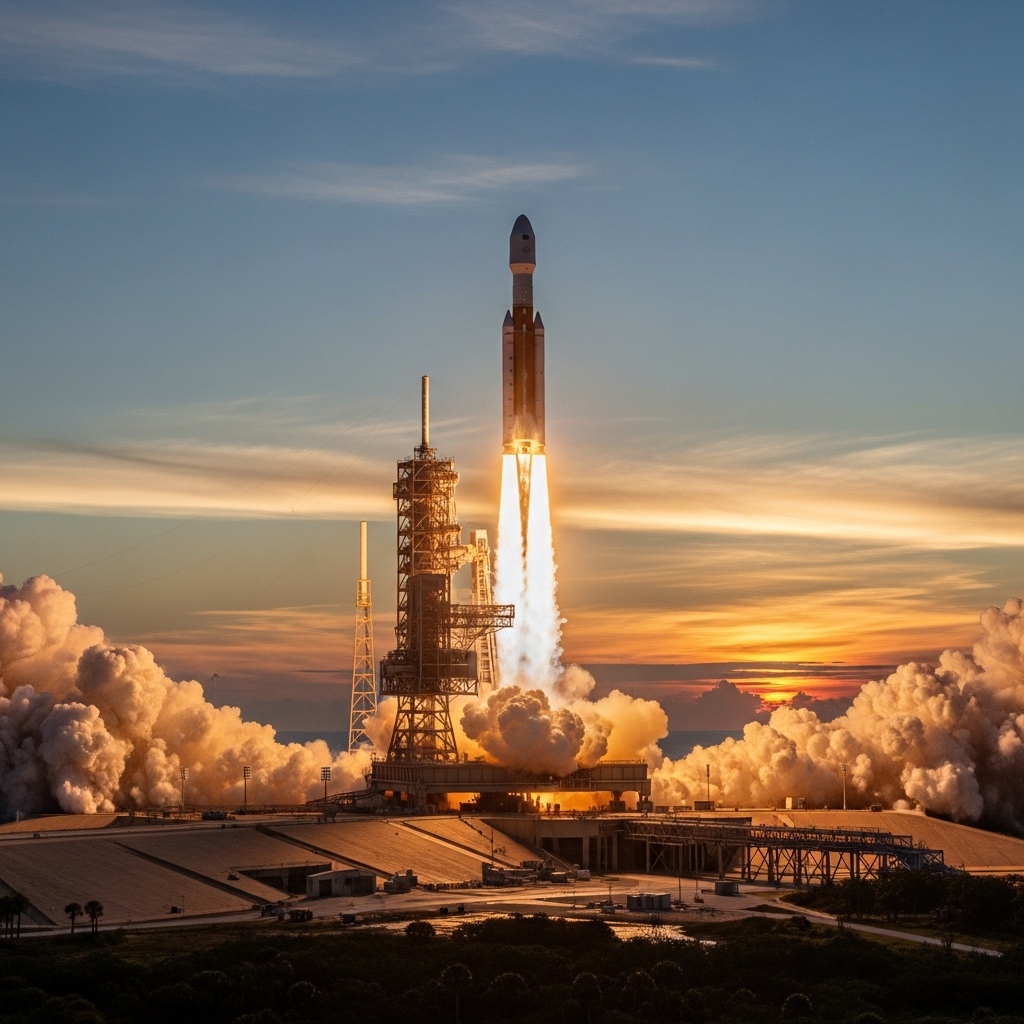
Humanity stands on the precipice of a new era in space exploration as NASA’s Artemis II mission gears up for an epic lunar journey. This historic spaceflight will ferry a four-person crew around the far side of the moon, marking the first time humans have ventured this far from Earth since the Apollo era over fifty years ago. Scheduled for a momentous launch on Wednesday, April 1, 2026, from Florida’s Kennedy Space Center, Artemis II is not just a mission; it’s a critical testbed for technologies that will ultimately pave the way for a sustainable human presence on the moon and future expeditions to Mars. Get ready to witness a landmark achievement that will redefine our relationship with the cosmos.
A New Chapter in Lunar Exploration
The countdown is ticking for Artemis II, a mission poised to send humans farther from our home planet than any previous endeavor since Apollo 17 in 1972. This roughly 10-day expedition is designed to usher in what NASA calls “the age of Artemis,” laying vital groundwork for deep space travel. It serves as the second phase of NASA’s ambitious multi-decade Artemis program, building upon the uncrewed success of Artemis I in November 2022. The program envisions not just returning humans to the moon, but establishing a lasting lunar presence and eventually facilitating Martian voyages.
The Historic Launch Window
The launch window for Artemis II is slated to open Wednesday evening at 6:24 p.m. ET, with a two-hour flexibility built in for any last-minute adjustments. Weather forecasts are highly favorable, indicating an impressive 80% chance of clear skies. This provides an excellent opportunity for residents across Florida and South Georgia to witness the magnificent spectacle of liftoff.
However, the path to launch has seen its share of challenges. The mission experienced a liquid hydrogen leak during a February fueling practice run, which caused an initial delay. A subsequent helium-flow issue pushed the mission further into April. Most recently, the Eastern Range identified a communication problem with the flight termination system (FTS), a crucial safety mechanism. Engineers have diligently worked on a solution to verify its readiness, as proper FTS functionality is non-negotiable for public safety.
Meet the Trailblazing Artemis II Crew
This mission is notable for its diverse and experienced crew, representing a significant step forward in inclusive space exploration. For the first time, a woman, a person of color, and a non-American astronaut will journey to the moon.
Christina Koch: Record-Breaking Engineer
Christina Koch, a 47-year-old engineer, will be the first woman to travel on a lunar mission. She holds the record for the longest single spaceflight by a woman, spending an astounding 328 days in space from 2019-2020. Koch also participated in the world’s first all-female spacewalk, demonstrating her pioneering spirit.
Victor Glover: Pioneering Pilot
Victor Glover, 49, a U.S. Navy aviator and test pilot, will be the first Black astronaut assigned to a lunar mission. He made history as the first Black astronaut to live and work aboard the International Space Station (ISS) in 2020-2021. Glover was also among the first astronauts to launch with SpaceX, highlighting his experience with commercial spaceflight.
Jeremy Hansen: Canada’s Lunar Voyager
Jeremy Hansen, 50, from the Canadian Space Agency, brings his background as a former fighter pilot to the mission. As the sole space rookie on the crew, he will become the first non-American to travel to the moon, underscoring the international collaborative nature of the Artemis program.
Reid Wiseman: Mission Commander
Commander Reid Wiseman, 50, a retired Navy captain, leads this historic mission. He previously lived aboard the ISS in 2014 and later served as the head of NASA’s astronaut corps. His extensive leadership and spaceflight experience are invaluable for such a monumental undertaking.
The Mighty Space Launch System (SLS)
Artemis II will be propelled by NASA’s powerful new Space Launch System (SLS) rocket. Standing at an impressive 322 feet (98 meters) tall, the SLS is a marvel of modern engineering. While slightly shorter than the iconic Saturn V rocket used during the Apollo program, the SLS boasts even greater power at liftoff, thanks to its pair of strap-on boosters. The rocket incorporates salvaged space shuttle engines and other components, running on liquid hydrogen fuel—a challenging but potent propellant.
Orion: The Astronauts’ Home in Space
Perched atop the SLS is the Orion capsule, which will serve as the crew’s home for their 10-day journey. Orion is designed to carry astronauts safely through deep space and back to Earth. The capsule’s systems and life-support capabilities will undergo comprehensive testing in this crewed environment, ensuring future missions are even safer and more efficient.
Overcoming Technical Hurdles
The use of liquid hydrogen fuel, while powerful, has presented challenges in the past, including hydrogen leaks that frequently grounded space shuttles. The uncrewed SLS test flight in 2022 also encountered hydrogen leak issues. These experiences have led to rigorous checks and repairs, readying Artemis II for its mission. NASA engineers are committed to ensuring every system is optimal before launch.
Artemis II Mission Profile: Beyond the Moon
The mission profile involves a multi-stage, record-setting journey designed to rigorously test the Orion spacecraft and its crew.
Earth Orbit & Docking Practice
Approximately 24 hours after liftoff, the spacecraft will achieve a stable, high Earth orbit. During this initial phase, the astronauts will spend about 25 hours circling Earth in a high, lopsided orbit. They will use the separated upper stage of the SLS rocket as a target for crucial docking practice. Steering their Orion capsule around it, they will rely on their eyes to judge the distance, venturing no closer than 33 feet (10 meters). Commander Wiseman emphasizes the effectiveness of these “simple” yet vital manual maneuvers.
The Lunar Slingshot & Far Side Pass
Following Earth orbit, Orion will execute a precise propulsion system burn. This maneuver will propel the crew 244,000 miles (393,000 kilometers) towards the moon, leveraging a fuel-efficient free-return trajectory similar to the technique famously employed during Apollo 13. As the spacecraft travels behind the moon, it will temporarily lose contact with Earth, resulting in a brief communications blackout. During this unique phase, astronauts will gain a perspective “that no human eye has ever seen before,” observing previously unseen regions of the lunar far side.
Breaking Records: Farthest Human Travel
On flight day six, the Orion capsule will reach its farthest point from Earth, sailing an astonishing 5,000 miles (8,000 kilometers) beyond the moon. This will officially surpass Apollo 13’s distance record, making the Artemis II astronauts the most remote human travelers in history. This monumental achievement will validate critical technologies and procedures for NASA’s ambitious plans.
Scientific Objectives & Lunar Insights
While Artemis II will not land on the lunar surface, its scientific objectives are crucial. The crew will test Orion’s life support, navigation, and communication systems in the harsh deep space environment. They will also monitor their responses to radiation and conduct medical and scientific experiments, including a suit pressurization test.
During the roughly six-hour lunar flyby, the crew anticipates a “photo frenzy.” They have prepared extensively by studying maps and satellite images of the lunar far side, which will appear the size of a basketball at arm’s length. NASA geologist Kelsey Young, their lunar mentor, will monitor the flyby from Mission Control. The observations of the lunar far side are particularly valuable, as only China has successfully landed on this side, with NASA and private companies primarily focusing on the near side. The astronauts will use both professional cameras and the latest smartphones to capture “inspiring” pictures, hoping to unify global interest in lunar exploration.
The Return Journey: Pacific Splashdown
After its lunar pass, the spacecraft will perform a “lunar slingshot” maneuver, expertly harnessing the moon’s gravitational pull to accelerate its return trajectory directly back to Earth. The mission will conclude with the Orion capsule’s splashdown in the Pacific Ocean on flight day 10, approximately nine days, one hour, and 46 minutes after liftoff. This return strategy mirrors the Apollo missions.
Heat Shield Scrutiny
A key focus for the return will be Orion’s heat shield. During the uncrewed 2022 test flight, the heat shield sustained significant charring and gouging. While the heat shield is being retooled for future capsules, Artemis II will utilize the original design. To mitigate heat exposure during reentry, NASA is strategically shortening the capsule’s atmospheric descent profile. Navy recovery ships, including helicopters and medical Marine units, will be stationed off the coast of San Diego to retrieve the Orion capsule after it parachutes into the ocean. Local military units from Naval Base North Island and Camp Pendleton will play a crucial role in this recovery effort.
The Broader Vision: Artemis Program’s Future
Artemis II is a pivotal stepping stone in NASA’s comprehensive Artemis program, named after Apollo’s twin sister in Greek mythology. This program builds upon Apollo’s legacy, embracing modern innovation, international partnerships, and collaborations with private companies like SpaceX and Blue Origin.
From Artemis I to Future Lunar Bases
Artemis I (November 2022): An uncrewed test flight that successfully orbited Earth and collected vital data, proving the SLS rocket and Orion spacecraft systems.
Artemis III (2027): A crewed low Earth orbit mission designed to test integrated operations between the Orion capsule and commercial lunar landers.
Artemis IV (early 2028): Aimed at achieving the first crewed lunar landing since Apollo 17. This mission will target the moon’s south pole, a region believed to harbor water ice—a crucial resource for future outposts.
Artemis V (late 2028): Will conduct a second crewed lunar landing and initiate the construction of a lunar base, laying the groundwork for humanity’s sustained presence beyond Earth.
The Artemis program represents a bold commitment to extending humanity’s reach into deep space.
Global Impact & Community Engagement
The Artemis II mission extends beyond scientific and technological achievements; it serves as a powerful symbol of global unity and human aspiration. NASA geologist Kelsey Young highlights how “the moon is like such a unifying thing,” and this mission will bring that sense of connection closer to people worldwide. The local involvement of San Diego military units in recovery efforts, coupled with public watch parties hosted by institutions like the San Diego Air & Space Museum, fosters a strong sense of community pride and engagement. This mission symbolizes not just a return to the moon, but a significant leap towards a future where humanity can thrive in the cosmos.
Frequently Asked Questions
What are the primary objectives of the Artemis II mission?
The main goals of Artemis II are to thoroughly test the Orion spacecraft’s systems and life-support capabilities with a human crew, assess the astronauts’ ability to maneuver the vehicle, and conduct essential rendezvous and docking demonstrations in deep space. These objectives are critical preparatory steps for subsequent lunar landings and the broader Artemis program’s aim to establish a sustainable human presence on and around the moon.
Who are the astronauts on the Artemis II crew?
The Artemis II mission will carry four highly accomplished astronauts: Commander Reid Wiseman (USA), Pilot Victor Glover (USA), Mission Specialist Christina Koch (USA), and Mission Specialist Jeremy Hansen (Canada). This diverse crew includes the first woman, person of color, and non-American astronaut to venture to the moon, reflecting a significant milestone in inclusive space exploration.
How does Artemis II pave the way for future lunar and Mars missions?
Artemis II is a crucial stepping stone by validating the Orion spacecraft and SLS rocket with a human crew in deep space, beyond low Earth orbit. By testing life support, navigation, and communication systems, and having astronauts practice maneuvers around the moon, it provides vital data and experience. This mission directly informs and de-risks future endeavors, including the Artemis III lunar landing, the construction of lunar bases, and ultimately, human expeditions to Mars as part of NASA’s long-term vision for deep space exploration.
The Next Giant Leap Awaits
As Artemis II prepares for its historic launch, it symbolizes humanity’s enduring quest for exploration and discovery. This mission is a testament to perseverance, international collaboration, and cutting-edge technology. It’s more than just a journey around the moon; it’s a profound declaration of our species’ commitment to pushing boundaries and reaching for the stars. The success of Artemis II will provide invaluable insights, inspiring a new generation and laying robust foundations for the future of space travel, ushering in an unprecedented age of lunar and interplanetary exploration.