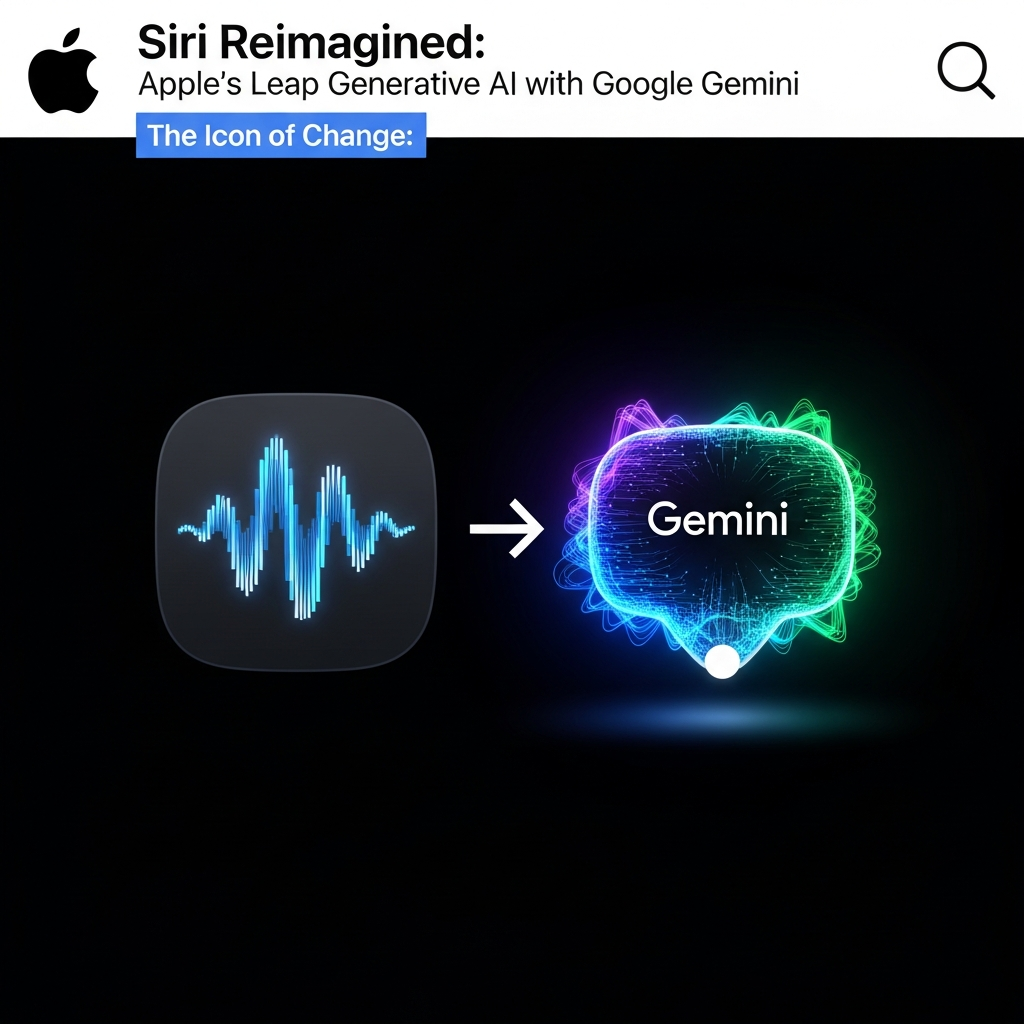
Apple is on the cusp of fundamentally transforming Siri, its long-standing virtual assistant, into a sophisticated generative AI chatbot. This monumental Siri overhaul, expected to debut with iOS 27, signals Apple’s aggressive push into the competitive artificial intelligence landscape. Leaked reports and expert analyses, particularly from Bloomberg’s Mark Gurman, detail a dual-phase rollout, leveraging a strategic partnership with Google’s formidable Gemini AI models to power a new era of “Apple Intelligence.” This isn’t just an update; it’s a complete reimagining designed to deliver unparalleled functionality, deeper system integration, and a truly conversational user experience for iPhone, iPad, and Mac users.
The Dawn of a Smarter Siri: A Two-Phase AI Evolution
Apple’s ambitious plan for Siri involves a significant, multi-stage evolution, codenamed “Project Campos.” This transformation aims to equip Apple devices with AI capabilities that rival, if not surpass, current industry leaders. The journey begins with a foundational improvement expected in iOS 26.4, introducing a Google Gemini-powered chatbot for enhanced contextual understanding and “World Knowledge Answers.” This initial step sets the stage for the true revolution: the iOS 27 Siri overhaul. Later in the year, iOS 27 will unleash a deeply integrated, advanced AI-powered Siri, featuring both voice and text interfaces. This new Siri will be capable of running apps, modifying settings, and intelligently using personal data, all while maintaining Apple’s stringent privacy standards. This comprehensive strategy underlines Apple’s determination to lead in the generative AI space.
A Dedicated App and Conversational Interface
One of the most striking changes in the upcoming Siri overhaul is the introduction of a standalone Siri application. This new app, anticipated across iPhone, iPad, and Mac, will serve as a central hub for all user interactions with the assistant. Moving beyond its current ephemeral presence, Siri will adopt a chat-style interface, much like a typical messaging application. Users will find a visible conversation thread, complete with chat bubbles and a text input field, reminiscent of the Messages app. This design allows users to access all past conversations directly, pin favorite chats, save older interactions, and even search across previous discussions. The familiar glowing edges that currently signify Siri’s activation are slated to be replaced by this new, persistent visual design, marking a radical shift in user interaction.
The interface is also designed for intuitive interaction. Users will be able to easily start new conversations via a simple plus (+) button and upload attachments like images and documents for Siri’s analysis. The assistant will support seamless switching between text and voice input modes, adapting to user preferences. Furthermore, Siri will provide proactive suggestions based on prior usage, making interactions more intuitive and relevant. This proactive capability aims to anticipate user needs, transforming Siri from a reactive tool into a truly intelligent companion.
Deep Integration: Siri as a System-Wide AI Agent
Beyond the dedicated application, the revamped Siri is evolving into a comprehensive system-wide AI agent. This deeper integration across Apple’s ecosystem, including iPhones and Macs, is a cornerstone of the new “Apple Intelligence.” The enhanced assistant will offer superior, granular control over device features and various applications. Crucially, Siri will gain the ability to access personal data – such as messages, notes, and emails – but strictly with explicit user permission, reinforcing Apple’s commitment to privacy. This granular access empowers Siri to execute complete, multi-step tasks within applications, moving far beyond simple, singular commands. Imagine asking Siri to “find all photos of my dog from last summer and email them to my mom,” and having it intelligently complete the entire process.
This deep integration extends to all core Apple applications like Mail, Music, Podcasts, TV, Xcode, and Photos. Such pervasive access will enable highly contextual voice commands. For example, within the Photos app, users could ask Siri to locate a specific picture based on a detailed description of its contents and then apply particular edits like cropping or color adjustments. Similarly, in the Mail app, Siri could be prompted to draft an email to a friend about upcoming calendar plans, pulling information directly from the Calendar app. A system-wide “Ask Siri” toggle is also in development, allowing users to directly send highlighted content from any application into a Siri conversation for immediate processing. Additionally, a “Write with Siri” option promises to integrate AI-powered writing tools directly into the device’s keyboard, offering smart assistance for text generation across the OS.
The Google Gemini Partnership: Powering Apple’s AI Future
Central to this monumental Siri overhaul is a strategic collaboration between Apple and Google, integrating advanced AI capabilities into iPhones. This significant partnership will see Apple leveraging Google’s Gemini models for its “Apple Intelligence” initiatives. Reports indicate Apple will gain full access to the Gemini model within its own data centers. This access is crucial for Apple to create smaller, task-specific AI models, optimized to run directly on Apple devices. This process, known as “distillation,” allows Apple to transfer Gemini’s extensive knowledge into more compact, efficient models. These condensed models are designed to operate effectively on-device, requiring less computing power while still mimicking Gemini’s sophisticated “chain of thought” reasoning.
This hybrid approach addresses both performance and privacy concerns. While complex AI tasks will be handled by custom Gemini models on Apple’s private cloud servers, Apple’s own existing models will continue to run on-device for processing personal data. This dual strategy ensures user data remains localized where possible, enhancing privacy, while still tapping into the immense power of cloud-based AI for more demanding computations. The deal is reportedly worth $1 billion annually, with Apple choosing Google after evaluating alternatives like Anthropic. Despite this reliance, Apple has no plans to publicly highlight Google’s involvement in its marketing, maintaining its brand focus. This decision showcases Apple’s pragmatic approach to AI development, acknowledging the significant expertise and investment required to build foundational AI models from scratch.
Why Now? Apple’s Aggressive AI Gambit
Apple’s move to thoroughly revamp Siri with generative AI is a clear response to the rapidly accelerating AI landscape. For years, critics have pointed to Apple’s perceived lag in adopting advanced AI features compared to competitors like OpenAI’s ChatGPT and Google’s conversational AI. This aggressive push, despite its relatively late entry, highlights Apple’s determination to avoid being left behind. The company has allocated substantial resources, including increased oversight from software chief Craig Federighi, to propel its AI development forward. The pursuit of “edge AI,” where AI processing occurs directly on the device, is central to Apple’s long-term strategy. This approach reduces reliance on costly cloud infrastructure, enhances user privacy, and facilitates the introduction of numerous AI-augmented products. While leveraging Google’s expertise, Apple’s Foundation Models team continues to develop its own in-house AI models, indicating a hybrid and forward-looking strategy for its long-term AI development. This strategic blend aims to provide users with cutting-edge AI features while upholding Apple’s core values.
Unwavering Commitment to User Privacy
Despite the deep system integration and access to personal data, Apple’s steadfast commitment to user privacy remains paramount. The design principles of the new Siri overhaul emphasize explicit user permission for data access. By primarily using condensed Gemini models for on-device AI, Apple ensures that localized features enhance user privacy by processing sensitive data locally, minimizing reliance on cloud infrastructure for routine tasks. This approach reflects Apple’s historical preference for local, on-device AI models to safeguard user data, a key differentiator in the AI arms race. While server-based AI is necessary for computational intensity, Apple’s hybrid model aims to strike a balance, delivering powerful AI without compromising the trust of its users. This careful limitation of personal data access, even while enabling greater functionality, will be a critical factor in user adoption and confidence.
Frequently Asked Questions
What are the key new features coming with the iOS 27 Siri overhaul?
The iOS 27 Siri overhaul will introduce a comprehensive suite of new features, transforming it into a generative AI chatbot. Key enhancements include a standalone Siri app with a chat-style interface for viewing past conversations, pinning chats, and uploading attachments. Siri will gain deep system-wide integration, allowing it to control apps, access personal data (with user permission), and perform multi-step tasks across the Apple ecosystem. It will also offer proactive suggestions, web search capabilities, content generation, image creation, information summarization, and contextual commands within apps like Photos and Mail.
How does Apple plan to integrate Google Gemini AI into Siri for iOS 27?
Apple is reportedly partnering with Google to integrate custom Gemini AI models into the next-generation Siri. This involves Apple gaining access to Gemini models within its own data centers to “distill” their knowledge into smaller, optimized AI models that can run efficiently on Apple devices. This hybrid approach will see more complex AI tasks handled by Google Gemini on Apple’s private cloud servers, while Apple’s own models manage personal data processing directly on the device. This strategy aims to combine Gemini’s powerful intelligence with Apple’s focus on on-device processing and user privacy.
When can users expect to experience the major Siri overhaul and what devices will support it?
The major Siri overhaul, including the advanced generative AI chatbot experience, is expected to be a flagship feature for iOS 27, iPadOS 27, and macOS 27. It is anticipated to be unveiled at Apple’s Worldwide Developers Conference (WWDC) in June, with a public release alongside other major software updates likely in September. An earlier, Google Gemini-powered update for improved contextual awareness is expected with iOS 26.4 in June. The new Siri features will be supported on compatible Macs, iPhones, and iPads capable of running these upcoming operating system versions, signaling a broad rollout across the Apple device ecosystem.
The Future is Conversational: What This Means for Apple Users
The upcoming Siri overhaul in iOS 27 marks a pivotal moment for Apple and its users. It represents not just an incremental improvement, but a fundamental shift towards a truly intelligent, conversational, and deeply integrated virtual assistant. By combining its own in-house AI development with the formidable power of Google Gemini, Apple is poised to deliver an AI experience that is both cutting-edge and privacy-conscious. This ambitious revamp will empower users with unprecedented control, efficiency, and proactive assistance across their Apple devices. As we anticipate the revelations at WWDC, the promise of a smarter, more capable Siri heralds a new era for Apple Intelligence, cementing its place in the rapidly evolving world of generative AI.