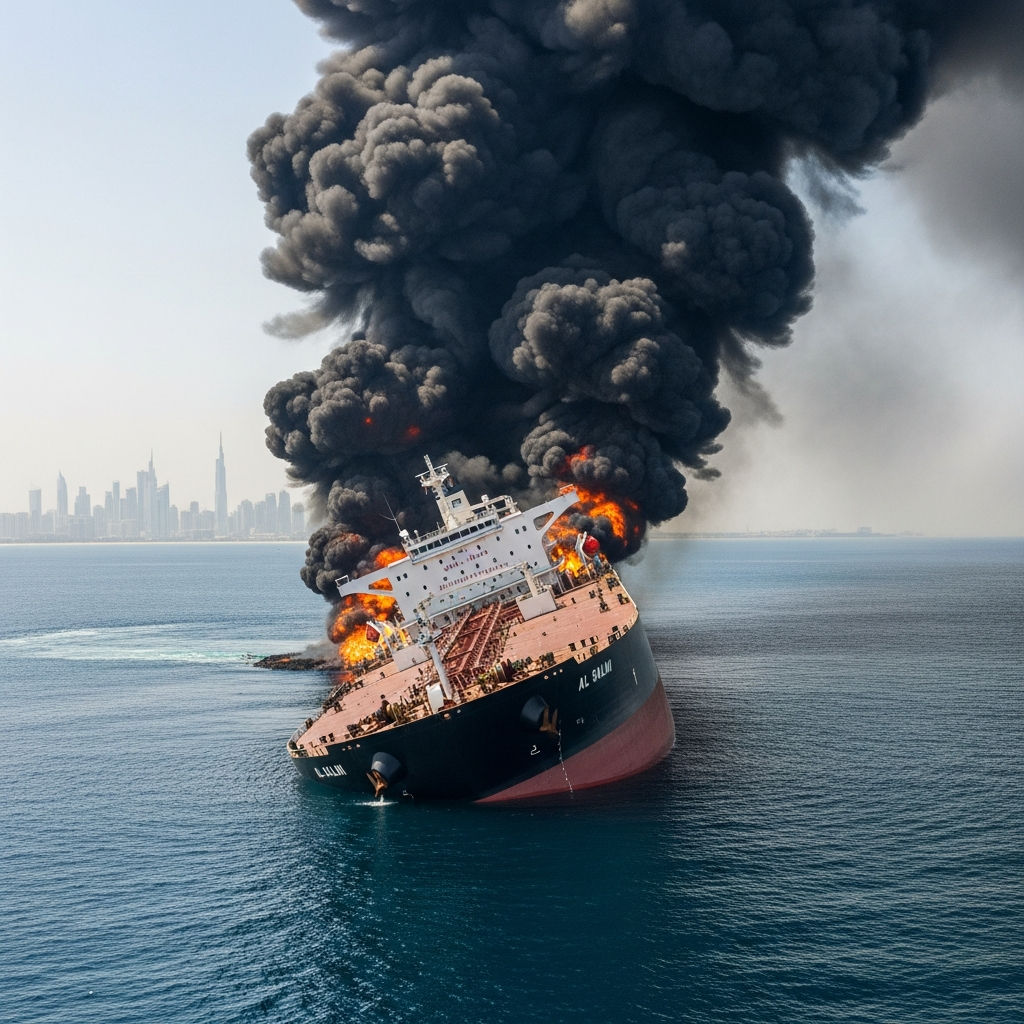
A critical juncture has unfolded in the Middle East, with an Iran oil tanker attack igniting fresh fears across global markets and escalating a month-long regional conflict. The recent drone strike on a fully loaded Kuwaiti crude carrier, the Al Salmi, off Dubai, marks a dangerous expansion of hostilities, sending shockwaves through energy sectors and challenging international stability. This incident follows a period of intense military engagement and contradictory signals from the Trump administration, leaving the world on edge about the conflict’s trajectory and its severe economic repercussions.
Escalation in the Gulf: A Dangerous Precedent Set
On March 31, 2026, a Kuwaiti-flagged crude oil tanker, the Al Salmi, endured a drone attack while anchored in Dubai port. This strike, attributed to Iran, caused significant damage to the vessel’s hull and sparked a fire. Carrying an estimated 2 million barrels of oil, worth over $200 million, the incident immediately raised concerns about a major environmental disaster. Fortunately, Dubai authorities swiftly extinguished the blaze, securing all 24 crew members and, crucially, preventing any oil leakage into the Persian Gulf.
This attack on the Al Salmi is not an isolated event. It represents the latest in a series of assaults on merchant ships in the Gulf since the alleged US-Israeli strikes on Iran began in late February. Earlier, on March 12, another foreign tanker suffered damage off Basra. Kuwait’s military simultaneously reported confronting “hostile missile and drone attacks,” underscoring the broadening scope of the conflict. The direct targeting of commercial shipping in such a vital waterway intensifies geopolitical tensions and threatens the bedrock of global trade.
Broader Regional Strikes and Counter-Strikes
The Al Salmi incident occurred amidst a flurry of other military actions across the region. Iran reportedly launched missile attacks on a key water and electrical plant in Kuwait and an oil refinery in Israel. Simultaneously, two successive Iranian missile launches targeted central Israel, triggering sirens in Jerusalem. Israel and the U.S. responded with new waves of strikes on Iran, including explosions and power cuts in Tehran, and Israeli attacks on “regime sites” across the capital. A petrochemicals plant in Tabriz was also targeted.
The conflict’s reach extends further. Saudi Arabia intercepted five missiles targeting its oil-rich Eastern province, while a missile aimed at Dubai was also intercepted. In Lebanon, the parallel conflict between Israel and Iran-aligned Hezbollah militia escalated, with Israel reporting four soldiers killed and UN peacekeepers tragically losing their lives. Tehran-backed Houthi militants in Yemen joined the fray, launching missiles and drones at Israel, with Iran reportedly encouraging them to prepare for renewed Red Sea shipping campaigns. These widespread engagements highlight a rapidly evolving, multifaceted conflict with no clear end.
Global Economic Fallout: A Looming Energy Crisis
The escalating hostilities, particularly the Iran oil tanker attack and the persistent threat to maritime routes, have plunged global energy markets into crisis. Oil prices are experiencing unprecedented volatility, with Brent crude futures surging approximately 59% for the month, reaching around $115 per barrel. This marks the highest price point since the war began, reflecting acute fears over global supply disruptions.
A primary driver of this concern is Iran’s effective closure of the Strait of Hormuz, a critical chokepoint for approximately a fifth of the world’s oil and liquefied natural gas (LNG) supplies. While Iran has permitted a “trickle of ships” from nations it deems “non-hostile” (like two Chinese container ships), the near-closure of this vital artery sends shivers through global economies. Energy analysts caution that if the Strait of Hormuz remains largely closed, crude oil prices could dramatically surge to $150-$200 a barrel within six to eight weeks.
Financial Markets in “Fear Mode”
The ripple effects extend far beyond oil. Financial markets are in “fear mode,” experiencing significant declines. Asian shares saw their steepest fall since 2022, with MSCI Asia-Pacific ex-Japan down over 12%, Japan’s Nikkei down 12.6%, and South Korea’s Kospi plummeting over 17%—its largest decline since 2008. Bonds are also declining, while the U.S. dollar shows strong gains as investors seek safe havens.
Higher energy prices are causing increased pain for energy-reliant Asian economies and exerting pressure on U.S. household finances. Domestic gasoline prices in the U.S. recently climbed above $4 a gallon for the first time since August 2022. This economic strain presents a significant political challenge for President Trump and the Republican Party ahead of upcoming midterm elections. The International Monetary Fund (IMF) warns of higher prices and slower global growth due to the conflict, reinforcing fears of stagflation—a combination of high inflation and stagnant economic growth. In response, G7 ministers have pledged “all necessary measures” to ensure energy market stability, and the UN Security Council scheduled an emergency session following peacekeeper deaths.
Trump’s Contradictory Stance and Diplomatic Deadlock
The escalating conflict is further complicated by President Donald Trump’s frequently shifting and contradictory public statements. While the White House insisted the U.S. and Iran were in talks, Iran’s foreign ministry spokesperson explicitly stated no direct negotiations had occurred, dismissing U.S. peace proposals as “unrealistic, illogical and excessive.” Trump himself has vacillated between hints of an imminent deal and aggressive threats.
He explicitly threatened to “obliterate” Kharg Island and Iran’s oil wells, and later, Iran’s energy grid and even water desalination plants (potentially a war crime under Geneva Conventions), if a deal or ceasefire was not reached “shortly” and the Strait of Hormuz not “Open for Business” by his April 6 deadline. Conversely, he also told aides he was willing to end the U.S. military campaign against Iran even if the Strait remained largely closed, reportedly seeking to hobble Iran’s navy and missile stocks within “four to six weeks,” then pressure Tehran diplomatically. He even claimed Iran’s new leaders were “very reasonable” and would allow 20 oil tankers through Hormuz. This dual approach has created significant uncertainty and cast doubt on any clear U.S. strategy.
Iran’s Rejection and International Mediation Efforts
Iran has consistently denied progress in peace negotiations, rejecting a 15-point plan sent by Trump via Pakistan. Tehran’s demands reportedly include war reparations, recognition of its control over Hormuz shipping, and U.S./Israel pledges against future attacks. An Iranian parliamentary committee has even approved legislation to impose fees in the Strait of Hormuz, pending a full parliamentary vote.
Amidst this diplomatic deadlock, several nations are attempting to mediate. Egyptian President Abdel-Fattah El-Sisi has urged Trump to end the conflict, with Egypt, Pakistan, and Turkey actively engaging in mediation efforts. Despite these attempts, the situation remains highly volatile, with both sides entrenched in their positions.
Military Dynamics and the Human Cost of Conflict
The ongoing conflict is characterized by intense military exchanges and significant humanitarian consequences. Reports indicate a significant depletion of missile interceptors for both Israel and the U.S. Israeli news outlet Haaretz, citing official sources, claims that Iranian missile success rates have reached 80%, with many missiles not being intercepted. Estimates from the Royal United Services Institute for Defense and Security (RUSIDS) suggest Israel has used approximately 80% of its Arrow 2 and Arrow 3 interceptors, 54% of its David’s Sling missiles, and 45% of its American-made THAAD interceptors. For the U.S., RUSIDS suggests 60% of THAAD missiles deployed to protect Gulf states have been utilized. NATO air defenses also intercepted an Iranian missile heading towards Turkey.
The U.S. military has reinforced its presence, deploying approximately 3,500 sailors and Marines with fighter aircraft to the Middle East on the Tripoli Amphibious Ready Group. Thousands of 82nd Airborne Division soldiers have also been deployed, expanding Trump’s options to include ground forces inside Iranian territory, though no immediate plans for a ground invasion have been signaled. The White House is also reportedly considering asking wealthy Arab nations like Saudi Arabia, Qatar, and the UAE to cover war costs, and has requested an additional $200 billion in funding from Congress.
Devastating Humanitarian Impact
The human cost of this conflict has been severe and widespread. More than 4,750 deaths have been reported, with three-quarters occurring in Iran, where over 1,900 people have died. Lebanon has seen over 1,200 fatalities and more than a million displaced individuals. Dozens have also died in Israel (19) and Arab Gulf states (24), including a worker killed in the Kuwaiti power plant attack. The U.S. reports 13 troops killed and over 300 injured, while 10 Israeli soldiers have also lost their lives. The conflict is fueling a growing humanitarian crisis, exacerbating regional instability and creating immense suffering for civilian populations caught in the crossfire.
Frequently Asked Questions
What were the immediate global economic impacts of the latest Iran attacks?
The recent Iran oil tanker attack and broader hostilities immediately sent global energy markets into turmoil. Brent crude oil prices surged nearly 60% for the month, reaching around $115 per barrel, driven by fears of supply disruptions from the Strait of Hormuz. Financial markets entered “fear mode,” with Asian shares experiencing their steepest falls since 2022. U.S. gasoline prices rose above $4 a gallon, and the IMF warned of higher prices and slower global growth, increasing fears of stagflation.
Which key regions and entities are most directly affected by the escalating conflict?
The conflict directly impacts Iran, Israel, and Gulf states such as Kuwait, Saudi Arabia, and the UAE, which have faced missile and drone attacks. Lebanon is also heavily affected due to Israel’s conflict with Hezbollah. Economically, energy-reliant Asian economies suffer significantly from high oil prices. Globally, all nations relying on oil and LNG supplies passing through the Strait of Hormuz, including major European and American markets, feel the economic strain. Humanitarian crises are most acute in Iran and Lebanon.
What is the outlook for global oil prices if the Strait of Hormuz remains disrupted?
If the Strait of Hormuz, a critical chokepoint for global oil and LNG, remains significantly disrupted or closed, energy analysts warn of severe consequences. Prices could dramatically surge to $150-$200 a barrel within six to eight weeks. This would create immense pressure on global economies, exacerbate inflation, and potentially trigger a deep recession. The G7 has pledged measures to ensure stability, but continued closure would likely lead to unprecedented economic hardship worldwide.
A Volatile Future
The recent Iran oil tanker attack serves as a stark reminder of the extreme volatility gripping the Middle East. With military engagements escalating across multiple fronts, vital shipping lanes under threat, and global energy markets in disarray, the world faces a period of profound uncertainty. The contradictory signals from major powers, coupled with the immense humanitarian toll, underscore the urgent need for a clear, unified diplomatic strategy. Without a concerted effort to de-escalate, this conflict risks becoming a prolonged “war of attrition” with devastating and unpredictable consequences for global peace and prosperity.