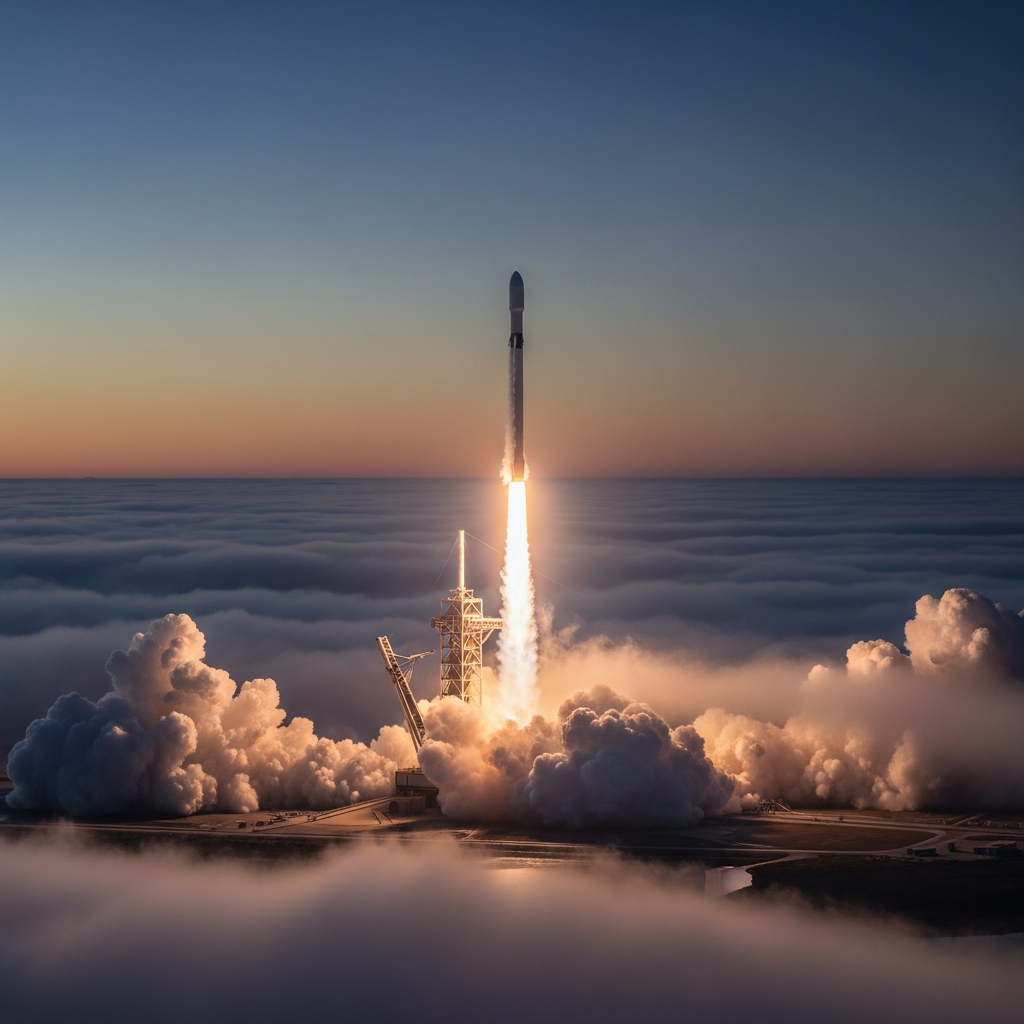
The dawn of March 30, 2026, marked a significant milestone in commercial spaceflight as SpaceX successfully executed its Transporter-16 rideshare mission. From the fog-shrouded launchpads of California’s Vandenberg Space Force Base, a mighty Falcon 9 rocket soared skyward. This mission wasn’t just another rocket launch; it was a testament to the democratization of space, carrying an unprecedented 119 diverse payloads into orbit. This monumental deployment showcased cutting-edge technologies and critical scientific instruments, redefining access to the final frontier for a global array of innovators and researchers.
The Transporter-16 Mission: A New Era of Access
The Transporter-16 mission was the sixteenth installment in SpaceX’s highly successful Transporter rideshare series. This program, alongside its sibling Bandwagon initiative, has collectively lofted well over 1,600 payloads to orbit since its inception. These missions offer a cost-effective and reliable pathway for small satellites—from tiny CubeSats to more complex microsatellites—to reach space. The launch window opened precisely at 3:20 a.m. local California time (6:20 a.m. EDT / 1020 GMT) and spanned 57 minutes, highlighting SpaceX’s precision scheduling.
The Transporter series plays a pivotal role. It enables a broader range of scientific studies and technological demonstrations. By sharing a single rocket, participants can dramatically reduce their launch costs. This makes space accessible to universities, startups, and government agencies alike, fostering rapid innovation.
A Falcon 9’s Precision Flight and Recovery
At the heart of the Transporter-16 mission was the Falcon 9 rocket, SpaceX’s workhorse orbital launch vehicle. This particular Falcon 9 booster, designated B1093, was no stranger to spaceflight. It was embarking on its twelfth mission, a remarkable achievement that underscores SpaceX’s pioneering efforts in rocket reusability.
Approximately 8.5 minutes after liftoff, the first stage performed a spectacular, precision landing. It touched down flawlessly on SpaceX’s autonomous droneship, “Of Course I Still Love You.” This vessel was stationed hundreds of miles downrange in the Pacific Ocean. Meanwhile, the rocket’s upper stage continued its journey, delivering the 119 payloads to their targeted Sun-synchronous orbit (SSO). Deployments began about 55 minutes after launch, continuing for over two hours. The successful booster recovery demonstrated the maturity and efficiency of SpaceX’s operational capabilities.
A Fleet of Futures: The 119 Diverse Payloads
The sheer volume and diversity of the 119 payloads on Transporter-16 were extraordinary. This manifest included everything from tiny picosatellites to sophisticated orbital transfer vehicles (OTVs). These OTVs carried additional payloads for later deployment. This mission truly represented a snapshot of the global space industry’s current ambitions.
Exolaunch: Orchestrating a Multitude of Innovations
German-based Exolaunch emerged as the largest customer on Transporter-16. They managed the deployment of 57 payloads for more than 25 different entities. These included private companies, government agencies, and academic institutions worldwide. Exolaunch has been a consistent partner on every SpaceX rideshare mission since 2020. They have successfully deployed over 670 satellites to date.
Among their notable deployments were:
EnduroSat’s Femto-1: A demonstration of high-efficiency electric propulsion for advanced in-orbit maneuvers.
Aethero Space’s Phobos: A 4U microsatellite acting as an on-orbit data center. It featured an Nvidia computing module, offering 20 times the typical on-orbit compute power for AI and Earth imaging applications.
University of Colorado, Boulder’s COSMO: This 6U Compact Spaceborne Magnetic Observatory was designed to precisely measure Earth’s magnetic field, aiming for a more accurate global model.
Greece’s Ermis 1, 2, and 3 constellation: This trio included two 6U Earth-observation satellites and an 8U satellite providing space-based 5G and Internet of Things (IoT) connectivity.
PeakSat: A 3U nanosatellite from the Aristotle University of Thessaloniki, focusing on optical communications via laser links.
Disco-2: A student-developed 3U CubeSat monitoring climate change in the Arctic, studying glacier melt and sea temperatures.
TORO3: From Pyras Technology Inc., this ocean-color sensing satellite continues to monitor algae concentrations and plankton blooms.
SEOPS, NearSpace Launch, and Momentus Inc. Contributions
Other significant payload integrators also contributed to the Transporter-16 manifest. SEOPS manifested 19 payloads from 13 countries. These included five PocketQubes from Scotland-based Alba Orbital, such as the Earth-observation Unicorn-2S and Unicorn-2R. Vega Space’s VegaFly-1, a 1P satellite with a two-megapixel camera, and FOSSA Systems’ FOSSASAT-2E for IoT communications were also aboard.
NearSpace Launch hosted eight satellites, notably the “Dream Big Constellation.” This was a six-satellite cluster developed in collaboration with U.S. Midwest universities. Its goal was to inspire a future STEM workforce, blending education with practical space experience.
Momentus Inc. deployed its Vigoride-7 Orbital Service Vehicle (OSV). This platform hosted 10 payloads and was set to perform multiple in-orbit demonstrations. These included Rendezvous and Proximity Operations (RPO) and even in-space manufacturing experiments.
NASA’s Strategic Payloads and Advanced Research
NASA leveraged the Transporter-16 mission for several critical demonstrations. These focused on advanced in-space communications and novel thermal protection systems. A pair of instrumented tiles from NASA’s Ames Research Center were tested. They integrated with sensors on Varda Space Industries’ W-6 capsule, designed to capture vital data during hypersonic atmospheric entry. This built upon previous successful heat shield tests on Varda’s W-2 capsule.
Further scientific endeavors included:
Atmosphere Effects of Precipitation through Energetic X-rays (AEPEX) CubeSat: This mission investigated high-energy particles within Earth’s radiation belts. It aimed to understand how these particles transfer energy into the upper atmosphere, which is crucial for improved space weather forecasting.
MagQuest Challenge CubeSats: Three CubeSats developed through the MagQuest challenge aimed to provide deeper insights into Earth’s magnetic field.
TechEdSat23 CubeSat: This NASA-backed payload tested three advanced technologies: an exo-brake for rapid deorbiting, a new radiation sensor (Radiation Shielding Efficacy Testbed), and a miniaturized NOAA Data Collection System radio.
- R5-S10 CubeSat: Known as “Realizing Rapid, Reduced-cost high-Risk Research project Spacecraft 10,” this CubeSat served as a testbed for emerging small spacecraft technologies. These included proximity operations and formation flying techniques. Uniquely, R5-S10 planned to use Wi-Fi to transfer demonstration data via an in-space router from Solstar Space Company.
- www.space.com
- www.ksby.com
- www.nasaspaceflight.com
- keyt.com
- www.nasaspaceflight.com
Democratizing Space: The Rideshare Revolution
SpaceX’s dedicated rideshare program has fundamentally transformed access to orbit. Historically, launching a satellite was prohibitively expensive, often requiring a dedicated rocket and months or years of planning. Rideshare missions like Transporter-16 provide a significantly cheaper alternative. They enable smaller entities to “hitch a ride” alongside larger payloads.
This model is critical for the rapid growth of the New Space economy. It accelerates technological development and scientific discovery by removing traditional barriers to entry. The diverse range of payloads on Transporter-16, from AI data centers to climate monitoring, highlights this impact. It enables a future where space-based applications are more accessible and integrated into daily life.
Reflecting on the Spectacle and Future Implications
For those unable to watch the live webcast, replays of the Transporter-16 launch offer a powerful reminder of humanity’s ongoing push into space. The spectacle of a Falcon 9 ascending from Vandenberg, followed by the balletic return of its first stage, continues to inspire. The success of Transporter-16 reinforces the vital role of reusable rockets and frequent rideshare opportunities. It’s part of a broader trend towards making space a more routine and affordable domain. This allows for a continuous stream of innovation. The advancements tested on these small satellites today will undoubtedly pave the way for tomorrow’s large-scale space infrastructure and exploration endeavors.
Frequently Asked Questions
What kind of payloads did SpaceX’s Transporter-16 mission carry?
The Transporter-16 mission carried a highly diverse manifest of 119 payloads. These included various types of small satellites such as cubesats, microsats, and picosatellites. The mission also featured hosted payloads, a reentry vehicle, and several orbital transfer vehicles (OTVs) designed to deploy additional payloads later. Specific examples highlighted in the mission were an on-orbit AI data center (Aethero Space’s Phobos), Earth magnetic field observatories (COSMO, MagQuest CubeSats), climate change monitors (Disco-2, TORO3), and several NASA research payloads focusing on thermal protection, space weather, and in-space communications.
Where did the Transporter-16 mission launch from, and what was the booster’s fate?
The Transporter-16 mission launched from Vandenberg Space Force Base in California. The launch occurred from Space Launch Complex 4 East (SLC-4E). Following a successful liftoff and first-stage separation, the Falcon 9 booster (B1093) performed a controlled descent. Approximately 8.5 minutes after launch, it executed a precise landing on SpaceX’s autonomous droneship, “Of Course I Still Love You,” stationed in the Pacific Ocean. This marked the twelfth successful launch and landing for that particular booster, showcasing SpaceX’s advanced reusability capabilities.
How do SpaceX’s rideshare missions, like Transporter-16, benefit the commercial space industry and scientific research?
SpaceX’s rideshare missions significantly benefit the commercial space industry and scientific research by providing highly affordable and frequent access to orbit. By allowing multiple customers to share a single Falcon 9 rocket, the cost per payload is dramatically reduced compared to dedicated launches. This “democratizes” space, enabling startups, universities, and smaller government agencies to deploy their technologies and conduct research. It fosters rapid innovation, accelerates the development of new space-based applications, from IoT connectivity to advanced Earth observation, and supports a vibrant ecosystem for the growing New Space economy.
Conclusion
The Transporter-16 mission stands as a powerful demonstration of the evolving landscape of space exploration. It showcased SpaceX’s incredible capability to launch a record number of diverse payloads efficiently and affordably. By enabling a wide range of scientific experiments and technological advancements, from AI in orbit to advanced climate monitoring, these rideshare missions are not just about reaching space. They are about empowering the next generation of innovators and researchers. As the demand for space-based solutions continues to grow, missions like Transporter-16 will remain instrumental in driving progress and expanding humanity’s reach beyond Earth.