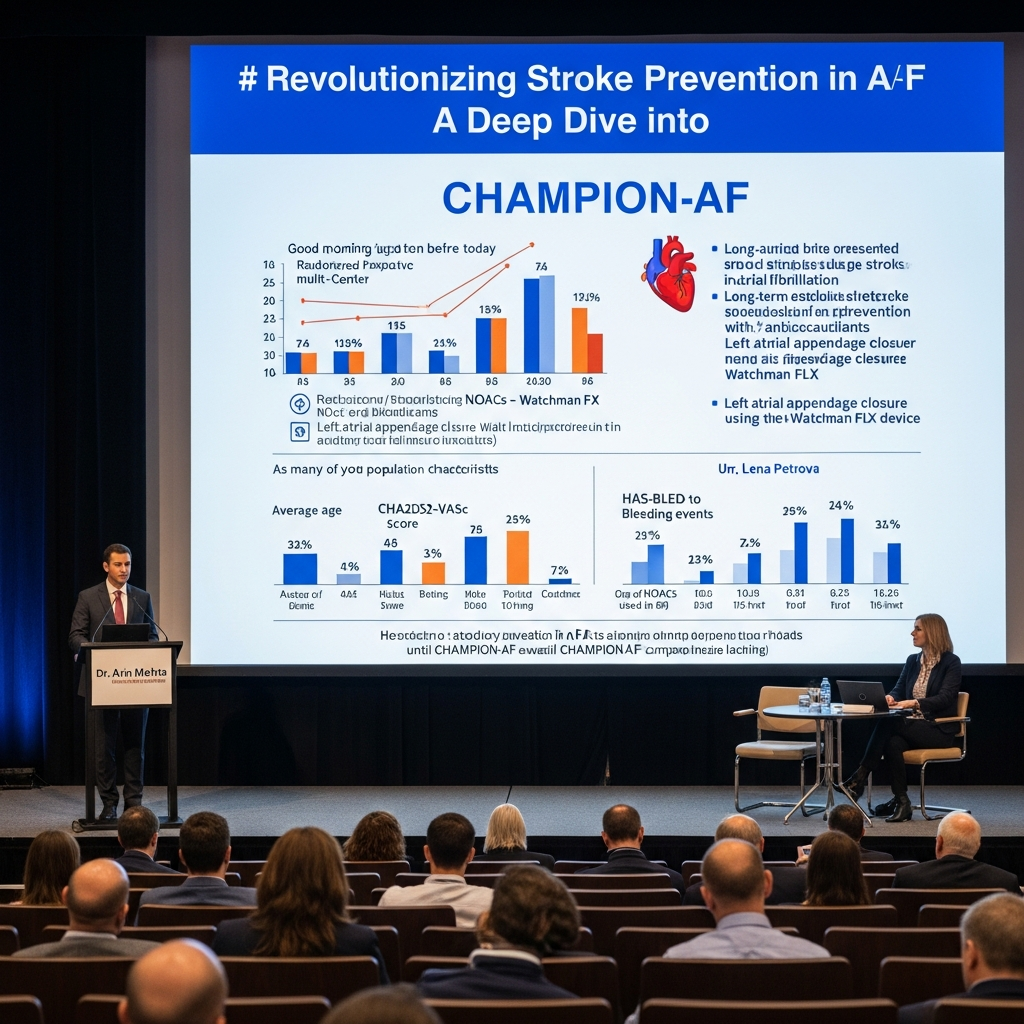
For millions globally, atrial fibrillation (AF) necessitates long-term oral anticoagulation to prevent devastating strokes. This foundational practice rests on some of medicine’s strongest evidence. Yet, the ongoing challenges of bleeding complications and medication adherence constantly drive the search for alternatives. The CHAMPION-AF trial recently presented its findings, which proponents may tout as a breakthrough for left atrial appendage closure (LAAC) devices like Watchman FLX. However, a deep dive into the data reveals critical weaknesses. This expert analysis unpacks why the CHAMPION-AF trial results, despite initial fanfare, do not provide sufficient evidence to alter established clinical guidelines for AF stroke prevention.
Unpacking CHAMPION-AF: Study Design and Initial Buzz
The CHAMPION-AF trial enrolled approximately 3,000 AF patients. Participants were randomized to receive either the Watchman FLX percutaneous LAAC device or direct-acting oral anticoagulants (DOACs). A key inclusion criterion was patient eligibility for long-term anticoagulation. The central question posed by the study was undoubtedly provocative: Could a mechanical approach to LAAC offer outcomes equivalent to, or even superior to, oral anticoagulation? Given the robust evidence supporting anticoagulants, any alternative treatment would need unassailable proof to justify a shift in practice.
The trial’s presentation as a late-breaker at the 2026 American College of Cardiology meeting generated significant attention. While many predicted it would be promoted as a “positive” trial, a thorough evaluation of the actual data challenges this optimistic interpretation. The evidence, upon closer inspection, appears far too weak to overturn one of medicine’s most reliably supported treatments.
Red Flag 1: The Troubling Stroke Signal
Perhaps the most alarming finding in the CHAMPION-AF trial involved stroke rates. Data showed a concerning trend: stroke incidence was 46% higher in the Watchman arm compared to the DOAC group. Specifically, 50 strokes occurred in patients receiving the Watchman device versus 33 in the DOAC cohort. This translates to an incidence of 3.3% versus 2.6% (Hazard Ratio [HR], 1.46; 95% CI, 0.94-2.27).
Ischemic Stroke: A Clear Deterioration
Delving deeper, the disparity in ischemic stroke cases was even more pronounced. The Watchman arm experienced 45 ischemic strokes, while the DOAC group had only 27 (HR, 1.61; 95% CI, 1.00-2.59). It is critical to note that the upper bound of the 95% confidence interval for both total and ischemic stroke extended above 2. This suggests a potential for significantly worse outcomes with the device. Notably, hemorrhagic strokes occurred equally in both groups (five patients each). This clear signal of increased ischemic stroke risk is particularly worrisome, especially given that the enrolled patients had a relatively moderate CHA2DS2VASc score of 3.5, indicating they were not at exceptionally high risk.
Red Flag 2: Non-Inferiority Margin Under Scrutiny
The declaration of non-inferiority (NI) for efficacy in the accompanying New England Journal of Medicine paper requires careful examination. The CHAMPION-AF authors projected a primary outcome rate (stroke, systemic embolism, and cardiovascular [CV] death) of 12% in the DOAC arm. They subsequently set an NI margin, deeming the Watchman device non-inferior if its event rate was less than 4.8% higher than the DOAC arm.
In reality, the observed incidence of the primary efficacy endpoint was much lower than predicted: 4.8% in the DOAC arm versus 5.7% in the Watchman arm. This yielded an absolute risk difference of 0.9% (95% CI, -0.8 to 2.6%). Because the upper bound of the 95% CI (2.6%) fell below the chosen 4.8% margin, the authors concluded non-inferiority.
The Problem with a Generous Margin
The issue here lies in the NI margin itself. It was based on a much higher predicted event rate. When actual event rates come in significantly lower, as they did in CHAMPION-AF, a large absolute margin like 4.8% becomes overly generous. Standard practice often involves defining both an absolute risk margin and a relative risk ratio. The 4.8% absolute risk increase corresponds to a substantial 40% higher rate of the primary endpoint. Thus, an appropriate relative NI margin should ideally be 1.40. Crucially, the CHAMPION-AF authors omitted setting a relative risk ratio margin, a practice observed in previous pivotal trials comparing Watchman with warfarin. Had a standard relative NI margin been applied, the observed relative risk increase of 1.20 (95% CIs, 0.87-1.66) would not have met non-inferiority, as the upper bound of 1.66 exceeds 1.40.
Red Flag 3: Flawed Safety Endpoint Excludes Crucial Bleeds
The methodology for the primary safety endpoint in CHAMPION-AF also raises serious concerns. The decision to exclude procedural bleeding from this endpoint essentially guaranteed a “positive” outcome that holds little clinical utility for patients. No patient undergoing a procedure can realistically disregard the risk of a vascular or pericardial bleed during the intervention itself. While excluding procedural bleeds might have been acceptable for “proof-of-concept” measures in earlier trials (like PREVAIL) a decade ago, it is an unacceptable omission in a study aiming to transform treatment paradigms today. If the goal is to revolutionize how millions of AF patients are managed, all relevant bleeding events, including those related to the procedure, must be accounted for.
Furthermore, the inclusion of “clinically relevant non-major bleeding” in the endpoint, while seemingly reasonable, is problematic in an open-label trial. In such trials, both patients and physicians are aware of treatment assignments. As observed in prior studies like OPTION, patients on DOACs may be more prone to reporting non-major bleeding events. Many clinicians recognize this bias. The CHAMPION-AF manuscript and its supplement notably failed to list the specific types of bleeds, an omission that is significant. In trials like OPTION, these often include minor “nuisance” issues like bruising or oral bleeds, which while uncomfortable, differ vastly in clinical impact from major bleeding events.
Red Flag 4: Watchman’s Failure to Reduce Major Bleeding
From a patient’s perspective, the decision to undergo an LAAC device implantation involves weighing pros and cons from the moment they enter the procedure room. A major bleed, whether it occurs during the procedure or years later, carries the same gravity for the patient.
In CHAMPION-AF, major bleeding events were largely comparable between the two arms. There were 83 major bleeds in the Watchman arm versus 87 in the DOAC arm (5.5% vs 5.8%; HR, 0.92; 95% CI, 0.68-1.24). While the authors classified this as a secondary endpoint and declared it non-inferior, the more accurate interpretation is that the Watchman arm showed no superiority over DOACs in reducing major bleeding. To justify a radical shift from one of medicine’s most evidence-based therapies, any alternative treatment must demonstrate clear safety superiority, especially when patients potentially face a 66% higher risk of stroke, systemic embolism, or CV death.
Red Flag 5: The Misleading “Net Clinical Benefit” Claim
The trial authors declared a positive “net clinical benefit” by combining the efficacy endpoint (CV death, stroke, systemic embolism) with non-procedural bleeding. While this composite endpoint might appear appealing on a marketing slide, it fails to reflect how patients actually evaluate such a crucial trade-off.
Patient Perspective: Stroke vs. Bleeding Trade-Off
Consider the patient’s perspective: the CHAMPION-AF trial documented 17 more strokes in the Watchman arm, offset by only four fewer episodes of major bleeding. The stark reality here requires little statistical nuance. Stroke is undeniably one of the most devastating cardiovascular outcomes, frequently resulting in permanent disability and a profound reduction in quality of life. To justify a therapy associated with an excess of strokes, there would need to be a truly massive reduction in major bleeding events, far beyond what CHAMPION-AF demonstrated.
Red Flag 6: Historical Context and Skeptical Priors
New clinical trials should update existing beliefs, much like medical tests. For LAAC devices versus anticoagulation, our prior beliefs should lean towards skepticism, given the history of previous trials. For instance, PREVAIL failed to demonstrate non-inferiority for LAAC against warfarin for composite stroke, systemic embolism, and CV death. The PRAGUE-17 trial, while informative, suffered from an insufficient number of events to provide definitive conclusions. Even more concerning, the CLOSURE-AF trial not only failed to meet non-inferiority but was technically inferior to best medical therapy (primarily DOACs).
Attempts to differentiate CLOSURE-AF from CHAMPION-AF have surfaced, but they often lack solid support. One argument suggests CLOSURE-AF included various devices, implying Watchman is superior. However, a large head-to-head randomized controlled trial found similar efficacy and safety outcomes between the two most common LAAC devices. Another explanation posits that CHAMPION-AF operators were more skilled than their German counterparts in CLOSURE-AF, which is curious considering Germany’s early adoption and extensive experience with LAAC devices, predating widespread US use.
Learning from Prior LAAC Trials
A more plausible reason for CLOSURE-AF’s failure to meet non-inferiority is its enrollment of higher-risk patients. These patients often face increased procedural risks and a greater likelihood of strokes originating from causes other than the left atrial appendage. Interestingly, a subgroup analysis within the CHAMPION-AF trial itself showed a trend towards worse outcomes in higher-risk patients in the Watchman arm, lending credence to this hypothesis.
To shift from such a pessimistic prior belief about LAAC would demand exceptionally robust and compelling data. Instead, CHAMPION-AF presented a higher stroke rate and virtually identical major bleeding rates in the device arm. This evidence falls far short of what’s needed to instill confidence or change long-standing practice.
Frequently Asked Questions
What were the main concerns raised about the CHAMPION-AF trial’s methodology?
The CHAMPION-AF trial faced significant criticism regarding its methodological choices. Key concerns included a non-inferiority (NI) margin that was deemed too generous, especially given the lower-than-predicted event rates. Critics argue that a standard relative risk ratio margin, typically used in such trials, was not applied, which would likely have led to a failure to meet non-inferiority. Additionally, the primary safety endpoint was considered flawed for excluding procedural bleeding, an important risk factor for patients undergoing LAAC, thereby potentially presenting an incomplete picture of the device’s true safety profile.
Where can clinicians find established guidelines for atrial fibrillation stroke prevention?
Clinicians can access well-established, evidence-based guidelines for atrial fibrillation stroke prevention from major professional societies. These include the American College of Cardiology (ACC), the American Heart Association (AHA), and the Heart Rhythm Society (HRS) in the United States, as well as the European Society of Cardiology (ESC) internationally. These organizations regularly update their guidelines based on robust clinical trial data, consistently emphasizing the strong evidence base for oral anticoagulants like DOACs for stroke prevention in eligible AF patients.
Should patients with atrial fibrillation consider the Watchman FLX device based on CHAMPION-AF?
Based on the detailed analysis of the CHAMPION-AF trial, the evidence is not strong enough to recommend a widespread shift from current oral anticoagulation practices to the Watchman FLX device for all eligible AF patients. The trial showed a higher rate of strokes in the device arm and no clear reduction in major bleeding when all relevant bleeds are considered. While LAAC offers an alternative for specific patients unable to tolerate anticoagulants, CHAMPION-AF does not provide the “unassailable” evidence needed to position the Watchman FLX device as a general substitute for effective, evidence-based long-term oral anticoagulation. Patients should have thorough discussions with their cardiologists about individual risks and benefits.
Conclusion: Upholding Evidence-Based Practice
A concerning narrative may emerge, suggesting that the Watchman device performed as well as DOACs, presenting LAAC as an equivalent alternative to long-term oral anticoagulation. Given the millions of individuals worldwide living with atrial fibrillation and relying on anticoagulants, accepting LAAC as a substitute based on the weak evidence from the CHAMPION-AF trial would constitute a serious misstep in modern medicine. Responsible professional societies and thoughtful clinicians must critically evaluate this data and publicly advocate for evidence-based practice, resisting marketing-driven attempts to promote interventions that lack robust clinical support. Prioritizing patient safety and adhering to stringent evidence standards remains paramount in cardiovascular care.