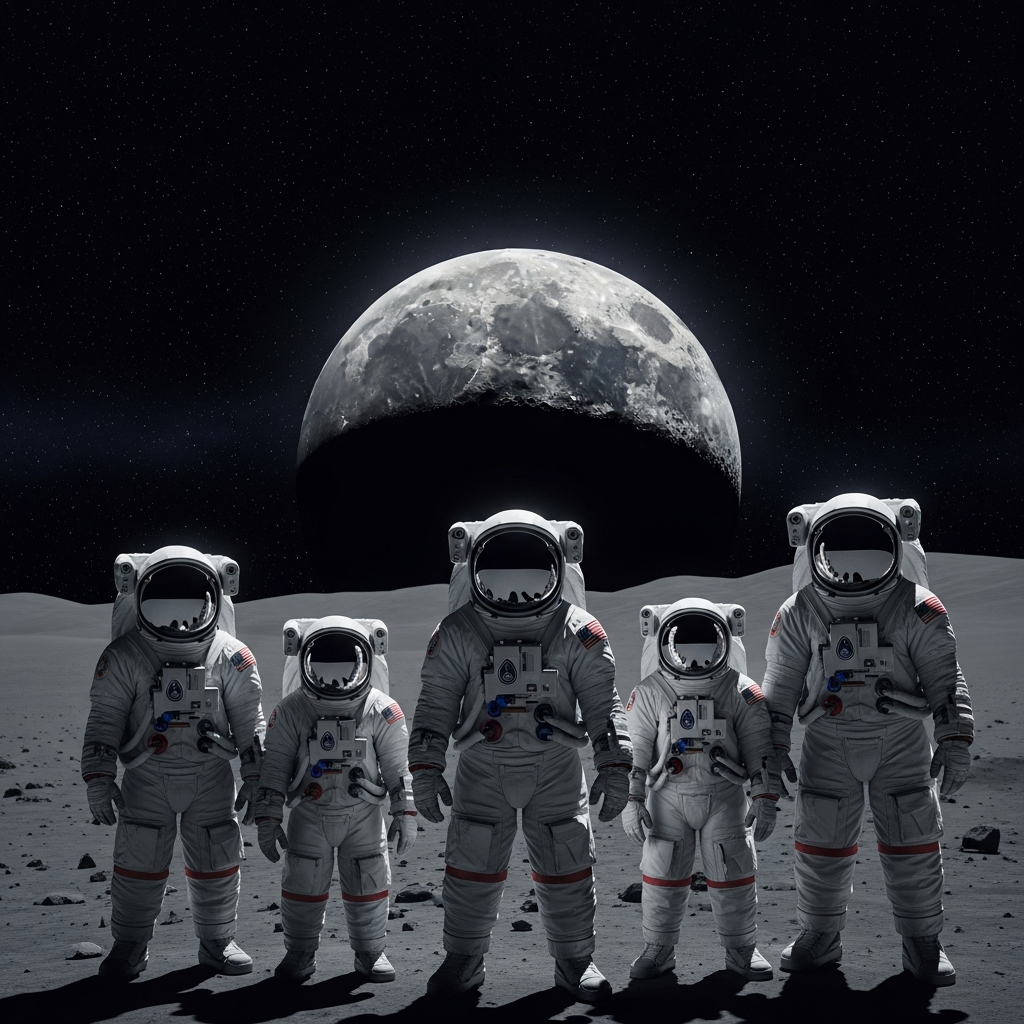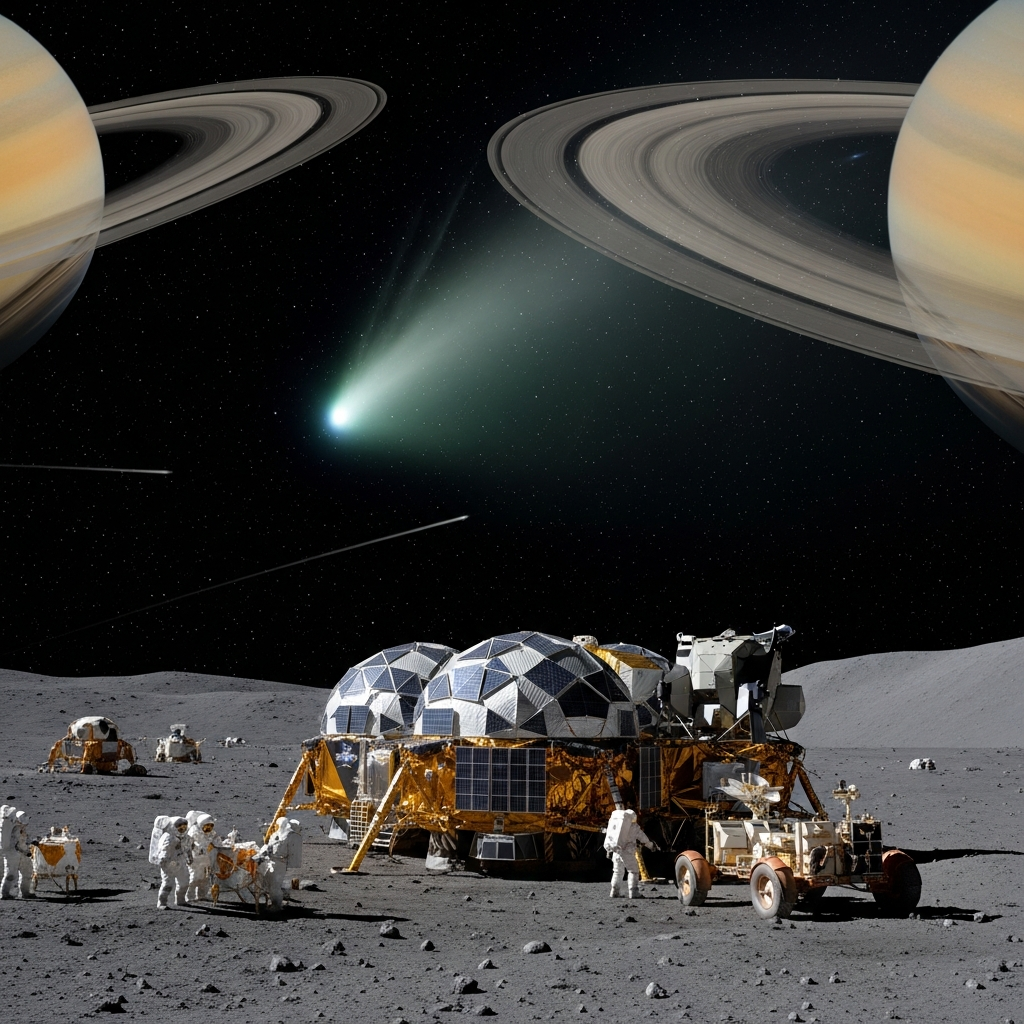
Major shifts are underway in space exploration! NASA is dramatically changing its lunar strategy, now prioritizing a permanent moon base over the Gateway orbital station. This bold new vision aims for a sustained human presence on the Moon. Meanwhile, scientists have observed a comet performing an unprecedented spin reversal, challenging our understanding of these icy wanderers. And closer to home, stunning new images from Hubble and Webb unveil Saturn’s dynamic atmosphere in unprecedented detail. Dive into this week’s most captivating science news.
NASA Shifts Lunar Strategy: Gateway Out, Moon Base In
NASA is making a monumental pivot in its Artemis program. The space agency has announced a significant redirection of its lunar exploration strategy. The goal is to establish a robust, enduring human presence on the Moon. This new approach involves “pausing” the ambitious Lunar Gateway orbiting station. Instead, resources will focus on building a permanent NASA moon base directly on the lunar surface.
The Pivot: From Orbital Station to Surface Outpost
The Gateway space station was initially conceived as the first orbital station around the Moon. It aimed to provide a “home-away-from-home” for astronauts. Gateway also intended to support lunar surface and deep-space missions, including journeys to Mars. However, the project had faced criticism. Concerns included potential financial waste and a distraction from direct lunar surface ambitions. Hints of this shift emerged from proposed budget cuts. Now, NASA has officially confirmed the change during its “Ignition” event. This marks a strategic move towards sustained surface operations.
NASA Administrator Jared Isaacman articulated the agency’s commitment. He stated, “NASA is committed to achieving the near-impossible once again.” Isaacman highlighted the goal to return to the Moon before President Trump’s term ends. This includes building a NASA moon base, establishing an enduring presence, and ensuring American leadership in space. The pivot to surface infrastructure is a logical step. It supports the ultimate goal of consistent human activity on the lunar terrain.
Three Phases to a Permanent Lunar Presence
The ambitious NASA moon base plan will unfold in three distinct phases. This methodical approach will ensure a deliberate and achievable path. It echoes the Mercury and Gemini programs that preceded Apollo.
Phase One: Experimentation and Modular Approach
The initial stage focuses on foundational activities. NASA will utilize its Commercial Lunar Payload Services (CLPS) program. This involves contractors sending rovers and instruments to the Moon. The Lunar Terrain Vehicle (LTV) program will also be instrumental. These missions aim to advance critical capabilities. These include mobility, power generation, and communications. Surface operations and scientific investigations are also key targets. This phase uses a “repeatable, modular approach.”
Phase Two: Early Infrastructure and Lessons Learned
Following the experimental phase, NASA will establish early infrastructure. This stage leverages insights from earlier Artemis missions. Astronauts will begin constructing “semi-habitable infrastructure” on the ground. Regular logistics systems will also be put in place. This phase seeks to support consistent astronaut operations. Significant contributions from international partners are expected. The Japanese Aerospace Exploration Agency (JAXA) may provide a pressurized rover. Other partners will offer scientific payloads, rovers, and transportation.
Phase Three: Long-Term Human Presence
The final phase envisions a sustained, long-term human presence. Advanced cargo-capable human-landing systems will become operational. These systems will deliver heavier infrastructure. This is essential for a continuous human foothold. International collaboration will be vital. Contributions include the Italian Space Agency’s Multi-purpose Habitats (MPH). The Canadian Space Agency will provide a Lunar Utility Vehicle. Further opportunities for habitation, surface mobility, and logistics are anticipated.
International Collaboration and Budget
Building the NASA moon base will not happen overnight. NASA plans a substantial investment of approximately $20 billion over the next seven years, through 2033. This ambitious project involves dozens of missions. It will also require extensive collaboration with commercial and international partners. The European Space Agency (ESA), a former Gateway partner, is consulting its members. They are assessing the implications of this announcement. NASA also plans to engage the public. A dedicated moon base website and lunar relay satellites will allow people to follow the assembly process.
The New Space Race: US vs. China
This strategic pivot occurs amidst a renewed 21st-century space race. The United States aims to return humans to the Moon before China. NASA targets crewed lunar landings every six months following the Artemis V mission, currently planned for 2028. China has set its own goal of a human lunar presence by 2030. Administrator Isaacman emphasized the competitive nature. He warned against past complacency. He stated that success or failure in this race would be measured in months, not years. NASA is also enhancing internal capabilities to reduce reliance on external contractors. They plan to increase launch frequency. The agency recently announced the Space Reactor-1 Freedom mission. This nuclear-powered spacecraft will test propulsion and power generation.
Cosmic Curiosity: Comet 41P Reverses Its Spin
Beyond lunar ambitions, a fascinating discovery has captivated astronomers. A study in The Astronomical Journal reported an unprecedented event. Researchers observed comet 41P/Tuttle-Giacobini-Kresák reversing its spin. This marks the first observation of its kind.
Unprecedented Astronomical Observation
Observations in 2017 revealed this cosmic anomaly. Comet 41P initially slowed its spin after a close flyby of the sun. By December of that year, it began picking up speed again. NASA’s Neil Gehrels Swift Observatory measured its spin period at 46-60 hours in May 2017. Later, the Hubble Space Telescope observed it at just 14 hours. This dramatic change puzzled scientists.
The Science Behind the Reversal
Researchers attribute this phenomenon to the sun’s intense heat. The heat caused the comet’s ice to sublimate. This process released uneven jets of gas from its sides. David Jewitt of the University of California at Los Angeles explained the mechanics. “Jets of gas streaming off the surface can act like small thrusters,” he said. These unevenly distributed jets dramatically altered the comet’s rotation. Jewitt compared it to pushing a merry-go-round against its spin to slow and reverse it.
Comet 41P is a relatively small body. Its nucleus is only about 0.6 miles across. It originated from the Kuiper Belt. It passes through the inner solar system every 5.4 years. Scientists have observed it becoming less active recently. This suggests significant changes are occurring on its surface. While it has maintained its orbit for around 1,500 years, it now appears to be rapidly evolving.
The Fate of a Rapidly Evolving Comet
The rotational changes could lead to structural instability. If these changes continue, the comet’s future is uncertain. “I expect this nucleus will very quickly self-destruct,” Jewitt predicted. This unique observation offers invaluable insights into comet dynamics. It deepens our understanding of how these icy bodies interact with solar radiation.
Saturn’s Grandeur: New Views from Hubble and Webb
Closer to home, new astronomical images have unveiled Saturn’s breathtaking beauty. NASA, ESA, and CSA released stunning photos of the ringed planet. These images provide an exceptionally detailed look at Saturn’s “busy” atmosphere.
Captured in 2024, these photographs utilized two powerful telescopes. The Hubble Space Telescope and the James Webb Space Telescope worked in tandem. They revealed intricate features previously unseen. These include powerful storms, clouds at varying depths, and Saturn’s characteristic “ribbon wave” jet stream. The side-by-side comparison highlights the complementary capabilities of these advanced instruments. These new views offer fresh perspectives on gas giant atmospheric science.
Frequently Asked Questions
Why did NASA cancel the Gateway space station in favor of a moon base?
NASA decided to pause the Gateway space station in its current form to prioritize a permanent human presence directly on the lunar surface. Administrator Jared Isaacman stated this shift is a logical step toward achieving sustained operations on the Moon. While Gateway was intended to be an orbital outpost, the agency now aims to invest its resources, approximately $20 billion over seven years, into building tangible infrastructure on the Moon itself to ensure American leadership and accelerate lunar exploration efforts.
How will NASA build the lunar base, and what are its key phases?
NASA’s plan for building the lunar base involves three distinct phases. Phase One focuses on experimentation, using Commercial Lunar Payload Services (CLPS) and Lunar Terrain Vehicle (LTV) programs to send rovers and instruments to test critical capabilities. Phase Two will establish early, “semi-habitable infrastructure” with astronauts on the ground and significant international collaboration. Phase Three, dependent on advanced cargo-capable landers, will deliver “heavier infrastructure” to support long-term stays, including contributions like Italy’s Multi-purpose Habitats and Canada’s Lunar Utility Vehicle.
What are the implications of Comet 41P’s spin reversal for future comet studies?
The unprecedented observation of Comet 41P/Tuttle-Giacobini-Kresák reversing its spin offers critical insights into comet dynamics. Scientists believe this occurred due to uneven gas jets from sublimating ice, acting like small thrusters. This discovery challenges previous assumptions about comet stability and rotation. It suggests that internal processes driven by solar heat can dramatically alter a comet’s physical state. For future studies, this highlights the importance of continuous observation and detailed modeling of comet surfaces to understand their evolution and potential for structural instability, especially for smaller, rapidly evolving comets.
Conclusion: A New Era in Space Exploration
This week’s science news underscores a dynamic period in space exploration. NASA’s strategic pivot towards a permanent NASA moon base signals a bold commitment. This move promises a tangible human foothold on our celestial neighbor. Meanwhile, the perplexing behavior of Comet 41P reminds us of the universe’s many mysteries. And the stunning new images of Saturn continue to expand our cosmic perspective. These developments collectively pave the way for a future brimming with scientific discovery and unprecedented human endeavor beyond Earth.