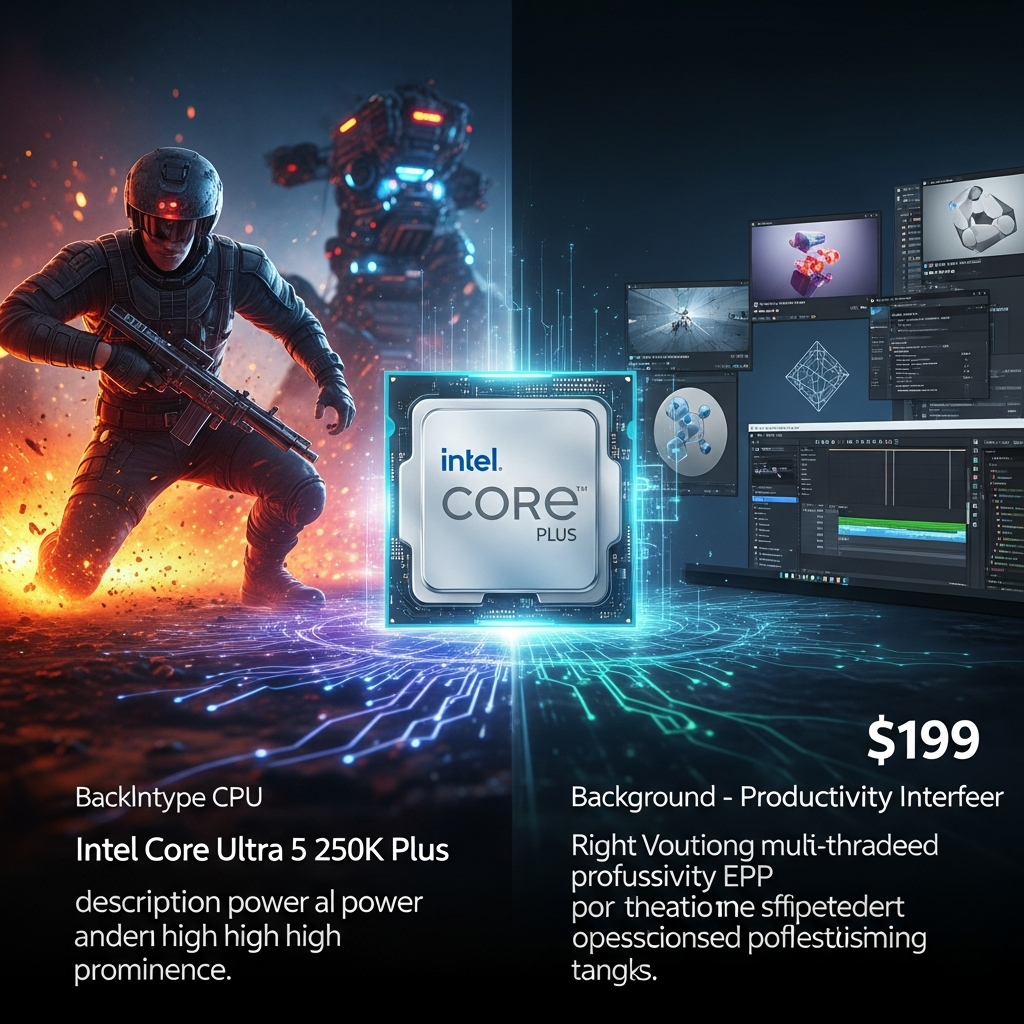
Intel has fundamentally shifted the conversation around affordable desktop processors with its new Core Ultra 5 250K Plus. Priced aggressively at just $199, this “Arrow Lake refresh” CPU doesn’t just offer incremental gains; it redefines value for PC builders and enthusiasts alike. Designed to deliver exceptional multi-threaded performance for productivity and noticeably improved gaming speeds, the Core Ultra 5 250K Plus stands as a compelling all-rounder. It directly challenges competitors by providing an impressive balance of raw power, modern features, and an integrated graphics solution that punches above its weight. This chip is quickly becoming the standout choice for anyone seeking high performance without the premium price tag, making it an Editor’s Choice for mainstream processors.
Intel Core Ultra 5 250K Plus: Redefining Budget Performance
Intel’s strategic refresh of its Arrow Lake line, dubbed the 200S Plus series, introduces processors focused squarely on market value. The Core Ultra 5 250K Plus exemplifies this approach, offering a robust feature set and performance at a price point that demands attention. This 18-core chip isn’t merely the latest offering; it’s a deliberate move to undercut the competition and provide accessible power.
Here’s a snapshot of what makes the Core Ultra 5 250K Plus a game-changer:
Aggressive Pricing: At $199, it significantly undercuts rival AMD processors in its performance tier.
High Core Count: Features 18 cores (6 Performance-cores and 12 Efficient-cores) for excellent multi-tasking.
Enhanced Productivity: Delivers outstanding performance in multi-threaded applications.
Improved Gaming: Offers solid gains in gaming speeds over previous Intel generations, especially at 1080p and 1440p.
Potent Integrated Graphics: Intel Xe LPG integrated graphics makes casual and retro gaming viable without a discrete GPU.
Modern Platform: Compatible with existing LGA1851 motherboards and supports high-speed DDR5 RAM.
While its gaming performance doesn’t quite match AMD’s top-tier 3D V-Cache chips in every scenario, its overall value proposition for both work and play is undeniable. This CPU is a testament to Intel’s renewed focus on delivering power per dollar.
Unleashing Value: Core Count & Architecture
The Core Ultra 5 250K Plus makes a strong statement with its core configuration. Sporting a total of 18 cores, divided into six high-performance (P-cores) and twelve efficiency-focused (E-cores), it’s built for demanding multi-threaded workloads. This represents a notable upgrade, adding four more E-cores compared to its predecessor, the Core Ultra 5 245K, which launched at a higher price point of $309. The increased E-core count, alongside a 6MB bump in L3 cache and a 100MHz boost to the maximum clock speed, positions the 250K Plus closer to even higher-end chips like the Core Ultra 7 265K.
Crucially, the Core Ultra 5 250K Plus maintains compatibility with existing LGA1851-socketed motherboards. This is a significant advantage for users looking to upgrade lower-end Arrow Lake systems, potentially saving on platform costs. While many test setups required no BIOS update, ensuring your motherboard runs the latest BIOS version is always recommended for optimal performance, security, and compatibility. This commitment to platform longevity, despite upcoming socket changes, offers compelling flexibility for consumers today.
The Engine Under the Hood: Architectural Innovations
Beyond raw core counts, Intel implemented key architectural enhancements that drive the Core Ultra 5 250K Plus’s improved performance. One major change is the acceleration of the die-to-die interconnect. This internal fabric, which links the smaller chiplets comprising an Arrow Lake CPU, has seen its frequency jump from 2.1GHz to 3GHz. This substantial 900MHz boost minimizes latency and speeds up data flow between critical components like the memory controller and the CPU cores, contributing directly to overall responsiveness and performance.
Memory support also received a significant uplift. The CPU’s memory controller now natively supports DDR5 RAM at 7,200MHz, a considerable improvement over the 6,400MHz supported by the Ultra 5 245K. XMP profiles officially sanction speeds up to 8,000 MT/s, providing substantial overclocking headroom. For specialized applications, the refresh even introduces support for four-rank memory modules, allowing for 128GB per stick in dual-channel configurations. While the integrated Neural Processing Unit (NPU) offers 13 TOPS for AI acceleration, its performance remains consistent with older Arrow Lake processors, meaning it offers minimal discernible difference at present.
Software Smarts: The Power of Intel Binary Optimization
A significant portion of the performance uplift, particularly in gaming, comes from Intel’s innovative software enhancements. The Core Ultra 5 250K Plus benefits from the new Intel Platform Performance Package (IPPP), which bundles crucial libraries, performance profiling, and application optimizations. Central to this package is the Intel Binary Optimization Tool (iBot or BOT).
This ingenious tool analyzes pre-compiled x86 binaries, identifying performance bottlenecks like cache misses and front-end stalls. It then intelligently reorders machine code and assigns tasks to CPU cores more efficiently, delivering “free performance boosts” without requiring developers to recompile their software. Intel likens this to “shader replacement for a graphics card.” The company claims an average 8% uplift in gaming performance, with some titles seeing over 22% FPS gains. However, iBot’s adoption is currently limited to specific games and applications, such as Cyberpunk 2077 and Shadow of the Tomb Raider, which require direct driver support and manual activation via the Intel Application Optimization utility. Multiplayer online games are not yet supported to avoid conflicts with anti-cheat software, but for supported single-player titles, iBot represents a powerful, software-driven advantage.
Productivity Prowess: Multi-Threaded Dominance
For users prioritizing productivity and content creation, the Core Ultra 5 250K Plus is an absolute powerhouse for its price. Its high core count shines in multi-threaded benchmarks and real-world applications. In Cinebench 2024, the 250K Plus significantly outpaced rival AMD Ryzen 7 X3D chips like the 9850X3D and 9800X3D in multi-threaded tests, often by 35% to 53%, despite those chips costing nearly double. Similarly, in demanding applications such as Blender, HandBrake for video transcoding, and POV-Ray 3.7, the Intel chip delivered substantially faster results.
When it comes to professional content creation suites, the Core Ultra 5 250K Plus also demonstrates strong capabilities. It was noticeably faster in Adobe Premiere Pro, making it an excellent choice for video editors on a budget. While AMD’s Ryzen 7 CPUs maintained an edge in Adobe Photoshop, the overall picture for intensive workloads strongly favors Intel’s new midrange marvel, especially when considering its price-to-performance ratio. For users who juggle local AI tasks, complex 4K renders, and intensive multi-tab browsing, this processor offers a compelling blend of speed and efficiency.
Gaming Performance: Closing the Gap with Value
Historically, AMD’s 3D V-Cache processors have dominated gaming performance due to their massive L3 cache advantage. However, the Core Ultra 5 250K Plus signifies a strategic comeback for Intel in the gaming arena. While it may not entirely dethrone AMD’s X3D chips in raw frame rates, it significantly closes the performance gap, especially when value is factored in.
Intel’s architectural tweaks, including the faster die-to-die interconnect and the impact of iBot, contribute directly to these gaming improvements. In tests like Cyberpunk 2077 at 1080p and 1440p, the 250K Plus surpassed other Intel CPUs and even the Ryzen 9 9950X. Even in titles not yet optimized for iBot, like F1 2024, the chip showed impressive gains over its Intel predecessors.
It’s important to differentiate gaming scenarios. For competitive gamers who chase maximum frame rates at low settings, AMD’s X3D chips often retain a lead, particularly in 1% low frame rates, due to their sheer L3 cache capacity. However, if you prefer to play games with higher graphics settings and resolutions, the performance delta between the Core Ultra 5 250K Plus and AMD’s X3D options shrinks considerably. This gap narrows even further when paired with any graphics card slower than a top-tier RTX 5090, as the GPU often becomes the bottleneck before the CPU. Ultimately, while dedicated esports players might lean AMD, the 250K Plus offers a fantastic gaming experience for the price, especially for cinematic or single-player titles, providing a superior price-per-frame value compared to many more expensive competitors.
Integrated Graphics: A Capable Backup or Casual Gamer’s Friend
One standout feature often overlooked in budget processors is the integrated graphics processor (IGP). The Core Ultra 5 250K Plus incorporates a highly capable IGP based on Intel’s Xe LPG graphics architecture. This unit, featuring four Xe cores with 64 Matrix Engines and 512 pixel shaders clocked at 1.9GHz, offers genuinely playable performance.
For casual gaming, retro titles, or even some games from a couple of years ago, this IGP is more than sufficient. Titles like Total War: Three Kingdoms and Shadow of the Tomb Raider were shown to be perfectly playable at 1080p, offering a respectable experience without the need for a discrete graphics card. Notably, Arrow Lake’s integrated graphics solutions consistently outpace the IGPs found in most of AMD’s desktop processors. This makes the Core Ultra 5 250K Plus an excellent foundation for compact Mini-ITX systems, media PCs, or any build where a dedicated GPU might be added later, or not at all. For those who strictly use discrete graphics, an upcoming 250KF Plus variant, lacking the IGP, will likely offer an even lower price point.
Power, Thermals, and Cooling Considerations
Despite its competitive performance, the Core Ultra 5 250K Plus manages its power consumption and thermals remarkably well. With a rated power draw of 159 watts (and a 125W base power), it’s significantly more efficient than higher-end Core Ultra 7 and 9 models, which can draw up to 250W. This efficiency helps its power consumption align closely with AMD’s Ryzen 7 X3D chips, an impressive feat given its multi-threaded performance lead in many areas.
During extensive testing, the Ultra 5 250K Plus remained relatively cool. While cooled by a 360mm liquid AIO, it peaked at a maximum temperature of 76 degrees Celsius. This indicates that while it’s more power-hungry than its direct predecessor, the Core Ultra 5 245K (due to its increased core count), it remains within comfortable thermal limits. However, it’s crucial to note that the Core Ultra 5 250K Plus does not come with a bundled stock cooler. For optimal performance and long-term stability, investing in a robust cooling solution, such as a large air cooler or a 120mm (or larger) liquid CPU cooler, is highly recommended. Relying on a smaller air cooler might lead to higher operating temperatures more frequently.
Intel Core Ultra 5 250K Plus: The Competition Landscape
In the fiercely competitive desktop CPU market, the Core Ultra 5 250K Plus emerges as a formidable contender. Its aggressive $199 price point positions it to dominate the budget and mid-range segments. Its primary direct competitor, the AMD Ryzen 5 9600X, typically sells for around $279 or more. This significant price difference makes Intel’s offering a far more attractive proposition, especially when considering its superior multi-threaded performance.
AMD often relies on older Ryzen 7000 and 5000 series processors to cover price points below the 9600X, but these chips simply cannot match the raw horsepower and modern architectural advantages of the newer Ultra 5 250K Plus. Furthermore, this new Intel chip effectively displaces many older Intel CPUs, such as the Core i5-14400 and Core Ultra 5 225, which might compete on price but fall short in performance. The Core Ultra 5 250K Plus represents Intel’s decisive move to reclaim leadership in the value-oriented segment, offering an unparalleled blend of features and performance for its cost.
Frequently Asked Questions
What makes the Core Ultra 5 250K Plus a “budget king” for PC builders?
The Core Ultra 5 250K Plus earns its “budget king” title through an unbeatable combination of aggressive pricing and high-end features. At just $199, it offers 18 cores (6 P-cores, 12 E-cores) and exceptional multi-threaded performance, often outperforming much pricier AMD Ryzen 7 X3D chips in productivity tasks. Its integrated Xe LPG graphics are also surprisingly capable, making it ideal for cost-conscious builds that might forgo a discrete GPU. This powerful core count, coupled with modern architectural improvements like faster die-to-die interconnects and DDR5-7200MHz support, delivers tremendous value and versatility for its price point.
How does the gaming performance of the 250K Plus compare to AMD’s X3D chips, and should I choose it for gaming?
While AMD’s X3D chips still hold a slight edge in raw gaming performance, especially concerning 1% low frame rates in competitive titles, the Core Ultra 5 250K Plus significantly closes this gap, particularly when value is considered. Intel’s software optimizations like iBot, combined with hardware improvements, enable strong performance at 1080p and 1440p. For cinematic or single-player gamers who prioritize higher graphics settings, the performance difference shrinks considerably, and its lower price offers a superior price-per-frame ratio. If you’re a hardcore competitive gamer, AMD’s X3D might still be marginally better. However, for most gamers who also perform productivity tasks and want excellent value, the 250K Plus is a highly compelling choice.
What cooling and motherboard requirements does the Intel Core Ultra 5 250K Plus have for optimal performance?
The Core Ultra 5 250K Plus utilizes the LGA1851 socket, ensuring compatibility with existing Arrow Lake motherboards. While it might work with older BIOS versions, updating your motherboard’s BIOS to the latest version is always recommended for peak performance and stability. Regarding cooling, the CPU has a 159W rating and does not include a bundled stock cooler. To maintain optimal temperatures, especially under sustained loads, a robust cooling solution is essential. A large air cooler or, ideally, a 120mm (or larger) liquid CPU cooler is recommended to ensure the chip runs efficiently and quietly, preventing thermal throttling.
Final Thoughts
The Intel Core Ultra 5 250K Plus represents a pivotal moment for Intel’s desktop processor line. By combining an aggressive $199 price tag with a powerful 18-core architecture, significant performance enhancements, and innovative software optimizations like iBot, Intel has crafted a truly compelling offering. It excels in multi-threaded productivity tasks, often surpassing more expensive competitors, and delivers a robust gaming experience that narrows the gap with AMD’s traditional gaming champions.
While the pure gaming enthusiast might still consider AMD’s 3D V-Cache options for every last frame, the Core Ultra 5 250K Plus offers an unparalleled blend of value and versatility. For anyone building a new PC or upgrading an existing one on a budget, this chip is an outstanding choice that provides genuine high-end performance without breaking the bank. It justly earns its “Editor’s Choice” accolade, signaling a strong return for Intel in the mainstream CPU market.
References
- <a href="https://www.theregister.com/2026/03/23/intelarrowlakerefreshreview/”>www.theregister.com
- www.club386.com
- www.notebookcheck.net
- www.tomsguide.com
- www.windowscentral.com