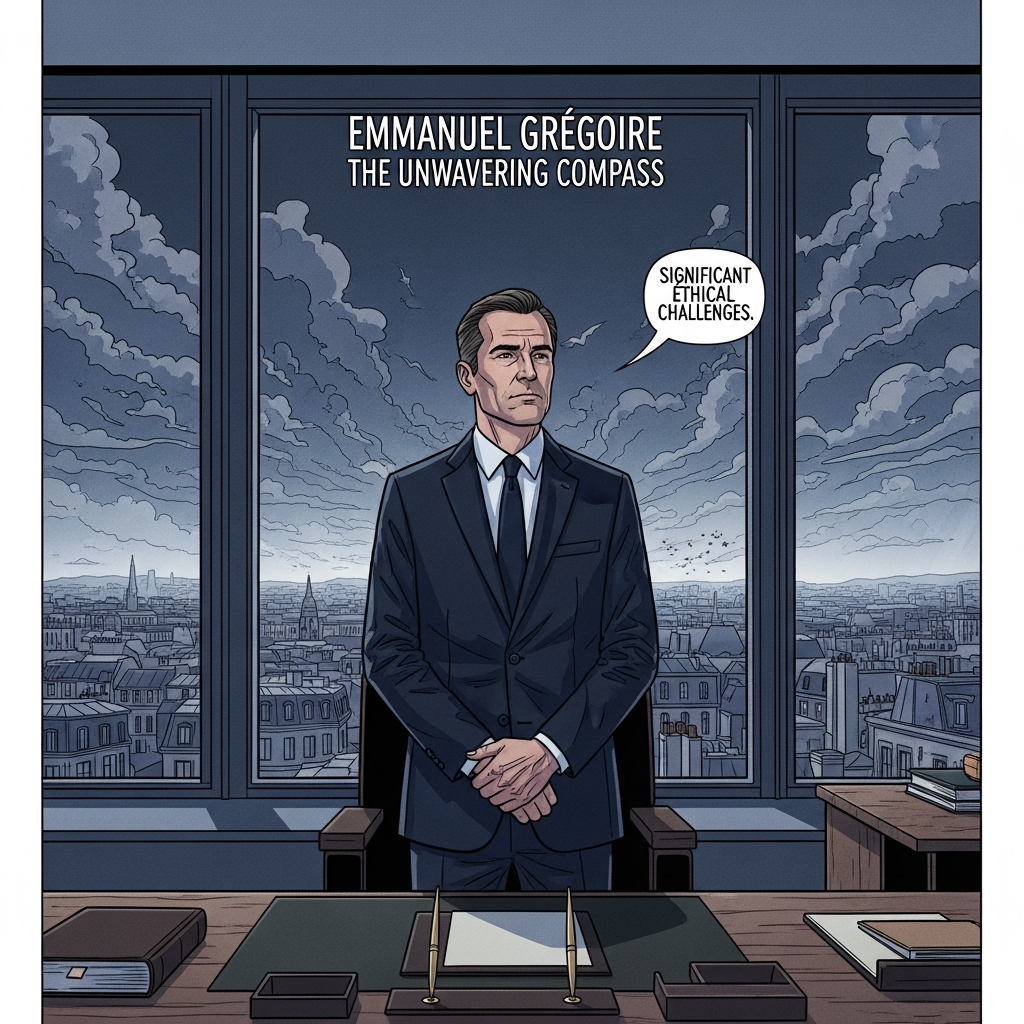
Paris has elected Emmanuel Grégoire as its new mayor, ushering in an era defined by a bold commitment to “absolute moral rigour.” Taking office after a significant victory for the left, Grégoire faces immediate, profound tests to his administration’s ideals. From a pressing child protection scandal to ambitious environmental and social reforms, his leadership promises a transformative, yet challenging, path for the French capital. This pivotal moment for Paris also carries broader implications for French politics, especially with the 2027 presidential election on the horizon.
A Mandate for Moral Rigour and Progressive Change
Emmanuel Grégoire, a 48-year-old Socialist, secured his mayoral victory by campaigning on a platform of ethical governance and deep-seated societal reform. His win marked a fifth consecutive term for the Socialists in Paris. Symbolizing his down-to-earth approach, Grégoire famously took a celebratory tour on a share-scheme bicycle. This simple act underscored his pledge of humility and frugality, positioning him as “of an absolute moral rigour.” He defeated right-wing former minister Rachida Dati in a hard-fought contest.
Central to his “moral rigour” promise is a drastic overhaul of official conduct. Grégoire has committed to shrinking Paris officials’ hefty expense accounts. He also plans to end the use of chauffeur-driven cars for city officials. Transparency is a key focus, with pledges to guarantee open reporting on expenses for district mayors and elected representatives. Even budgets for items like clothing and travel face reduction under his new directive. These measures aim to restore public trust and redefine the standards of urban governance.
Pioneering Sustainable Urbanism and Environmental Action
Grégoire’s victory is a resounding endorsement of progressive environmental policies in Paris. He has pledged to continue and expand the city’s pro-cycling and pedestrian-friendly initiatives. His administration will build new bike lanes and uphold existing limits on cars in the city. These steps are vital for reducing Paris’s dangerous air pollution and addressing the health threat of soaring summer temperatures. The previous administration, under Anne Hidalgo, had already invested significantly in cycling infrastructure. Grégoire will carry this legacy forward, aiming for an even greener Paris.
His ambitious urban transformation plans include turning 10 major boulevards into public gardens. Additionally, he promises to pedestrianize 1,000 streets across the city. These initiatives align with the “15-minute city” concept, a vision for urban planning where residents can access essential services within a short walk or bike ride. While this concept has sparked debate, Grégoire’s election confirms public support for reducing car dependency. His commitment ensures Paris remains at the forefront of sustainable urban development.
Confronting the Child Protection Crisis Head-On
One of the most immediate and severe challenges facing Mayor Grégoire is a profound child protection scandal. Paris has been rocked by multiple police inquiries into alleged sexual abuse and rape of young children in state nursery and primary schools. By 2025, at least 30 school monitors in Paris had been suspended following abuse complaints. Grégoire has been outspoken about the previous administration’s mishandling of complaints from concerned parents.
He has promised a “total transformation” of the recruitment and oversight system for school monitors. Grégoire calls for a “big bang” to address “major dysfunction” within the system. His proposed reforms include changing recruitment processes, revising contracts, and launching a citizens’ consultation. This issue carries deeply personal significance for Grégoire, who revealed during his campaign that he himself was sexually abused as a child by a school monitor. His candid disclosure underscores his unwavering commitment to safeguarding Paris’s most vulnerable residents.
Tackling Paris’s Pressing Social Issues
Beyond environmental and ethical reforms, Mayor Grégoire has committed to addressing Paris’s persistent social challenges. The city faces severe social housing shortages, a crisis exacerbated by the proliferation of tourist rentals. Grégoire has famously declared, “Airbnb is my enemy,” signaling his intent to tackle the impact of short-term rentals on housing affordability for residents. His administration will likely implement stricter regulations to prioritize long-term housing for Parisians.
Another critical concern is the escalating homelessness problem, particularly the increasing number of families with children sleeping rough. Grégoire has made a solemn promise: “no more children are sleeping rough.” Charities and community groups are closely monitoring how his administration plans to achieve this ambitious goal. His policies aim to create a more equitable Paris, ensuring dignified living conditions for all its inhabitants.
Paris: A Bastion Against the Far-Right
Emmanuel Grégoire’s victory holds significant political weight beyond the Parisian city limits. It was part of a broader round of mayoral elections across France, seen as a crucial barometer ahead of the 2027 presidential election. His win for the united grouping of Socialists, Greens, and other centre-left parties sends a clear message. Grégoire explicitly framed his success as a “clear rejection of racism and antisemitism.” He vowed to make Paris a “place of resistance” against “Trumpian politics” and the far-right.
While the far-right National Rally (RN) saw gains in smaller towns, their failure to capture major urban centers like Marseille and Paris was a strategic setback. The elections revealed that a unified “Republican front” of mainstream parties can still effectively block the far-right in significant urban areas. Grégoire’s victory in Paris demonstrates that a bold, progressive platform can resonate, even as the national political landscape remains fragmented. His leadership in Paris will serve as a prominent counter-narrative against the rising tide of far-right sentiment across France.
From Deputy to Defining Leader
Despite his decade of service at city hall, including six years as deputy mayor to the outgoing Anne Hidalgo, Emmanuel Grégoire was relatively unknown to the public before this mayoral campaign. He oversaw the city budget and played a crucial role in Hidalgo’s administration. Notably, he was not Hidalgo’s personal choice as successor. This distance from the incumbent, however, proved advantageous. It allowed Grégoire to carve out his own identity and position himself as a candidate bringing fresh perspectives and genuine change. His 2024 win of a Paris parliament seat, achieved after left-wing parties allied to counter the far-right in a snap election, further solidified his political standing.
Grégoire’s ascent marks a new chapter for Paris. His journey from deputy to mayor, coupled with his ambitious promises, sets the stage for a compelling and closely watched tenure. His ideals of “absolute moral rigour” face rigorous testing. Paris, under his guidance, is poised for a period of intense reform.
Frequently Asked Questions
What key pledges define Emmanuel Grégoire’s mayoralty in Paris?
Emmanuel Grégoire’s mayoralty is defined by several core pledges. Foremost is his commitment to “absolute moral rigour,” which involves drastically cutting officials’ expenses, ending chauffeur-driven cars, and ensuring transparency in city spending. Environmentally, he champions expanding bike lanes, pedestrianizing streets, and creating public gardens. Socially, he aims to combat the housing crisis, notably by tackling tourist rentals (“Airbnb is my enemy”), and to end homelessness for families with children.
How does Mayor Grégoire plan to address the child protection scandal in Paris?
Mayor Grégoire has promised a “total transformation” and a “big bang” to tackle the child protection scandal in Paris schools. This includes revising recruitment processes and contracts for school monitors. He also plans to launch a comprehensive citizens’ consultation to gather public input and ensure accountability. His personal experience as a childhood sexual abuse survivor fuels his determination to implement significant systemic reforms and improve oversight.
What impact will Emmanuel Grégoire’s victory have on the broader French political landscape?
Emmanuel Grégoire’s victory in Paris provides a significant boost for centrist and left-wing parties in France. It demonstrates that a unified progressive front can successfully resist the far-right National Rally (RN) in major urban centers. His win is seen as a “clear rejection of racism and antisemitism,” positioning Paris as a “place of resistance” against “Trumpian politics.” This outcome offers crucial insights into alliance strategies and political dynamics ahead of the 2027 presidential election, highlighting the viability of the left in key urban strongholds.