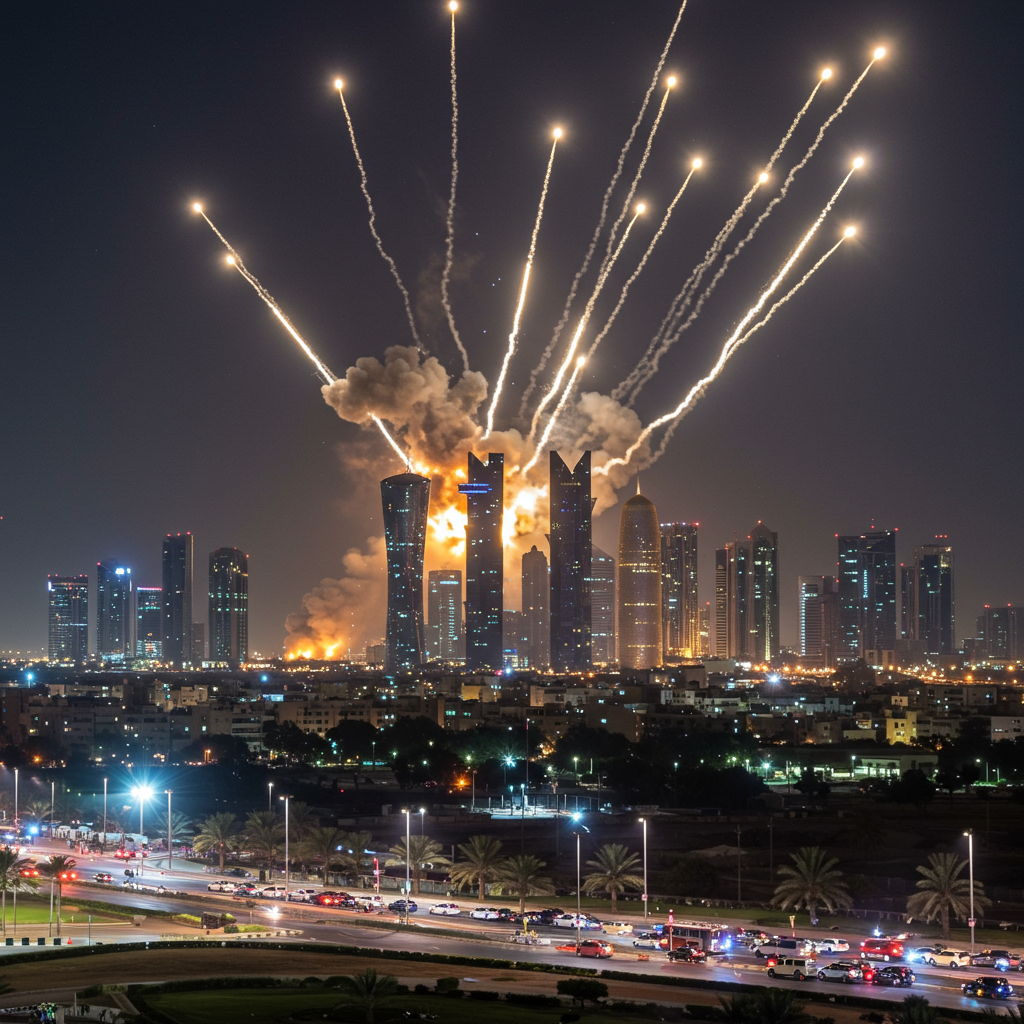
Recent Iranian missile strikes, targeting the strategic Israeli towns of Arad and Dimona near a vital nuclear research facility, have ignited a fierce debate regarding Israel’s defense readiness and its assessment of Iranian military capabilities. This escalating conflict, with significant casualties reported, marks a critical juncture, drawing the Israeli public into the direct impact of war in an unprecedented way. As regional tensions soar and global leaders issue stark warnings, a pressing question emerges: has Israel truly underestimated the scope and sophistication of Iran’s formidable military arsenal?
Recent Escalation: A Shockwave Across Israel
The events of March 22, 2026, sent shockwaves through Israel. Iranian missiles struck civilian areas in Arad and Dimona, wounding at least 180 people and necessitating the evacuation of hundreds. This attack, explicitly declared by Iran as retaliation for an earlier Israeli-US strike on its Natanz nuclear facility, highlights a new, more lethal phase in the ongoing conflict. Israeli Prime Minister Benjamin Netanyahu acknowledged a “very difficult evening in the battle for our future,” with total war-related casualties in Israel reaching 4,564 since February 28.
The Arad and Dimona Strikes
The precision and impact of the strikes on Arad and Dimona underscore a critical shift. These towns, particularly Dimona, are home to Israel’s primary nuclear research center, making them highly strategic targets. The successful penetration of some Iranian munitions past Israeli air defenses, despite activation, raised immediate concerns about the effectiveness of existing protective measures against a determined adversary.
Unprecedented Impact on Israeli Public
Analysts observe a profound change in the conflict’s dynamics. While Israel has historically engaged in military campaigns in Gaza, the occupied West Bank, and Lebanon, it’s rare for the Israeli populace to experience the direct effects of war on its home front with such intensity. This psychological shift contributes to the growing apprehension and the urgent reassessment of military strategies. Furthermore, the broader context of violence in the region, including accusations of a “genocidal war” against Palestinians in Gaza and intensified Israeli military actions and displacement in the occupied West Bank, fuels the narrative of a deeply entrenched and escalating conflict.
Iran’s Evolving Missile Arsenal: A Deep Dive
For decades, Iran has meticulously cultivated the Middle East’s largest and most diverse missile program. This strategic investment provides Tehran with significant reach and deterrence, effectively compensating for its lack of a modern air force. The program encompasses a wide array of ballistic and cruise missiles, designed for various engagement scenarios.
The Breadth of Iranian Missile Power
Iran’s missile development, unfettered by international enforcement mechanisms, has focused on enhancing both offensive capabilities and the resilience of its proxy networks. From short-range tactical weapons to longer-range strategic deterrents, Iran’s arsenal is designed to be versatile and adaptable in a regional conflict. Israeli defense officials are particularly concerned that Iran has steadily channeled advanced missile production know-how and substantial funding to regional proxies from Yemen to Lebanon, exacerbating potential multi-front threats.
Short- and Medium-Range Systems
Iran’s short-range ballistic missiles, with ranges between 150km and 800km (93-500 miles), are optimized for rapid regional strikes and targeting nearby military objectives. Key systems include the Fateh variants (like Zolfaghar), Qiam-1, and the older Shahab-1/2 missiles. Their shorter range allows for volleys, compressing warning times and making pre-emption significantly more difficult. Medium-range systems extend this reach, featuring the Shahab-3, Emad, Ghadr-1, various Khorramshahr models, and Sejjil missiles, alongside newer designs such as Kheibar Shekan and Haj Qassem.
Long-Range and Cruise Missiles
Iran also possesses a robust capability in longer-range land-attack and antiship cruise missiles. These include the Soumar, Ya-Ali, and Quds variants, Hoveyzeh, Paveh, and Ra’ad. The Soumar, one of Iran’s longest-reaching ballistic missiles, reportedly has a range of 2,000km to 2,500km (1,243-1,553 miles). Intriguingly, reports surfaced of two Iranian missiles potentially targeting the US-UK military base on Diego Garcia, 4,000km (2,485 miles) from Iran, though Iranian officials denied the claim. This suggested capability far exceeds previously acknowledged limits and follows a critical decision by former Iranian Supreme Leader Ali Khamenei to remove the 2,200km missile range cap after a previous 12-day conflict with Israel in June.
The Controversial Use of Cluster Munitions
A particularly alarming aspect of Iran’s recent attacks is the confirmed use of cluster munitions. As explained by Uzi Rubin, founding director of Israel’s missile defense program, these are not single explosive payloads. Instead, a cluster warhead disperses multiple bomblets—ranging from 20 to 80, depending on the missile—over a wider area upon approaching its target. This method maximizes ground impact, making interception exceedingly challenging. While Iran has reportedly used these munitions before, their deployment in the latest strikes has drawn sharp criticism. Amnesty International has condemned such use as a “flagrant violation of international humanitarian law.” It’s important to note that neither Iran nor Israel are signatories to the 2008 Convention on Cluster Munitions, which bans these weapons.
Defense Challenges: Why Israeli Systems Fell Short
The fact that some Iranian missiles successfully struck Arad and Dimona, despite Israel’s advanced air defense systems being active, points to specific technical and strategic challenges. An investigation is reportedly underway, with an Israeli military spokesman acknowledging the interception failures.
Intercepting Cluster Warheads: A Technical Hurdle
The nature of cluster munitions presents a formidable challenge to missile defense. For a ballistic missile carrying cluster bomblets to be effectively intercepted, it must occur before the payload opens and releases its submunitions. Once the warhead disperses, the threat transforms from a single, identifiable target into multiple, smaller, and widely dispersed projectiles. This rapid fragmentation makes it exponentially more difficult for conventional air defense systems to track and neutralize all incoming threats, significantly reducing warning times and increasing the likelihood of successful strikes.
Strategic Decisions: Conserving Interceptors?
Adding to the complexity, reports from The Times of Israel suggested that the Israeli air force might be conserving its interceptors. Military officials reportedly assessed that Iranian cluster bombs were unlikely to cause significant harm if people took shelter, potentially leading to a decision to avoid shooting down some of them. However, with 180 wounded in the March 22 attacks, this calculation appears to have been tragically incorrect, prompting serious questions about strategic priorities in a rapidly evolving threat landscape. The IDF had also “burned through a host of boutique capabilities,” including “unprecedented deceptions, special weaponry, classified technologies and tactics,” specifically reserved for Iran, in a previous campaign.
Beyond Missiles: The Broader Strategic Miscalculations
The ongoing conflict between the US, Israel, and Iran, now seemingly entering a dangerous new phase, appears to be founded on a series of significant miscalculations by key players. The “illusion of control” has permeated strategic thinking, leading to assumptions that calibrated pressure and limited strikes would not trigger a wider regional conflagration.
The Illusion of Control: US and Israeli Assumptions
The US strategy, particularly under President Trump, has been characterized by a drive for “peace by subjugation” – demanding Iran dismantle its nuclear program, limit missile capabilities, and abandon regional alliances. This approach, backed by a massive military buildup, rested on the precarious assumption that Iran would confine its responses to a limited war to preserve its regime. However, Iran’s Supreme Leader had explicitly warned that any US-initiated conflict would become a regional war. This misjudgment was arguably fueled by Iran’s earlier, notably restrained responses to provocations like the assassination of General Qasem Soleimani, which was mistakenly interpreted as a sign of weakness rather than strategic prudence.
Hezbollah’s Resurgence: A Second Front
A second critical miscalculation, largely on Israel’s part, concerned Hezbollah. Following a year of conflict on Israel’s northern front and the alleged elimination of much of Hezbollah’s leadership, Prime Minister Netanyahu had declared the Lebanese armed movement “pushed decades back” and no longer a threat. This assessment, bolstered by Hezbollah’s restraint during Israel’s previous 12-day war with Iran, suggested a belief that they would not pose a significant threat during an attack on Iran. However, just two weeks into the current conflict, Hezbollah has demonstrated formidable capabilities, firing long-range missiles into central Israel and hundreds of rockets into the north, paralyzing the region and causing Israeli casualties. This has opened a dangerous second front, stretching Israel’s resources and creating immense political pressure.
The Regime Change Gambit: An Unfulfilled Objective
At the core of the US-Israeli strategy, according to some analysts, is an attempt at regime change in Iran. This objective, particularly a “lifelong obsession” for Netanyahu, contrasts with earlier claims of merely preventing Iran’s nuclear and ballistic missile programs. This shift implied that previous efforts to cripple Iran’s capabilities were unsuccessful. The assumption that the Iranian government was close to collapse, influenced by perceived weakening of Iran and its allies, internal demonstrations, and the effects of earlier conflicts, has proven flawed. US intelligence sources suggest the Iranian government is not on the verge of collapse, and Iran successfully managed the succession of its Supreme Leader. If regime change fails, it could signify a colossal defeat for US hegemony in the Middle East, potentially benefiting rivals and damaging both US and Israeli standing globally.
A Region on the Brink: Escalation and Global Repercussions
The current phase of the conflict involves a dangerous game of tit-for-tat targeting critical infrastructure, threatening to spiral into a wider, devastating regional war with global economic implications.
Targeting Critical Infrastructure
The cycle of strikes has seen US and Israeli forces target Iran’s Natanz nuclear facility, one of its most important uranium enrichment sites. In response, Iran has directly targeted Israel’s main nuclear facility near Dimona. Israel has also struck fuel storage facilities in Tehran, causing vast toxic smoke, while the US has hit Iran’s Kharg Island, a vital oil export hub, threatening further attacks. This pattern suggests that important infrastructure will continue to be a primary target for all parties.
The Strait of Hormuz: A Global Chokepoint
Perhaps the most significant and immediate global threat stems from Iran’s actions in the Strait of Hormuz. Iran has “essentially closed” this vital chokepoint, through which a significant portion of the world’s oil and gas transits. This move, coupled with Iran’s targeting of military bases and crucial energy infrastructure across Arab Gulf countries, risks triggering a global energy crisis. US President Donald Trump issued a stern 48-hour ultimatum, demanding the full reopening of the Strait, threatening to “hit and obliterate their various POWER PLANTS, STARTING WITH THE BIGGEST ONE FIRST” if Iran did not comply. Such actions underscore the severe economic and geopolitical consequences of this escalating conflict.
Humanitarian Crisis and Broader Context
Beyond the immediate military clashes, the conflict deepens existing humanitarian crises. In Gaza, despite a US-brokered ceasefire, hundreds of Palestinians have been killed, with the total casualty count since October 2023 exceeding 72,000. Displacement, lack of essential resources, and accusations of torture against Palestinian detainees highlight the severe human cost of the ongoing violence. This broader context of human rights concerns and humanitarian catastrophe inextricably links the regional dynamics to the ethical implications of the conflict.
The Path Forward: Navigating a Volatile Future
The current trajectory suggests that the conflict is no longer about avoiding war, but preventing its expansion. The illusion of control has dissipated, revealing a systemic confrontation with far-reaching consequences. For any hope of stabilization, experts argue that diplomacy must replace incremental coercion. The critical lessons from previous administrations — that limited war rarely stays limited in the Gulf — appear more relevant than ever. Israeli officials, while preparing for further hostilities, caution against media “noise” that could inadvertently provoke a preemptive Iranian strike. The future remains precarious, with the potential for further multi-front escalations and a reassessment of alliances and strategies across the Middle East.
Frequently Asked Questions
What makes Iran’s missile program particularly challenging for defense systems?
Iran’s missile program is challenging due to its sheer size, diversity, and technological advancements, including the use of cluster munitions. The arsenal comprises short- to long-range ballistic and cruise missiles that can be launched in volleys, shortening warning times. Cluster warheads, which disperse multiple bomblets, complicate interception because a single target quickly becomes numerous, smaller projectiles, making it exceedingly difficult for air defense systems to neutralize all incoming threats after dispersal.
Where are the key strategic chokepoints and nuclear facilities involved in this escalating conflict?
Key strategic locations involved include Iran’s Natanz nuclear facility and Israel’s main nuclear research center near Dimona, both of which have been targets. Other crucial infrastructure includes fuel storage facilities in Tehran and Iran’s Kharg Island oil export hub. A critical global chokepoint is the Strait of Hormuz, which Iran has “essentially closed,” threatening global oil and shipping traffic, prompting severe warnings from international leaders.
How might the use of cluster munitions impact international law and future conflict strategies?
The use of cluster munitions by Iran, though not new, has significant implications for international law and future conflict strategies. While banned by the 2008 Convention on Cluster Munitions, neither Iran nor Israel are signatories, allowing their continued use without direct legal violation for these specific states. However, their deployment garners strong condemnation from human rights groups like Amnesty International, which calls it a “flagrant violation of international humanitarian law.” Strategically, their effectiveness against modern air defenses may encourage their proliferation or further development in future conflicts, posing severe humanitarian risks due to their indiscriminate nature.