The universe often holds its most profound secrets in plain sight, waiting for a serendipitous moment to be revealed. Such was the case when NASA’s Hubble Space Telescope, a venerable eye on the cosmos, unexpectedly captured comet C/2025 K1 (ATLAS) in the rare act of breaking apart. This extraordinary event offers astronomers an unprecedented real-time glimpse into the dynamic forces that can shatter these ancient celestial wanderers, providing critical clues about the very origins of our solar system. The detailed findings from this accidental discovery were published in the prestigious journal Icarus.
Hubble’s Fortuitous Gaze: Witnessing the Unpredictable
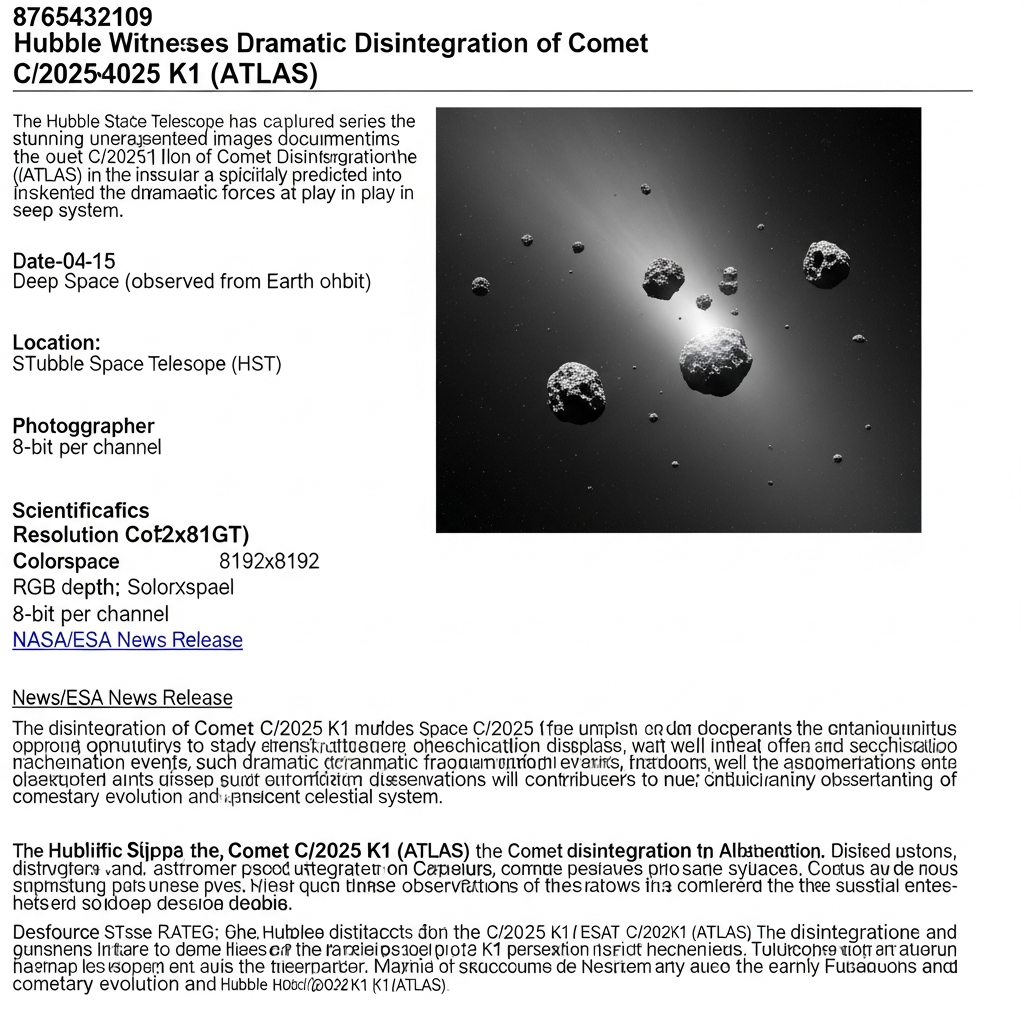
Observing a comet as it disintegrates is a scientifically coveted yet incredibly difficult feat. These events are often unpredictable and fleeting, making precise targeting challenging. John Noonan, a physics professor at Auburn University and co-author of the study, aptly described the situation: “Sometimes the best science happens by accident.” The Hubble team hadn’t initially intended to observe Comet C/2025 K1 (ATLAS). Technical issues with their original target forced a last-minute change. Remarkably, as Hubble turned its powerful gaze towards K1 in November 2025, the comet began to fragment.
This “extraordinarily minuscule” probability yielded a goldmine of data. Noonan himself recalled seeing the initial images and realizing there wasn’t just one comet, but at least four distinct objects. This immediate observation, mere days after the initial breakup, proved invaluable. Previous attempts to witness such an early stage of cometary fragmentation had been thwarted by scheduling complexities.
Anatomy of a “Dirty Snowball”: Why Comets Break
Comets are often dubbed “dirty snowballs,” loose conglomerations of ice, dust, and rock that orbit the Sun. Comet K1, discovered by the ATLAS survey in May 2025, is a long-period comet. It originated from the distant Oort Cloud, a vast reservoir of icy bodies located at the far reaches of our solar system. Objects from the Oort Cloud are considered primordial relics, preserving material largely unchanged since the solar system’s formation billions of years ago.
As a comet like K1 ventures closer to the Sun, solar heating causes its various ices to sublimate, transforming directly into gas. This process creates a glowing “coma” — a fuzzy envelope of gas and dust — and often a spectacular tail. However, this solar heating also exerts immense stress on the comet’s fragile structure. Coupled with gravitational forces, these pressures can overwhelm the comet, leading to its fragmentation. K1 was estimated to be about 5 miles (8 kilometers) across before its dramatic disintegration, slightly larger than an average comet. The breakup likely occurred shortly after its closest approach to the Sun, known as perihelion, when it experienced maximum heating and stress within Mercury’s orbit.
Hubble’s Unparalleled Detail of Fragmentation
Hubble observed Comet K1 over three consecutive days: November 8, 9, and 10, 2025. The telescope’s high-resolution instruments captured the comet splitting into at least four primary pieces. Each of these fragments developed its own miniature coma of gas and dust. What truly amazed scientists was the ongoing nature of the event; during the observation period, one of the smaller fragments was seen breaking apart even further.
Ground-based telescopes at the time could only detect faint, indistinguishable bright blobs. Hubble’s sharp vision was crucial, allowing scientists to meticulously track the individual fragments as they drifted apart. This provided an unusually clear and detailed view of the entire disintegration process, offering insights into how ancient objects in our solar system evolve and ultimately meet their end. Researchers estimate that the initial breakup of the Comet K1 ATLAS breakup began approximately eight days before Hubble commenced its observations.
The Delayed Brightening Enigma: A Cometary Mystery
One of the most perplexing findings from the Hubble comet breakup observation was the absence of an immediate brightening after fragmentation. Scientists had expected that the exposure of fresh, pristine ice during the breakup would lead to an almost instantaneous surge in brightness. However, ground-based observers noted a delay between the physical splitting and the visible outbursts. This puzzling phenomenon challenges conventional understanding of cometary behavior.
The research team has proposed two leading theories to explain this delay:
Dust Layer Formation: It’s possible that a thin layer of dry dust needs to form over the newly exposed ice before it can be effectively blown off by solar radiation and gas jets. This dust layer would then be responsible for reflecting sunlight, leading to the delayed brightening.
Internal Pressure Buildup: Alternatively, heat might need to penetrate beneath the comet’s surface, slowly building up internal pressure. This accumulated pressure could then suddenly eject an expanding cloud of dust, causing the delayed outburst.
This early observation, just days after the fragmentation, is paramount for understanding the precise physical processes occurring at a comet’s surface. It provides critical data on the timescale required for a substantial dust layer to form and be ejected by the escaping gases.
Unlocking Ancient Chemistry and Solar System Origins
Beyond the mechanics of the breakup, Comet K1 is revealing secrets about the primordial material of our solar system. Early ground-based observations indicate that K1 is chemically unusual, showing significantly lower levels of carbon compared to most other comets. This distinct composition hints at unique formation conditions or evolutionary paths for this specific icy body.
Studying a comet during its fragmentation allows scientists to effectively “crack open” the object. This provides a rare opportunity to view ancient material that has not been processed or altered by billions of years of exposure to solar radiation and cosmic rays. By analyzing this pristine interior, researchers can differentiate between a comet’s original, primitive properties and any changes induced by its long journey through space. Future spectroscopic analysis using Hubble’s STIS (Space Telescope Imaging Spectrograph) and COS (Cosmic Origins Spectrograph) instruments is expected to provide even more detailed insights into K1’s unique chemical makeup and, by extension, the very origins of our solar system. While other fascinating celestial events, like the flare-up of interstellar comet 3I/ATLAS, offer insights into extrasolar chemistry, K1 provides a rare window into our own cosmic backyard.
The Legacy of K1 and Hubble’s Enduring Vision
The fragments of Comet C/2025 K1 (ATLAS) are now approximately 250 million miles from Earth, traveling through the constellation Pisces. Having shed its structural integrity, K1 is outbound and expected to permanently exit the solar system, with no likelihood of return. However, its dramatic demise has left an invaluable scientific legacy.
The observation of the Comet K1 ATLAS breakup underscores the continued importance and scientific prowess of the Hubble Space Telescope. A collaborative mission between NASA and the European Space Agency, Hubble has been providing groundbreaking astronomical observations for over three decades. This accidental yet profound discovery highlights how continuous observation and adaptability can lead to some of the most significant breakthroughs in our understanding of the cosmos. The data gathered from K1 will continue to inform our knowledge of cometary physics, solar system formation, and the surprising resilience—and fragility—of these icy time capsules from space.
Frequently Asked Questions
What caused Comet C/2025 K1 (ATLAS) to break apart?
Comet C/2025 K1 (ATLAS) broke apart primarily due to the intense stress it experienced during its closest approach to the Sun, a point known as perihelion. As the “dirty snowball” made of ice, dust, and rock neared the Sun, solar heating caused its ices to sublimate into gas. This process, combined with strong gravitational forces and internal weaknesses, overwhelmed the comet’s fragile structure, leading to its fragmentation into at least four pieces. The breakup likely began about eight days before Hubble’s observations in November 2025.
Why was Hubble’s observation of Comet K1 ATLAS considered so “special” or accidental?
Hubble’s observation of Comet K1 ATLAS breaking apart was special because it was entirely serendipitous and occurred at an unprecedented early stage. The research team was forced to switch targets due to technical constraints and stumbled upon K1’s disintegration just as it was happening. Observing a comet’s fragmentation in real-time and so soon after it begins is extremely rare; previous observations usually occurred weeks or months later. This early vantage point provided critical, real-time data on the physics occurring at the comet’s surface.
What new insights does the breakup of Comet K1 ATLAS offer about comets or our solar system?
The breakup of Comet K1 ATLAS offers several key insights. Firstly, it provides direct evidence of the forces that can destroy comets, improving models of cometary evolution. Secondly, the puzzling delay between the comet’s physical breakup and its visible brightening challenges existing theories, suggesting the need for a dust layer to form or internal heat to build before material is ejected. Lastly, K1’s chemically unusual composition, with lower carbon levels, offers a rare glimpse into the diverse primordial materials from the Oort Cloud, helping scientists understand the early formation conditions of our solar system.