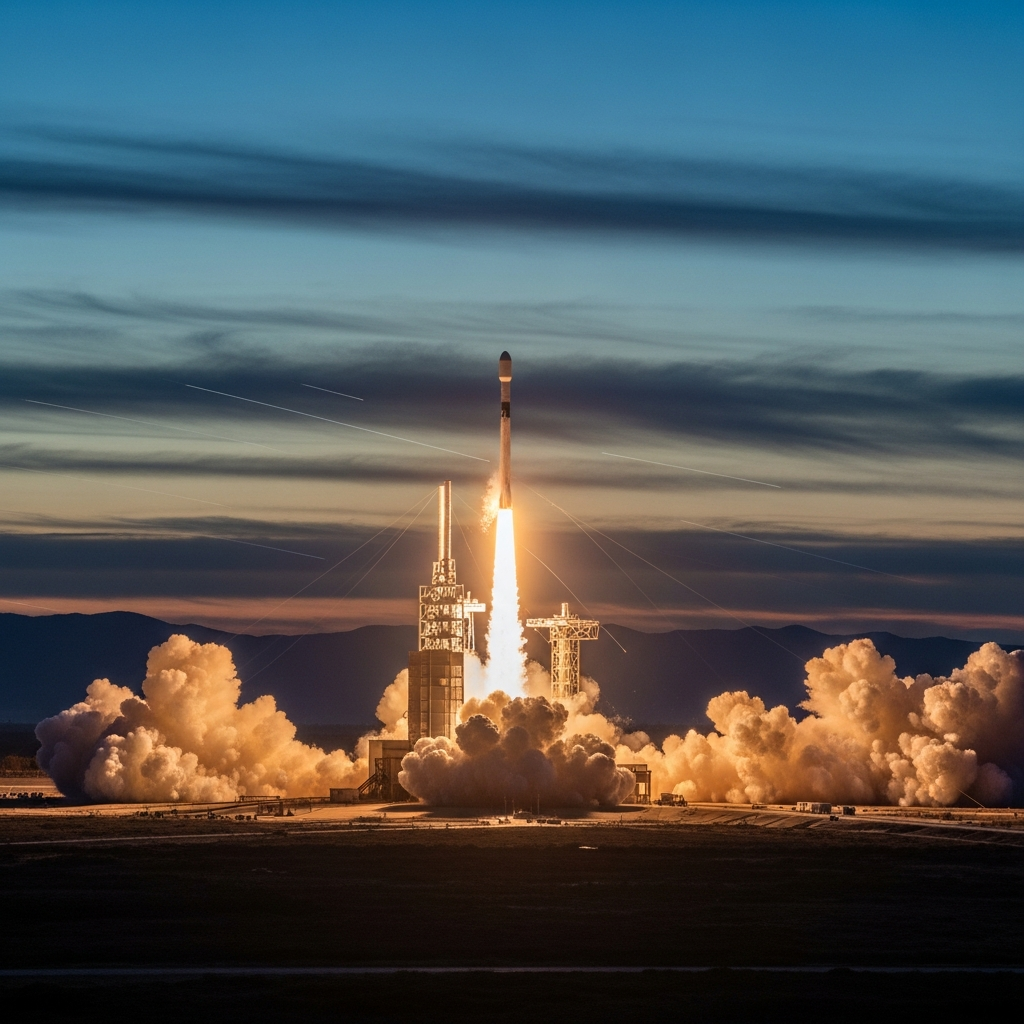
A spectacular SpaceX Falcon 9 launch from Vandenberg Space Force Base in California has once again captivated skygazers and advanced global connectivity. On the evening of March 16, 2026, a Falcon 9 rocket successfully deployed 25 Starlink satellites into low-Earth orbit, marking a significant step in the expansion of high-speed internet access worldwide. This mission highlighted SpaceX’s groundbreaking commitment to reusable rocket technology, showcasing the fourteenth flight of this particular Falcon 9 first-stage booster.
For residents across Santa Barbara, San Luis Obispo, and Ventura counties, the launch was a memorable event, complete with thunderous sonic booms as the booster returned to Earth. This successful operation underscores Vandenberg’s growing prominence in the commercial space industry. It also reflects SpaceX’s relentless pace in redefining space exploration and making satellite internet more accessible and reliable for millions globally.
The Starlink Constellation: Bringing Broadband to Every Corner
The recent SpaceX Vandenberg launch played a crucial role in expanding the Starlink constellation, an ambitious initiative to deliver high-speed, low-latency broadband internet across the globe. Comprising thousands of satellites orbiting at approximately 550 kilometers (342 miles), Starlink is acclaimed as the world’s largest satellite internet network. These 25 new satellites represent a critical increment towards enhancing network speeds, reducing latency, and boosting reliability, especially for users in remote or underserved areas.
Starlink’s innovative service supports demanding applications, from seamless streaming and online gaming to reliable video calls. By providing internet access where traditional infrastructure is limited, it enables vital services like telemedicine and distance learning in previously unreachable regions. The continuous expansion ensures that Starlink remains at the forefront of global connectivity, empowering millions of customers across diverse needs.
Falcon 9’s Reusability: A Game Changer for Space Access
The March 16th launch was a powerful demonstration of SpaceX’s pioneering reusable rocket technology. The Falcon 9, recognized as the world’s first orbital-class reusable rocket, significantly reduces the cost of space access. Following its separation from the upper stage, the first-stage booster executed a flawless controlled descent. It landed smoothly on the autonomous droneship “Of Course I Still Love You,” stationed in the Pacific Ocean. This precision landing exemplifies SpaceX’s leadership and technical prowess in advancing reusable rocketry.
Reusability is not just about cost savings; it also accelerates the pace of innovation and increases launch frequency. This commitment to sustainable spaceflight allows SpaceX to conduct an “especially busy stretch” of missions from Vandenberg. Such rapid turnaround times were once unimaginable in the space industry. The thunderous sonic booms heard by coastal residents were a direct result of the returning booster re-entering the atmosphere at supersonic speeds, a visceral reminder of the immense power and engineering involved.
Navigating Launch Complexities: Lessons from Past Missions
SpaceX’s path to frequent, reliable launches isn’t without its challenges. Rocket launches are complex endeavors, always subject to potential delays from weather or technical issues. In fact, just prior to this successful March 16th mission, an earlier Falcon 9 launch experienced an anomaly. On February 2, 2026, during a Starlink launch from Vandenberg, the rocket’s upper stage successfully deployed its payload but failed to execute its prescribed deorbit burn. This incident led to an uncontrolled return to Earth.
The Federal Aviation Administration (FAA) swiftly grounded all Falcon 9 missions pending an investigation. The FAA, overseeing and accepting the findings of SpaceX’s internal investigation, determined the probable root cause was the Falcon 9 stage 2 engine’s failure to ignite. In response, SpaceX implemented both technical and organizational preventative measures. This rapid resolution by February 6th cleared Falcon 9 rockets to resume flights, showcasing the rigorous safety protocols and quick problem-solving capabilities inherent in the space industry. This commitment to continuous improvement ensures the safety and reliability of future missions.
SpaceX’s Broad Impact: From Starlink to Human Spaceflight
Founded in 2002 by Elon Musk, SpaceX has grown into a dominant force across both commercial and government spaceflight sectors. Beyond the regular deployment of Starlink satellites, the company plays a critical role in national security by launching classified payloads for the U.S. Department of Defense. Furthermore, SpaceX remains the sole American vehicle capable of transporting astronauts to the International Space Station (ISS). This is achieved aboard the Dragon crew capsule as part of NASA’s Commercial Crew Program.
For instance, following the FAA’s clearance of Falcon 9 flights, the Crew-12 mission was officially scheduled for February 11, 2026, from Florida’s Cape Canaveral. This mission aimed to transport four international astronauts to the ISS for an approximate nine-month residency, aboard a Crew Dragon capsule named “Freedom.” Such missions are vital for maintaining the ISS’s full complement of crewmembers and advancing crucial scientific research in orbit.
The Future Frontier: Starship and Beyond
Looking ahead, SpaceX continues to push the boundaries of space exploration with its next-generation Starship system. The US government recently granted approval for SpaceX to construct a new launch pad for its Starship Super Heavy rocket at Launch Complex 37 (SLC-37) within the Kennedy Space Center in Florida. Construction has already begun. This new facility will significantly enhance Starship’s operational capabilities and boost launch cadence, aspiring to achieve “airport-like efficiency.”
The Starship system, comprising the Starship spacecraft and the powerful Super Heavy booster, is designed for heavy-lift missions, including national security objectives and NASA’s ambitious Artemis lunar exploration program. The Super Heavy booster alone generates over 17 million pounds of thrust—more than double that of the historic Saturn V rocket. This ambitious development, with first launches from the new pad anticipated as early as summer 2026, further solidifies Florida’s standing as a premier global spaceport. It underscores SpaceX’s long-term vision for human exploration beyond low-Earth orbit.
Frequently Asked Questions
What makes the recent Falcon 9 Starlink launch from Vandenberg a significant milestone?
The March 16, 2026, Falcon 9 launch from Vandenberg Space Force Base was significant for several reasons. It successfully deployed 25 additional Starlink satellites, bolstering global high-speed internet access. More notably, it marked the fourteenth flight of a single Falcon 9 first-stage booster, setting a new standard for reusability in orbital-class rockets. This achievement demonstrates SpaceX’s advanced engineering and efficiency, further reducing the cost and accelerating the pace of space missions.
Where are SpaceX’s primary launch facilities, and what types of missions do they support?
SpaceX operates primary launch facilities on both U.S. coasts. Vandenberg Space Force Base in California is crucial for polar and sun-synchronous orbit missions, including many Starlink deployments and classified payloads for the U.S. Department of Defense. On Florida’s Space Coast, at Cape Canaveral Space Force Station and Kennedy Space Center, SpaceX supports launches to the International Space Station (ISS) with its Dragon crew capsules, additional Starlink missions, and future Starship operations.
How does SpaceX’s reusability technology, like the Falcon 9 booster, contribute to future space missions and global internet access?
SpaceX’s reusability technology, epitomized by the Falcon 9’s ability to land and be refurbished, drastically reduces the cost per launch. This cost efficiency enables a much higher frequency of launches. For future space missions, this means more opportunities for scientific research, satellite deployment, and even human spaceflight. For global internet access, it accelerates the expansion of the Starlink constellation, making high-speed broadband more accessible and reliable to remote areas worldwide, supporting critical services like telemedicine and education.
Pioneering the Future of Space
The successful SpaceX Vandenberg launch is more than just another mission; it’s a testament to humanity’s rapid strides in space exploration. From enhancing global internet connectivity with Starlink to pushing the boundaries of rocket reusability and preparing for deep space human exploration with Starship, SpaceX continues to reshape the aerospace landscape. These endeavors underscore a future where space is more accessible, connected, and ultimately, a frontier for ongoing discovery and innovation.