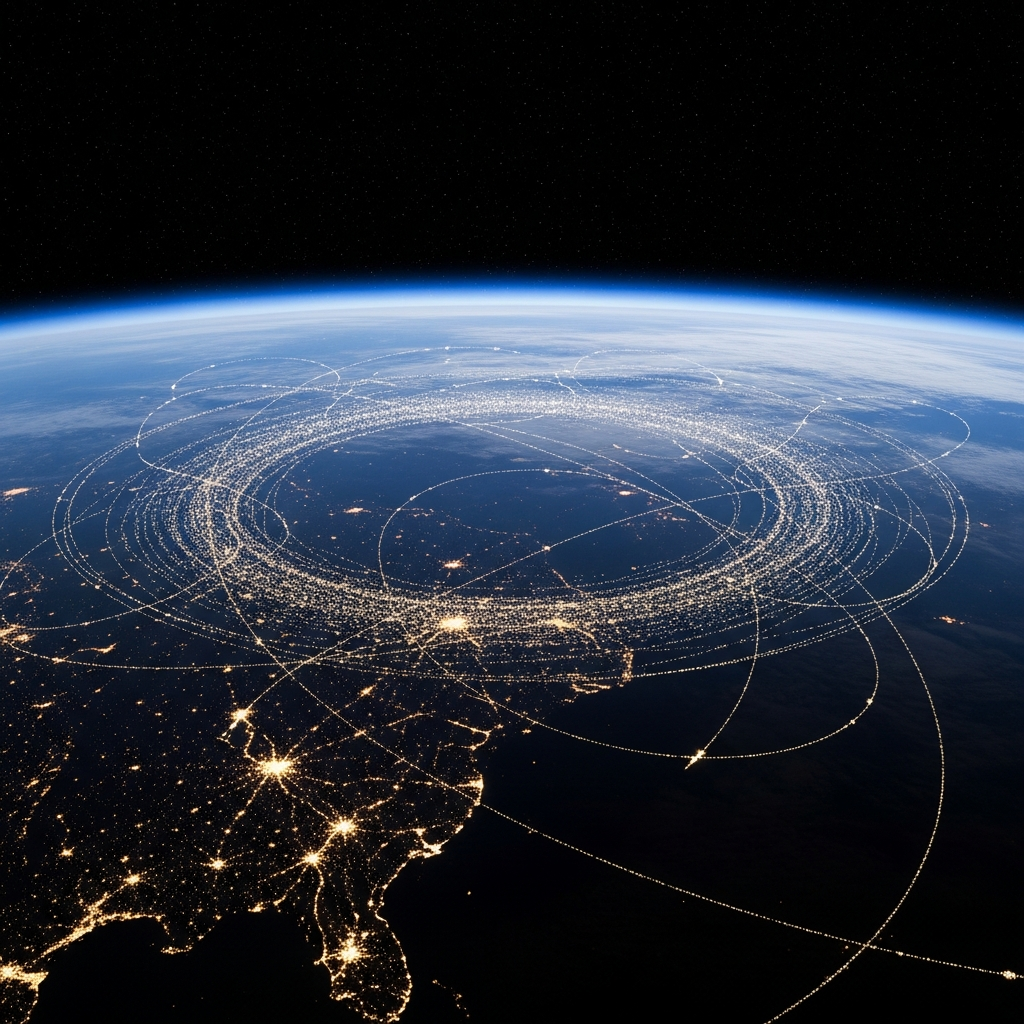
The heavens are more crowded than ever before. As of March 17, 2026, SpaceX’s Starlink constellation has officially surpassed 10,000 active satellites in Earth’s orbit. This monumental achievement, once deemed impossible, marks a definitive shift in our relationship with space, ushering in an era of unprecedented orbital activity and sparking crucial conversations about connectivity, space safety, and the future of astronomy. Discover how this rapidly expanding network is reshaping global communication and what challenges lie ahead in our increasingly busy cosmic neighborhood.
The Dawn of the Mega-Constellation Era
For much of the space age, Earth’s orbit remained a relatively sparse domain. Just a few hundred satellites circled our planet until the turn of the millennium, growing to a few thousand by the 2010s. Then, in 2019, everything changed. SpaceX launched its initial Starlink internet satellites, beginning a relentless deployment campaign that has fundamentally transformed low Earth orbit (LEO). This aggressive expansion culminates in today’s staggering figures.
“Starlink has changed our relationship with space,” observes Hugh Lewis, a space debris expert at the University of Birmingham. “The character of the night sky is no longer the same as it once was, and I’m not sure it will ever be again.” This milestone of a single company operating over 10,000 satellites overhead confirms that mega constellations are here to stay, with profound implications for technology and policy.
Starlink’s Exponential Growth: A Closer Look at the Numbers
The 10,000 active satellite mark was achieved with a launch at 1:19 A.M. EDT on Tuesday, March 17, 2026. A Falcon 9 rocket from Vandenberg Space Force Base in California deployed 25 Starlink satellites. This mission, followed by another from Cape Canaveral later the same day, brought the total active count to 10,039 units, according to astrophysicist Jonathan McDowell, who meticulously tracks space launches.
SpaceX has launched a grand total of 11,529 Starlink satellites since May 2019. The difference in numbers reflects a dynamic system where some satellites have been deorbited or replaced. Notably, an earlier milestone of 10,000 launched satellites was surpassed in October 2025. Today’s active fleet constitutes approximately two-thirds of all operational satellites circling Earth, showcasing Starlink’s unparalleled dominance in LEO.
Unprecedented Reach and Geopolitical Influence
What began as a speculative venture to provide global internet access has rapidly evolved into a critical infrastructure. Starlink now serves over 10 million users across 160 countries, territories, and other markets. Its reach extends from remote rural communities and critical humanitarian operations in Ukraine to indigenous tribes deep within the Amazon.
This extensive network grants SpaceX, and its CEO Elon Musk, significant geopolitical power. The ability to provide or restrict internet access for entire regions at will is a formidable tool in today’s interconnected world. This strategic advantage has not gone unnoticed by global competitors.
The Engine Behind the Surge: SpaceX’s Innovation
Starlink’s supremacy is a testament to SpaceX’s world-leading capabilities in logistics, manufacturing, and launch operations. The company’s reusable Falcon 9 rocket has been the primary workhorse, completing over 600 launches. With one Falcon 9 booster (B1088) making its 14th flight for the March 17 mission, and another (B1090) completing its 11th, the efficiency is clear. SpaceX’s aggressive launch cadence saw 34 Falcon 9 missions by March 2026, with 26 dedicated to Starlink deployments alone.
Caleb Henry, Director of Research for Quilty Space, highlights five key factors for SpaceX’s market dominance:
Massive Capital Investment: Billions of dollars raised, far exceeding rivals.
Vertical Integration: Developing and manufacturing rockets, satellites, ground gateways, and user terminals in-house.
Cost-Effective User Terminals: Building user terminals at an unprecedented scale and lower price point, making the service accessible to a broader consumer market.
Rapid Manufacturing: The ability to mass-produce satellites efficiently.
Reusable Rocket Technology: The Falcon 9’s reusability drastically reduces launch costs and enables frequent deployments.
In stark contrast, Europe’s OneWeb, the next largest constellation, operates a comparatively modest 654 satellites.
Navigating a Crowded Sky: Collision Avoidance and Space Safety
Operating at altitudes between 480 and 550 kilometers (300 to 340 miles), Starlink satellites must constantly avoid collisions. The risk of impacts, which could produce thousands of pieces of space debris and trigger a cascading “Kessler syndrome” rendering parts of LEO unusable, is very real. SpaceX has proactively addressed this by implementing sophisticated autonomous collision avoidance systems.
In 2025 alone, Starlink’s constellation performed approximately 300,000 collision avoidance maneuvers, as reported to the Federal Communications Commission (FCC). This translates to nearly 40 maneuvers per satellite over 12 months – an astonishing figure compared to the handful a typical satellite might perform annually pre-Starlink. To further enhance space situational awareness (SSA), SpaceX publicly launched its ‘Stargaze’ system, utilizing multiple star trackers on each satellite to map LEO objects and expedite collision avoidance. While the system maintains a perfect record of zero Starlink satellite collisions so far, experts like astronomer Samantha Lawler express apprehension: “Our ability to keep using orbit depends on Starlink continuing to operate perfectly. It makes me nervous, for sure.”
Challenges and Concerns: The Dark Side of Dominance
Despite Starlink’s technological marvels, its rapid expansion raises significant challenges and environmental concerns:
Space Debris and Incidents: While collision avoidance is robust, individual satellite issues persist. In July 2024, a 2.5-kilogram piece of a deorbited Starlink satellite survived reentry, landing on a Canadian farm. December 2025 saw a near-miss reported by China involving one of its satellites and a Starlink unit. The same month, a Starlink satellite exploded in orbit, ejecting debris, though it was not collision-related. SpaceX identified and removed the responsible parts from subsequent designs.
Atmospheric Effects: The climatic effects of thousands of Starlink satellites burning up in the atmosphere daily remain poorly understood. Experts worry about potential changes to the stratosphere’s temperature and composition.
Interference with Astronomy: Perhaps the most vocal concern comes from the scientific community. Interference from Starlink and other satellites is now a routine frustration for astronomers, obscuring celestial objects and hampering research. A study led by Alejandro Borlaff at NASA’s Ames Research Center found that adding half a million satellites could result in at least one disrupting almost every image taken by every telescope, both on Earth and in space. Borlaff’s chilling prognosis: “There is no place in the sky that won’t have any satellites.”
- Growing Competition: Starlink’s monopoly on satellite internet is already attracting rivals. Jeff Bezos-backed Amazon Project Kuiper has launched around 200 of its planned 7,500 satellites. China is aggressively pursuing its own government-backed mega constellations, Qianfan and Guowang, aiming for 15,000 and 13,000 satellites respectively. As Mustafa Bilal from CASS states, “If there are more players in the market… this monopoly they have on satellite Internet is definitely going to degrade.”
- www.space.com
- www.scientificamerican.com
- spaceflightnow.com
- arstechnica.com
- www.satellitetoday.com
The Future Orbit: Starship, AI, and Millions More
The 10,000 active Starlink satellites are merely the beginning. Tens of thousands more internet constellation satellites are planned globally in the coming years. Elon Musk has even announced ambitious plans for a staggering one million satellites for a new orbital artificial intelligence data center, to be launched using SpaceX’s massive Starship rocket. In total, a breathtaking 1.7 million satellites are currently proposed worldwide.
This future vision sparks an urgent question: How many satellites can Earth’s orbit truly accommodate before collisions become inevitable? A 2022 study suggested millions might be achievable, while other experts propose a more conservative limit closer to 100,000. As Victoria Samson, chief director of space security and stability at the Secure World Foundation, aptly puts it, “I never would have thought we’d have constellations with thousands of satellites. So I don’t want to say ‘never.’”
Frequently Asked Questions
What does reaching 10,000 active Starlink satellites signify for space?
Reaching 10,000 active Starlink satellites fundamentally confirms the arrival of the “mega constellation era.” This milestone, achieved by SpaceX in March 2026, demonstrates an unprecedented scale of orbital deployment by a single entity. It signals a new phase in space utilization, where commercial entities heavily dominate low Earth orbit, profoundly impacting global connectivity, space traffic management, and the visibility of the night sky for astronomers. It marks a shift from thousands to potentially millions of objects orbiting Earth.
How does Starlink manage collision risks with such a vast constellation?
Starlink manages collision risks through an advanced autonomous system designed to perform avoidance maneuvers. Operating at specific LEO altitudes, the satellites automatically track other objects and adjust their paths to prevent collisions. In 2025, SpaceX reported approximately 300,000 such maneuvers to the FCC, averaging nearly 40 per satellite annually. Additionally, SpaceX has developed ‘Stargaze,’ its own Space Situational Awareness (SSA) system, which uses on-board star trackers to create detailed maps of LEO objects, further enhancing collision prevention capabilities.
What are the primary concerns surrounding the rapid expansion of mega constellations?
The rapid expansion of mega constellations like Starlink raises several critical concerns. Foremost among these are increased space debris risks, as a single collision could trigger a cascading “Kessler syndrome,” rendering portions of orbit unusable. Astronomers are deeply worried about light pollution and radio interference, as thousands of bright satellites obscure celestial objects and hamper scientific observation. There are also poorly understood environmental impacts from routine satellite deorbiting and atmospheric burn-up. Lastly, the immense geopolitical power concentrated in the hands of a few private entities through controlling global internet access is a growing concern.
Conclusion
The ascent of SpaceX’s Starlink to over 10,000 active satellites is an undeniable triumph of engineering and ambition. It has democratized internet access for millions, connected remote regions, and demonstrated the astounding potential of reusable rocket technology. Yet, this achievement also illuminates a complex future, where the marvels of connectivity clash with the urgent need for orbital sustainability and the preservation of our night sky. As Earth’s orbit grows busier by the day, the fundamental question remains: Can humanity adapt and innovate quickly enough to cope with this new reality, ensuring that progress in space doesn’t come at an irreparable cost to our shared cosmic heritage? The answers will shape not just the future of satellite internet, but the future of space itself.