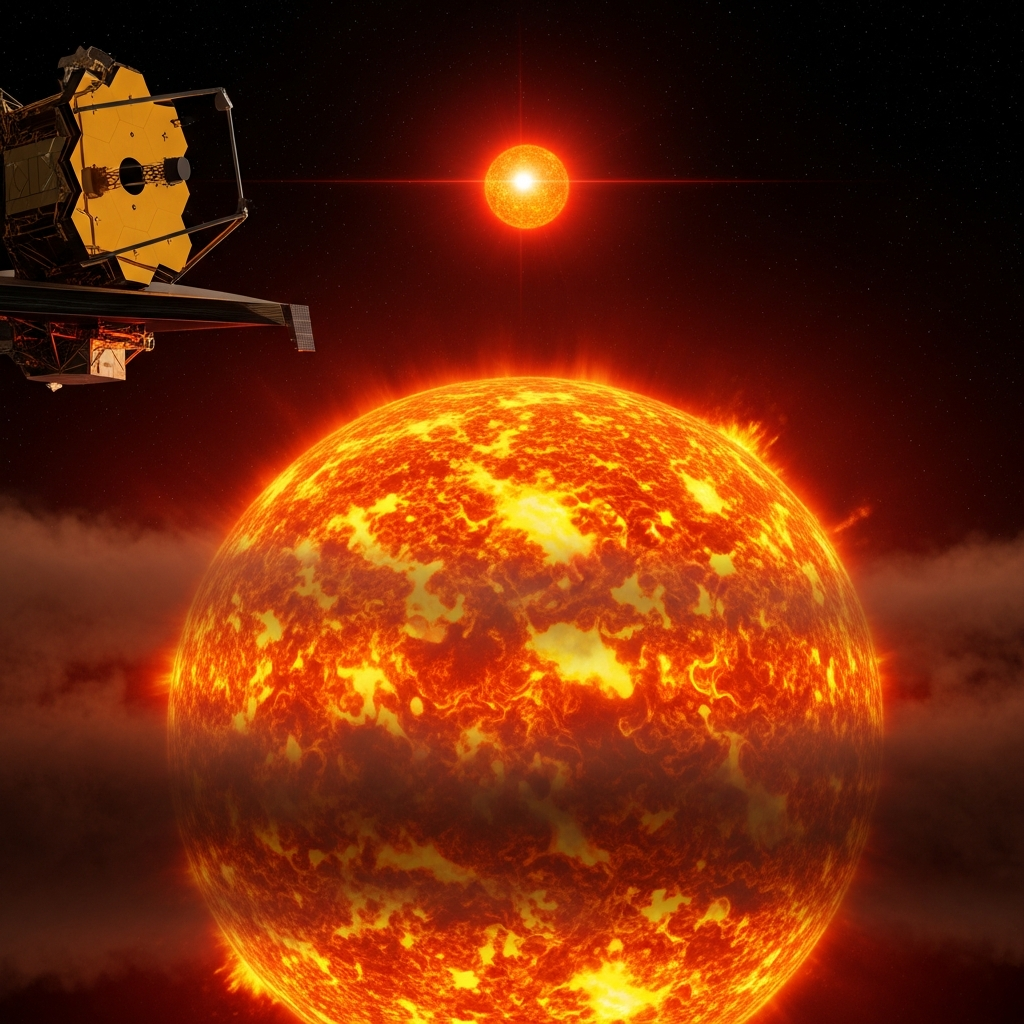
Astronomers have made a groundbreaking discovery: a new class of exoplanet unlike any found before. Orbiting a red dwarf star 35 light-years from Earth, L 98-59 d is a world defined by its scorching molten sulfur interior and a distinctly pungent atmosphere. This unique sulfur exoplanet, revealed through observations from the James Webb Space Telescope (JWST) and advanced computer simulations, is challenging our fundamental understanding of planetary evolution. Get ready to explore a bizarre alien world that likely smells of rotten eggs and reshapes how we classify planets across the cosmos.
Unveiling L 98-59 d: A Peculiar Neighbor
The journey to uncover L 98-59 d began with initial detections in 2019. However, it was later observations in 2024, leveraging the unparalleled capabilities of the James Webb Space Telescope (JWST), that unveiled its truly peculiar nature. This exoplanet, roughly 1.6 times the size of Earth and about twice its mass, exhibited an unusually low bulk density. More strikingly, its atmospheric composition showed clear hints of sulfur-bearing volatiles, including hydrogen sulfide (H2S) and sulfur dioxide (SO2).
Scientists from leading institutions like the University of Oxford, the University of Groningen, and ETH Zurich collaborated to decode these signals. They employed sophisticated computer models, including a coupled atmosphere-interior evolutionary model called PROTEUS, to trace the planet’s development over nearly five billion years. Their findings, published in Nature Astronomy, painted a picture of a world that defies traditional classifications for small exoplanets.
Beyond Common Classifications: A Sulfur-Dominated World
Traditionally, exoplanets of L 98-59 d’s size and mass would fall into one of two main categories:
Rocky “gas dwarfs”: Planets with a solid core enveloped by a thick, hydrogen-rich atmosphere.
“Water worlds”: Planets primarily composed of water, with deep oceans and ice layers.
However, L 98-59 d fits neither description. Its observed low density, combined with the presence of abundant sulfur compounds in its atmosphere, pointed to a completely different planetary type. Researchers propose it represents a novel class of gas-rich, sulfur-dominated planets that sustain long-lived magma oceans. This discovery profoundly expands the known diversity of worlds beyond our solar system.
The “Stinky” Atmosphere: Sulfur’s Dominance
One of the most remarkable characteristics of L 98-59 d is its atmosphere. Observations indicate a thick, hydrogen-rich atmosphere laden with hydrogen sulfide (H2S). For those familiar with Earth’s chemistry, H2S is the compound responsible for the distinctive, unpleasant odor of rotten eggs. This suggests that if you could somehow stand on this distant exoplanet, the smell would be overwhelmingly sulfurous.
Further JWST observations confirmed the presence of sulfur dioxide (SO2) and other sulfur gases in the upper atmosphere. The models revealed that the SO2 isn’t directly outgassed from the planet’s interior. Instead, it’s produced in situ through photochemical reactions. Ultraviolet radiation from the host star, the red dwarf L 98-59, drives these processes. Specifically, SO2 forms from H2S in the presence of hydroxyl (OH) radicals, which are themselves generated by the photolysis of water (H2O). This complex photochemistry highlights an active and dynamic atmospheric environment on L 98-59 d.
The Role of Photochemistry in Atmospheric Composition
The detection of SO2 at higher altitudes is a critical clue. Without photochemistry, thermochemical reduction would likely prevent SO2 from accumulating in the upper atmosphere. The models showed a significant increase in SO2 abundance when photochemical kinetics were included. This means the planet’s atmospheric signature is a direct result of intricate chemical reactions driven by stellar radiation, making it distinct from many other observed exoplanets. The presence of water, even in small amounts, is crucial for initiating these reactions.
A Planet Forged in Fire: The Permanent Magma Ocean
At the heart of L 98-59 d’s uniqueness lies its interior: a vast, permanent magma ocean. Simulations suggest that the planet’s mantle is composed of molten silicate, much like lava on Earth, extending thousands of kilometers deep. This global magma ocean, estimated to have a melt fraction of around 45%, plays a pivotal role in the planet’s evolution and current state.
This molten interior is not just a passive feature; it actively interacts with the atmosphere. It acts as a massive reservoir, absorbing and releasing gases over eons. The magma ocean’s chemically reducing conditions are crucial. This allows sulfur to remain predominantly dissolved in the melt, while hydrogen and carbon are mostly stored in the atmosphere. This long-term chemical exchange between the molten interior and the atmosphere has profoundly shaped the planet’s distinctive properties.
Buffering the Atmosphere and Retaining Volatiles
A key finding is that this molten exoplanet can retain its thick, hydrogen-rich atmosphere, replete with sulfurous gases, for billions of years. Normally, intense stellar radiation from a red dwarf star would strip away a planet’s atmosphere. However, the magma ocean prevents this. It acts as a buffer, continuously regulating atmospheric escape. As hydrogen preferentially escapes, the atmospheric S/H (sulfur to hydrogen) ratio gradually increases over time, leading to the sulfur-rich signature observed today.
The magma ocean is sustained by a strong atmospheric greenhouse effect and likely by tidal heating. The viscosity of the melt, especially as it approaches a ~45% melt fraction, becomes inefficient at transporting energy, contributing to the magma ocean’s persistence over geological timescales. This mechanism is central to understanding how L 98-59 d maintains its unique composition.
Evolutionary Journey: From Sub-Neptune to Sulfur World
The PROTEUS evolutionary models suggest that L 98-59 d had a dynamic past. It likely formed with an abundant supply of volatile material, possibly resembling a larger sub-Neptune planet (with a radius greater than 1.7 Earth radii). Over its nearly five-billion-year history, the planet underwent substantial bulk density changes and radius shrinkage.
Its radius decreased through a two-stage process:
- Rapid Thermal Contraction: Early in its history, surface cooling from extremely high temperatures (around 3,360 K) to about 1,830 K over 1.4 billion years caused significant deflation. This initial cooling was the primary driver for its radius shrinking from over 2.2 Earth radii to roughly 1.74 Earth radii.
- Slower Contraction via Mass Loss: Later, irreversible loss of CHNOS (carbon, hydrogen, nitrogen, oxygen, sulfur) volatiles due to XUV-driven photoevaporation became the dominant factor. This continuous atmospheric stripping further reduced the planet’s radius to its present-day value.
This Gyr-scale contraction suggests a fascinating possibility: some sub-Neptunes observed today might be transient states, eventually evolving into super-Earths like L 98-59 d. This offers an alternative explanation for the “radius valley” phenomenon observed in exoplanet populations, moving beyond simple atmospheric escape models.
Challenging Planetary Paradigms and Future Discoveries
The discovery of L 98-59 d fundamentally challenges the existing, potentially oversimplified, categories astronomers use to describe small planets. It reveals an entirely new pathway for planetary evolution, demonstrating that some worlds can be neither conventional gas dwarfs nor water worlds, but rather unique molten sulfur planets.
Dr. Harrison Nicholls, the lead author, emphasized that this finding implies the vast diversity of worlds beyond our solar system is much greater than previously imagined. While L 98-59 d is undoubtedly too hostile to support life as we know it – with its extreme temperatures, molten interior, and toxic atmosphere – its existence broadens our perspective on planetary habitability and diversity. It pushes scientists to refine their classifications of exoplanets, moving beyond broad categories to embrace more nuanced types like “sulfur-drenched magma planets.”
This research also provides valuable insights into the earliest stages of rocky planet formation, including Earth and Mars, which are believed to have begun with magma oceans. By studying distant worlds like L 98-59 d, we gain clues about our own planet’s deep past.
Frequently Asked Questions
What makes L 98-59 d a new type of planet?
L 98-59 d stands out due to its unique combination of a surprisingly low density, a thick hydrogen-rich atmosphere abundant in sulfur compounds like hydrogen sulfide and sulfur dioxide, and a massive, permanent molten silicate interior (a magma ocean). Unlike “gas dwarfs” with rocky cores or “water worlds” covered in deep oceans, L 98-59 d represents a novel class: a molten sulfur planet where sulfur chemistry dominates both its atmosphere and its internal structure, constantly exchanging volatiles with its deep magma ocean. This distinct composition and evolutionary pathway challenge existing planetary classification systems.
How did astronomers discover the unique properties of L 98-59 d?
Astronomers utilized data from the James Webb Space Telescope (JWST) for key atmospheric observations, complemented by various ground-based telescopes. To understand the planet’s internal dynamics and evolution, a research team led by the University of Oxford employed advanced computer simulations, including a coupled atmosphere-interior evolutionary model called PROTEUS. These models traced the planet’s history over billions of years, from formation to the present. By integrating these simulations with observed data like the planet’s bulk density and atmospheric composition, they inferred the presence of its permanent magma ocean and the complex chemical processes shaping its sulfur-rich atmosphere.
Could planets like L 98-59 d support life?
No, it is highly unlikely that L 98-59 d could support life as we know it. The planet’s environment is far too hostile. Its interior is characterized by a vast, permanent magma ocean of molten silicate, implying extremely high surface temperatures. The atmosphere, while hydrogen-rich, is laden with toxic sulfur compounds like hydrogen sulfide, notorious for its “rotten egg” smell. The constant chemical exchange between the molten interior and the atmosphere, coupled with intense stellar radiation from its host red dwarf star, creates conditions incompatible with the liquid water, stable temperatures, and complex organic chemistry considered essential for life.
The Future of Exoplanet Exploration
With the increasing stream of data from JWST and anticipated contributions from future missions like Ariel and PLATO, scientists are poised to discover even more exotic worlds. The computer models developed for L 98-59 d can now be applied, potentially with machine learning, to map the vast diversity of exoplanets. This effort will deepen our understanding of how planets form and evolve, ultimately helping to pinpoint which types of worlds might harbor the conditions necessary for life. The existence of “pungent planets” like L 98-59 d serves as a potent reminder that the universe holds countless surprises, pushing the boundaries of our imagination and scientific inquiry.