Unlocking your brain’s latent potential is no longer science fiction. The Memory Palace, or Method of Loci, stands as humanity’s most enduring “cognitive hack.” This ancient technique, deceptively simple, offers a powerful shortcut to enhance memory, bypass mental bottlenecks, and fundamentally optimize how your brain processes information. Far from a mere parlor trick, its effectiveness is rooted in deep neuroscience, echoing even the sophisticated architectures of modern artificial intelligence. Dive into the scientific principles that make the Memory Palace an indispensable tool for mastering information.
The Ancient Secret to Superior Memory
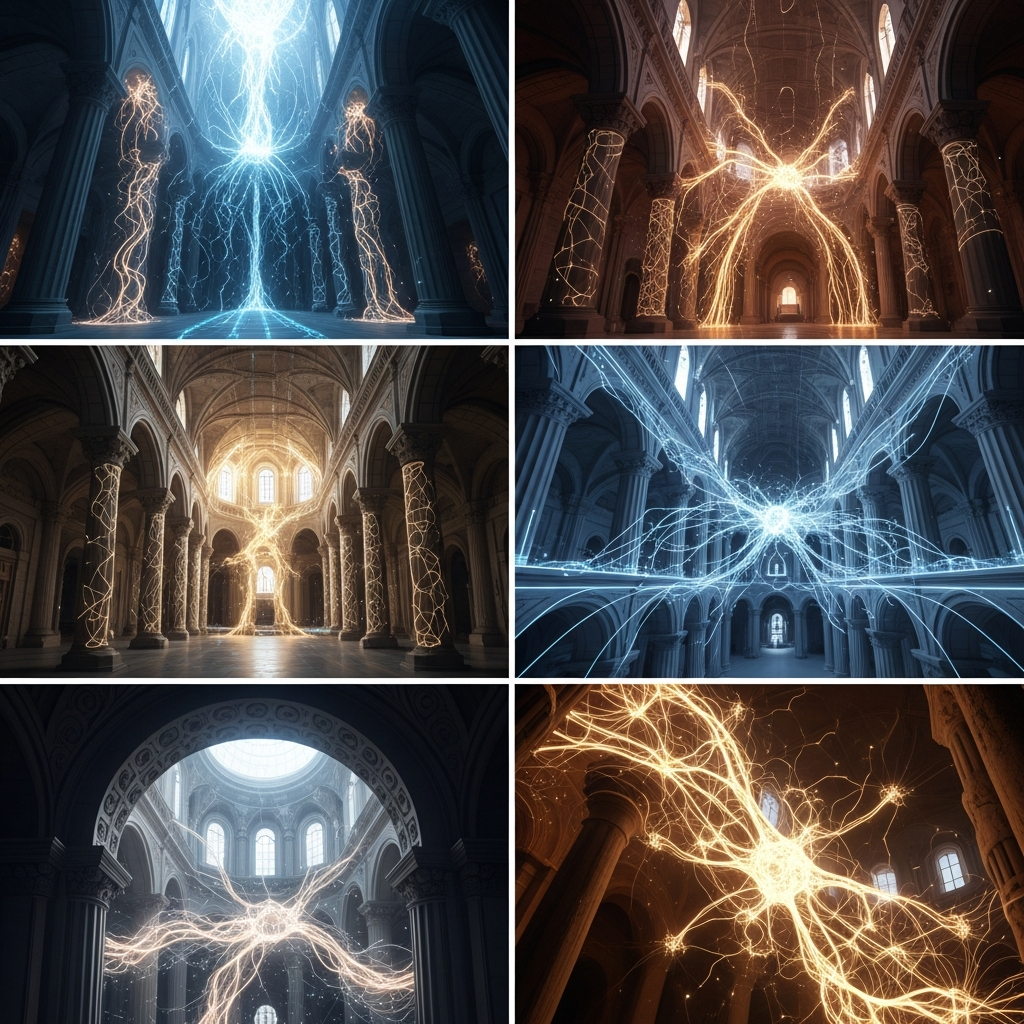
For millennia, the Method of Loci has been a cornerstone of mnemonic mastery. Its enduring power lies in its ability to leverage the brain’s innate strengths. In essence, it involves associating abstract data with specific locations within a familiar imagined environment, turning your mind into a vast, navigable archive.
Why Spatial Memory Reigns Supreme
Our brains are not built equally for all tasks. While memorizing abstract lists can be slow and inefficient, spatial navigation is something our brains excel at. This is no accident. Evolution spent millions of years perfecting the hippocampus, a brain region dedicated to mapping physical environments. Think of your childhood home: you know its layout perfectly, able to “walk through” it mentally without effort. This neural structure represents a “flawlessly trained, high-dimensional manifold” in your brain’s architecture.
The Memory Palace technique cleverly “hijacks” this pre-existing, highly optimized spatial system. Instead of struggling to build a new mental structure for a fresh set of facts, you simply map abstract information directly onto your established spatial manifold. This is akin to a massive “transfer-learning” shortcut, employing your brain’s ancient navigation engine to store new, complex data.
Overcoming the “Overlapping Attributes” Challenge
Consider the difficulty of remembering a deck of cards. Each card shares numerous overlapping attributes: numbers, suits, colors. This semantic overlap can cause confusion, making individual memories blend together in your neural space. Our working memory struggles when attributes are too similar.
The Memory Palace elegantly solves this by anchoring each abstract item to a unique, mutually exclusive spatial coordinate. The “7 of Spades” isn’t just a floating concept; it’s vividly placed on the left cushion of your green sofa. By binding abstract concepts to rigid, distinct spatial vectors, you eliminate ambiguity. This transforms the probabilistic nature of recall into a deterministic lookup, much like how a computer indexes data in an array.
Engineering Unforgettable Memories: Deeper Attractor Basins
To truly grasp the power of the Method of Loci, imagine memory not as a static filing cabinet, but as a dynamic, topographical map within your brain. This map is governed by the “physics” of neural networks.
The Physics of Forgetting: Shallow vs. Deep Valleys
In computational models of the brain, like Hopfield networks, memories are stored as stable patterns of neural activity, acting as “energy minima” or “attractor valleys.” When you attempt to recall something, your brain’s state “rolls” down into the nearest valley. Abstract, isolated bits of information, like a random string of numbers, create very shallow, narrow valleys. Any cognitive “noise”—distraction, stress, or time—can easily bump your mental “ball” out of this shallow valley, leading to forgetting.
Conversely, a memory with strong, widespread neural connections forms an incredibly deep and wide valley. Once your mental state falls into such a valley, it’s far more difficult for it to escape.
Multimodal Embedding: Digging Craters in Your Mind
The core practice of the Memory Palace is to intentionally engineer massive, deep attractor valleys for information that would otherwise be fleeting. This is achieved through multimodal embedding: binding abstract information to vivid, concrete sensory data.
Instead of merely repeating “Lithium,” you might imagine a giant, neon-pink lithium battery sizzling and burning your hand while a loud siren blares. This bizarre combination simultaneously activates visual, tactile, auditory, and emotional neurons. You are drastically increasing the “weights” or connections across disparate brain regions. In essence, you are taking a mental shovel and digging a massive crater in your energy landscape, making that memory virtually impossible to dislodge.
Bypassing Cognitive Bottlenecks: A Parallel with AI
The surprising effectiveness of the Memory Palace highlights a fundamental principle of efficient information processing—one also leveraged by advanced artificial intelligence.
Expanding Your Mental RAM: Beyond Working Memory Limits
Human working memory is notoriously limited, traditionally estimated at holding only about 7±2 items at a time. This constraint severely restricts our immediate mental capacity. The Memory Palace cleverly bypasses this bottleneck by offloading working memory into long-term spatial memory. You’re not actively holding 50 items in your immediate attention; you’re simply holding a “pointer” to a physical room. Your spatial navigation system then loads the items sequentially as you mentally “walk” through your chosen environment.
The Transformer Connection: Spatial Lookups vs. Linear Scans
This mechanism bears a striking resemblance to why Transformer architectures dominate older AI models like LSTMs. Previous neural networks processed information sequentially, token by token. This created “long-range bottlenecks” where early information was diluted, and “sequential slowness” due to inability to parallelize.
Transformers revolutionized AI by introducing the “Attention” mechanism. This allows the model to process all tokens simultaneously, directly computing the similarity between any two pieces of information regardless of their distance in the sequence. It functions as a content-addressable memory system, effectively performing “spatial, geometric lookups” within a high-dimensional semantic space. Just as you can instantly “jump” to the kitchen sink in your Memory Palace to retrieve an item, a Transformer can directly access relevant information without linear scanning. Both systems leverage high-dimensional coordinates to bypass linear time, showcasing a profound parallel between human cognitive hacks and cutting-edge AI.
Mastering the Method: Practical Application of the Memory Palace
Transforming theory into practice is key to harnessing this powerful technique. Building your own Memory Palace is an accessible, actionable process.
Building Your Personal Cognitive Architecture
The foundation of a Memory Palace is a deeply familiar location. This could be your home, school, or even a favorite park. The crucial step is to define a clear, linear path through this chosen environment, identifying distinct “loci” or memory stations along the way. For instance, your path might be: Front Door → Hallway Mirror → Living Room Sofa → Television → Kitchen Counter. These loci will serve as your unmovable anchors for abstract memories.
The PAO System: A Champion’s Algorithm
Memory champions employ highly structured algorithms to translate abstract data into these deep, spatial attractors. The PAO (Person, Action, Object) System is one of the most effective.
Here’s a simplified breakdown:
- Build Your Palace: Select a familiar location and define a linear route with specific loci (e.g., your bedroom, kitchen, living room).
- Create Your Encoding Algorithm: Assign a specific Person, Action, and Object to every 2-digit number from 00 to 99. For example:
- Execute the Compression: To memorize a number like 154299, break it into chunks: 15, 42, 99. Take the Person from the first number, the Action from the second, and the Object from the third.
- Drop into the Loci: Place the resulting bizarre, hybrid image into the first locus of your Memory Palace.
- Modular Minds: Instead of one massive block, AI will have specialized “experts” (e.g., for vision, language, planning) coordinated by a central controller, optimizing computational efficiency like the human brain.
- www.npr.org
- www.pbs.org
- www.bbc.com
- www.teenvogue.com
- www.keranews.org
15 = Albert Einstein (Person) writing (Action) with chalk (Object).
42 = Michael Jordan (Person) dunking (Action) a basketball (Object).
Result: You vividly imagine Albert Einstein (from 15) dunking (from 42) a [Object for 99] through your front doorway.
This process compresses six abstract digits into a single, memorable, spatially anchored mental movie. When you mentally revisit that doorway, the bizarre image “attracts” your attention, allowing you to reverse the PAO algorithm and retrieve the original data.
Beyond Today’s AI: Lessons for Future Intelligence
While immensely powerful, even the Memory Palace and current AI architectures like Transformers have their limitations. Understanding these points us towards future breakthroughs.
The Limits of Current AI (and Human Memory)
Transformers, despite their capabilities, face significant hurdles. Their “Attention” mechanism scales quadratically (O(n²)), meaning computational cost explodes with larger data, limiting their “context window” and leading to a form of digital amnesia. Furthermore, current Transformers are primarily text predictors, lacking a true “world model” or grounded understanding of physical reality.
Similarly, while the Memory Palace expands our memory, it’s a tool for storing static data. It doesn’t inherently build a “world model” or allow for generative simulation in the same way a truly advanced intelligence might.
Towards Optimal Learning Systems
Extrapolating from these limitations, the next generation of AI will likely move beyond monolithic text predictors. Future architectures might include:
World-Model Learners: Systems that build predictive models of reality, simulating potential futures and evaluating outcomes, mirroring animal intelligence.
Applying these lessons back to human learning, an optimal human memory system shouldn’t just store data; it should allow for internal simulations, combining concepts in your spatial manifold to deduce new ideas. We could build “palaces within palaces,” creating continuously compounding knowledge graphs that act as meta-abstractions. This moves beyond mere recall towards genuine understanding and innovation.
Frequently Asked Questions
How does the Memory Palace fundamentally enhance memory recall?
The Memory Palace (Method of Loci) enhances memory by leveraging the brain’s highly optimized spatial navigation system in the hippocampus. It maps abstract, hard-to-remember information onto familiar physical locations, creating strong, multimodal associations. This process transforms fleeting memories into vivid, spatially anchored experiences, effectively “deepening the attractor basins” in your neural network and making recall more deterministic and robust against forgetting.
What practical steps can someone take to start building their first Memory Palace?
To begin building your first Memory Palace, choose a deeply familiar physical location, such as your home, and define a clear, sequential path through it. Identify distinct “loci” (memory stations) along this route, like your front door, sofa, or kitchen counter. Next, decide on the abstract items you wish to remember. For each item, create a vivid, bizarre, or emotional image and mentally “place” it at a specific locus. Regularly revisit your Memory Palace mentally to reinforce the associations.
How do the principles of the Memory Palace apply to advanced AI architectures like Transformers?
The principles of the Memory Palace directly parallel the breakthroughs in AI architectures like Transformers. Both systems overcome “memory bottlenecks” by abandoning linear, sequential processing for geometric, content-addressable lookups. The Memory Palace uses physical locations as “coordinates” for direct access to memories, while Transformers use “Attention” to create semantic links between all tokens simultaneously, regardless of their distance. Both demonstrate the power of non-sequential, spatial organization for efficient information retrieval in complex systems.
The Future of Memory
The Memory Palace is more than an ancient mnemonic; it’s a profound demonstration of cognitive engineering. By intentionally translating abstract, symbolic data into the spatial, visual, and emotional geometry our brains excel at, we unlock a formidable memory capacity. This technique, mirroring the elegant solutions found in cutting-edge AI, underscores the deep, interconnected principles governing efficient information processing in both biological and artificial intelligence. Embrace this powerful hack, and transform your relationship with information forever.