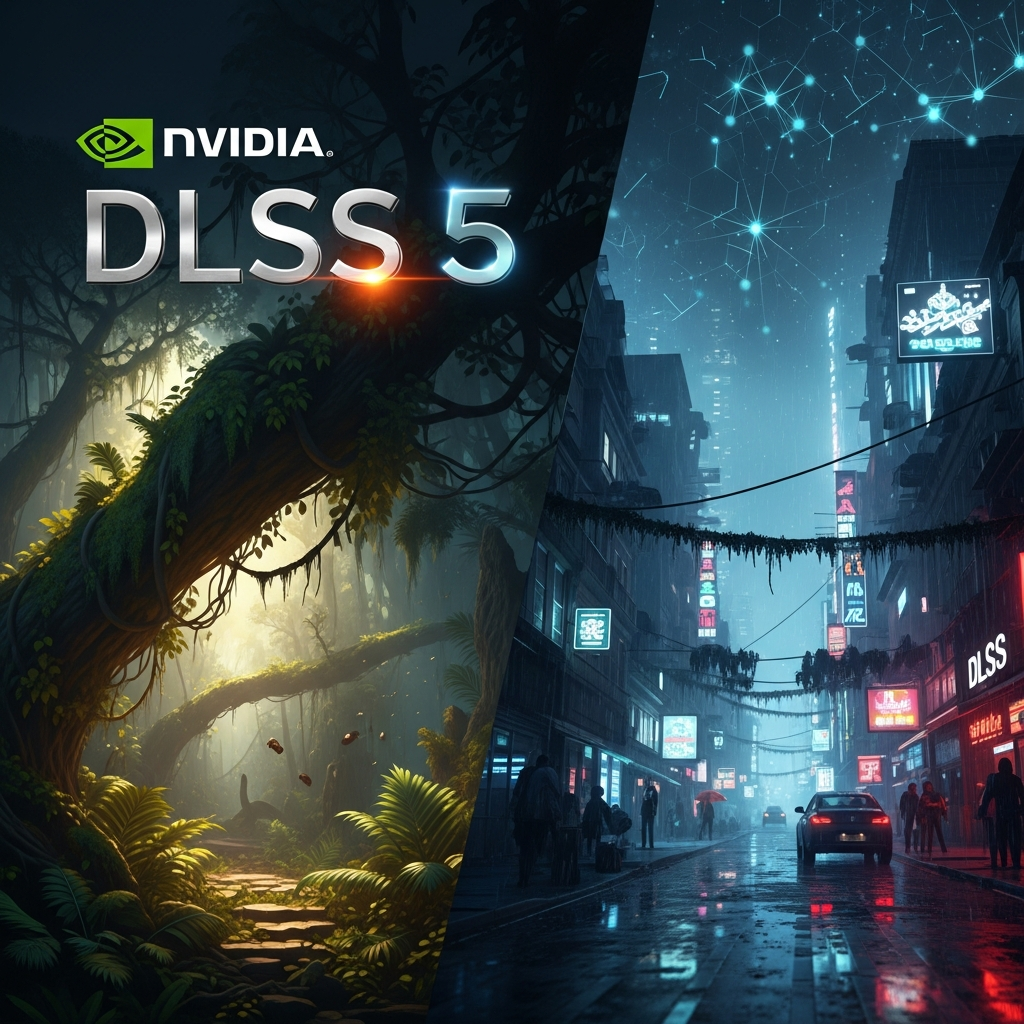
The landscape of computer graphics is undergoing a dramatic transformation, and at its forefront is NVIDIA DLSS 5. Hailed as the most significant leap since real-time ray tracing in 2018, this revolutionary Deep Learning Super Sampling technology promises to redefine visual fidelity in gaming. Shifting focus from mere performance boosts, DLSS 5 leverages advanced artificial intelligence to infuse game pixels with photoreal lighting and materials, moving us closer to Hollywood-level visual effects in real time. This fall, gamers and developers alike are set to experience an unprecedented era of realism.
Unpacking the Core of NVIDIA DLSS 5: AI-Powered Photorealism
NVIDIA’s CEO, Jensen Huang, aptly described NVIDIA DLSS 5 as the “GPT moment for graphics.” Unlike previous iterations that primarily aimed to upscale resolution or generate frames for performance gains, DLSS 5 fundamentally transforms the visual output. It introduces a real-time neural rendering model that processes a game’s color and motion vectors from each frame. This AI model then intelligently enhances the scene, adding photorealistic lighting and materials that are consistently anchored to the source 3D content. This sophisticated approach allows for a dramatic leap in realism without compromising artistic control.
The technology isn’t just about making things look “nicer.” It’s about a deep, semantic understanding of the game world. DLSS 5’s AI is trained end-to-end to comprehend intricate scene semantics, recognizing elements like characters, hair, fabric, translucent skin, and environmental lighting conditions. This allows it to generate visually precise images that accurately handle complex details such as subsurface scattering on skin, the delicate sheen of fabric, and realistic light-material interactions on hair. The result is an image that retains the original scene’s structure and semantics while dramatically elevating its visual quality.
From Performance Boost to Visual Breakthrough
For years, NVIDIA has pushed the boundaries of graphics horsepower, from programmable shaders to real-time ray tracing. However, even with monumental increases in compute power, achieving photorealism through brute force rendering in real time remains a massive challenge. Hollywood VFX, for instance, can take minutes or hours to render a single frame. This is where NVIDIA DLSS 5 steps in, offering an intelligent solution to bridge this gap.
While earlier DLSS versions like DLSS 4.5 focused on efficiency, using AI to draw a significant portion of pixels for performance, DLSS 5 pivots to visual transformation. It’s not just about drawing more pixels; it’s about drawing better pixels. This represents a paradigm shift where AI doesn’t just optimize existing rendering, but fundamentally reimagines it to produce “AI-produced pixels” that achieve a level of fidelity previously deemed impossible for real-time applications.
Demonstrating the Transformative Power of DLSS 5
Initial demonstrations at NVIDIA’s GTC 2026 keynote showcased the astonishing capabilities of NVIDIA DLSS 5. Gameplay from highly anticipated titles such as Resident Evil: Requiem, Hogwarts Legacy, and Starfield visibly illustrated the technology’s impact. Character fidelity received a significant boost, with noticeable improvements in hair and skin tone, including realistic subsurface scattering. Environmental realism also saw dramatic enhancements, with subtle yet accurate shadowing and ambient occlusion bringing worlds to life in games like Assassin’s Creed Shadows and The Elder Scrolls IV: Oblivion Remastered.
The handling of diverse materials, from metals and cloth to the skin of fruits, was described as “astonishing.” DLSS 5 particularly excels at rendering light and shadow around foliage, a notoriously difficult task for conventional renderers. While these early previews were conducted on high-end systems featuring dual RTX 5090 GPUs – one for the game and one for DLSS 5 processing due to early optimization – NVIDIA confirms the technology is designed to operate efficiently on a single video card upon release. This signifies its eventual accessibility to a broader range of gaming setups, though likely targeting the upcoming RTX 50-series.
Widespread Industry Adoption and Upcoming Titles
The potential of NVIDIA DLSS 5 has already garnered significant support across the gaming industry. Major publishers and developers, including Bethesda, CAPCOM, Hotta Studio, NetEase, NCSOFT, S-GAME, Tencent, Ubisoft, and Warner Bros. Games, have pledged their support. Industry figures like Todd Howard of Bethesda lauded its ability to “bring [Starfield] to life,” while Jun Takeuchi of CAPCOM highlighted its role in creating “cinematic, compelling and deeply believable” experiences.
A wide array of upcoming games are slated to integrate DLSS 5, promising a visual feast for players this Fall. This extensive list includes:
AION 2
Assassin’s Creed Shadows
Black State
CINDER CITY
Delta Force
Hogwarts Legacy
Justice
NARAKA: BLADEPOINT
NTE: Neverness to Everness
Phantom Blade Zero
Resident Evil™ Requiem
Sea of Remnants
Starfield
The Elder Scrolls IV: Oblivion Remastered
Where Winds Meet
This strong backing underscores the industry’s belief in DLSS 5 as a game-changer, poised to set new standards for graphical realism.
Developer Control and the Future of Game Artistry
Crucially, NVIDIA DLSS 5 is not a black box; it’s a powerful tool designed to augment, not replace, artistic vision. Game developers will have detailed controls over intensity, color grading, and masking, ensuring they can direct how and where these AI-powered enhancements are applied to maintain a game’s unique aesthetic. Its seamless integration through the existing NVIDIA Streamline framework simplifies the adoption process for studios.
The technology is also versatile, capable of enhancing standard rasterized games, ray tracing (RT) supported titles, and even path-traced experiences. Higher fidelity input, such as from a path-traced scene, will naturally lead to superior material response, lighting, and shading outputs from DLSS 5. This optional yet transformative feature empowers developers to fully realize their creative visions, unconstrained by traditional hardware limitations. The promise is a future where graphical innovation increasingly stems from sophisticated software advancements rather than solely incremental hardware gains.
The Road Ahead: Potential and Skepticism
While the promise of NVIDIA DLSS 5 is immense, the journey towards universal adoption still presents considerations. The author of one external report noted that real-time ray tracing, despite its revolutionary nature, has yet to become universally mainstream for a large portion of the gaming community. This raises questions about the pace of interest and adoption for NVIDIA’s latest advancements in “AI-produced pixels.”
However, the shift DLSS 5 represents is profound. By moving graphics innovation towards an AI-driven, software-defined approach, NVIDIA is “leapfrogging generations of GPU hardware evolution.” This could democratize access to photorealism, making it achievable on a wider range of hardware over time, provided the computational cost can be optimized for single-GPU usage, as NVIDIA intends. The debate around ML-driven visual enhancements versus traditional rendering will undoubtedly continue, but DLSS 5 clearly marks a pivotal moment in gaming graphics history.
Frequently Asked Questions
What exactly is NVIDIA DLSS 5 and how does it achieve photorealism?
NVIDIA DLSS 5 is the latest evolution of Deep Learning Super Sampling technology, focusing on transforming visual fidelity through AI. It utilizes a real-time neural rendering model that takes a game’s color and motion vectors as input. An advanced AI then processes this data to infuse the scene with photorealistic lighting and materials, consistently anchored to the game’s 3D world. This semantic understanding allows it to intelligently enhance intricate details like skin subsurface scattering, hair rendering, and environmental shadowing, creating a level of realism previously unachievable in real-time gaming.
Which games and hardware will support NVIDIA DLSS 5 upon its release?
NVIDIA DLSS 5 is expected to arrive this Fall and will be supported by a significant library of upcoming games from major publishers. Noteworthy titles include Starfield, Hogwarts Legacy, Resident Evil: Requiem, and Assassin’s Creed Shadows*, among many others. While initial demonstrations utilized dual RTX 5090 GPUs, the technology is designed to operate on a single video card, primarily targeting the new RTX 50-series GPUs for optimal performance and visual output. It will appear as an additional graphics option in PC game menus.
How does NVIDIA DLSS 5 compare to previous DLSS versions or traditional rendering methods?
Unlike earlier DLSS versions (e.g., DLSS 3, 4.5) which primarily focused on performance enhancement through resolution upscaling and frame generation, DLSS 5 shifts its core objective to fundamentally transforming visual fidelity. It moves beyond simply boosting frames to actively generating photorealistic lighting and materials via AI. Compared to traditional rendering, DLSS 5 “leapfrogs generations of GPU hardware evolution” by using machine learning to achieve realism that would otherwise require immense computational power or extensive developer time. It works in conjunction with existing rendering, using game inputs to enhance the final visual output while maintaining developer artistic control.
Conclusion: A New Era of Gaming Graphics
NVIDIA DLSS 5 represents more than just an incremental upgrade; it’s a profound re-imagining of how games can achieve photorealism. By harnessing the power of AI and deep learning, NVIDIA is offering developers unprecedented tools to realize their artistic visions and delivering gamers a truly transformative visual experience. As we approach its release this Fall, the anticipation for this “biggest breakthrough in computer graphics” since ray tracing is palpable. The future of gaming looks not only faster but also stunningly more realistic, ushering in an exciting new era defined by intelligent, AI-powered visuals.