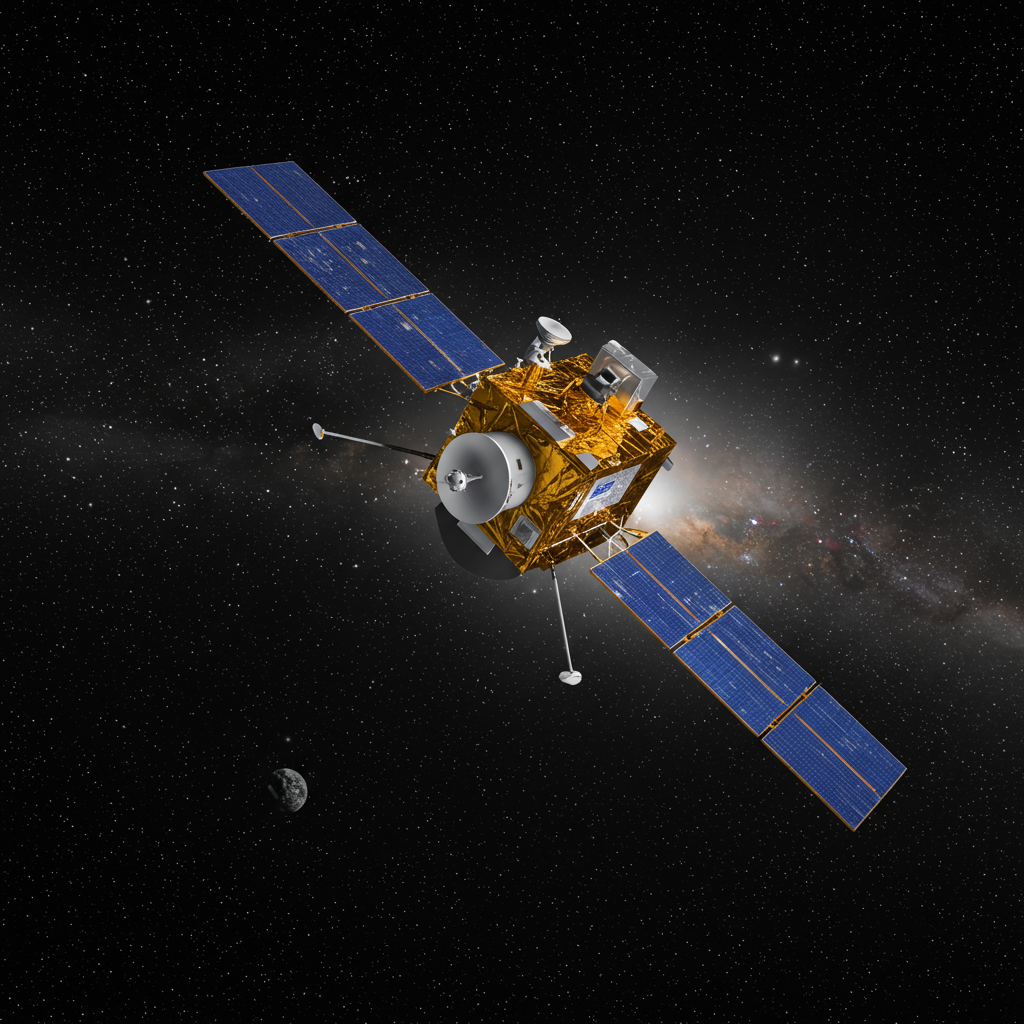
The University of Arizona (UArizona) is forging new frontiers in space exploration, taking a lead role in developing crucial instruments for the innovative Lazuli space telescope. This groundbreaking mission, part of the philanthropic Eric and Wendy Schmidt Observatory System, is poised to revolutionize our quest for exoplanets and potentially answer humanity’s most profound question: Is there life beyond Earth? With its deep expertise in optics and space instrumentation, the University of Arizona’s Steward Observatory is spearheading the construction of two of Lazuli’s three vital components, solidifying Tucson, Arizona’s position at the forefront of astronomical discovery.
UArizona’s Pivotal Role in the Lazuli Space Telescope Mission
UArizona’s renowned Steward Observatory is a cornerstone of this ambitious endeavor, tasked with building two of the three essential instruments for the Lazuli space telescope. This significant contribution underscores the university’s decades of leadership in designing and fabricating advanced technology for celestial observation. Associate Professor Ewan Douglas, who serves as the principal investigator for both instruments at Steward Observatory, highlights Lazuli as the “space arm” of a broader observatory system designed to accelerate scientific understanding.
The Eric and Wendy Schmidt Observatory System, an initiative by Schmidt Sciences, champions enhanced access to high-quality observational data, rapid development cycles, and open scientific collaboration. This approach allows researchers to bridge the gap between technological possibilities and tangible discoveries, pushing the boundaries of what’s achievable in astrophysics. For UArizona, it represents an unparalleled opportunity to leverage its unique capabilities for a global scientific impact.
Unveiling Cosmic Secrets: Lazuli’s Scientific Mission
The Lazuli space telescope, a 10-foot observatory set to launch within the next few years (projected completion by 2029), has a multifaceted mission. Its primary objective is to significantly advance the ongoing search for exoplanets, particularly those that might harbor life. Beyond this captivating pursuit, Lazuli will contribute to a deeper understanding of our universe, precisely measuring the distances to nearby stars and tracking the universe’s accelerating expansion.
This mission moves beyond merely detecting distant worlds; it aims to characterize them and their environments with unprecedented detail. From examining nearby stellar neighborhoods to probing the farthest galaxies, the data collected by the UArizona space telescope instruments will reshape our cosmic perspective. It promises to deliver insights into how quickly the universe is evolving and where Earth fits within this grand cosmic tapestry.
Engineering Tomorrow’s Vision: The Lazuli Instruments
The University of Arizona’s contribution to Lazuli focuses on two sophisticated instruments: the Widefield Context Camera (WCC) and the ExtraSolar Coronagraph (ESC). Each plays a distinct yet complementary role in achieving the telescope’s ambitious scientific goals.
The Widefield Context Camera will serve as a versatile general astrophysics imager, providing broad contextual views of the cosmos. Equipped with a suite of sensors and filters, it enables high-resolution studies across various celestial phenomena. Its design reflects a modern philosophy in space instrumentation, prioritizing rapid development by utilizing commercially available, off-the-shelf components rather than time-consuming custom hardware. This innovative approach, championed by UArizona, dramatically cuts down development time, allowing for faster scientific returns.
However, the true star of exoplanet imaging is the ExtraSolar Coronagraph (ESC). This specialized instrument is engineered to perform a seemingly impossible feat: blocking out the overwhelming light from a host star to reveal the much fainter planets or asteroid belts orbiting it. By adapting advanced adaptive optics technology for space, the ESC will continuously correct tiny optical imperfections within the telescope’s mirrors, creating “dark holes” in the starlight. This allows astronomers to detect planets that are a billion times dimmer than their parent stars, including reflected light from Neptune-sized worlds. The ESC promises to offer a sensitivity several orders of magnitude greater than even the venerable Hubble Space Telescope, a monumental leap in observational capability.
Speed, Efficiency, and Open Science: A New Paradigm
A cornerstone of the Lazuli mission, and a key commitment of the UArizona space telescope team, is the prioritization of speed and efficiency in scientific discovery. This is achieved through a strategic decision to leverage existing, well-proven software developed by UArizona scientists and students for ground-based instruments, rather than creating bespoke solutions that can take decades to finalize. Associate Astronomer Jared Males notes that this methodology significantly accelerates the process.
Beyond rapid development, the Lazuli project embraces an open science philosophy. All software and data generated by the mission will be made publicly available. This commitment to transparency and collaboration is designed to accelerate innovation across the scientific community, allowing future projects and researchers to build upon Lazuli’s findings and lessons learned. This forward-thinking approach ensures that the technological advancements made for Lazuli will inform and accelerate the development of future NASA missions, such as the Nancy Grace Roman Space Telescope and the proposed Habitable World Observatory, creating a synergistic pathway for sustained space exploration.
A Legacy of Innovation: UArizona’s Space Exploration Prowess
The University of Arizona’s leadership in the Lazuli mission is not an isolated event; it’s a testament to a long-standing legacy of innovation in space and astronomical sciences. The Steward Observatory, along with the Space Astrophysics Lab and Steward’s Center for Adaptive Optics, boasts world-class facilities for testing advanced instruments like coronagraphs in vacuum conditions. This infrastructure has been crucial in accelerating the research and development phase of projects like Lazuli.
Furthermore, UArizona’s Richard F. Caris Mirror Lab is globally unique, capable of producing the massive 8.4-meter mirrors as single units, as demonstrated by its critical role in constructing the primary mirror for the Vera C. Rubin Observatory. This unparalleled expertise in giant mirror fabrication underscores UArizona’s foundational contributions to the world’s most powerful telescopes.
The university’s impact extends to cutting-edge research, as evidenced by Steward Observatory researchers’ involvement in using the James Webb Space Telescope (JWST) to find compelling evidence of a potential giant planet orbiting Alpha Centauri A, our sun’s closest stellar neighbor. Such discoveries highlight UArizona’s continuous engagement at the very frontier of exoplanet research. The Lazuli project itself involves a diverse, multi-college team, spanning the Wyant College of Optical Sciences, the College of Engineering, and the College of Science, providing invaluable hands-on experience for students and fostering the next generation of space scientists.
Looking to the Stars: The Future of Lazuli and Beyond
The Lazuli space telescope represents an exciting new chapter in humanity’s quest to understand our place in the cosmos. With its projected completion by 2029, this 10-foot observatory, powered by the ingenuity of the University of Arizona, promises to deliver unprecedented views of distant planets and shed light on fundamental astrophysical questions.
By prioritizing rapid development, leveraging existing technologies, and committing to open science, the Lazuli mission is setting a new standard for collaborative and efficient space exploration. The insights gained from this pioneering UArizona space telescope will not only fuel scientific discovery but also inspire a new generation of explorers and innovators. As we look forward to Lazuli’s launch, the University of Arizona continues to stand as a beacon of excellence, propelling us closer to uncovering the universe’s most guarded secrets.
Frequently Asked Questions
What is the main goal of the Lazuli space telescope and when will it be completed?
The Lazuli space telescope’s main goal is to significantly advance the search for new exoplanets, including those that might harbor life, and to improve our understanding of the universe’s expansion and star distances. It’s part of the Eric and Wendy Schmidt Observatory System. The project, including the instruments developed by the University of Arizona, is projected to be completed by 2029.
Which specific instruments is the University of Arizona developing for the Lazuli mission?
The University of Arizona’s Steward Observatory is developing two of the three crucial instruments for the Lazuli space telescope: the Widefield Context Camera (WCC) and the ExtraSolar Coronagraph (ESC). The WCC provides general astrophysics imaging, while the ESC is designed to block starlight, enabling the direct observation of much dimmer exoplanets and asteroid belts orbiting other stars.
How does the University of Arizona’s approach to building Lazuli accelerate scientific discovery?
The University of Arizona is accelerating scientific discovery for Lazuli by prioritizing speed and efficiency. This includes using commercial, off-the-shelf components instead of custom hardware, and leveraging existing, proven software developed for ground-based instruments. Additionally, all software and data from the mission will be made publicly available, fostering open science and collaboration to benefit future projects and missions.