The dream of sustained human presence on the Moon is closer than ever, largely thanks to a vibrant ecosystem of private space contractors relentlessly pushing forward. Despite recent shifts in strategy and widely publicized challenges at NASA, companies like Lunar Outpost are embodying resilience and innovation. These commercial partners are proving indispensable in advancing the ambitious Artemis program, which aims to return humans to the lunar surface for the first time in over half a century.
As of early March 2026, NASA has announced a significant restructuring of its lunar landing plans. The agency confirmed that its first human moon landing in decades, originally targeted for Artemis III, will now be incorporated into a later 2028 launch attempt with Artemis IV. This decision by Administrator Jared Isaacman comes amidst technical hurdles, substantial budget overruns, and ongoing schedule delays for the program. Rather than deterring its commercial partners, this new timeline is being viewed by many as a strategic opportunity to accelerate critical long-term objectives.
NASA’s Evolving Lunar Strategy: Adapting to Deep Space Demands
NASA’s ambitious Artemis program, established to extend human exploration beyond Earth orbit, has encountered its share of deep space challenges. Persistent technical issues have pushed the program billions of dollars over budget and years behind its initial schedule. Critics suggested the agency might be attempting too much too quickly. Consequently, NASA Administrator Jared Isaacman made a pivotal announcement: the first human lunar landing would shift to the Artemis IV mission in 2028. This move has significant implications, creating both new questions and new opportunities for NASA’s extensive network of commercial collaborators.
While acknowledging the delays, Isaacman has also outlined a bold vision for the future. He sees the Moon as a vital hub for a “nascent orbital economy,” with plans to establish a permanent lunar base in the near future. This base would support lunar mining for Helium-3, a rare isotope crucial for future fusion energy reactors on Earth, and host lunar data centers. The establishment of this lunar infrastructure is not an end in itself, but a stepping stone towards developing space nuclear power for habitats and advanced propulsion for manned missions to Mars and beyond. This long-term vision underpins the agency’s commitment despite short-term adjustments.
Artemis I: Laying the Groundwork for Deep Space Exploration
The foundational Artemis I mission, launched uncrewed in November 2022, was a crucial integrated test flight. The Space Launch System (SLS) rocket, carrying the Orion spacecraft, embarked on a 25-day journey. It traveled an astounding 1.4 million miles, orbiting the Moon and flying 40,000 miles beyond its far side—a record for any human-rated spacecraft. Key objectives included rigorous testing of Orion’s heat shield performance during high-speed, high-heat re-entry and validating all mission operations. Despite a safe splashdown, an inspection revealed some heat shield damage, leading to planned trajectory modifications for future crewed missions to enhance safety.
The Artemis I mission also deployed 10 CubeSats for various scientific and technological experiments. It carried three manikins, including “Commander Moonikin Campos,” equipped with sensors to collect data on acceleration, vibration, and radiation exposure. Two torso phantoms, “Zohar” and “Helga,” provided critical comparative data on radiation protection with and without a specialized vest. These pioneering efforts gathered invaluable insights, paving the way for the complex demands of future human deep-space travel.
Private Sector Resilience: Lunar Outpost Forges Ahead
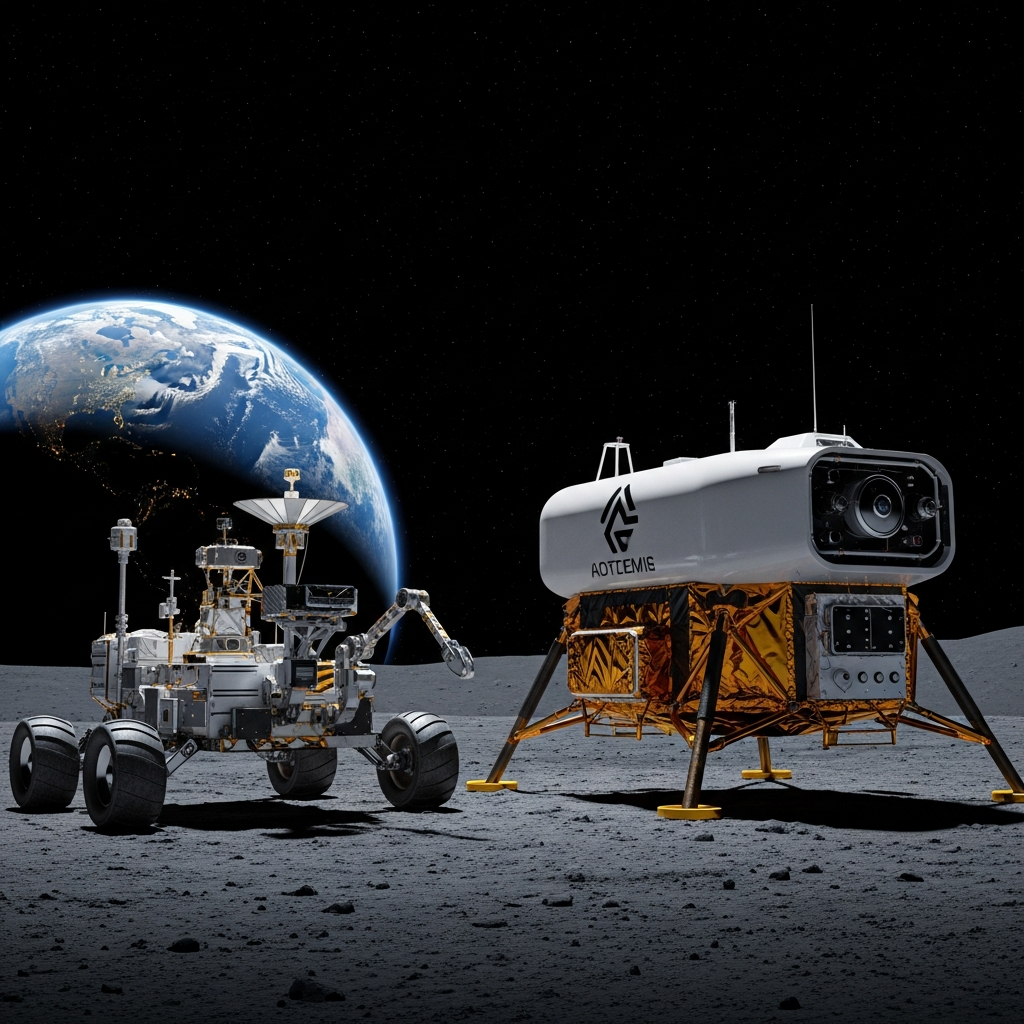
For private contractors like Lunar Outpost, a small space startup headquartered in Colorado, the evolving landscape presents a compelling mix of challenges and opportunities. Justin Cyrus, CEO of Lunar Outpost, views the Artemis IV delay as a chance to be part of an even more impactful mission. His company’s Mobile Autonomous Prospecting Platform (Mapp) rover, a compact yet sophisticated vehicle, is now slated to accompany Artemis IV astronauts in 2028. Mapp is crucial for NASA’s long-term lunar habitation plans, designed to explore lunar dust and soil at the Moon’s south pole.
“Humans will be back on the moon for the first time in over 50 years and one of our rovers will be alongside,” Cyrus stated, expressing excitement for the broader vision of “higher cadence, more missions going to the moon.” Lunar Outpost, founded in 2017, exemplifies the burgeoning era of public-private partnerships in space. The company aims to develop and operate a fleet of rovers for NASA, targeting both lunar and future Martian missions. Their largest project, the in-development Eagle lunar terrain vehicle (LTV), promises to be a highly capable crewed and cargo transport system for human spaceflight.
Overcoming Adversity: Mapp’s Journey to the Moon
The Mapp rover has faced significant adversity, highlighting the inherent risks in lunar exploration. In March 2025, Mapp made history by becoming the first commercial exploration vehicle to reach the lunar surface, riding aboard the Athena lander built by Texas-based Intuitive Machines. However, the lander toppled upon touchdown, trapping Mapp inside. Despite sending signals indicating full functionality, the rover could not deploy, eventually succumbing as its batteries died. This incident was a profound frustration for Cyrus and his 200+ employees.
Undeterred, Lunar Outpost immediately began preparing Mapp for its next attempt. The company’s workforce remains focused, developing not only rovers but also power- and oxygen-generating systems for space habitation and robotic arms for moon base construction. Cyrus emphasizes a strategy of “quietly going about its own business,” tuning out the highly publicized delays and failures faced by others, including NASA’s own Artemis woes. This agile approach enables them to adapt to constant change, a defining characteristic of the space industry.
The New Space Race: Collaboration Amidst Competition
The drive to return to the Moon is part of a “21st-century space race,” primarily between the U.S. and China, with China aiming for a lunar landing by 2030. NASA Administrator Isaacman has underscored the critical nature of this competition, warning that delays could threaten American leadership in space. This intense rivalry further highlights the necessity of robust public-private partnerships to maintain momentum and achieve strategic objectives.
NASA’s partnerships extend beyond Lunar Outpost. SpaceX received a nearly $3 billion contract in 2021 for its Super Heavy-Starship lunar lander, while Blue Origin secured a $3.4 billion contract in 2023 for a human lunar lander for the Artemis V mission. These collaborations are essential for developing next-generation heavy-lift launch vehicles and on-orbit refueling capabilities, crucial for frequent and cost-effective lunar access. Blue Origin, for instance, has recently advanced with its New Glenn rocket and its Mark 1 cargo lander, slated for lunar landing later this year.
Funding Challenges and Economic Impact
Despite ambitious goals and private sector drive, NASA itself has faced significant internal pressures. Protests from employees, contractors, and lawmakers have arisen over proposed budget cuts and mass layoffs, impacting over 40 ongoing and future science missions. These cuts threaten to cause a “brain drain” of critical institutional knowledge and talent, with some scientists even considering leaving the U.S. for international opportunities.
The economic impact of NASA’s work is substantial. For every dollar of tax revenue received, NASA is estimated to generate $3 in U.S. economic output, creating hundreds of thousands of jobs. Beyond direct economic output, countless “spinoff” technologies—from medical devices to advanced materials—benefit daily life. Cuts to programs like the Office of STEM Engagement also jeopardize workforce development and national interest in science, potentially affecting future generations. The recent “One Big Beautiful Bill Act,” allocating an additional $9.9 billion to NASA, aims to mitigate some of these financial pressures and support accelerated lunar initiatives.
Frequently Asked Questions
How has NASA’s Artemis program strategy recently shifted for human lunar landings?
NASA recently announced a significant change to its Artemis program, moving the target for its first human lunar landing in decades from Artemis III to the Artemis IV mission, now scheduled for 2028. This restructuring by Administrator Jared Isaacman addresses technical issues, budget overruns, and schedule delays. While delaying the initial landing, it aims to establish a more robust foundation for a sustained human presence, allowing commercial partners like Lunar Outpost to play a more integrated role in the later mission. This strategic pivot focuses on accelerating long-term objectives and building a lunar economy.
Which private companies are critical partners in NASA’s Artemis Moon missions?
Several private companies are essential to NASA’s Artemis Moon missions. Lunar Outpost is a key player, developing rovers like the Mapp (now slated for Artemis IV) and the Eagle LTV for lunar exploration and habitation. Intuitive Machines built the Athena lander that carried Mapp to the Moon in 2025. SpaceX holds a significant contract for its Super Heavy-Starship lunar lander for Artemis III, while Jeff Bezos’ Blue Origin secured a $3.4 billion contract for a human lunar lander for the Artemis V mission, advancing its New Glenn rocket and Mark 1 cargo lander. These commercial collaborations are vital for developing next-generation technologies and achieving mission goals.
What are the key challenges and opportunities facing private space contractors like Lunar Outpost?
Private space contractors like Lunar Outpost face significant challenges, including technical complexities, the inherent risks of spaceflight (as seen with Mapp’s trapped status after a lander toppled), and the need to adapt to NASA’s evolving timelines and budget shifts. However, these challenges often present opportunities. For Lunar Outpost, the Artemis IV delay means their Mapp rover will now accompany astronauts, increasing its impact. The broader opportunity lies in the burgeoning public-private partnership model, which offers lucrative contracts, accelerates innovation, and allows smaller, agile companies to contribute critical technologies for a sustainable lunar economy and future Mars missions.
The Future of Lunar Exploration: A Collaborative Frontier
Ultimately, NASA is determined to return humans to the Moon, and the private sector is proving to be an indispensable ally in this monumental endeavor. Companies like Lunar Outpost, with their unwavering focus and innovative spirit, are navigating the complexities of deep space with resilience. Their contributions, alongside those of industry giants like SpaceX and Blue Origin, are not just about reaching the Moon, but about establishing a sustainable, economically viable, and strategically crucial human presence beyond Earth. The next five years promise an exhilarating, step-by-step realization of this shared vision, transforming science fiction into a tangible reality. The collaborative frontier of lunar exploration is set to be an absolute blast.