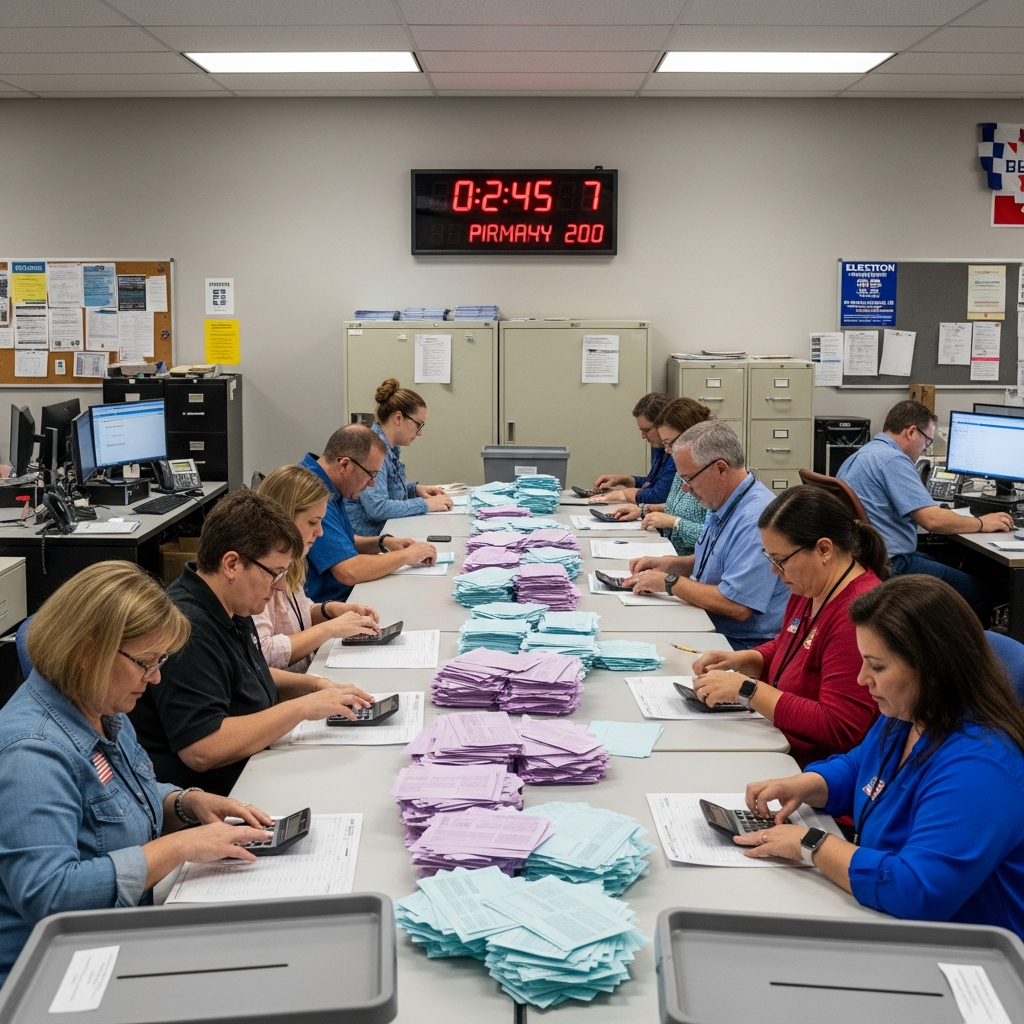
Election administration in Texas faces unique challenges, as highlighted by a recent incident in Calhoun County. The local Republican Party there missed a critical state-mandated deadline to report its primary election results, sparking concerns and raising questions about the complexities of ballot tabulation. This delay, attributed to a labor-intensive hand-counting process, meant final results weren’t submitted until days after polls closed, contrasting sharply with the swift reporting from local Democrats who utilized electronic voting equipment.
This article delves into the specifics of the Calhoun County delay, explores the legal ramifications, and places the incident within the broader context of election administration challenges across Texas. Understanding these issues is crucial for anyone interested in the integrity and efficiency of the electoral process.
Calhoun County’s Delayed Primary Results Unpacked
In a notable administrative lapse, Calhoun County Republicans finally submitted their primary election results to the state on Friday morning. This came after the county GOP failed to meet a state law requiring early-voting and Election Day results to be submitted within 24 hours of polls closing on Tuesday night. Mary Ann Orta, the county’s elections administrator, confirmed the missed deadline. The Texas Secretary of State’s Office also verified that the results were not submitted until Friday.
In contrast, the Democratic primary results for Calhoun County were reported to the state promptly on Tuesday night, shortly after polls closed. Democrats in the county opted for electronic voting equipment to tabulate their ballots, demonstrating a more streamlined process compared to the Republicans’ method.
Why Hand Counting Led to Delays
Texas law grants political parties at the county level significant autonomy in deciding how their primaries are administered. For the 2026 primary, Calhoun County Republicans chose to hand count all ballots. This included both early votes and those cast at 11 Republican precincts on Election Day. Hand counting is an exceptionally labor-intensive method, particularly in an election where 3,153 ballots were cast in the GOP primary alone.
Calhoun County GOP Chair Russell Cain acknowledged the extensive effort involved in a text message to Votebeat. He thanked the “hundred people devoted to this endeavor” and expressed appreciation for the continuous support from the Calhoun County Elections Office and the Texas Secretary of State. However, Cain did not immediately provide details on when the counting was completed or respond to inquiries about the missed deadline itself. This decision to hand count, while a party prerogative, directly contributed to the significant delay in reporting.
Legal Penalties and Enforcement Questions
Missing the 24-hour deadline for reporting election results is not merely an administrative oversight; it carries serious legal consequences in Texas. Under state law, such a failure is classified as a Class B misdemeanor. This offense can lead to fines of up to $2,000 and even potential jail time for those found responsible.
The Texas Secretary of State’s Office, however, remained tight-lipped regarding the enforcement of this law. A spokesperson declined to comment on how such violations are typically handled or the potential legal implications for the Calhoun County Republican Party. They did, however, refer to a section of the Texas election code. This code indicates that the canvassing authority—in this instance, the county party chair and the party’s executive committee—can seek a court order to compel the delivery of records and oversee the counting process. Furthermore, local prosecutors generally hold the authority to investigate and prosecute any election crimes or violations. The silence from state officials leaves open questions about accountability and future actions.
Strain on Election Staff
The extended delay took a heavy toll on election officials and their staff. Mary Ann Orta, the Calhoun County elections administrator, described the situation as exhausting. Her team had been sleep-deprived since Tuesday, patiently waiting for all necessary information to officially report the results to the state. “I’m exhausted and still trying to make heads or tails of everything we’ve got,” Orta stated, underscoring the significant burden placed on local election workers when such delays occur. Their commitment to accurate reporting often comes at a personal cost.
A Pattern of Primary Election Delays in Texas
The challenges faced by Calhoun County are not isolated incidents. Other Texas counties have also encountered significant delays in reporting primary election results, often due to similar factors. This highlights a broader trend in a state where local political parties have considerable discretion over their primary election administration.
Previous Incidents Across the State
Gillespie County (2026 Primary): Republicans in Gillespie County also opted to hand count ballots this year. While also a labor-intensive process, they managed to complete their count by approximately 5 a.m. on Wednesday, a more timely resolution compared to Calhoun County.
Eastland County (2026 Primary): This county, another hand-counting jurisdiction, did not report its totals to the state until about 5:45 p.m. on Wednesday. Their delay was complicated by an additional hurdle: election officials had to obtain a court order to access a secured box that mistakenly contained a tally form from one precinct.
Harris County (2022 Primary): In a more high-profile incident, Harris County failed to meet its state-mandated deadline in the 2022 primary. It took nearly 30 hours to complete vote counts. Officials cited issues with new voting equipment and an unusually long two-page ballot as the primary reasons. The county eventually sought a court order to extend its deadline. While no misdemeanor charges were filed, the county’s chief election official resigned days later following the discovery that thousands of ballots had been omitted from the total count.
These examples underscore the varied nature of challenges in Texas primary election administration, whether stemming from the choice to hand count ballots or issues with electronic systems. The pressure of strict reporting deadlines frequently plays a role in how counties choose their tabulation methods. Some county GOP officials have even cited deadline pressures as a direct reason for not* choosing hand counting, underscoring the logistical complexities and potential legal risks involved.
Understanding Texas Primaries
Primary elections in Texas are fundamental for both Republican and Democratic parties, determining the nominees who will represent them in the November general election. The decentralized nature of election administration, where county parties dictate their primary processes, creates a patchwork of approaches across the state. While this allows for local control, it can also lead to inconsistencies and varied efficiency in reporting results. The importance of these primaries cannot be overstated, as they often effectively decide certain state races, especially in heavily gerrymandered districts, despite historically lower turnouts compared to general elections.
Frequently Asked Questions
What are the consequences for missing Texas primary reporting deadlines?
Missing the state-mandated 24-hour deadline for submitting primary election results in Texas carries significant legal ramifications. It is classified as a Class B misdemeanor, which can result in fines of up to $2,000 and even potential jail time. While the Texas Secretary of State’s Office did not comment on enforcement specifics in the Calhoun County case, the election code allows for the canvassing authority (the county party chair and executive committee) to seek court orders to compel record delivery or supervise counting. Local prosecutors also have the authority to investigate and prosecute such election crimes.
How do Texas counties decide on primary election administration methods?
In Texas, political parties at the county level are granted the authority to decide how their primary elections will be administered. This includes choices regarding ballot tabulation methods, such as hand counting or using electronic voting equipment. This decentralized approach allows for local control and flexibility but can also lead to varying levels of efficiency and administrative challenges across different counties, as seen in the contrasting methods used by Democrats and Republicans in Calhoun County.
What challenges does hand-counting ballots present in Texas primaries?
Hand-counting ballots, while chosen by some county parties, presents significant logistical and time-sensitive challenges, particularly in primary elections with strict reporting deadlines. It is a labor-intensive process that requires numerous personnel and can easily lead to delays, as demonstrated in Calhoun County where results were submitted days late. This method also places considerable strain on election officials and staff, often extending their work hours significantly as they await complete data. The pressure of meeting the 24-hour reporting deadline often prompts many counties to opt for more automated tabulation methods.
Conclusion
The incident in Calhoun County serves as a potent reminder of the intricacies and potential pitfalls in election administration. While local control over primary processes offers flexibility, it also underscores the need for robust planning and efficient execution to ensure timely and transparent reporting of results. The missed deadline, the legal implications, and the strain on election staff highlight the critical importance of reliable vote tabulation methods. As Texas moves forward, ensuring that all counties can meet their reporting obligations will be paramount for maintaining public trust and the integrity of the electoral process.