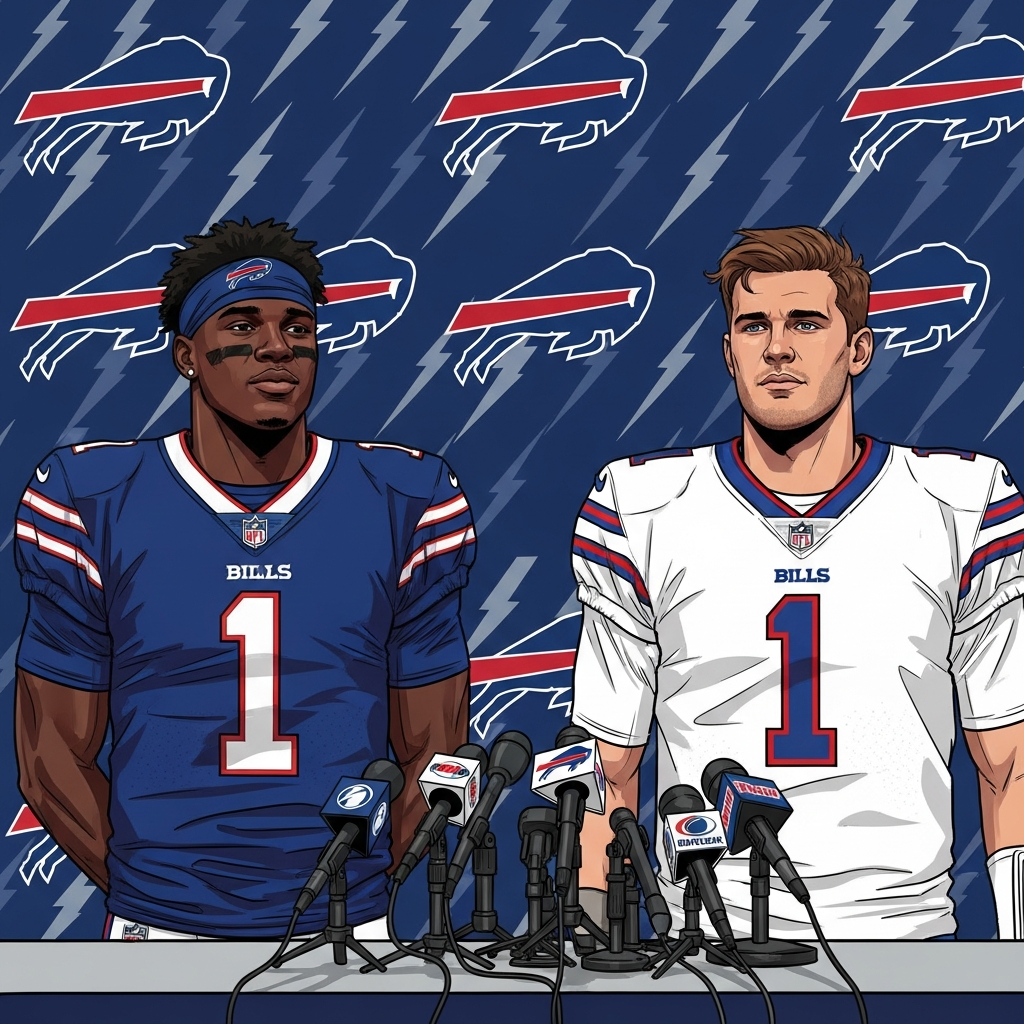
The NFL landscape shifted dramatically with the blockbuster announcement that Chicago Bears star wide receiver D.J. Moore has been traded to the Buffalo Bills. This high-profile move, finalized in early March 2026, sees the Bills acquire a formidable offensive weapon for quarterback Josh Allen, while the Bears strategically pivot towards a youth movement and significant financial flexibility. Moore’s departure from the Windy City was met with an outpouring of emotion, as the beloved receiver shared a poignant farewell, marking the end of a memorable chapter in his career and signaling new beginnings for two prominent NFL franchises.
DJ Moore’s Emotional Farewell to Chicago
Upon news of the trade, D.J. Moore took to social media to express his profound gratitude and appreciation for his three seasons with the Chicago Bears. His heartfelt message resonated deeply with fans, teammates, and staff alike, highlighting the strong bonds he forged during his tenure at Halas Hall and Soldier Field.
Moore began by thanking the Chicago faithful for their unwavering “love and support.” He emphasized that he and his family were “proud to call this place home,” describing the community’s embrace as “unbelievable.” He assured fans that he “gave [his] all every time [he] stepped on the field” and sincerely hoped his performances brought them pride. The receiver also fondly recalled the “unbelievable memories at Soldier Field,” acknowledging the vital role fans played in those cherished moments.
Beyond the stands, Moore extended his sincere appreciation to his “Bears teammates, coaches and staff.” He spoke of enjoying their daily camaraderie and expressed how much he would miss seeing them at Halas Hall. His message concluded with a powerful affirmation: “You all made me grateful every day to be a Chicago Bear!” In a characteristic move, Moore also included a subtle, unstated jab at the Green Bay Packers, a final nod to the heated divisional rivalry he relished. This emotional send-off from Moore underscored the deep connection he fostered with the organization and its passionate fanbase.
A Legacy Etched in Soldier Field Lore
Despite a relatively short three-season stint in Chicago, D.J. Moore left an indelible mark on the Bears’ franchise. During his time, he amassed impressive statistics, recording 244 receptions for 3,012 yards and 20 touchdowns, consistently showcasing his elite talent and playmaking ability.
His impact was particularly evident during quarterback Caleb Williams’ breakout 2025 campaign. Moore, renowned for his clutch performances, delivered multiple highlight-reel plays that were instrumental in the Bears securing an 11-6 record and an NFC North title. Fans will forever remember his iconic 46-yard walk-off touchdown against the Green Bay Packers, a moment that cemented his place in Bears lore. He further underscored his rivalry dominance by catching the go-ahead touchdown in Chicago’s thrilling 31-27 Wild Card playoff victory over Green Bay in January 2025, followed by another touchdown in their subsequent Divisional Round loss to the Los Angeles Rams.
Caleb Williams himself offered an emotional tribute to Moore, sharing a highlight reel of their memorable passes together on Instagram Stories. The video was set to Djo (Joe Keery)’s “End of the Beginning,” with lyrics like, “You take the man out of the city, not the city out the man… And when I’m back in Chicago, I feel it… Oh, I wave goodbye to the end of beginning,” perfectly capturing the poignant farewell. Their productive two seasons saw them combine for 1,648 yards and 12 touchdowns, establishing a strong on-field connection that will be missed.
Unpacking the Blockbuster Trade Details
The trade of D.J. Moore to the Buffalo Bills was a strategic decision by the Chicago Bears, largely driven by financial considerations and a commitment to their long-term vision. The deal, finalized on Thursday, March 5, 2026, involved the Bears sending Moore and a 2026 fifth-round draft pick to the Bills. In return, Chicago acquired a 2026 second-round selection.
This move was explicitly labeled a “cap-cutting measure” for the Bears. Moore’s significant $28.5 million cap hit for the upcoming 2026 season was a key factor. By executing this trade, Chicago successfully freed up approximately $16.5 million in crucial cap space. This financial flexibility empowers General Manager Ryan Poles to pursue other strategic roster enhancements, aligning with the team’s ongoing rebuild efforts around quarterback Caleb Williams.
Buffalo Bills: A New Weapon for Josh Allen
For the Buffalo Bills, the acquisition of D.J. Moore addresses a critical need for a true WR1, especially following the departure of star receiver Stefon Diggs. Moore, a 28-year-old superstar firmly in his prime, steps into a high-octane offense led by one of the NFL’s most dynamic quarterbacks, Josh Allen. This move immediately elevates Buffalo’s offensive prowess and positions them as even scarier contenders in a wide-open AFC East.
Bolstering the Bills’ Offensive Arsenal
Moore’s skillset is an ideal match for Allen’s play style. Known for his exceptional “YAC” (yards after catch) ability and “elite separation,” Moore provides Allen with a reliable and explosive target. His ability to create space and turn short passes into significant gains will be invaluable in Buffalo’s pass-heavy attack. The Bills are banking on this synergy to propel them deep into the playoffs, with many experts now viewing them as immediate Super Bowl contenders for the 2026 season.
A significant advantage for the Bills is Moore’s familiarity with Head Coach Joe Brady, who previously served as Moore’s offensive coordinator with the Carolina Panthers. Under Brady’s guidance, Moore consistently delivered some of the most productive numbers of his career. This reunion is expected to ignite a “Pro Bowl-caliber spark” instantly, allowing Moore to seamlessly integrate into Buffalo’s offensive scheme and hit the ground running. Despite playing on a crowded Chicago depth chart in 2025, Moore still managed 682 yards and 6 touchdowns, suggesting his production could soar in Buffalo’s focused passing game.
The Curtis Samuel Conundrum
Moore’s arrival has immediate and profound implications for the Bills’ wide receiver room, most notably signaling the likely departure of Curtis Samuel. General Manager Brandon Beane’s strategic trade for Moore, despite potentially “slightly overpaying,” makes logical sense given Buffalo’s roster needs.
Samuel, whose previous free-agency signing has been described as a “brutal swing-and-miss” due to low productivity and an injury-plagued two seasons with the Bills, now appears “as good as gone.” He played only 20 regular-season games, accumulating just 38 receptions for 334 yards and two touchdowns. With D.J. Moore, Khalil Shakir, Joshua Palmer, and Keon Coleman identified as “shoo-ins” for roster spots, Samuel would be left to compete for one or two remaining positions against less expensive alternatives.
Crucially, Samuel is set to count $9.5 million against the cap for the upcoming season. However, the Bills have a financial “out” before a $1 million roster bonus guarantees. Releasing Samuel would reduce his cap hit to a mere $3.45 million, providing a substantial saving of over $6 million. This financial imperative, coupled with Moore’s talent, makes Samuel “expendable” and his exit highly probable, allowing Buffalo to avoid a costly “hole in the roster.”
Chicago Bears: Embracing the Youth Movement
From the Chicago Bears’ perspective, the D.J. Moore trade was a pragmatic “math over emotions” decision by General Manager Ryan Poles. While Moore was undoubtedly a fan favorite and a top performer, his departure clears the path for the team’s burgeoning young receiving corps, specifically paving the way for emerging talents like Rome Odunze and Luther Burden III. These young pass-catchers are now poised to become the future of the Bears’ franchise.
Caleb Williams’ Evolving Receiving Corps
The cap savings of $16.5 million, coupled with the acquired 2026 second-round pick, provide the Bears with invaluable resources. This financial flexibility is rumored to be earmarked for a “massive defensive splash” in free agency, with star edge rusher Maxx Crosby frequently mentioned as a potential target. The additional draft capital further strengthens Chicago’s ability to build around quarterback Caleb Williams, signifying a full commitment to their “youth movement” and homegrown talent development.
While Caleb Williams will miss his connection with Moore, the focus now shifts to developing immediate chemistry with his new targets. The Bears aim to build a sustainable, competitive team through smart drafting and strategic free-agent acquisitions, with the Moore trade serving as a pivotal step in that long-term plan.
The Wider NFL Landscape: Impact of a Strategic Move
The D.J. Moore trade represents a significant strategic win for both the Buffalo Bills and the Chicago Bears, albeit with vastly different objectives. The Bills have acquired an elite, proven wide receiver to solidify their Super Bowl aspirations, providing Josh Allen with an immediate and high-impact target. This move instantly makes Buffalo a stronger contender in the AFC.
Conversely, the Bears have made a bold statement about their commitment to a youth-centric rebuild. By offloading a veteran with a substantial contract, they’ve gained crucial cap space and draft capital, empowering General Manager Ryan Poles to construct a team designed for sustained success around Caleb Williams. This trade will undoubtedly be a talking point throughout the 2026 NFL season, shaping expectations and setting the stage for an exciting future for both franchises.
Frequently Asked Questions
Why did the Chicago Bears trade DJ Moore to the Buffalo Bills?
The Chicago Bears traded D.J. Moore to the Buffalo Bills primarily as a strategic cap-cutting measure and to further commit to their youth movement. Moore carried a significant $28.5 million cap hit for the 2026 season. By trading him, the Bears freed up approximately $16.5 million in cap space, which can now be used to pursue other free agents, potentially on the defensive side of the ball. This move also clears the path for emerging young wide receivers like Rome Odunze and Luther Burden III to take on larger roles in the offense, aligning with the team’s long-term plan to build around quarterback Caleb Williams.
What does DJ Moore’s trade mean for the Buffalo Bills’ Super Bowl chances?
D.J. Moore’s trade significantly enhances the Buffalo Bills’ Super Bowl chances, providing Josh Allen with a much-needed, elite wide receiver. Following the departure of Stefon Diggs, Moore fills a critical WR1 void, bringing exceptional “YAC” and “elite separation” skills to a high-octane offense. His prior successful experience with Bills Head Coach Joe Brady (Moore’s former offensive coordinator) is expected to facilitate a seamless transition and an immediate “Pro Bowl-caliber spark.” This acquisition immediately makes the Bills a more formidable contender, with experts positioning them as strong Super Bowl favorites for the 2026 season.
Which young wide receivers will step up for the Chicago Bears after DJ Moore’s departure?
After D.J. Moore’s departure, the Chicago Bears are expected to lean heavily on their promising young wide receivers, particularly Rome Odunze and Luther Burden III. These emerging talents are now poised to take on expanded roles and become primary targets for quarterback Caleb Williams. The trade was a deliberate move to clear the runway for these younger players, giving them more opportunities to develop and showcase their abilities. Additionally, the Bears gained draft capital and cap space from the trade, which General Manager Ryan Poles can use to further bolster the roster with complementary pieces around their evolving receiving corps.