Humanity’s return to the Moon and the dream of sustained lunar settlements hinge on a critical challenge: feeding astronauts. Traditional farming methods are impossible in the Moon’s harsh environment. However, groundbreaking new research offers a compelling solution, demonstrating for the first time that chickpea plants can successfully grow and produce seeds in simulated lunar soil. This pioneering study reveals how a powerful biological alliance—involving chickpeas, special fungi, and organic compost—can transform inhospitable lunar regolith into a viable growth medium. This breakthrough in Lunar soil farming not only paves the way for sustainable space agriculture but also offers valuable insights for enhancing crop resilience in challenging conditions here on Earth.
The Lunar Farming Frontier: Overcoming Extreme Challenges
Establishing a permanent human presence on the Moon requires maximizing local resources. Lunar regolith, the Moon’s native soil, is abundant but far from Earth-friendly. It presents a formidable list of obstacles for plant growth:
Toxic Elements: High concentrations of heavy metals like iron, aluminum, zinc, and copper can be detrimental to plants.
Sterile Environment: Lunar soil completely lacks organic matter and the crucial microbial communities found in Earth’s healthy soils.
Poor Structure: Its irregular, angular particles lead to low water permeability, hindering water retention, nutrient uptake, and gas exchange.
Nutrient Availability: While essential nutrients like phosphorus, potassium, calcium, magnesium, and iron exist, they are locked in mineral forms, making them largely inaccessible to plants. Nitrogen, a vital plant nutrient, is almost entirely absent.
These combined factors make direct planting in lunar regolith a non-starter. To unlock the Moon’s potential as a farm, its physical and chemical properties must be radically transformed. This is where the innovative concept of bioremediation comes into play, leveraging biological processes to improve the lunar substrate.
Why Bioremediation is Key for Space Agriculture
Bioremediation offers a sustainable and regenerative pathway to make lunar soil productive. Instead of bringing massive amounts of Earth soil, this approach focuses on “terraforming” the regolith itself. The study’s core hypothesis was that a carefully engineered symbiosis could create a fertile support matrix. The research team specifically focused on three synergistic components: chickpeas, Arbuscular Mycorrhizal Fungi (AMF), and vermicompost (VC). Together, they aimed to enhance plant stress tolerance, sequester contaminants, and dramatically improve the soil’s structure.
The Trio for Terrestrial Success: Chickpeas, Fungi, and Compost
The selection of chickpea, AMF, and vermicompost was highly strategic, each playing a vital role in this pioneering Lunar soil farming experiment.
Chickpea: A Hardy, Nutritious Pioneer Crop
Chickpeas (Cicer arietinum) were chosen as the model plant for several compelling reasons:
Nutritional Value: They are a highly nutritious legume, rich in protein, carbohydrates, iron, phosphorus, calcium, and B vitamins—essential for an astronaut’s diet.
Stress Tolerance: Chickpeas are known for their resilience and ability to thrive in challenging conditions, making them ideal for the lunar environment.
AMF Symbiosis: Crucially, chickpeas readily form symbiotic relationships with Arbuscular Mycorrhizal Fungi.
Low Input: They require relatively low water and nitrogen inputs, a significant advantage for resource-scarce space missions.
Arbuscular Mycorrhizal Fungi (AMF): Nature’s Soil Engineers
AMF are a group of fungi that form symbiotic relationships with the roots of most plant species. Their role in this experiment was multifaceted:
Nutrient Acquisition: AMF hyphae (root-like structures) extend far beyond plant roots, accessing water and otherwise inaccessible nutrients like phosphorus, significantly boosting plant uptake.
Heavy Metal Remediation: AMF can sequester heavy metals in the rhizosphere, reducing their bioavailability and preventing their uptake by plants. They can also accumulate metals within their own fungal biomass.
Stress Protection: These fungi stimulate plant resistance, reducing the negative impact of metal toxicity and promoting growth even under extreme stress.
Soil Structure Improvement: AMF produce glomalin, a glycoprotein that acts as a “superglue,” binding soil particles to form stable aggregates. Their hyphae also physically entangle particles, improving water retention, gas exchange, and overall substrate structure. This is critical for improving the physical properties of sharp, angular lunar regolith particles.
Vermicompost: Nutrient-Rich Organic Booster
Vermicompost (VC) is a powerful organic amendment created through the bio-oxidative process of earthworms and their gut microbiota decomposing biowaste. Its benefits are numerous:
Nutrient and Mineral Supply: VC is packed with essential plant nutrients and minerals, making up for the lunar soil’s deficiencies.
Microbiome Introduction: It introduces a diverse and beneficial microbiome, which is completely absent in lunar regolith. These microbes enhance nutrient solubilization through biological weathering and enzyme activity.
Structural Enhancement: VC improves soil aggregate formation, lowers bulk density, modifies soil structure, and significantly boosts water retention.
Waste Recycling: The study highlights that astronauts could produce vermicompost on the Moon by feeding organic waste (food scraps, clothing fibers) to earthworms, creating a regenerative, closed-loop system.
The Experiment: Planting Seeds for the Future
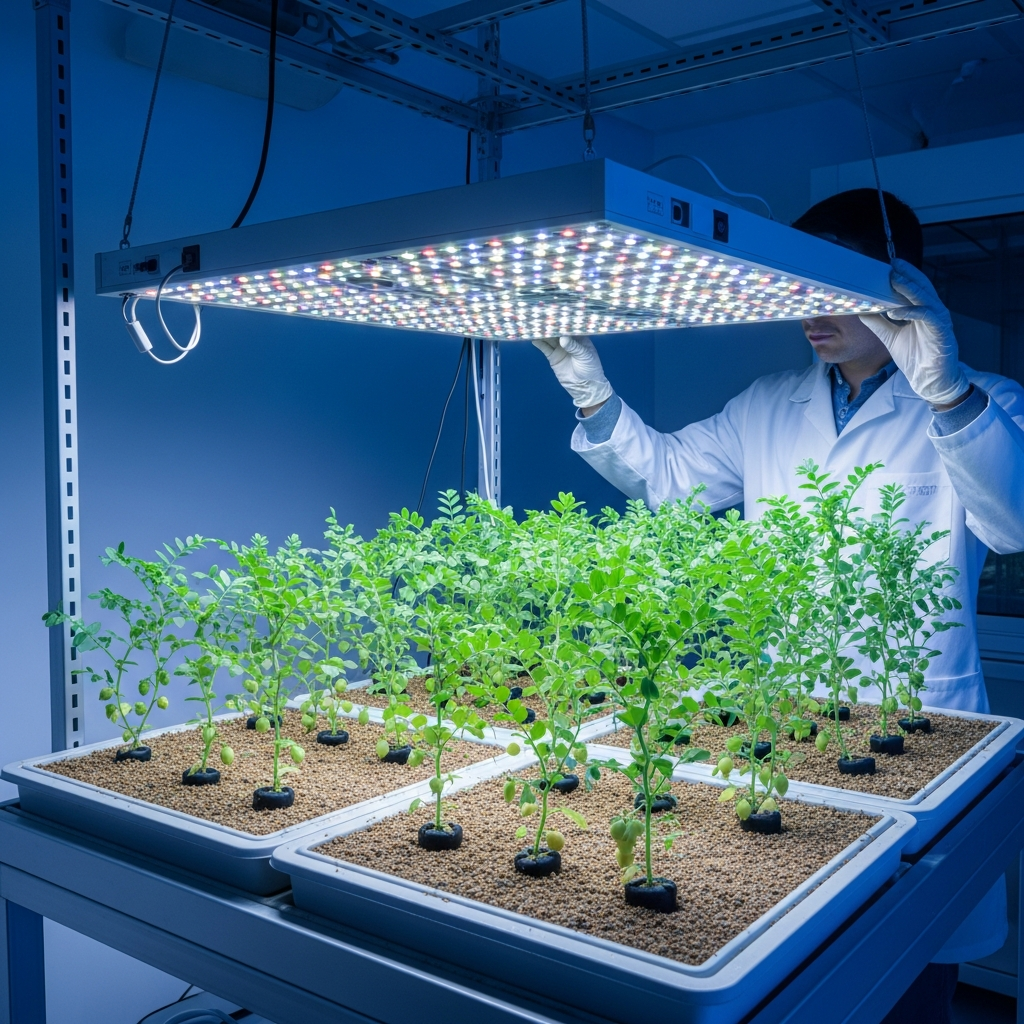
Researchers cultivated chickpeas in various mixtures of Lunar Regolith Simulant (LRS) and vermicompost, ranging from 25% LRS/75% VC to 100% LRS. These treatments were conducted both with and without AMF inoculation, and compared against Earth potting mix controls. The AMF inoculum included a blend of species to maximize effectiveness. Key aspects measured included plant establishment, growth, stress indicators, flowering, seed yield, biomass, AMF colonization, substrate pH, and aggregate stability.
Breakthrough Findings: Seeds of Hope for the Moon
The results were profoundly encouraging, offering tangible steps toward sustainable Lunar soil farming:
Successful Seed Production – A First!
Chickpeas successfully produced seeds in mixtures containing up to 75% LRS, but only when inoculated with AMF. Uninoculated LRS mixtures failed to produce any seeds, underscoring the indispensable role of the fungi. This marks the first documented instance of a crop growing to maturity and seeding in lunar regolith simulant.
Quality Over Quantity for Lunar Harvests
While the total number of seeds declined as LRS concentration increased, the individual seed weight remained stable in AMF-inoculated LRS50 and LRS75 treatments. This suggests that AMF continued to support vital nutrient uptake through the later stages of growth, allowing for normal seed filling once flowering and seed set began.
Enhanced Stress Tolerance
Plants in higher LRS concentrations showed stress symptoms like stunted growth and leaf yellowing. However, AMF inoculation dramatically extended the survival of plants in 100% LRS by two weeks. AMF-treated plants in pure LRS began senescence around day 75, compared to day 61 for uninoculated plants. This demonstrates a significant increase in plant resilience thanks to the fungi.
AMF Adapts to Extreme Conditions
Crucially, AMF successfully colonized roots across all inoculated LRS treatments, including 100% LRS. This proves the fungi’s remarkable ability to establish vital symbioses even under the most extreme, nutrient-poor conditions mimicking the Moon.
pH Modulation for Better Growth
Lunar regolith simulant is initially highly alkaline (pH 9.9). Vermicompost effectively lowered this to a slightly acidic range (5.9–6.4) in the mixtures. Post-harvest, AMF-inoculated mixtures maintained a more stable, narrower pH range (6.2–6.6), which is critical for maintaining the bioavailability of essential macronutrients for plant uptake.
Improving Moon Soil Structure
AMF inoculation significantly improved the aggregate stability of the LRS across all treatments, even 100% LRS. This physical transformation by the fungal hyphal networks and glomalin helps mitigate particle-related hazards, improves water retention, and enhances gas exchange—all vital for root health.
Increased Plant Biomass
AMF-inoculated plants in the 50% and 75% LRS mixtures showed significantly greater dry root and shoot biomass compared to their uninoculated counterparts, confirming improved overall growth and healthier development.
The Future of Moon Farming and Beyond
This study represents a monumental leap forward for Lunar soil farming and the broader vision of space agriculture. By demonstrating that biological amendments can transform inert lunar regolith into a productive growing medium, it validates the potential for in situ resource utilization. This means future lunar inhabitants might not need constant resupply missions for food, but could grow their own.
However, a critical next step involves assessing the safety and nutritional value of moon-grown chickpeas. While the plants showed resilience, the potential for absorbing toxic metals from the regolith needs thorough investigation to ensure the food is safe for human consumption. Future research will also focus on optimizing regolith conditioning, mitigating stress over multiple plant generations, and exploring diverse crop systems. The insights gleaned from this extraterrestrial research hold immense promise for enhancing soil health and plant resilience in challenging terrestrial environments as well, particularly for degraded or contaminated soils on Earth.
Frequently Asked Questions
How does bioremediation make lunar soil suitable for farming?
Bioremediation transforms harsh lunar regolith simulant (LRS) into a fertile growth medium by introducing biological agents. In this study, it involved adding nutrient-rich vermicompost to supply organic matter and a diverse microbiome, alongside Arbuscular Mycorrhizal Fungi (AMF). AMF form symbiotic relationships with plant roots, improving nutrient uptake, sequestering toxic heavy metals, and enhancing the soil’s physical structure by forming aggregates. This process addresses the lunar soil’s lack of organic material, microbial life, poor structure, and low nutrient bioavailability.
What are the key components needed to grow plants in moon soil simulant?
To successfully grow plants like chickpeas in lunar soil simulant, the research highlights three essential components: a resilient crop (like chickpea, chosen for its nutrition and stress tolerance), Arbuscular Mycorrhizal Fungi (AMF) for nutrient cycling, heavy metal remediation, and soil structure improvement, and vermicompost (VC) to provide organic matter, essential nutrients, and a beneficial microbiome. These components work synergistically to overcome the inherent challenges of lunar regolith, enabling plant growth and seed production.
Are chickpeas grown in lunar regolith safe and nutritious for astronauts to eat?
While this groundbreaking study successfully demonstrated the ability to grow chickpeas to seed in lunar regolith simulant, the safety and nutritional value for human consumption remain open questions. Researchers acknowledge the potential risk of plants absorbing toxic heavy metals present in the regolith during their growth. Future research is crucial to assess the metal content in harvested seeds and ensure their safety and nutritional quality before they can be considered a reliable food source for astronauts on long-term lunar missions.