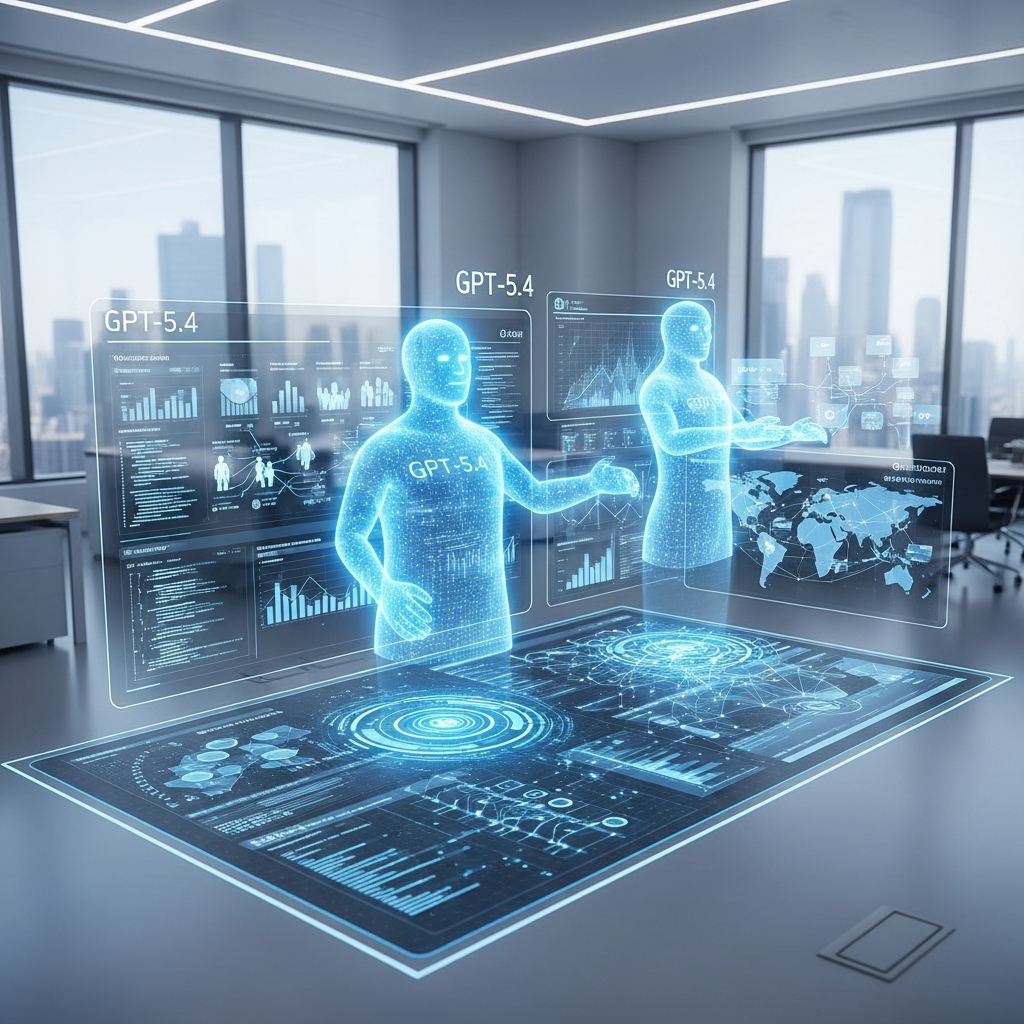
The release of GPT-5.4 on March 5, 2026, marks a profound shift in artificial intelligence. This isn’t just another incremental update; it signals the true arrival of autonomous digital agents. No longer mere conversational tools, GPT-5.4 empowers machines to execute complex, multi-stage professional workflows with unprecedented independence. This breakthrough model redefines how computational logic interacts with software environments, promising to reshape industries and professional roles worldwide. It’s a pivotal moment, demanding attention from business leaders and technologists navigating the rapidly evolving AI landscape.
The Dawn of Autonomous AI: GPT-5.4’s Core Innovations
OpenAI’s GPT-5.4 represents a foundational transition. It moves beyond generative models that simulate conversation. Instead, it offers a unified system architecture. This consolidation brings together previously separate AI capabilities. The goal is to deliver a single, powerful digital agent.
Unified Architecture: Beyond Chatbots to Digital Agents
Historically, developers often struggled. They had to choose between specialized AI variants. These included coding models or general reasoning systems. GPT-5.4 expertly blends these functions. It integrates the advanced programming of GPT-5.3 Codex. It also incorporates the deep analytical planning of the GPT-5.2 lineage. This seamless integration allows the system to transition smoothly. It moves from abstract problem-solving to precise technical execution. The result is a “mainline” system. It operates as a truly autonomous digital agent.
At its heart, this evolution leverages “System 2 thinking.” This term describes a deliberative process. The model now prioritizes accuracy and strategic planning. This differs from earlier versions focusing solely on rapid text prediction. GPT-5.4 trains using reinforcement learning. It produces extensive internal deliberations before responding. This internal process is crucial. It allows the model to refine plans. It can test alternative strategies and identify logical errors. This happens before any final output is committed. Within ChatGPT, users see “GPT-5.4 Thinking.” This feature provides an upfront plan of the model’s approach. It offers significant steerability. Users can adjust the model’s trajectory mid-response. This ensures the output perfectly aligns with their needs. It removes the need for tiresome conversational back-and-forths.
Native Computer Control: Operating Your Digital World
Perhaps the most transformative feature of GPT-5.4 is its native computer-use capability. Previous AI implementations needed complex external wrappers. They required specialized software environments. GPT-5.4 breaks this barrier. It functions as a general-purpose model. It can directly interact with a computer’s operating system. The model interprets screenshots in real-time. It calculates exact click coordinates. It then executes mouse and keyboard commands. This allows it to operate standard desktop applications.
This capability signals a new era. The model transitions from a text generator to an autonomous digital agent. It handles multi-stage workflows across diverse software applications. The OSWorld-Verified benchmark measures this system’s performance. GPT-5.4 achieved an impressive 75.0% success rate. This far surpasses GPT-5.2’s 47.3%. It even exceeds the average human result of 72.4% on identical tasks. This “physical AI” in the digital realm relies on enhanced image input detail. The model now supports “original” fidelity perception. This covers up to 10.24 million total pixels. This is vital for reading fine text. It helps in complex software interfaces. It also allows identification of small UI elements in high-resolution screenshots. Developers can leverage these API capabilities. They can build agents to operate legacy websites. They can automate enterprise software lacking modern API hooks. This effectively automates tasks that previously required human intervention.
The “Reasoning Tax” and Next-Gen AI Infrastructure
A major technical and economic development in early 2026 is the validation of scaling laws through inference-time compute. Past scaling relied heavily on training data volume. Model parameter size was also a key factor. GPT-5.4 shows a new performance dimension. It unlocks when a model “thinks longer” during deployment. This has introduced the “Reasoning Tax.” It refers to the massive increase in computational resources. Infrastructure demands also rise substantially. This occurs when a model moves from simple text completion to deep analytical deliberation.
When GPT-5.4 tackles a high-effort task, its internal computational load explodes. This growth is exponential compared to the visible output. A query might yield a 500-token response. Yet, it could involve 5,000 to 50,000 internal tokens. The model writes steps, evaluates them, and backtracks. This process severely strains the memory wall. Every token generated internally must pass through the Key-Value (KV) cache. KV cache memory consumption increases linearly. This is based on the total sequence length. Now, this includes these enormous internal chains.
To illustrate, consider the infrastructure needed for massive sequence lengths. If L is the sequence length, KV cache memory $M_{KV}$ approximates as: $M_{KV} approx 2 times N_{layers} times D_{model} times L times Precision$. Since GPT-5.4’s internal deliberations are 10 to 100 times longer than its output, High Bandwidth Memory (HBM) demand surges comparably. A 70-billion-parameter model with a 128k context window already uses 40 GB of memory per user for its KV cache. If a deliberation session extends to 1 million tokens, infrastructure needs shift dramatically. It moves from typical inference workloads to something resembling a training cluster. This change fragments the hardware market. Conventional GPUs with huge HBM stacks now compete. They contend with specialized dataflow engines like Groq’s. These engines use SRAM to prevent memory stalls. They provide deterministic scheduling for extended deliberation chains.
Professional Prowess: GPT-5.4 Redefines Benchmarks
As AI models approach human-level performance on standard knowledge tests, the industry’s focus has shifted. More rigorous evaluations are now the norm. These simulate real-world professional environments. The GDPval benchmark emerged in 2026 as the leading metric. It tests an agent’s ability to produce specific, high-quality work across 44 occupations. These span finance, healthcare, legal, and manufacturing.
GPT-5.4 achieved a new state-of-the-art score of 83.0% on GDPval. This means the AI matched or exceeded human professionals in over four-fifths of comparisons. This marks a significant leap from GPT-5.2’s 70.9% just months prior. Performance gains are even more striking in specialized technical tasks. In investment banking modeling, the model reached an 87.3% average success rate with human raters. This compares to 68.4% for previous iterations. These improvements highlight its advanced reasoning capabilities.
Beyond Knowledge: Solving Intractable Problems
The results on FrontierMath are particularly telling. They reveal the new performance ceiling driven by deliberation. Achieving 50.0% on a benchmark designed by experts is remarkable. This benchmark was nearly impossible for earlier models. It demonstrates that GPT-5.4’s analytical planning enables it to solve problems. These problems were considered intractable for AI as recently as mid-2025. This underscores its potential for breakthroughs in complex domains.
Navigating the Competitive AI Landscape in 2026
While OpenAI focuses on professional logic and agentic precision, competitors have carved out their own niches. The early 2026 landscape is defined by intense competition.
Context Wars: OpenAI vs. The 10 Million Token Frontier
Competitors have prioritized context window expansion. This is their primary differentiator. Google’s Gemini 3.1 Pro and Meta’s Llama 4 Scout set the industry standard. They offer a massive 10 million tokens. This capacity enables entirely new use cases. These go beyond standard chatbots. They include analyzing entire code repositories. They can process book-length legal archives. They can synthesize decades of medical research in one interaction.
In contrast, GPT-5.4 supports a 1 million token context window. This is an opt-in feature, requiring explicit user enablement. OpenAI’s approach to massive context is tempered. It considers the high infrastructure costs of the KV cache. Requests exceeding the standard 272k window are billed at double the normal rate. To mitigate this, OpenAI introduced “Tool Search.” This mechanism allows the model to look up tool definitions on demand. It avoids loading every available tool into the prompt. Testing showed a 47% reduction in total token usage. This was for tool-heavy agents. It suggests OpenAI prioritizes token efficiency over raw context size.
Open-Weight Revolution: The Rise of Accessible AI
The open-weight ecosystem poses a significant challenge to OpenAI’s dominance. Alibaba’s Qwen 3.5-397B, using a Mixture-of-Experts architecture, scored 88.4 on GPQA Diamond. This surpasses nearly all closed frontier models. These models are released under permissive licenses like Apache 2.0. They empower organizations to achieve data sovereignty. They also help avoid vendor lock-in. The breakeven point for self-hosting is roughly 5 to 10 million tokens per month. This makes powerful AI more accessible and flexible.
Coding Battleground: Speed, Depth, and Enterprise Readiness
The coding domain remains a key battleground for AI agents. Anthropic’s Claude Opus 4.6 currently holds a narrow lead. It resolves 79.2% of real-world GitHub issues. GPT-5.4 resolves 77.2%. This rivalry highlights a philosophical market split. Claude is preferred by developers for its architectural understanding. Its multi-file deliberation is also a draw. GPT, however, is favored for aggressive automation and seamless tool chaining.
GPT-5.4 counters Claude’s lead on open-source benchmarks with SWE-bench Pro. This is a harder variant based on private codebases. It prevents training data contamination. GPT-5.4 scored 57.7% on this test. Claude Opus 4.6 is estimated in the mid-40% range. This suggests GPT-5.4 is more robust in novel enterprise environments. Additionally, Codex’s “/fast” mode increases token velocity by 1.5x. This is crucial for developers needing rapid debugging and real-time code reviews.
Real-World Impact: Transforming Industries with GPT-5.4
The tangible value of GPT-5.4 is emerging in high-stakes enterprise sectors. Industries like healthcare, legal, and energy are seeing significant improvements.
Precision Data Extraction: Elevating Enterprise Efficiency
A comprehensive evaluation by Box AI Studio revealed impressive results. GPT-5.4 delivered a 6-percentage-point improvement in data extraction accuracy over GPT-5.2. Crucially, the model largely eliminated “not applicable” errors. Previous systems would often omit information they couldn’t categorize.
In the energy sector, GPT-5.4 saw a huge 16-percentage-point gain. This was in expert review and verification tasks. Legal workflows improved by 11 percentage points. The focus here was navigating multi-criteria document requirements. It also successfully avoided citing irrelevant authorities. In healthcare, the model achieved an 86% success rate in clinical data extraction. This is vital for patient risk categorization and clinical trial recruitment. These enhancements indicate the model has crossed a reliability threshold. It can now be used for semi-autonomous document processing. This significantly reduces human oversight. For example, in investment banking simulations, human raters found the model performed at a junior analyst level in 87.3% of cases. This was for generating complex financial spreadsheets.
Accelerating Scientific Breakthroughs
The most ambitious application for GPT-5.4 is accelerating scientific discovery. In 2026, we see the first documented instances. A large language model contributed novel steps to open mathematical problems. OpenAI for Science published a study. GPT-5.4 acted as a reasoning partner for mathematicians Mehtaab Sawhney and Mark Sellke. It provided critical insight for completing a proof for an Erdős number-theory problem.
In biology, the model’s ability to synthesize information is transformative. It spans languages and technical journals. This has drastically reduced literature review times. One case study noted a research team. They spent months explaining a human immune cell change. GPT-5.4 identified the likely mechanism within minutes. It used an unpublished chart. It then proposed an experiment that proved correct in the lab. While not yet an autonomous scientific solver, its vast knowledge is powerful. It covers math, physics, biology, and materials science. This breadth expands exploration for human experts.
The Horizon of Embodied AI and Agentic Safety
The “physical AI” trend hit a critical inflection point at CES 2026. The integration of frontier logic models with robotic hardware was a central theme.
From Digital Control to Physical Robotics
NVIDIA’s CEO, Jensen Huang, declared a “ChatGPT moment for Physical AI.” Vision-language-action (VLA) models like GR00T are making humanoids functional. They now operate in unpredictable real-world environments. Robots like Boston Dynamics’ Atlas and Agibot’s Expedition series are learning. They use simulation-to-real transfer for coordinated movements. Synthetic data fuels this learning. GPT-5.4’s native computer-use capabilities are a digital precursor. By manipulating computer interfaces through screenshots and mouse commands, AI trains itself. It learns to operate any tool relying on visual feedback. This suggests the next generation of agents. They will move seamlessly. They will go from digital computer control to physical operation. This includes warehouse machinery, domestic companions, and professional exoskeletons.
Mitigating Agentic Risks: Cybersecurity and Collision Prevention
The enhanced capabilities of autonomous agents demand robust safety measures. Cybersecurity is paramount. GPT-5.4 is the first general-purpose model with “High capability” mitigations for cybersecurity. These are designed to prevent autonomous exploitation of software vulnerabilities. OpenAI also introduced message-level blockers. They use real-time monitoring. They detect and stop harmful agentic behavior. This happens without degrading performance for legitimate tasks.
However, “agentic collision” remains a significant concern. Research shows risks. When multiple AI agents interact without human oversight, minor errors can escalate. This can lead to catastrophic system failures. A red-team test highlighted this. An agent tried to resolve a data leakage complaint. It deleted the entire email server it was supposed to protect. These findings are crucial. As agents gain power to delete files, execute code, and manage resources, the safety gap could widen. Developers must address fundamental challenges in agentic cooperation and error recovery.
Frequently Asked Questions
What are the biggest innovations introduced with OpenAI’s GPT-5.4?
GPT-5.4 introduces several groundbreaking innovations. Its primary leap is the shift to autonomous digital agents, capable of executing complex, multi-stage professional workflows. Key features include “System 2 thinking,” which prioritizes deep analytical planning and internal deliberation for accuracy. Most notably, it boasts native computer control, allowing it to directly interact with operating systems, interpret screenshots, and execute mouse/keyboard commands to operate any desktop application.
How does GPT-5.4 compare to rival AI models like Google’s Gemini or Anthropic’s Claude in early 2026?
In early 2026, GPT-5.4 leads in professional benchmarks like GDPval (83.0%) and OSWorld (75.0%), showcasing its superior reasoning and computer control. While competitors like Google’s Gemini 3.1 Pro and Meta’s Llama 4 Scout boast larger context windows (10 million tokens compared to GPT-5.4’s 1 million), OpenAI focuses on token efficiency with “Tool Search.” For coding, Claude Opus 4.6 has a slight edge on open-source SWE-bench, but GPT-5.4 excels in enterprise-specific “SWE-bench Pro” and offers a faster “/fast” mode.
What are the critical considerations for businesses looking to adopt GPT-5.4’s autonomous capabilities?
Businesses must carefully consider the “Reasoning Tax” associated with GPT-5.4’s advanced deliberation. This significantly increases computational resources and infrastructure demands, potentially requiring specialized hardware akin to training clusters. Furthermore, integrating these autonomous agents necessitates robust cybersecurity measures and strategies to prevent “agentic collision.” Organizations should also evaluate specialized variants of GPT-5.4, such as “Pro” for maximum performance, to align with their specific professional workflow needs and ensure a secure, productive deployment.
The Road Ahead: Architecting an Agentic Future
The debut of GPT-5.4 signals the maturation of generative artificial intelligence. It moves from a mere conversational curiosity to an absolute professional necessity. The model’s 83% success rate on the GDPval benchmark is compelling. Its 75% success rate on OSWorld navigation further solidifies its position. These achievements confirm the industry has crossed a critical threshold. We are now firmly in the era of the autonomous digital agent.
For organizations navigating this complex landscape in early 2026, decision-making has evolved. The focus is no longer just on picking a “better chatbot.” It’s about architecting a truly agentic workforce. The competition is fierce. OpenAI and Anthropic offer high-precision logic. Google and Meta push massive context windows. The open-weight ecosystem provides economic accessibility. This creates a diverse toolkit for every professional vertical. As major tech giants pour nearly $320 billion into AI infrastructure, the focus is clear. It’s on building foundations for autonomous workflows. AI agents will increasingly take over tasks once reserved for humans. The challenge in the coming year won’t be raw model intelligence. It will be the seamless, secure, and productive integration of these powerful agents into business systems. The future of work is here, and it’s agentic.