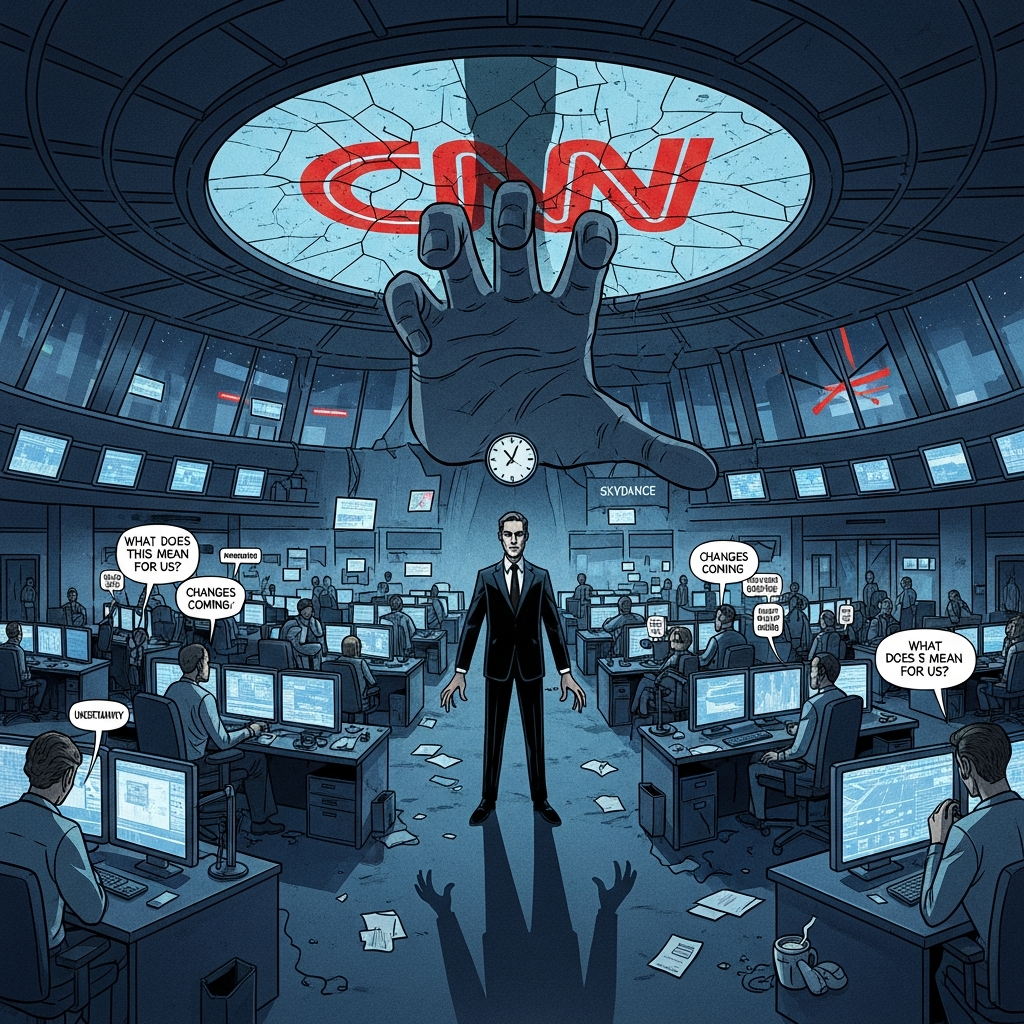
A palpable unease has gripped CNN’s newsrooms as David Ellison moves closer to assuming control of Warner Bros. Discovery (WBD). Insiders describe “off-the-charts” panic among staffers, who are bracing for a future reshaped by the Paramount Skydance chief’s vision. This impending shift follows a dramatic turn of events, leaving many to wonder about the iconic news network’s editorial independence, its workforce, and its very identity.
The Unexpected Turn: Netflix’s Retreat Clears Ellison’s Path
The path for Ellison’s acquisition became unmistakably clear following Netflix’s sudden withdrawal from the bidding war for Warner Bros. Discovery. Despite widespread expectations that Netflix would counter Paramount’s “superior” $31-per-share offer, the streaming giant abruptly declared the deal “no longer financially attractive.” This unexpected reversal, occurring shortly after Netflix’s CEO met with White House officials, stunned the entertainment industry and effectively removed Netflix as a formidable competitor. Their departure left the door wide open for David Ellison, head of Paramount Skydance, to consolidate his position and secure control over WBD’s vast portfolio.
Alarm Bells Ringing: Inside CNN’s Hudson Yards Offices
The news landed like a meteor at CNN’s headquarters in Hudson Yards. Within minutes of the announcement, alarm bells resonated through the offices. Staffers rapidly grew anxious over the very real possibility of working under Bari Weiss before the year’s end. This prospect, coupled with the near certainty of “brutal layoffs” across the new, combined company, has fostered a mood described as “horrific” by insiders. Messages flooded communication channels, underscoring the widespread apprehension. The emotional toll of this uncertainty highlights deep concerns about both job security and the network’s long-standing journalistic ethos.
The Ellison Influence: Political Ties and Editorial Ambitions
A significant source of anxiety among CNN personnel stems from David Ellison’s reported close relationship with former President Donald Trump. Ellison has reportedly “gone to great lengths to signal to Trump that he is an ally,” a factor that fuels staff fears regarding potential editorial shifts. This concern is amplified by Ellison’s track record at CBS News, where he installed Bari Weiss as editor-in-chief. Weiss has been vocal about the need for news organizations to produce content “enough people want,” advocating for a tempering of liberal slants and the integration of more right-leaning voices. Her mandate, expected to extend to CNN, involves seeking journalists who mirror social media creators and expanding the range of stories and voices amplified. Ellison himself has echoed this, articulating a focus on “revitalization” through broader coverage.
A Controversial Vision for News
Weiss’s approach, viewed by some CBS staff as a “political project” rather than a genuine modernization effort, has stirred skepticism. CNN, with its decade-long history of anti-Trump programming and frequent criticism from the former president, finds itself at a crossroads. The prospect of an owner with a “personal allegiance to a political figure,” rather than one solely accountable to public markets, is seen as “existential for the brand.” While CNN CEO Mark Thompson has attempted to quell fears with internal town hall meetings, urging staffers not to “jump to conclusions,” the core concerns around “job loss” and “editorial indifference” persist, with job security reportedly outweighing editorial worries.
Forging a Media Behemoth: The Scope of Ellison’s Empire
The acquisition of Warner Bros. Discovery by Paramount Skydance is poised to create a colossal media empire under the Ellisons’ control, pending regulatory approval. This monumental merger would unite Paramount, CBS, and their vast film and streaming assets with WBD’s extensive portfolio. The combined entity would boast a formidable streaming presence, merging HBO Max (nearly 130 million subscribers with hits like “The Pitt” and “Heated Rivalry”) with Paramount+ (79 million customers, home to “Mission: Impossible” and “Star Trek”). This strategic consolidation aims to be a “Hollywood champion,” expanding “consumer choice and opportunities for creative talent and labor.” While specific streaming strategies are still developing, experts anticipate bundled offerings and a focus on increasing subscriber numbers to attract advertisers and fund content investment.
A Legacy of Iconic Content and Expanding Reach
The newly formed empire will command an unparalleled film studio and catalog, merging WBD’s iconic franchises like “Harry Potter,” “Batman,” and “The Lord of the Rings” with Paramount Pictures’ classics such as “The Godfather.” This includes an immense real estate footprint, combining WBD’s 110-acre Burbank lot with Paramount’s 65-acre Hollywood lot. Furthermore, the Ellisons will control a vast cable television presence, combining HBO’s prestigious library with Paramount’s MTV, Comedy Central, Nickelodeon, and BET, alongside WBD’s Discovery, HGTV, Food Network, TLC, and TNT, among others. In sports, TNT’s extensive rights (MLB, NHL, NASCAR, NCAA March Madness) will complement CBS network’s existing NFL and Masters golf portfolios, creating a dominant force in live sports broadcasting.
Funding the Ambition: Larry Ellison’s Financial Gambit
This ambitious $111 billion bid for WBD represents one of history’s largest mergers, a move spearheaded by Larry and David Ellison. The financial underpinning for such a colossal deal is equally remarkable. With Paramount’s cash reserves at $3 billion, the acquisition relies heavily on a $57.5 billion debt commitment from major banks and a significant $45.7 billion equity commitment from Larry Ellison’s trust. Despite being the world’s sixth-richest person, Larry Ellison’s liquid assets are less than his commitment. The solution lies in pledging a substantial portion of his Oracle stock. Regulatory filings revealed he had 346 million pledged Oracle shares, valued at approximately $50 billion, sufficient to cover his commitment without requiring a direct sale that could alarm Oracle shareholders.
Navigating Regulatory Hurdles and Market Reactions
This unprecedented consolidation, bringing CBS, CNN, HBO Max, Paramount+, Warner Bros., and Paramount Pictures under one umbrella, is expected to attract intense antitrust scrutiny from the Department of Justice and the FCC. However, the Ellisons’ reported “chummy relationship” with the Trump administration could influence regulatory responses. Larry Ellison’s numerous White House visits and his new status as President Trump’s neighbor hint at political leverage. While the deal promises to significantly augment Ellison’s power, large, debt-heavy mergers often rattle markets initially. Paramount’s share price, for example, halved after the Ellisons took control, though it saw a temporary jump on news of the WBD bid. The financial and regulatory challenges ahead underscore the sheer scale and complexity of this transformative media acquisition.
Uncertain Futures: Staff Concerns and Historical Precedents
The “horrific” mood inside CNN reflects deep-seated anxieties among its 3,000+ employees. Beyond job losses, staffers worry about the future “editorial indifference” and the fundamental reshaping of CNN’s identity. The idea of a potential “bloodbath” if CBS News and CNN were to merge operations is a persistent fear. CNN CEO Mark Thompson’s memo to staff, urging them to focus on journalism during a “newsy year,” attempts to provide reassurance amidst the chaos. However, the history of CNN, which has experienced multiple corporate changes—from Time Warner to AT&T and Discovery—each followed by cost-cutting, only amplifies the current unease. Past internal conflicts, such as resistance to former CEO Chris Licht’s attempts to temper partisanship, highlight the deeply ingrained culture at CNN and the challenge any new owner faces in steering its direction. The very thought of Bari Weiss wielding influence over a network known for its distinct voice creates significant internal “tension,” which some observers even note manifesting on-screen.
Frequently Asked Questions
What are the primary concerns of CNN staff regarding David Ellison’s control?
CNN staff are primarily concerned about significant job losses and a drastic shift in the network’s editorial direction. The prospect of Bari Weiss, known for her efforts to temper liberal slants and integrate conservative voices at CBS News, potentially influencing CNN’s content, has caused “off-the-charts panic.” Additionally, David Ellison’s reported close ties to former President Donald Trump raises fears that journalistic independence could be compromised, transforming the network’s long-standing identity.
What major media assets will be united under David Ellison’s expanded empire?
David Ellison’s expanded empire, formed by merging Paramount Skydance with Warner Bros. Discovery, will encompass a vast array of media assets. This includes major streaming services like HBO Max and Paramount+, iconic film studios such as Warner Bros. Pictures and Paramount Pictures, and an extensive portfolio of cable networks including HBO, CNN, MTV, Comedy Central, Nickelodeon, BET, Discovery, HGTV, Food Network, TLC, and TNT. The combined entity will also command significant sports broadcasting rights.
How might David Ellison’s ownership influence CNN’s future editorial direction?
Ellison’s ownership is widely expected to bring about “sweeping changes” to CNN’s editorial direction. With Bari Weiss, whom Ellison installed at CBS News, likely to exert influence, there’s an anticipated push to broaden the range of stories and voices, potentially moving away from a perceived liberal slant. This could involve integrating more right-leaning perspectives and adopting a style that seeks to engage a wider audience, which some fear could dilute CNN’s established journalistic brand and independence.
Conclusion: A New Era for CNN and the Media Landscape
David Ellison’s imminent takeover of Warner Bros. Discovery marks a seismic shift not only for CNN but for the entire media landscape. The apprehension at CNN, fueled by fears of layoffs and profound editorial changes under a politically connected owner, underscores the human impact of such massive corporate consolidations. As Ellison’s vast new empire takes shape, uniting streaming powerhouses, iconic film studios, and a sprawling network of cable channels, the industry watches closely. The financial dexterity required for such an acquisition, coupled with the inherent regulatory challenges, paints a picture of unprecedented ambition. For CNN, the path ahead remains shrouded in uncertainty, yet one thing is clear: a new era is dawning, promising a significant recalibration of its mission and identity in the ever-evolving world of news and entertainment.