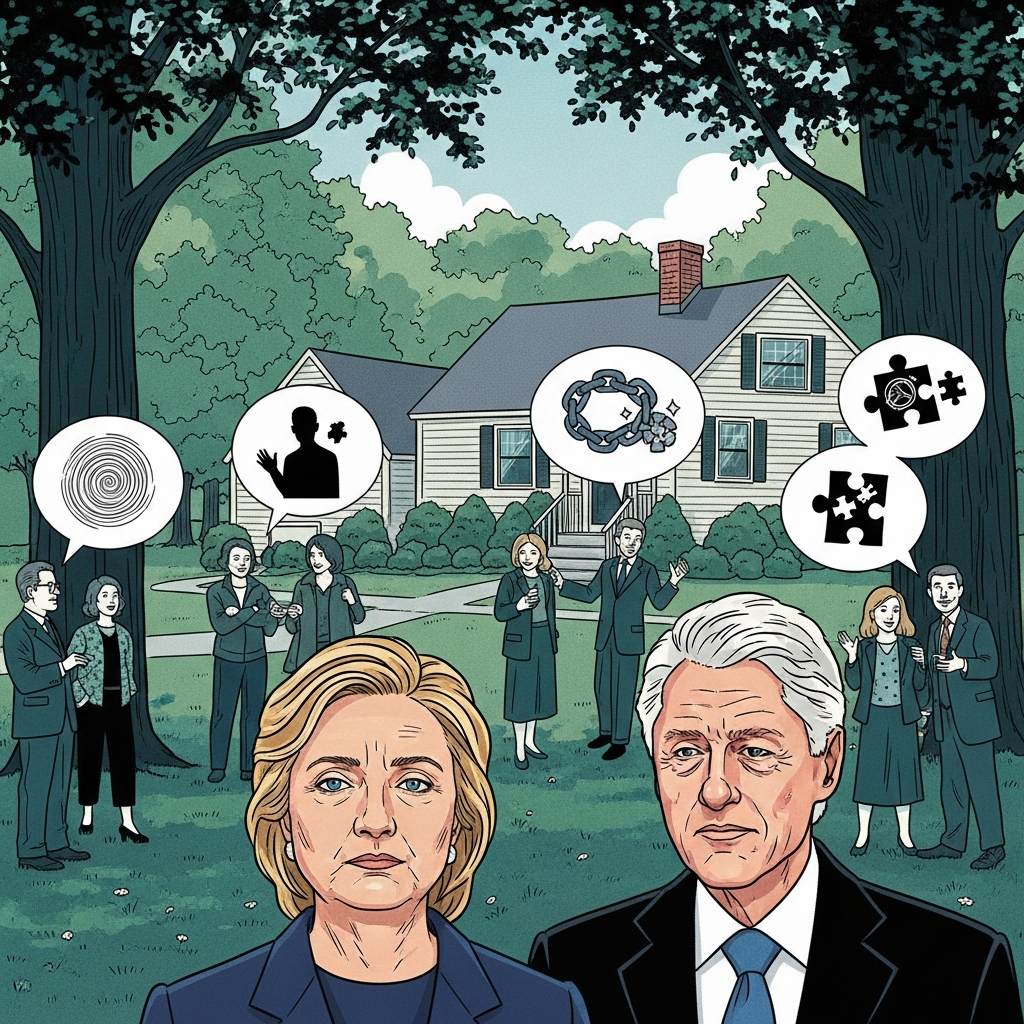
In the tranquil, tree-lined community of Chappaqua, New York, residents recently found themselves at the epicenter of a national political firestorm. Hillary Clinton’s closed-door testimony concerning her and Bill Clinton’s past associations with convicted sex offender Jeffrey Epstein and his co-conspirator Ghislaine Maxwell brought the quiet hamlet into the spotlight. This deposition, occurring over two decades after the Clintons first made Chappaqua their home, sparked a range of opinions among neighbors. While some dismissed the inquiry as a politically motivated “fishing expedition,” others passionately demanded full transparency and accountability for all powerful figures implicated in the Epstein scandal.
Hillary Clinton’s Testimony: Behind Closed Doors in Chappaqua
On February 26, Hillary Clinton, former Secretary of State and presidential candidate, delivered extensive testimony under subpoena. The six-and-a-half-hour session took place at the Chappaqua Performing Arts Center. This familiar local venue, less than a mile from the Clintons’ home, was chosen to accommodate the “forced process” conveniently. Clinton vehemently denied any knowledge of Epstein’s criminal activities during her deposition.
She reportedly stated, “I did not know Jeffrey Epstein” and asserted she had “no idea” about his illicit operations. Clinton also criticized House lawmakers, accusing them of embarking on a “fishing expedition” rather than conducting a serious investigation into Justice Department failures to prosecute Epstein earlier. During the private proceedings, questions reportedly even veered into unrelated topics like UFOs and the debunked Pizzagate conspiracy theory, which Clinton described as “quite unusual.”
Chappaqua’s Diverse Voices on the Epstein Inquiry
Despite the national media focus on Hillary Clinton’s arrival, daily life continued in Chappaqua. Locals, accustomed to spotting the Clintons walking their dogs or shopping, went about their business. However, opinions on the testimony, particularly in this heavily Democratic town, were far from uniform. The community’s response underscored a broader national debate about political accountability and justice.
Frustration with Congressional Tactics
New Castle Town Councilwoman Jennifer Naparstek Klein, a staunch supporter of Hillary Clinton, voiced strong frustration. She called Congress’s behavior “deliberately dissembling” and an “insult and assault on the integrity of women.” Klein suggested Clinton was being used as a “pawn” to divert attention from former President Donald Trump’s alleged misdeeds, noting Trump’s own past ties to Epstein, which Trump has denied.
A Demand for Universal Truth and Accountability
Conversely, residents like Steven Sabbagh, from nearby South Salem, welcomed the mandatory testimony. He emphasized the importance of “every bit of truth” emerging for the victims of Epstein’s crimes. Sabbagh expressed hope that “people get punished for what they did,” lamenting the manipulation of justice.
Heather Smith, a recent Cornell University graduate and survivor of sexual assault, stressed that the issue should transcend political divisions. She advocated for “transparency” from the government to rebuild public trust. Smith insisted that “everyone who’s involved or named in the Epstein files” should face tough questions and be held accountable, explicitly mentioning both Bill Clinton and Donald Trump. This sentiment resonated with a growing bipartisan demand for accountability.
Anticipation for Bill Clinton’s Testimony
Tim Gomes, an IT professional identifying as an independent voter, found Hillary Clinton’s claims of limited knowledge credible. However, he expressed keen interest in Bill Clinton’s upcoming testimony, scheduled for the following day. Gomes underscored the belief that “everyone should be held accountable,” suggesting Bill Clinton’s deposition would be pivotal.
Dismissing the Inquiry as Political “Farce”
Long-time Clinton supporter Betty Cotton dismissed the entire inquiry as a “farce” and “ridiculous.” She praised Hillary Clinton as an “unbelievable trooper” for agreeing to testify. Cotton questioned whether Trump would face similar scrutiny, highlighting the partisan perceptions surrounding the investigation.
The Congressional Inquiry: Unpacking Intentions
The Republican-led House Oversight Committee compelled the Clintons’ testimonies following months of disputes. Representative James Comer (R-Kentucky), who chairs the Oversight Committee, clarified the inquiry’s goals. He stated lawmakers sought to understand how Epstein accumulated wealth and cultivated his social network of powerful individuals. Specific areas of interest included Epstein’s alleged fundraising for the Clinton family foundation and Ghislaine Maxwell’s attendance at Chelsea Clinton’s wedding in 2010.
Comer asserted that the investigation aimed to expand knowledge of Epstein’s sex trafficking operation. He also inquired whether Epstein served as an asset for any government. The committee’s stated purpose was not to accuse the Clintons of wrongdoing. Instead, it focused on addressing the alleged mismanagement of the federal investigation into Epstein and Maxwell and understanding Epstein’s 2019 death by suicide.
Bill Clinton’s Documented Connections and Denials
Bill Clinton, who was slated to testify shortly after Hillary, has long been a central figure in discussions surrounding Epstein. He has consistently maintained he was unaware of Epstein’s alleged criminal activities while they socialized. However, Comer claims Epstein visited the White House 16 times during Bill Clinton’s presidency. The former president also flew on Epstein’s private jet multiple times in the early 2000s, after leaving office, for what his spokesperson stated were “charitable trips” related to the Clinton Foundation.
In his 2024 memoir, Bill Clinton expressed regret for the association. He wrote, “Traveling on Epstein’s plane was not worth the years of questioning afterward. I wish I had never met him.” He has denied accusations, including those from Donald Trump, that he visited Epstein’s private island 28 times. Upon Epstein’s 2019 federal indictment, Bill Clinton’s representative stated he had not spoken to Epstein in “well over a decade.” While “Epstein files” made public by Congress included photos of Bill Clinton with Epstein, these documents did not indicate any criminal wrongdoing on his part.
Political Dynamics and Bipartisan Calls for Transparency
The path to these depositions was fraught with political tension. The Clintons initially provided written statements but resisted in-person appearances. They branded the subpoenas “invalid and legally unenforceable.” However, under the threat of being held in contempt of Congress, carrying potential fines or jail time, they ultimately agreed to testify. This pressure underscored the committee’s determination.
Hillary Clinton characterized the depositions as a Republican tactic. She suggested it was designed to “divert attention” from former President Trump and questioned why others with ties to Epstein, including Trump, had not faced similar scrutiny. Despite the partisan nature, a new generation of Democratic politicians has also prioritized transparency regarding Epstein. Several Democratic lawmakers on the Oversight panel even joined Republicans in advancing contempt charges against the Clintons, emphasizing their loyalty to survivors over former party leaders. The top Democrat on the committee, Rep. Robert Garcia, acknowledged that both Republican and Democratic administrations “have failed survivors” by not releasing more information to the public.
Hillary Clinton’s Firm Denials and Criticisms
Emerging from her private session, Hillary Clinton unequivocally reiterated her lack of knowledge about Epstein’s crimes. She stressed that she had “answered every one of their questions as fully as I could based on what I knew.” Clinton acknowledged knowing Ghislaine Maxwell “casually as an acquaintance,” noting Maxwell attended Chelsea Clinton’s wedding as a “plus one.”
She further criticized the Republican-led committee for refusing a public hearing, which forced her to address the media afterward. Clinton insisted she and Bill Clinton had “nothing to hide” and had repeatedly called for the full release of the Epstein files, advocating for “sunlight” as a “disinfectant.” Committee Chairman Comer, despite the partisan wrangling, described the discussion as “productive.” He noted Hillary Clinton frequently redirected questions to her husband, stating, “I don’t know, you’ll have to ask my husband” more than a dozen times, indicating more questions for Bill Clinton.
Frequently Asked Questions
What was the primary purpose of Hillary Clinton’s recent testimony regarding Jeffrey Epstein?
Hillary Clinton’s testimony was primarily compelled by the House Oversight Committee to gather information on how Jeffrey Epstein accumulated wealth and cultivated a social network of powerful individuals, including her husband, Bill Clinton. While not accusing her of wrongdoing, the committee sought to expand its understanding of Epstein’s sex trafficking operation, investigate alleged mismanagement of the federal inquiry into Epstein and Ghislaine Maxwell, and explore how they sought to curry favor. Clinton herself criticized the inquiry as a “fishing expedition,” stating she had “no idea” about Epstein’s criminal activities.
Where did Hillary Clinton provide her closed-door testimony, and why was that location significant?
Hillary Clinton provided her closed-door testimony at the Chappaqua Performing Arts Center in Chappaqua, New York. This location is less than a mile from her home, making it a familiar and convenient venue for the subpoenaed deposition. The choice of location was significant as it brought the national spotlight to the Clintons’ long-time residential community, highlighting how their personal lives in a quiet hamlet intersect with high-stakes political investigations.
How did Chappaqua residents react to Hillary Clinton’s Epstein testimony, and what were their main points of view?
Chappaqua residents displayed a diverse range of reactions to Hillary Clinton’s testimony. Some ardent supporters, like Councilwoman Jennifer Naparstek Klein, viewed the inquiry as a politically motivated attack and an “insult” to women, believing Clinton was being used as a “pawn.” Conversely, others, such as Steven Sabbagh and Heather Smith, emphasized the critical importance of truth and accountability for victims, regardless of political affiliation, calling for justice for all powerful figures involved. Many residents, accustomed to the Clintons’ presence, expressed a desire for full transparency, with some looking forward to Bill Clinton’s subsequent testimony for more answers.
Conclusion
The recent testimony of Hillary Clinton in Chappaqua underscores the enduring national debate surrounding Jeffrey Epstein’s network and the quest for accountability. While residents of the Clintons’ hometown offered a microcosm of the nation’s divided sentiments, a common thread emerged: a profound demand for transparency. The congressional inquiry, propelled by legal pressures and public interest, continues to shine a light on the complex interplay of power, politics, and justice. As investigations evolve and more information comes to light, the pursuit of truth for Epstein’s victims remains a central imperative, pushing for comprehensive accountability from all individuals implicated in this sprawling and tragic saga.