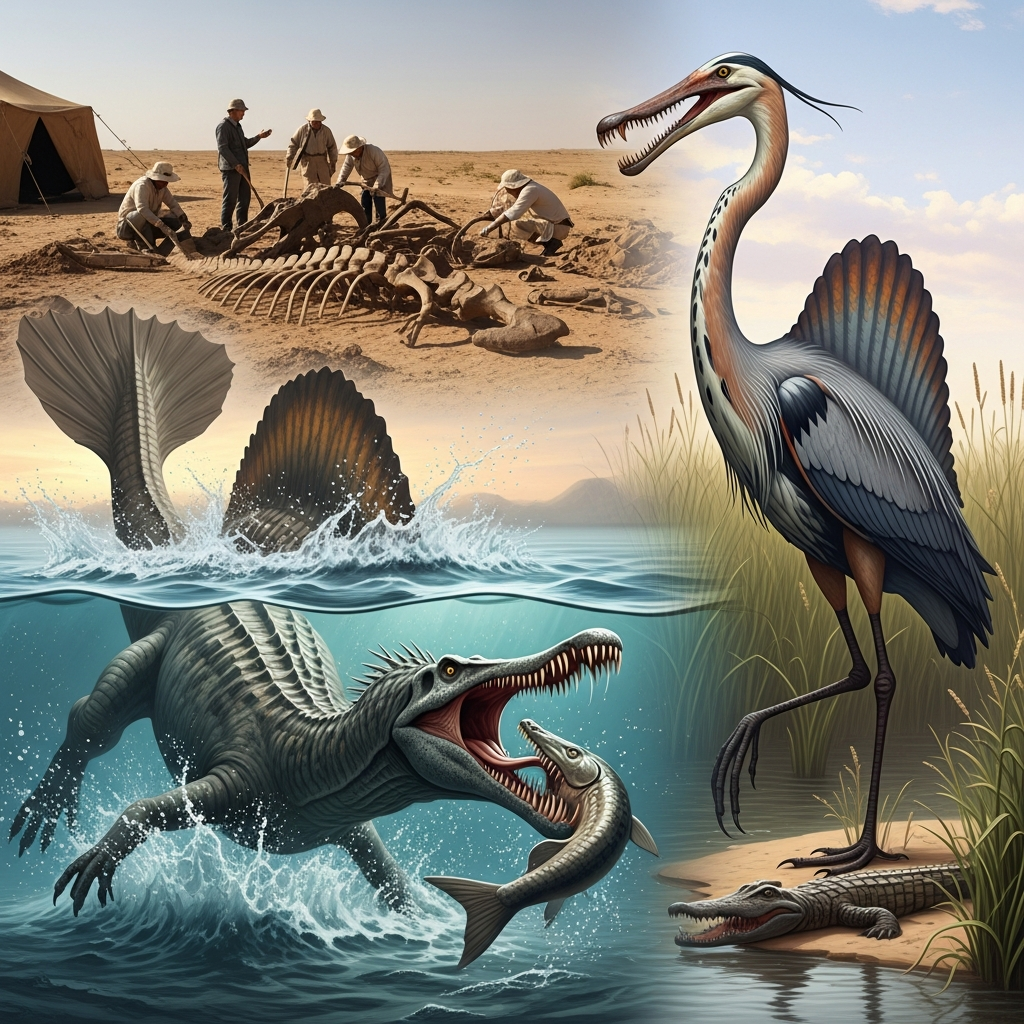
The dusty dunes of the Sahara have once again yielded a breathtaking secret from Earth’s ancient past: a newly discovered species of Spinosaurus. This extraordinary find, Spinosaurus mirabilis, isn’t just another fossil; it’s a critical piece in an enduring paleontological puzzle, reigniting the heated debate about whether this colossal predator was truly a swimming “river monster” or a wading “heron from hell.” Unveiling its unique scimitar-like head crest, scientists are pushing the boundaries of our understanding of aquatic dinosaurs, offering fresh evidence that promises to reshape our view of prehistoric river ecosystems.
Unearthing a Saharan Spectacle: The Discovery of Spinosaurus Mirabilis
Under the harsh Saharan sun, an astonishing discovery unfolded in Niger in 2022. Paleontologist Daniel Vidal, part of a team led by National Geographic Explorer Paul Sereno from the University of Chicago, unearthed a mysterious bone. Initially thought to be a dinosaur vertebra, closer inspection revealed a spectacular, curved bone: a scimitar-like crest that once adorned the skull of one of Earth’s most bizarre dinosaurs. Vidal recalls the moment with awe, describing it as “amazing… like a unicorn.”
This unique find, published in Science, belongs to an entirely new species: Spinosaurus mirabilis. This magnificent creature roamed an ancient river ecosystem approximately 95 million years ago during the Late Cretaceous period. The desolate site, called Jenguebi by the local Tuareg community, translates poignantly to “No water, no goat”—a stark contrast to its lush prehistoric past. Sereno was drawn to the Sahara by a 1950s report of a dinosaur tooth, a “needle in the haystack” search that eventually led his team to Jenguebi in 2019, where they first found a Spinosaurus jawbone. Subsequent excavations in 2022 confirmed bones from three S. mirabilis individuals. This rare collection also included the formidable Carcharodontosaurus, long-necked sauropods, crocodiles, turtles, and a freshwater fish species that could grow up to 12 feet long. Such a rich assemblage of partial skeletons from this period in Africa is “something to get really, really excited about,” noted paleontologist Matt Lamanna.
The Scimitar Crest: A Display of Ancient Grandeur
Among Spinosaurus mirabilis‘s most striking features is its dramatic head crest. While other spinosaurids also bore crests, none were quite as pronounced as the curved blade-like structure found on S. mirabilis. Envisioned as having been covered in a sheath of keratin, much like a modern rhino’s horn, it likely protruded even higher than current skull reconstructions suggest, forming an unmistakable silhouette alongside the dinosaur’s iconic back sail.
Researchers hypothesize this standout feature served as a form of visual communication. Much like the crests of today’s helmeted guineafowl, it may have been used to signal to potential mates or rivals. This idea of complex display structures evolving across diverse lineages is further supported by discoveries like Mirasaura grauvogeli, a Triassic reptile unrelated to birds or dinosaurs that also possessed feather-like plumes. This demonstrates that advanced integumentary adaptations for signaling appeared very early in vertebrate evolution. Lamanna and other experts agree that such a display is the most probable explanation, perhaps communicating dominance (“I’m the biggest, baddest dude on the block”) or attracting a partner (“Hey, I would make a great mate”).
Spinosaurus: The Enigma of the Water-Loving Dinosaur
The new Sahara specimens also offer crucial insights into the dental structure of Spinosaurus. They confirm the presence of interlocking, cone-shaped teeth, remarkably similar to those of modern crocodiles and ancient aquatic reptiles like plesiosaurs. This specialized dental arrangement creates a “fish trap,” a term coined by Vidal. When Spinosaurus snagged its slippery prey, the unique teeth would pierce and secure it, preventing escape.
This “fish trap” is just one of many peculiar traits fueling a longstanding debate about Spinosaurus‘s aquatic lifestyle. Dinosaurs are typically viewed as land-dwellers, but Spinosaurus defies convention. Its bizarre combination of features includes a long, crocodilian snout, relatively short legs for a theropod, a prominent six-foot sail along its back, unusually dense bones, and a long tail capped with a fin-like fan of spines. Stretching nearly 50 feet, it even surpassed T. rex in length, making it a truly formidable predator.
The Great Aquatic Debate: Swimming vs. Wading
The debate surrounding Spinosaurus‘s water affinity intensified with the 2014 discovery of Spinosaurus aegyptiacus fossils in Morocco’s Kem Kem beds. That team, led by National Geographic Explorer Nizar Ibrahim, controversially argued that S. aegyptiacus spent much of its life in water, potentially making it the first known swimming dinosaur.
Researchers have interpreted Spinosaurus‘s confusing blend of features in contrasting ways. Ibrahim and his colleagues suggest its heavy bones were optimized for buoyancy, much like a manatee or penguin, and its powerful, fin-like tail could propel it after underwater prey. This paints a picture of a crocodile-like ambush predator, submerged and lying in wait. In stark contrast, Sereno and his co-authors propose a “heron-like” strategy: a monstrous wader patrolling riverbanks, plunging its head to snatch fish.
This distinction is crucial when comparing it to other large theropods. For instance, while Tyrannosaurus rex was likely capable of a basic “doggy paddle” due to its relatively light, air-sac-filled bones, Spinosaurus possessed extra-dense bones. This unique skeletal density would have counteracted buoyancy, allowing Spinosaurus to submerge and propel itself more effectively, unlike T. rex which would have floated awkwardly at the surface.
How Spinosaurus Mirabilis Shapes the Argument
The discovery of S. mirabilis adds fresh evidence to this complex paleontological discussion. The Jenguebi site, hundreds of miles from the nearest ancient ocean, is the farthest inland a Spinosaurus fossil has ever been found. Sereno’s team argues that its presence in riverbank sediments, alongside forest-dwelling sauropods, suggests it primarily lived in the forests lining these banks and waded into the water.
Their comparative analysis further supports this “wading” hypothesis. By examining skull, neck, and back leg traits of Spinosaurus species against a diverse range of animals—including other dinosaurs, birds, crocodiles, and reptiles—Sereno’s team found a closer alignment with wading birds like herons and storks rather than fully aquatic crocodilians. Sereno posits, “I think the argument is coming together functionally and from the fieldwork that these were giant, heron-like animals displaying and clamping down on fish.”
However, Ibrahim remains unconvinced. He points out that wading birds typically have extremely long, light legs, features diametrically opposed to Spinosaurus‘s relatively short, dense limbs and immense weight (over 13,000 pounds). Such a massive animal, he argues, would struggle to wade stealthily. Thomas Holtz Jr., a paleontologist not involved in the study, highlights that a dinosaur of Spinosaurus‘s size likely couldn’t afford to be picky. “To a certain extent, you’ve got to be an opportunist,” he suggests. While chemical evidence from teeth confirms a fish-heavy diet, it also reveals consumption of other dinosaurs, hinting at opportunistic feeding, perhaps ambushing land animals crossing rivers. Ultimately, Lamanna hedges his bets: “What if it’s doing both? What if it’s wading sometimes? What if it’s getting into the water and swimming around some? The common denominator is ambush.”
The Unfinished Picture: Why the Debate Continues
The frustratingly incomplete fossil record remains the biggest obstacle to resolving the Spinosaurus debate. The first excavated Spinosaurus fossils were tragically destroyed during World War II, leaving paleontologists with a fragmented picture. To truly understand its unique adaptations, scientists need more complete skeletons, ideally from a single individual, spanning from snout to tail.
Paleontologists like Holtz liken current efforts to decipher Spinosaurus‘s life based on scant evidence to the parable of blind scholars encountering an elephant for the first time—each touching a different part and forming a disparate conclusion. “Only in this case,” Holtz laments, “the elephant’s been blown to smithereens.”
Despite these challenges, the future holds promise. Sereno hints at an unidentified spinosaurid uncovered in Brazil, while Ibrahim’s team is analyzing new Spinosaurus finds that suggest “if anything, the animal was even more aquatic than we previously thought.” These forthcoming discoveries, especially of front limbs or juvenile specimens, could finally shed light on how this magnificent dinosaur moved, hunted, and thrived in its ancient world.
Frequently Asked Questions
What makes Spinosaurus mirabilis a unique discovery?
Spinosaurus mirabilis is a unique discovery primarily due to its distinct, scimitar-like head crest, a feature more dramatic than any other known spinosaurid. Found in Niger, its fossils represent the farthest inland Spinosaurus discovery, offering new clues about its habitat away from coastal deltas. The site also yielded a rich array of associated fossils, providing a snapshot of its ancient river ecosystem approximately 95 million years ago. This new species adds significant new evidence to the ongoing debate about Spinosaurus‘s aquatic lifestyle.
Where was the new Spinosaurus mirabilis fossil discovered, and what other animals were found with it?
The new Spinosaurus mirabilis fossil was discovered in a remote fossil site called Jenguebi, located in Niger’s central Sahara Desert. This area, now dry and barren, was once a thriving river ecosystem during the Late Cretaceous period. Alongside bones from three S. mirabilis individuals, paleontologists unearthed fossils of other predatory dinosaurs like Carcharodontosaurus, two species of long-necked sauropod dinosaurs, crocodiles, turtles, and a freshwater fish species that could grow up to 12 feet long.
Why is there such a strong debate among scientists about Spinosaurus’s lifestyle?
The debate stems from Spinosaurus‘s perplexing combination of features: a long snout with specialized “fish trap” teeth, a massive back sail, relatively short legs for a theropod, dense bones, and a fin-like tail. These traits suggest an aquatic existence, but paleontologists disagree on how aquatic it was. Some, like Nizar Ibrahim, propose it was a powerful swimmer, using its dense bones for buoyancy control and tail for propulsion like a manatee. Others, including Paul Sereno, argue it was more of a wading predator, akin to a giant heron, hunting along riverbanks. The scarcity of complete fossil skeletons, compounded by the destruction of early finds, means scientists are piecing together its life from fragments, leading to diverse interpretations.
Conclusion: The Enduring Mystery of the Spinosaurus
The discovery of Spinosaurus mirabilis and its distinctive scimitar crest is a testament to the ongoing revelations hidden within Earth’s ancient strata. This fascinating new species has not only expanded our understanding of spinosaurid diversity but has also intensely revitalized one of paleontology’s most intriguing questions: how did Spinosaurus truly interact with its aquatic world? Whether it was a masterful swimmer or a colossal wader, this prehistoric giant undeniably carved a unique niche in the Late Cretaceous. As paleontologists continue their tireless search for more complete skeletons, the full story of this oddball, fish-eating theropod promises to be even more extraordinary than we can currently imagine. The quest for definitive answers continues, fueled by every new bone that emerges from the sands of time.