In an era where digital data grows exponentially, the challenge of long-term preservation looms large. Traditional storage solutions like magnetic tapes and hard drives, designed for decades, inevitably succumb to degradation, necessitating costly and energy-intensive data migrations. This constant battle against “bit rot” jeopardizes invaluable information, from personal memories to scientific breakthroughs and cultural heritage. Enter Microsoft’s Project Silica, a groundbreaking initiative poised to redefine digital archiving by encoding data into glass, promising an unprecedented lifespan of over 10,000 years.
This revolutionary technology, detailed in leading scientific publications like Nature, offers a future-proof solution to humanity’s escalating data dilemma. Project Silica is not merely an incremental improvement; it’s a fundamental shift towards a storage medium inherently resistant to the very forces that erode digital information today: heat, water, dust, and electromagnetic interference. By leveraging the durability of glass, Microsoft Research aims to secure our digital legacy for millennia, providing true peace of mind for future generations.
Unpacking Project Silica: Data in Glass
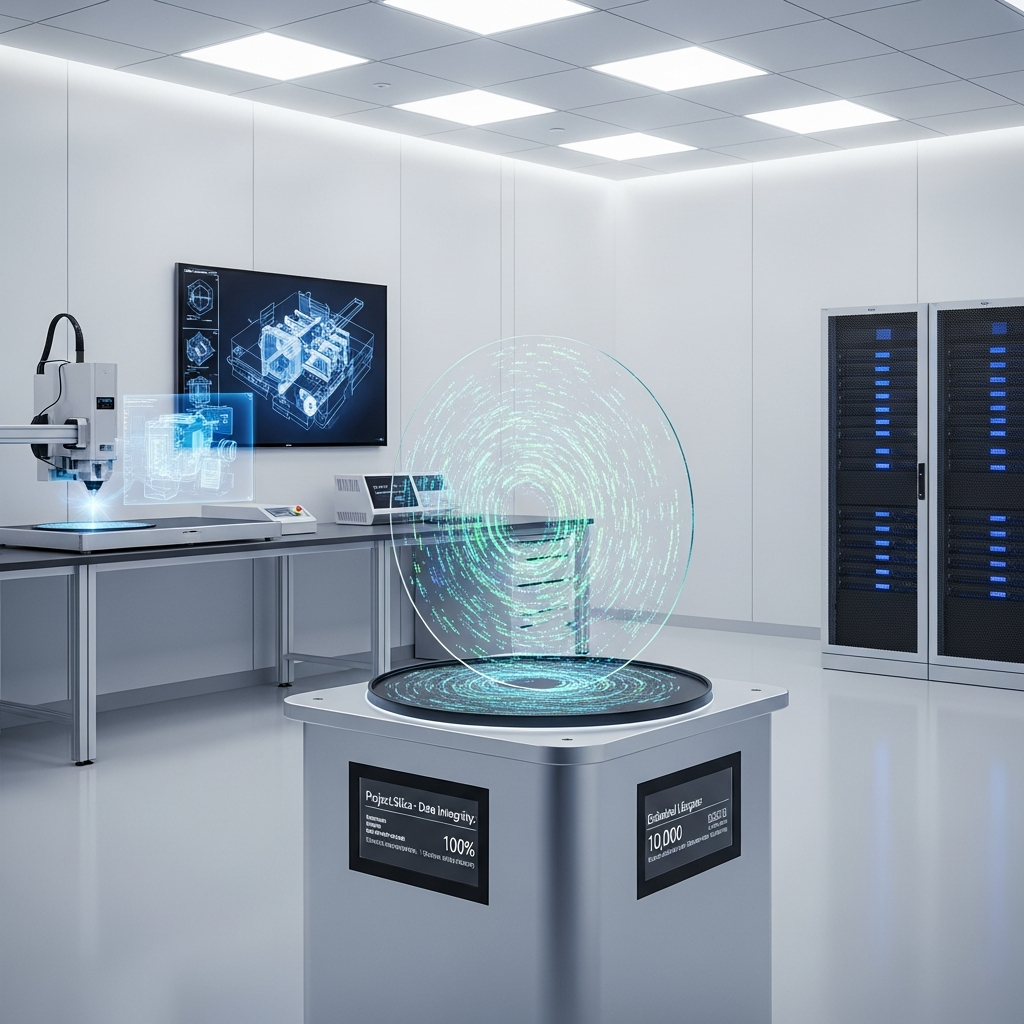
At its core, Project Silica transforms digital bits into physical voxels—tiny, three-dimensional deformations—etched directly into glass using ultra-fast femtosecond lasers. Think of it as engraving information within the structure of the glass itself, creating a permanent record that defies the fleeting nature of electronic data. This innovative approach addresses the critical need for “cold storage” – data that is infrequently accessed but must endure indefinitely.
Initially, Project Silica relied on specialized, high-purity fused silica glass. While effective, its cost and manufacturing complexity posed significant barriers to widespread adoption. However, a major breakthrough has seen researchers successfully adapt the technology to work with ordinary borosilicate glass. This readily available material, commonly found in Pyrex cookware, dramatically reduces the cost and simplifies the production of the storage media, making the vision of ultra-long-term glass storage far more attainable. This transition is a game-changer, moving the technology from a niche scientific marvel to a potentially scalable, commercially viable solution for major data centers and cloud providers.
The Science of Immutability: How Glass Stores Data
The process of writing data into glass involves highly precise femtosecond lasers. These lasers create microscopic alterations within the glass structure, forming “voxels” that represent encoded data. Two primary methods have been developed for this:
Birefringent Voxels: These voxels are formed by anisotropic (direction-dependent) changes within the glass, allowing for very high data density. Initially requiring multiple laser pulses, refinements have reduced this to just two, and even a “pseudo-single-pulse” technique that significantly boosts writing speed.
Phase Voxels: A newer innovation, phase voxels modify the phase change of the glass rather than its polarization. Crucially, phase voxels require only a single laser pulse, simplifying the writing process and making them highly efficient. This method was specifically developed for the more cost-effective borosilicate glass.
The inherent properties of glass make it an ideal medium for archival storage. Unlike plastic or magnetic materials, glass does not degrade from exposure to water, extreme temperatures, or common environmental pollutants. It also remains unaffected by electromagnetic fields, ensuring data integrity even in challenging conditions. These features combine to create a truly robust storage solution unlike any before it.
Unprecedented Longevity and Robustness
Project Silica’s most compelling promise is its unparalleled data longevity. Accelerated aging tests, a standard industry practice for predicting material lifespan, have demonstrated that data stored in glass can endure for over 10,000 years at room temperature. This figure stands in stark contrast to the decades-long lifespan of current storage media, which suffer from “bit rot” and physical degradation. For context, 10,000 years predates nearly all recorded human history, underscoring the revolutionary nature of this preservation capability.
The stability extends beyond just time. Glass is remarkably resilient to physical stressors. It can withstand being boiled, baked in an oven, microwaved, and even scoured with steel wool without losing data. This level of durability means that critical archives, historical records, and vast datasets can be stored with confidence, eliminating the constant worry of media failure or environmental damage. Imagine storing entire libraries or national archives on small glass platters, knowing they will outlast the civilizations that created them.
Enhancing Performance: Speed, Density, and Decoding
While longevity is key, practical archival systems also demand efficiency. Project Silica has made significant strides in balancing durability with performance:
Data Density: Using fused silica glass, researchers achieved an impressive 1.59 Gbit mm⁻³ (gigabits per cubic millimeter), translating to 4.84 terabytes (TB) on a single 120 mm square, 2 mm thick glass platter. For borosilicate glass, the density is 0.678 Gbit mm⁻³, yielding 2.02 TB per platter. These capacities demonstrate the potential to store vast amounts of data in a compact physical footprint.
Write Throughput: Initial write speeds reached 25.6 Mbit s⁻¹ for fused silica. With the newer phase voxels in borosilicate glass, throughput started at 18.4 Mbit s⁻¹ with a single beam. A crucial advancement is the development of multi-beam writing systems, allowing multiple voxels to be written simultaneously. A four-beam system for phase voxels achieved 65.9 Mbit s⁻¹, with simulations suggesting even higher speeds (16+ beams) are possible if productized.
- Reading and Decoding: The reading process involves automatically sweeping the glass platter under a microscope equipped with a camera to capture images of each voxel layer. These images are then fed into sophisticated machine learning-based decoders, specifically convolutional neural networks (CNNs). These CNNs are adept at inferring symbols from noisy images and accounting for inter-voxel cross-talk, ensuring error-free data retrieval. A simplified reader requiring only one camera, down from three or four, further reduces cost and complexity.
- <a href="https://www.theregister.com/2026/02/19/microsoftglassstorage/”>www.theregister.com
- www.nature.com
- www.microsoft.com
- www.theguardian.com
- techcrunch.com
The entire workflow, from writing to reading and decoding, is fully automated. This robust, low-effort operation is critical for deployment in large-scale data centers, where manual intervention would be impractical and prone to error. The system’s ability to maintain data integrity across billions of bits has been extensively characterized, proving its reliability at scale.
Real-World Applications and Future Outlook
Project Silica is not envisioned for consumer devices or home offices. Its immense capacity and unprecedented longevity make it ideally suited for enterprise-level archival storage. Cloud companies, major data centers, and institutions managing vast quantities of critical long-term information are the primary beneficiaries. Proofs of concept already include storing Warner Bros.’ “Superman” movie on quartz glass and collaborating with the Global Music Vault to preserve musical heritage for millennia.
Microsoft states that the “research phase is now complete,” and they are “continuing to consider learnings from Project Silica as we explore the ongoing need for long-term preservation of digital information.” While a specific productization roadmap remains undefined, the intellectual property is highly valued, and the company is “exploring options for how to apply the research learnings.” This suggests a strategic interest in integrating the technology into future cloud services or licensing it to partners. The continued advancement in laser technology, optics, and machine learning models further promises to enhance density and efficiency, paving the way for even more powerful iterations of glass storage.
However, challenges remain. Melissa Terras, a professor of digital cultural heritage, points out the “readability problem” – ensuring that the specific technologies and instructions required to access data in glass will remain comprehensible to future generations thousands of years from now. Furthermore, the substantial investment required to deploy Project Silica at scale presents an economic hurdle. Despite these considerations, the foundational advances made by Project Silica represent a monumental leap forward in addressing the fundamental fragility of digital information.
Frequently Asked Questions
What is Microsoft Project Silica and why is it important?
Microsoft Project Silica is a research initiative that has developed a novel archival data storage technology using femtosecond lasers to encode data into glass. It’s important because it addresses the critical problem of digital data degradation and the limited lifespan of current storage solutions (like tapes and hard drives). Project Silica offers unprecedented data longevity, promising to preserve information for over 10,000 years, securing our digital heritage for future generations against “bit rot” and environmental damage.
How does Project Silica store data in glass, and what types of glass are used?
Project Silica stores data by using femtosecond lasers to create microscopic, permanent deformations called “voxels” (3D pixels) within the glass. These voxels encode digital information. Initially, expensive fused silica glass was used. However, a significant breakthrough now allows the use of more accessible and cheaper borosilicate glass, commonly found in Pyrex cookware. This innovation makes the technology more cost-effective and scalable for commercial applications, simplifying both the writing and reading processes.
What are the key performance metrics and future applications of Project Silica?
Key performance metrics include a data density of up to 4.84 terabytes (TB) per 120 mm glass platter (for fused silica) and 2.02 TB per platter (for borosilicate glass). Write speeds have reached 65.9 Mbit s⁻¹ using multi-beam systems. The technology also features machine learning for robust data decoding and automated operation. Project Silica is designed for ultra-long-term archival storage for cloud companies, major data centers, and institutions needing to preserve vast amounts of critical information for millennia, rather than for consumer use.