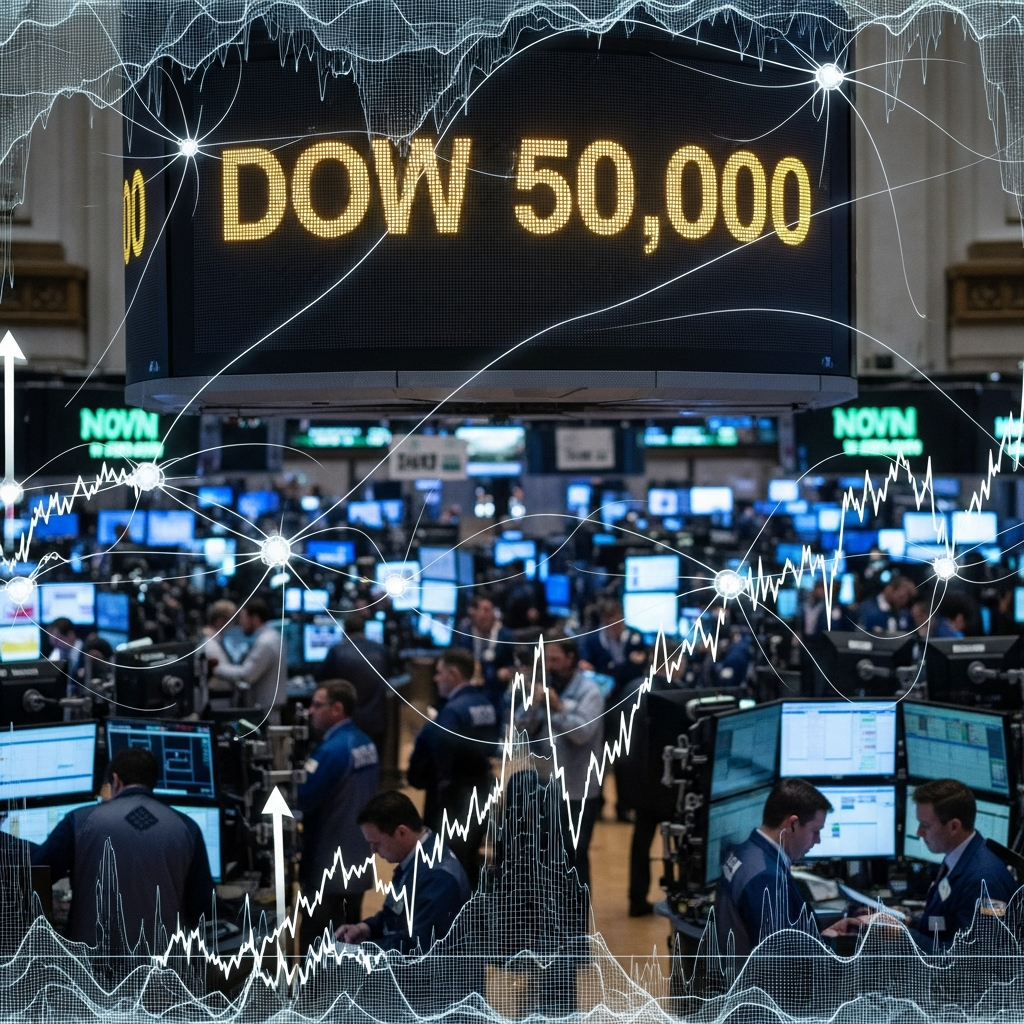
The stock market recently navigated a period of intense volatility, marked by historic milestones and significant sector shifts. Wall Street celebrated the Dow Jones Industrial Average surging past 50,000 points, signaling robust investor confidence. However, this optimism coexisted with notable turbulence in the tech sector, driven by both the immense potential and speculative concerns surrounding artificial intelligence (AI) investments. This dynamic landscape saw major indices fluctuate, with a complex interplay of corporate earnings, geopolitical tensions, and cryptocurrency movements shaping daily trading.
Understanding these multifaceted influences is crucial for investors. The market’s recent performance highlights a “tug-of-war” between an “AI boom” and “AI bubble” fears. While some companies soared on AI demand, others faced sharp declines amidst cautious spending outlooks and heightened competition. This overview delves into the key events, corporate plays, and economic indicators that defined this high-stakes market period, offering a clearer picture of where opportunities and challenges lie.
Wall Street’s Landmark Moment: The Dow Crosses 50,000
Late 2025 and early 2026 saw the U.S. stock market deliver a mix of impressive gains and sharp corrections. A significant highlight was the Dow Jones Industrial Average (DJIA) achieving a historic milestone, surpassing 50,000 points. This rally, one of the best market performances since May, emerged after a period of apprehension regarding substantial AI investments. The S&P 500 also climbed, recording a 2% increase on one notable trading day, while the tech-heavy Nasdaq Composite showed consistent, albeit more modest, gains.
This upward momentum was partly fueled by a surprise drop in inflation and more moderate labor market data. These economic signals helped keep expectations for 2026 interest-rate cuts largely intact, fostering a positive environment. Wall Street, entering a holiday-shortened week in December 2025, even saw increasing optimism for a “Santa Claus rally.” However, beneath these headline gains, a more complex story of sector-specific performance and volatile reactions to technological shifts was unfolding.
AI’s Dual Impact: Innovation Fuels Gains, Investment Causes Jitters
The artificial intelligence revolution continued to be a central theme, acting as both a powerful catalyst and a source of investor apprehension. Chipmakers, critical enablers of AI, experienced significant surges. An ETF tracking software firms climbed 3.5%, and a gauge of chipmakers soared 5.7%. Nvidia Corp.’s CEO, Jensen Huang, confirmed the overwhelming demand for AI technology, stating it was “incredibly high.” South Korean giants Samsung Electronics and SK Hynix saw their shares jump significantly, contributing to a nearly 7% climb in the Kospi index, driven by the global rush for AI memory chips.
Yet, the scale of AI investment also generated “pressure points.” Amazon.com Inc., for example, saw its stock sink by 5.6% following its announced plans to invest a massive $200 billion into AI technology. This reaction suggested that while the long-term potential of AI is recognized, the immediate scale of investment by some companies caused investor apprehension. Fears of an “AI bubble” intensified, particularly concerning Big Tech overspending. Major software companies like SAP, Salesforce, and ServiceNow experienced significant sell-offs, fueled by concerns that their traditional software-as-a-service (SaaS) models could face severe competition or even replacement by AI-driven solutions.
Tech Sector Swings: From Record Highs to Steep Declines
The broader tech sector showcased extreme volatility. While companies like MongoDB and Credo soared 25% and 15% respectively on strong quarterly results driven by booming AI demand, other tech giants faced headwinds. Nvidia, despite its overall strong position, saw shares drop nearly 3% amid reports of cooling relations with OpenAI over chip dissatisfaction. OpenAI’s CEO, Sam Altman, even declared a “code red” for the company due to mounting competition.
PayPal experienced a dramatic stock tumble of over 20% after missing earnings and forecast estimates, citing weaker U.S. retail spending. Novo Nordisk, the pharmaceutical giant behind popular weight-loss drugs, saw its shares plunge over 14% on a disappointing 2026 sales forecast. This was attributed to intensifying competition, a push for drug price cuts, and patent expiry concerns. Even established names like Amazon and Microsoft saw declines, reflecting a broader sell-off in software stocks. Conversely, Apple closed at another record high, and Intel surged about 7% on rumors of supplying chips to Apple by 2027. This dynamic illustrates the highly selective nature of market gains within the tech sphere.
Global Currents: Commodities, Crypto, and Geopolitical Influence
Beyond equities, other asset classes and macroeconomic factors played a significant role in market movements. Precious metals, particularly gold and silver, experienced remarkable volatility. Gold saw a dramatic jump of over 6% on one day, its biggest daily gain since 2008, after notching its deepest daily drop in 43 years just days prior. Silver also rebounded sharply, surging over 9%. Both metals surged to fresh record highs at other times, on pace for their strongest annual performance since 1979, driven by escalating geopolitical tensions and growing bets on multiple U.S. interest rate cuts.
Crude oil prices also reacted to global events, rising after reports of a U.S. fighter jet shooting down an Iranian drone, indicating escalating tensions. A U.S. government shutdown, though partial and brief, caused delays in economic data releases, adding to market uncertainty. Separately, the Trump administration reportedly explored allowing U.S. oil companies to drill in Venezuela, aiming to unlock vast hydrocarbon reserves, though initial reactions from major oil firms like Exxon Mobil were cautious.
Cryptocurrency’s Rollercoaster Ride
The cryptocurrency market also mirrored the broader volatility, but with its own dramatic swings. Bitcoin rocketed back above $91,000 on one Tuesday, marking its best day in months and halting a weeks-long skid that had seen it tumble to as low as $84,000. This recovery followed a significant 50% tumble from its peak valuation in prior periods. Crypto-linked companies like Coinbase and Robinhood saw their shares turn upbeat. Strategy, a company pioneering digital asset treasuries, also rebounded, despite earlier pressure from Bitcoin’s price collapse from its October high of over $126,000. However, expert views remained mixed, with some warning of a “trap door” for Bitcoin if it broke below critical support levels, potentially leading to further declines. Bank of America, conversely, announced plans to cover four Bitcoin ETFs, recommending a 1% to 4% allocation for wealth management clients, signaling growing institutional acceptance.
Corporate Moves and Economic Foresight
Major corporate news and strategic acquisitions continued to reshape industries. Alphabet acquired data center infrastructure firm Intersect for $4.75 billion, a strategic move to expand capacity and optimize energy solutions for Google’s data centers, vital in the “AI arms race.” Cintas Corporation launched a second takeover bid for rival UniFirst at $275 per share, valuing the offer at $3.96 billion. In the entertainment sector, Larry Ellison, Oracle’s founder, agreed to personally guarantee $40.4 billion in equity financing for Paramount Skydance’s proposed $108.4 billion acquisition of Warner Bros. Discovery.
Leadership changes also made headlines, with Disney naming parks chief Josh D’Amaro as its next CEO, set to replace Bob Iger. Walmart surpassed a $1 trillion market capitalization, buoyed by positive investor sentiment following a CEO change. Boeing jumped 9% as its CFO projected positive free cash flow in 2026, a significant improvement from previous years, also benefiting from rival Airbus’s production issues. On the macroeconomic front, markets priced in a high probability of a Federal Reserve interest rate cut on December 10, a substantial increase from mid-November. The U.S. Energy Secretary proposed utilizing industrial backup diesel generators to combat rising electricity prices, particularly as energy-intensive AI data centers are projected to dramatically increase electricity demand.
Frequently Asked Questions
What key factors are driving the recent volatility in the stock market?
The recent volatility in the stock market is primarily driven by a combination of factors including the evolving landscape of AI investments, fluctuating corporate earnings reports, and geopolitical tensions. AI’s dual nature as both a growth engine and a source of bubble concerns creates significant swings, especially in the tech sector. Additionally, macroeconomic data influencing interest rate expectations, commodity price movements tied to global events, and the unpredictable nature of cryptocurrency markets all contribute to a complex and dynamic market environment.
Which major companies were notably impacted by recent tech sector shifts?
Several major companies experienced significant impacts from recent tech sector shifts. On the positive side, chipmakers like Nvidia, Samsung Electronics, and SK Hynix saw surges due to high demand for AI technology. MongoDB and Credo also soared on strong AI-driven quarterly results. However, Amazon saw its stock decline despite massive AI investment plans, reflecting investor apprehension about the scale of spending. PayPal tumbled due to missed earnings, and traditional software firms like SAP and Salesforce experienced sell-offs amidst fears of AI competition.
Given the current AI enthusiasm and market swings, how can investors approach their portfolios?
Given the prevailing AI enthusiasm and significant market swings, investors should adopt a balanced and informed approach. Experts like UBS strategists anticipate continued stock market volatility in 2026, with potential declines followed by quick recoveries. This suggests a need for diversification beyond just a few tech giants. While AI presents compelling opportunities, it’s crucial to assess specific company fundamentals and long-term viability rather than chasing speculative trends. Staying updated on economic indicators, geopolitical developments, and corporate earnings will be key to navigating this complex market.
Navigating the Future: A Complex Outlook
The recent period in the stock market, marked by the Dow’s impressive ascent to 50,000, clearly illustrates an era of unprecedented technological disruption and economic shifts. The influence of AI is undeniable, creating both incredible wealth generation and significant market apprehension. While sectors like chip manufacturing and specific software firms thrive on AI demand, others grapple with the implications of massive investment and heightened competition. Geopolitical tensions, commodity price fluctuations, and the rollercoaster ride of cryptocurrencies further underscore the intricate web of factors influencing investor sentiment.
Moving forward, Wall Street will continue to dissect corporate earnings, monitor evolving AI trends, and react to global events. The market remains an arena of both “pressure points” and “opportunities,” as articulated by experts. Investors are advised to remain agile, conducting thorough research and maintaining a diversified portfolio to navigate this exciting yet challenging financial landscape. The quest for value in a rapidly changing world requires continuous adaptation and a keen eye for both innovation and underlying market fundamentals.