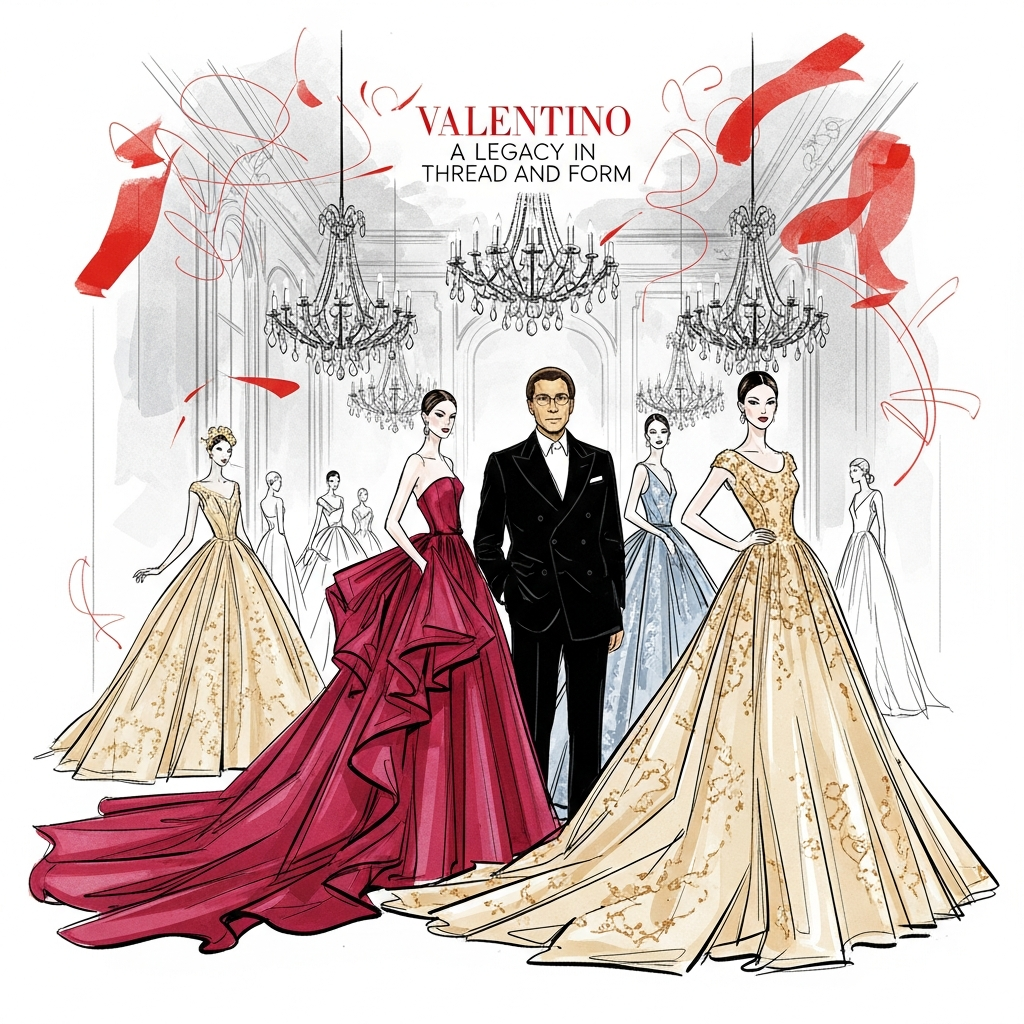
The fashion world mourns the passing of Valentino Garavani, the legendary Italian designer who, for over five decades, defined glamour and elegance. Known mononymously simply as Valentino, his exquisite haute couture creations graced royalty and Hollywood’s biggest stars, cementing his status as a true icon. Garavani’s influence shaped an era of unparalleled luxury, leaving an indelible mark on global fashion that continues to inspire.
The End of an Era: Valentino Garavani’s Peaceful Passing
Valentino Clemente Ludovico Garavani passed away peacefully at his home in Rome on January 19, 2026, at the age of 93. His death was confirmed in a statement by the Fondazione Valentino Garavani e Giancarlo Giammetti, noting he was surrounded by his loved ones. Tributes poured in from around the globe, recognizing the immense contributions of the “Emperor of Fashion.”
Public mourning for the revered couturier included his body lying in state at Rome’s Piazza Mignanelli between January 21 and 22. A funeral service followed on January 23 at the Basilica of Saint Mary of the Angels and Martyrs, allowing admirers to pay their final respects. Italian Prime Minister Giorgia Meloni lauded him as an “undisputed master of style and elegance,” underscoring Italy’s profound loss.
A Prodigy’s Journey: From Voghera to Parisian Chic
Born in Voghera, Italy, in May 1932, Valentino Garavani developed an early and intense passion for fashion. He often described this fascination as an “illness” fueled by a lifelong love for “beautiful things.” Disdainful of informal attire and poor grooming, he believed elegant presentation reflected self-respect and good education. His fascination with Hollywood glamour, even leading to him being named after Rudolph Valentino, hinted at his future trajectory.
At just 17, Garavani embarked on his formal fashion education in Paris. He studied at the prestigious Chambre Syndicale de la Couture Parisienne and honed his skills through apprenticeships. Working under esteemed designers like Jacques Fath, Balenciaga, Jean Dessès, and Guy Laroche, he absorbed the decadent post-WWII aesthetic, particularly influenced by Christian Dior. This rigorous training laid the groundwork for his unique vision.
Crafting an Empire: The Birth of Maison Valentino
After nearly a decade immersed in Parisian couture, Valentino Garavani returned to Rome in 1960. With financial backing from his parents, he established his eponymous fashion house near the city’s iconic Piazza di Spagna. Rome, then a thriving hub for cinema, provided the perfect backdrop for his burgeoning brand. This pivotal year also marked his meeting with Giancarlo Giammetti, who would become his lifelong partner and the strategic business mind behind Maison Valentino. Giammetti’s acumen was instrumental in transforming the company into a global powerhouse.
Valentino’s debut collection in Florence in 1962 garnered immediate international attention. It was here that he introduced what would become his undeniable signature: the deep, rich hue known globally as “Valentino red.” This distinctive color, which he reportedly discovered during a trip to Spain, quickly became a defining element of the brand’s identity.
The Signature Style: Unrivaled Glamour and Elegance
Valentino’s aesthetic became synonymous with luxury, wealth, and unadulterated opulence. He wasn’t concerned with being the “most fashionable” or “cutting-edge.” Instead, his singular focus was on producing “beautiful clothes” that made women feel elegant and confident. His designs transcended fleeting trends, consistently exuding a timeless glamour.
The “Valentino red” was more than just a color; it was a statement. From the iconic fiesta dress that helped elevate his brand to global renown, to his final collection in 2008 where every model concluded the show in a red gown, the color remained central to his vision. Valentino himself perfectly embodied the luxurious lifestyle he designed for. He was known for his immaculate appearance, from perfectly coiffed hair to his caramel tan, often accompanied by his beloved pug dogs. This personal embodiment of glamour further amplified his brand’s allure.
Dressing the World’s Elite: Valentino’s Star-Studded Clientele
Valentino Garavani’s client list read like a who’s who of Hollywood legends and international royalty. He dressed figures like Elizabeth Taylor, Nancy Reagan, Sharon Stone, Julia Roberts, Gwyneth Paltrow, Nicole Kidman, Jennifer Lopez, Audrey Hepburn, and Princess Diana. His creations were a staple on the red carpet, a platform that greatly benefited his designs, which primarily consisted of “fabulous gowns.”
A pivotal moment in his career came with his association with Jacqueline Kennedy Onassis. After President John F. Kennedy’s assassination, Kennedy commissioned six black and white haute couture dresses from Valentino for her mourning period. This cemented his reputation internationally. Most notably, for her 1968 marriage to Aristotle Onassis, Kennedy chose an ivory-coloured lace dress designed by Valentino, causing a sensation worldwide. This high-profile endorsement led to Valentino becoming the first Italian designer to open a shop in New York in 1970, profoundly elevating the “Made in Italy” label to global prominence. His royal commissions continued throughout his career, including the wedding dress for Princess Madeleine of Sweden in 2013. Even the Empress of Iran, Farah Pahlavi, famously wore a Valentino coat during her escape in the 1979 revolution.
Milestones and Accolades: A Legacy of Influence
Throughout his illustrious career, Valentino achieved numerous milestones. His 1962 Florence debut set the stage, followed by his groundbreaking New York boutique in 1970. In 2007, Rome hosted a legendary three-day celebration for his 45th anniversary. This extravagant event included a fashion show, a gala ball, and a concert, drawing A-list guests from across the globe.
Industry experts and peers consistently lauded his contributions. Alexandra Shulman, former editor-in-chief of British Vogue, recognized him as “one of the last of the great designers of the modern day” who “epitomised glamour and luxury.” Fellow designer Donatella Versace honored him as “a true maestro.” In December 2023, his enduring impact was further recognized with the outstanding achievement award at the British Fashion Awards in London, a testament to his lasting influence on Italian high fashion and global style.
Beyond the Runway: Valentino’s Pop Culture Footprint
Valentino’s persona and designs transcended the runway, making notable appearances in popular culture. He famously made a cameo playing himself in the Oscar-nominated 2006 film The Devil Wears Prada. His life and career were also chronicled in the critically acclaimed 2008 documentary, Valentino: The Last Emperor, which premiered at the Venice International Film Festival. This film offered an intimate look into his inner circle, including the lavish 45th-anniversary celebrations and his beloved pugs. These cultural touchstones further solidified his image as a fashion icon.
The Evolution of a Brand: From Couture to Conscious Design
After nearly half a century in fashion, Valentino Garavani announced his retirement in 2007, presenting his final haute couture show in Paris in January 2008. He expressed a desire to “leave the party when it is still full,” bowing out at the peak of his creative powers. Following his retirement, the Maison Valentino brand experienced several ownership transitions, eventually coming under the control of the Qatari luxury investment group Mayhoola in 2012, with Kering acquiring a 30% stake in 2023.
Crucially, the legacy of Maison Valentino has continued to evolve, demonstrating a robust commitment to sustainability in recent years. Under the motto “Let the Beauty Prosper,” the house has aligned its strategy with Global Reporting Initiative standards, emphasizing ethical practices across its operations. This commitment, articulated by Creative Director Pierpaolo Piccioli and CEO Jacopo Venturini, is built on three core pillars: Product, People, and Planet. The 2023 Sustainability Report highlighted significant progress, including over 70% traceability for key raw materials and nearly 90% renewable energy use at Italian headquarters and boutiques. Initiatives like the “Open for a Change” footwear project, which re-engineered iconic sneakers with bio-based and recycled materials, exemplify this shift. This transformation ensures that the brand’s storied legacy, founded on beauty and elegance by Valentino Garavani, continues to adapt and champion the priorities of a new, conscious era.
Frequently Asked Questions
What was Valentino Garavani’s signature color?
Valentino Garavani’s unmistakable signature color was “Valentino red.” This deep, rich hue, discovered by the designer during a trip to Spain, became a defining element of his brand. It was famously incorporated into iconic pieces like the fiesta dress and prominently featured in his final collection in 2008, where every model wore a red gown, symbolizing its profound importance to his aesthetic.
Where did Valentino Garavani establish his iconic fashion house?
Valentino Garavani established his iconic fashion house, Maison Valentino, in Rome in 1960. After honing his skills in Parisian couture, he returned to the Italian capital, setting up his boutique near the historic Piazza di Spagna. This location, amidst Rome’s thriving cinema scene, provided the perfect glamorous backdrop for his burgeoning brand, which quickly gained international recognition.
How has Maison Valentino evolved its commitment to sustainability since its founder’s retirement?
Since Valentino Garavani’s retirement in 2008, Maison Valentino has significantly evolved its commitment to sustainability, making it a structural part of the brand’s identity. Guided by the motto “Let the Beauty Prosper,” the house now implements a comprehensive strategy focused on Product, People, and Planet. This includes goals like tracing over 70% of key raw materials, using nearly 90% renewable energy in Italian operations, and developing sustainable product lines such as the “Open for a Change” sneakers, which incorporate bio-based and recycled materials.