A historic chapter in human spaceflight is unfolding as SpaceX’s Crew-11 mission prepares for an unprecedented early return from the International Space Station (ISS). For the first time in the orbiting laboratory’s 25-year history, an entire crew is being medically evacuated. This critical event, driven by a private medical concern aboard the station, showcases the rigorous safety protocols and adaptive capabilities of NASA and its international partners. As the world watches, the four astronauts of Crew-11 are set to depart on January 14, embarking on a carefully planned journey back to Earth aboard the Crew Dragon capsule, Endeavour. This guide provides all essential details, including departure and splashdown times, live broadcast information, and the broader context of this significant mission.
The Unprecedented Return from Orbit
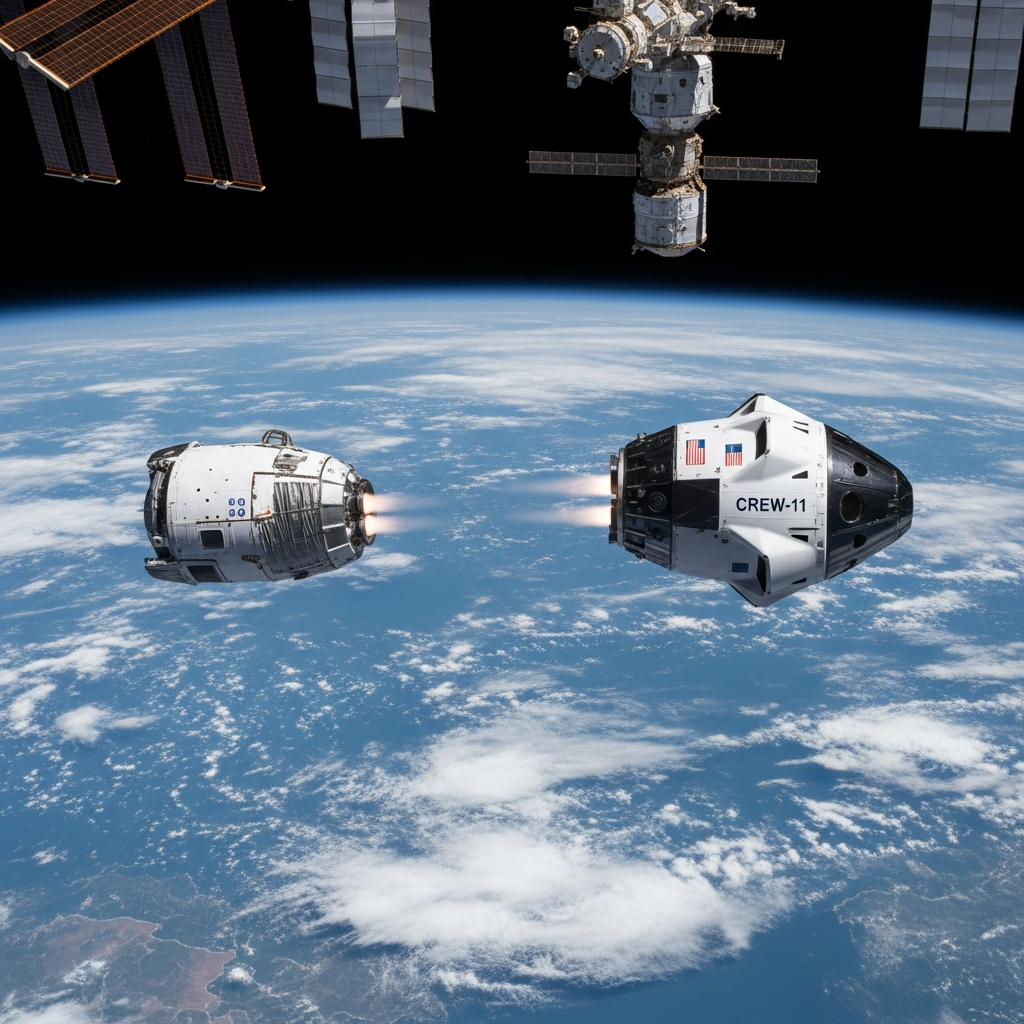
On January 14, the Crew Dragon Endeavour will undock from the International Space Station. This marks a pivotal moment in space exploration. It is the first time an entire ISS crew has returned early due to a medical evacuation. While orbital medical returns have happened historically (like from the Soviet Salyut 7 station in 1985), this is a unique event for the collaborative ISS program. The mission, originally planned for six months, is concluding approximately one month ahead of schedule.
The four-person crew includes NASA astronauts Mike Fincke and Zena Cardman. They are joined by Japan’s Kimiya Yui and Russian cosmonaut Oleg Platonov. This diverse crew highlights the international cooperation inherent in ISS operations. Their early departure underscores the unwavering commitment to astronaut health and safety.
Why the Early Departure? A Focus on Crew Health
The decision for an early return stems from a medical concern affecting one of the Crew-11 astronauts. NASA has withheld the individual’s identity and the specific nature of the issue. This is in accordance with privacy protocols. However, officials confirm the astronaut is in a stable condition. The issue, which arose on January 7, is reportedly not an injury. It is thought to be related to the prolonged exposure to microgravity. Dr. James Polk, NASA’s Chief Medical Officer, explained that Earth-based maladies can be exacerbated in space. Conditions like spinal lengthening, fluid shifts, and changes in bone density are common effects of microgravity.
NASA Administrator Jared Isaacman emphasized that the necessary diagnostic and treatment capabilities are not available on the ISS. Therefore, an early return to Earth is crucial for comprehensive medical evaluation and care. Mission pilot Mike Fincke reassured the public, stating, “First and foremost, we are all OK.” He called the decision “deliberate,” affirming it was “the right call.” This proactive approach by NASA demonstrates their robust safety-first philosophy. It also led to the cancellation of two planned spacewalks for January.
Crew Preparations for the Journey Home
Ahead of their departure, the Crew-11 astronauts have been intensely focused on preparations. This includes packing personal items and other crucial gear into the Crew Dragon. They also conducted rigorous fit-checks of their Dragon pressure suits. These checks are vital, especially given the physiological changes astronauts experience in microgravity. Suit audio and video communication systems were also tested.
On January 12, a significant change of command ceremony took place. Crew-11 pilot Mike Fincke, who had been commanding ISS Expedition 74, formally handed control to Roscosmos cosmonaut Sergey Kud-Sverchkov. Despite the urgency, astronauts even managed some last-minute scientific work. This included ocular examinations, artery imaging, and studies on blood vessel function. Japanese astronaut Kimiya Yui shared poignant farewell posts, reflecting on his time in space.
Key Timings: Undocking and Splashdown Schedules
Understanding the exact schedule is crucial for those wishing to follow this historic event. The Crew-11 mission’s return involves two main phases: undocking from the ISS and splashdown back on Earth.
Undocking Details
The Crew Dragon Endeavour is scheduled to undock from the International Space Station on Wednesday, January 14, at 5:05 p.m. EST (2205 GMT). Before undocking, the hatches between Endeavour and the ISS will close. This critical step is planned for approximately 90 minutes earlier, at 3:30 p.m. EST (1930 GMT), assuming all procedures proceed as planned. This sequence is part of standard SpaceX and NASA departure protocols.
Splashdown Details
The journey home will be relatively swift. Crew-11’s Endeavour capsule is anticipated to splash down in the Pacific Ocean. The targeted location is off the coast of Southern California. This splashdown is scheduled for Thursday, January 15, at 3:41 a.m. EST (0841 GMT). This timing is less than 11 hours after undocking. It will follow a deorbit engine burn conducted 51 minutes prior to splashdown. SpaceX shifted to exclusively Pacific splashdowns in 2025. This change helps mitigate risks associated with re-entry debris.
Monitoring Conditions: A Flexible Schedule
It is important to remember that this schedule remains fluid. NASA officials consistently emphasize that “mission managers continue monitoring conditions.” The undocking of the SpaceX Dragon depends on several critical factors. These include spacecraft readiness, the recovery team’s preparedness, prevailing weather conditions, and sea states in the recovery area. Other operational considerations also play a role. This flexibility underscores NASA’s safety-first approach. Any changes to the schedule will be promptly announced.
How to Watch the Historic Event Live
For space enthusiasts and the public, multiple avenues are available to watch Crew-11’s return. Both NASA and SpaceX will provide extensive live coverage of key mission milestones.
NASA Coverage
NASA plans comprehensive coverage of the hatch-closing, undocking, and splashdown.
Hatch-closing coverage: Begins Wednesday, January 14, at 3:00 p.m. EST (2000 GMT).
Undocking coverage: Resumes Wednesday, January 14, at 4:45 p.m. EST (2145 GMT).
Splashdown coverage: Starts Thursday, January 15, at 2:15 a.m. EST (0715 GMT). This will include the de-orbit burn at 2:50 a.m. EST and the splashdown 51 minutes later.
A post-return press conference is scheduled for Thursday, January 15, at 5:45 a.m. EST (1045 GMT). NASA will also webcast this event.
These events will be available on NASA+, NASA’s YouTube channel, and potentially the agency’s X account and Amazon Prime.
SpaceX Webcast
SpaceX will also provide its own live webcast.
The webcast will begin 15 minutes before undocking on Wednesday.
It will resume approximately one hour before splashdown on Thursday.
- SpaceX’s feed will be accessible via its official website and its X account.
- www.space.com
- www.space.com
- www.usatoday.com
- gizmodo.com
- talkoftitusville.com
Life Aboard the ISS During Transition
The early departure of Crew-11 will significantly impact the International Space Station’s crew complement. This event highlights the critical importance of crew rotation and contingency planning.
Crew Changes and Preparations
The departure marks a busy period for both the returning crew and those remaining on the ISS. The Crew Dragon Endeavour, after undocking, will undergo standard re-entry procedures. Once splashdown occurs, a dedicated SpaceX recovery vessel, equipped with medical personnel, will retrieve the capsule. The crew will receive immediate medical examinations. This process is crucial for assessing their health after prolonged spaceflight and identifying the medical concern.
The Remaining “Skeleton Crew”
Upon Crew-11’s undocking, the ISS will operate with a reduced crew of just three astronauts. This “skeleton crew” will consist of NASA astronaut Chris Williams and Roscosmos cosmonauts Sergey Kud-Sverchkov and Sergei Mikaev. This is the smallest crew complement in years for the station. Chris Williams will be the sole American operator for NASA’s systems and science experiments.
NASA and SpaceX are actively exploring options to accelerate the launch of the replacement Crew-12 mission. This mission was originally slated for mid-February. Administrator Jared Isaacman has expressed confidence in the station’s ability to operate safely with a reduced crew. The ISS has successfully managed with as few as two people in the past, for example, after the Columbia tragedy in 2003. This strategy of flying mixed crews ensures that at least one person from each nation is always aboard. This allows for the operation of the interdependent station segments. Importantly, NASA confirms that this evacuation will not impact plans for the Artemis 2 moon mission. That mission remains on track for an early February launch.
Broader Implications and Safety Protocols
This unprecedented medical evacuation from the ISS serves as a critical real-world test. It validates NASA’s comprehensive contingency planning and evacuation protocols. The incident reinforces the importance of building redundancy into every human spaceflight mission. Dr. James Polk noted that statistically, such evacuations might be expected about once every three years. The ISS’s 25-year record without one speaks volumes about its safety.
The event also underscores the value of commercial partnerships, such as with SpaceX. Their Crew Dragon capsule provides a “safe, reliable, and flexible capability” for prompt returns. This capability is essential for managing unforeseen medical situations in orbit. The commitment to human life and health remains the paramount priority in all space endeavors. This mission, while challenging, reaffirms the robustness of humanity’s continuous presence in space.
Frequently Asked Questions
Why is this ISS medical evacuation unprecedented, and what caused it?
This event marks the first time an entire crew is medically evacuated from the International Space Station (ISS) in its 25-year history. It’s unprecedented for the ISS, though not for orbital spaceflight historically. The early return is due to a medical concern affecting one of the four Crew-11 astronauts. While their identity and specific condition are confidential, NASA has stated the astronaut is stable. The issue is not an injury but is believed to be related to the physiological effects of prolonged microgravity, necessitating Earth-based diagnostic and treatment capabilities.
Where and when can I watch the Crew-11 undocking and splashdown live?
You can watch the historic Crew-11 return live through several platforms. NASA will provide extensive coverage on NASA+, its YouTube channel, and potentially its X account, with broadcasts for hatch-closing starting at 3:00 p.m. EST on January 14, undocking coverage at 4:45 p.m. EST on January 14, and splashdown coverage from 2:15 a.m. EST on January 15. SpaceX will also offer its own webcast on its website and X account, beginning 15 minutes before undocking and resuming an hour before splashdown.
How does this early return impact the International Space Station’s operations?
The early return of Crew-11 will leave the ISS with a reduced “skeleton crew” of just three astronauts: NASA’s Chris Williams and Roscosmos cosmonauts Sergey Kud-Sverchkov and Sergei Mikaev. This is the smallest crew complement in years. NASA and SpaceX are exploring accelerating the Crew-12 mission launch, originally targeted for mid-February, to restore a full complement. Despite the temporary reduction, NASA assures that the station can operate safely, leveraging its robust safety protocols and the mixed crew strategy that ensures continuous operation of all segments.
Looking Ahead
The return of Crew-11 is more than just a logistical operation; it’s a testament to the meticulous planning, advanced technology, and unwavering dedication to safety that define modern space exploration. As the Crew Dragon Endeavour brings its precious cargo home, the lessons learned from this unprecedented medical evacuation will undoubtedly shape future missions. It reinforces humanity’s capacity to adapt and innovate, even in the most challenging frontier – space. Stay tuned to NASA and SpaceX channels for the latest updates on this unfolding story.