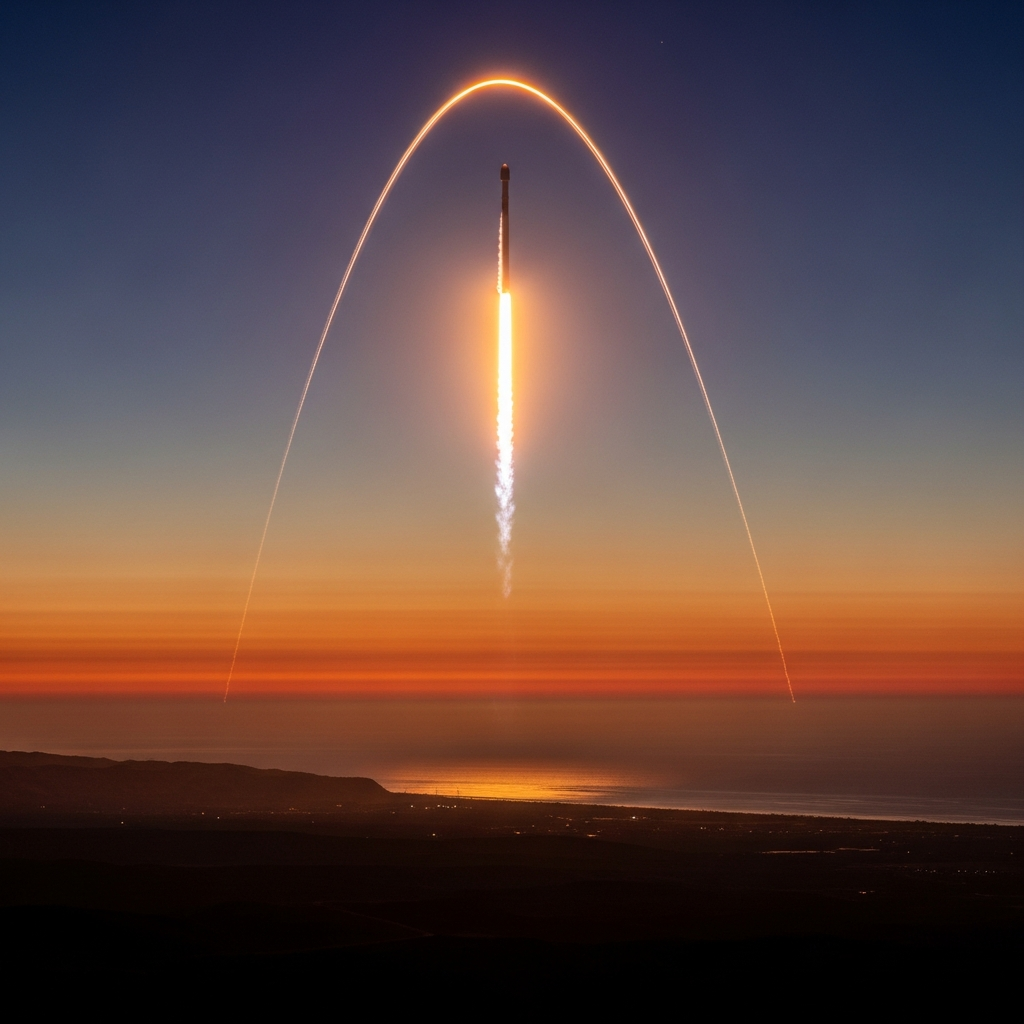
A new chapter in humanity’s quest to understand alien worlds began on January 11, 2026. From California’s Vandenberg Space Force Base, a SpaceX Falcon 9 rocket soared into the sky. Its mission: to deploy approximately 40 diverse spacecraft, including NASA’s groundbreaking Pandora exoplanet observatory. Dubbed “Twilight” by SpaceX, this rideshare launch delivered its precious payloads into a unique dusk-dawn sun-synchronous orbit, literally tracing the line between day and night on our planet.
This pivotal mission heralds a significant leap forward. It promises to deepen our understanding of distant exoplanet atmospheres. By meticulously analyzing the faint whispers of light from stars, Pandora aims to reveal the secrets held within these faraway skies. Beyond scientific discovery, the Twilight mission showcased a vibrant ecosystem of innovation, deploying cutting-edge commercial and scientific satellites that will impact everything from global communication to in-space manufacturing.
Unlocking Alien Atmospheres: The Pandora Mission’s Breakthrough
The centerpiece of the Twilight mission is NASA’s Pandora small satellite. This 716-pound (325 kilograms) observatory is designed for a yearlong orbital mission. Its primary goal is to conduct an unprecedented detailed study of at least 20 known exoplanets. Pandora utilizes a sophisticated 17-inch-wide (45 centimeters) telescope, a collaboration between Corning Incorporated and Lawrence Livermore National Laboratory. This instrument will observe exoplanets as they “transit” or pass in front of their host stars. This “transit method” is a cornerstone of exoplanetary science, having revealed over 6,000 alien worlds by detecting the subtle dip in a star’s brightness.
A Dual-Wavelength Approach to Exoplanet Secrets
While the transit method is excellent for discovery, characterizing exoplanet atmospheres presents a unique challenge. Different elements and molecules absorb starlight at specific wavelengths. This creates a spectral fingerprint, revealing an atmosphere’s composition. However, stellar activity, like sunspots or flares, can mimic or mask these faint atmospheric signals. Pandora addresses this directly with an innovative dual-wavelength strategy.
NASA officials highlighted Pandora’s unique capability: “Pandora aims to disentangle the star and planet spectra.” It achieves this by simultaneously monitoring the exoplanet’s host star in visible light while collecting infrared data. Its near-infrared camera, originally a spare from the James Webb Space Telescope project, collects spectra across the 0.87 to 1.63 micron range. This multiwavelength observation provides crucial constraints on stellar spot coverage. This allows scientists to precisely separate the star’s inherent spectral characteristics from the planet’s atmospheric signature. It’s the first space telescope built specifically to study starlight filtered through exoplanet atmospheres in such detail.
Pandora will focus on exoplanets whose atmospheres are predominantly composed of water or hydrogen. These targets range in size from Earth-like to Jupiter-sized, orbiting mid-K to late-M stars, many initially discovered by NASA’s Transiting Exoplanet Survey Satellite (TESS) mission. The data gathered will significantly enhance the interpretation of measurements from the James Webb Space Telescope and guide future quests for potentially habitable worlds. Following a one to two-month commissioning phase, Pandora will embark on its one-year prime science mission. Operations will be managed from the University of Arizona, with data processing handled by NASA’s Ames Research Center.
A Constellation of Innovation: The Twilight Rideshare Payloads
Beyond Pandora, the Twilight mission carried a diverse and impressive array of other satellites. This included a mix of scientific CubeSats and advanced commercial spacecraft. Such rideshare missions are crucial for providing cost-effective access to space for a broad range of applications.
Commercial and Scientific Trailblazers
Among the notable payloads were ten Aether spacecraft from Toronto-based Kepler Communications Inc. These 300-kilogram satellites represent the largest fleet of Canadian-built spacecraft to date. Kepler is a pioneer in space-based optical communications, using laser light for high-throughput, low-latency links. Their satellites boast substantial onboard computing power, enabling real-time data processing for applications like wildfire detection. CEO Mina Mitry emphasized that this technology “redefines how space systems communicate,” removing bottlenecks of traditional radio links.
Capella Space also launched two advanced Acadia Earth-imaging radar satellites. These offer high-resolution imagery, vital for global monitoring and intelligence. NASA’s CubeSat Launch Initiative (CSLI) further contributed two specialized CubeSats:
SPARCS (Star-Planet Activity Research CubeSat): Led by Arizona State University, this shoebox-sized telescope will investigate coronal mass ejections on small stars. Understanding these energetic stellar eruptions is critical for assessing the habitability of exoplanets orbiting these stars.
BlackCAT (Black Hole Coded Aperture Telescope): From Pennsylvania State University, this X-ray telescope will observe powerful cosmic phenomena. Its targets include X-ray flares from active galaxies with supermassive black holes and distant gamma-ray bursts, especially those linked to gravitational waves.
Further demonstrating the breadth of the mission, Türkiye-based Plan-S Satellite and Space Technologies deployed four Connecta Internet of Things (IoT) CubeSats. Germany’s Dcubed launched its Araqys-D1/Dcubed-1 CubeSat, aiming for a “global first” by manufacturing a 60-cm boom directly in the vacuum of space. This in-space manufacturing breakthrough could revolutionize how large components and even entire space systems are built in orbit.
SpaceX’s Role: Mastering Rideshare and Reusability
The successful Twilight mission underscores SpaceX’s established expertise in rideshare launches. Building on the success of its 15 Transporter series flights and four Bandwagon program missions, Twilight marks a new dedicated rideshare program. The Falcon 9 rocket’s first stage, specifically booster 1097, completed its fifth mission with a precise landing back at Vandenberg Space Force Base just 8.5 minutes after liftoff. This recovery highlights SpaceX’s commitment to reusability, a cornerstone of its strategy to lower launch costs and increase access to space.
The strategic dusk-dawn sun-synchronous orbit chosen for Twilight ensures continuous access to sunlight for the satellites’ solar arrays. This provides uninterrupted power and consistent lighting conditions for Earth observation missions. The seamless deployment of all satellites within a 90-minute window, beginning an hour after liftoff, showcased the precision and reliability of SpaceX’s launch services.
The Dawn of a New Era in Space Exploration
The Twilight mission represents more than just a single launch; it signifies a robust, collaborative future for space exploration. Missions like Pandora push the boundaries of astrophysics, revealing intricate details about distant worlds. Concurrently, the diverse array of commercial and scientific satellites launched alongside it demonstrates the growing commercialization of space. From real-time global awareness to in-space manufacturing, these advancements pave the way for a truly connected space economy and unprecedented scientific discovery.
Advancing Our Cosmic Understanding
The data from Pandora will be a treasure trove for astronomers worldwide. By providing precise measurements of exoplanet atmospheres, it will help refine models of planetary formation and evolution. The insights gained about stellar variability will also benefit future missions, allowing for more accurate observations across the board. This mission, alongside the work of the accompanying CubeSats, directly supports NASA’s strategic goals of fostering new science, technology, and commercial opportunities in space.
Frequently Asked Questions
What is the main goal of NASA’s Pandora mission?
NASA’s Pandora mission aims to conduct detailed studies of the atmospheres of at least 20 known exoplanets. Its primary objective is to differentiate between signals originating from an exoplanet’s atmosphere (like hazes, clouds, or water) and those from its host star’s variability. By simultaneously collecting visible and near-infrared light, Pandora will provide crucial data to accurately interpret observations from missions like the James Webb Space Telescope and guide future quests for habitable worlds.
Which unique technologies did other satellites on the Twilight mission demonstrate?
The Twilight mission carried several innovative payloads beyond Pandora. Kepler Communications launched ten Aether satellites featuring space-based optical communication technology, using lasers for high-throughput, low-latency data links. Germany’s Dcubed deployed a CubeSat designed for in-space manufacturing, attempting to deploy a 60-cm boom in the vacuum of space. Additionally, NASA-backed CubeSats like SPARCS are studying stellar flares and BlackCAT is an X-ray telescope investigating powerful cosmic events, showcasing diverse technological advancements.
How does the “Twilight” orbit benefit satellite missions?
The “Twilight” mission delivered satellites into a dusk-dawn sun-synchronous orbit. This specific orbital path closely traces the line between day and night on Earth. This strategic placement ensures continuous exposure to sunlight for the satellites’ solar arrays, providing uninterrupted power. It also offers consistent lighting conditions for Earth observation points below, which is highly beneficial for imaging and monitoring missions, ensuring reliable data collection over extended periods.