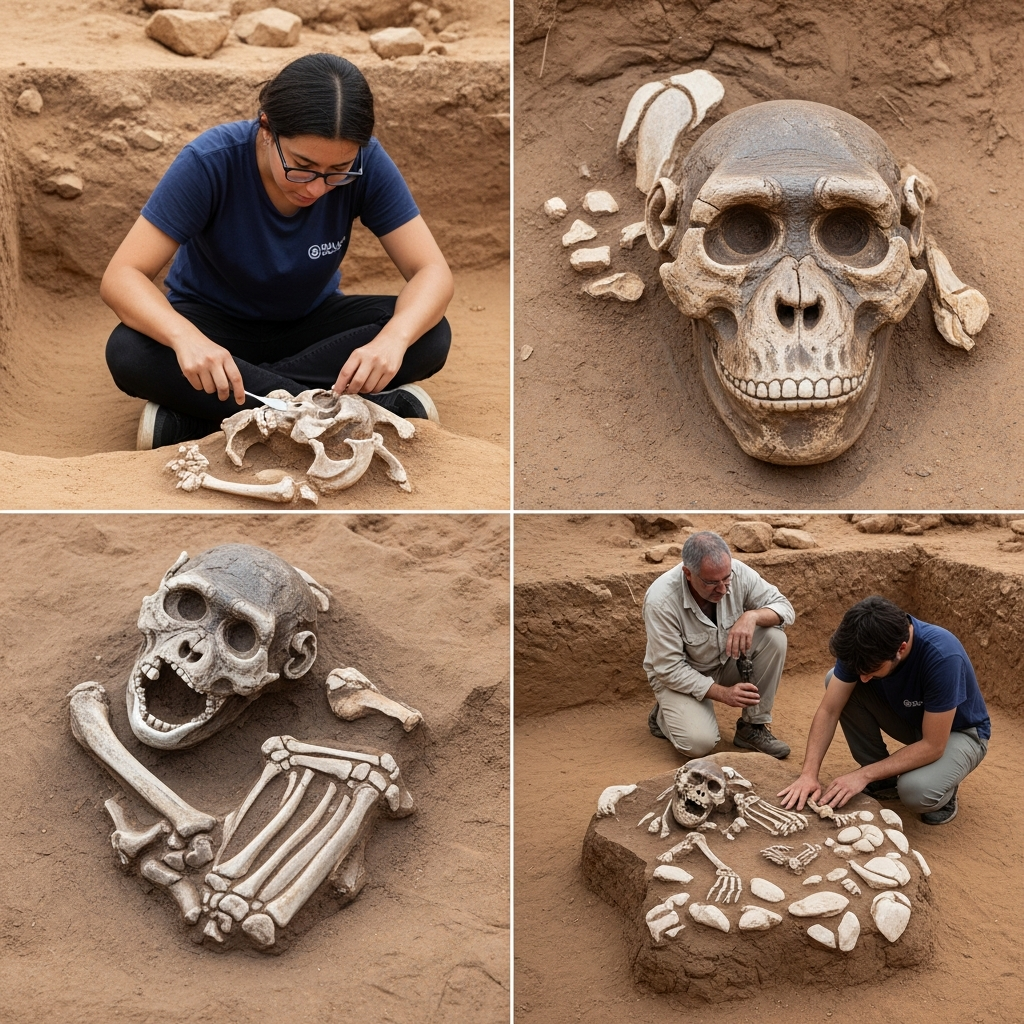
A groundbreaking discovery in Morocco is rewriting our understanding of human evolution, providing compelling evidence that the lineage leading to modern humans emerged in Africa far earlier than previously thought. New hominin fossils, securely dated to approximately 773,000 years ago, have been unearthed at Thomas Quarry I in Casablanca. These remarkably preserved remains offer an unprecedented glimpse into the ancestral populations that existed just before the pivotal divergence of Homo sapiens, Neanderthals, and Denisovans. This deep dive into our past strengthens the argument for an African origin of our species, positioning North Africa as a key region in this complex evolutionary story.
A Pivotal Discovery in Casablanca: Unearthing Our Deep Past
For over three decades, an international team has meticulously excavated the Grotte à Hominidés (ThI-GH) within Thomas Quarry I, a significant archaeological site located in Casablanca, Morocco. This sustained effort has yielded a trove of information, including Acheulean stone tools and diverse animal fossils, all found within a clear stratigraphic context. The most exciting finds are the hominin fossils themselves, representing at least three individuals and comprising mandibles, teeth, and vertebrae.
Among the key specimens is a nearly complete adult mandible, ThI-GH-10717, which provides crucial insights into the facial structure and dental patterns of these early human ancestors. Researchers also found a fragmentary child’s mandible (ThI-GH-10978), a second adult hemimandible (ThI-GH-1), and a series of eight associated vertebrae. The site appears to have functioned as a carnivore den, evidenced by numerous animal bones bearing gnawing marks and the scarcity of stone artifacts, suggesting these hominins were perhaps prey rather than residents.
Why This Moroccan Discovery Matters
The significance of these Moroccan hominin fossils lies in their precise dating and unique morphology. They are contemporary with Homo antecessor from Spain, a species previously considered a potential common ancestor. However, the Moroccan specimens exhibit distinct features, highlighting a fascinating period of regional differentiation among hominin populations. This discovery reinforces Africa’s central role in the evolutionary journey of Homo sapiens.
Pinpointing the Past: Unprecedented Dating Precision
The age of the ThI-GH hominin fossils is exceptionally precise, a critical factor for understanding their place in human evolution. Researchers utilized a high-resolution magnetostratigraphic record from the cave’s sediments. This technique capitalizes on the Matuyama–Brunhes Transition (MBT), a globally synchronous geomagnetic polarity reversal that occurred approximately 773,000 ± 4,000 years ago.
By analyzing 180 magnetostratigraphic samples, scientists determined that the hominin-bearing layers were deposited precisely during this transition, which lasted between 8,000 and 11,000 years. This provides an unusually firm chronological anchor for African Pleistocene hominins. Independent biochronological data, derived from 37 species of mammals found alongside the human remains, further corroborates this precise age. These faunal comparisons align the site with the Early-Middle Pleistocene boundary and suggest ecological corridors across the Sahara, facilitating exchanges between North, East, and South African faunas during this period. While other dating methods like Optically Stimulated Luminescence (OSL) and Electron-Spin Resonance (ESR) yielded younger, less consistent results, the robust magnetostratigraphic and biochronological evidence firmly places the ThI-GH hominins around 773,000 years ago.
A Mosaic of Traits: Unraveling Their Morphology
The Moroccan hominin fossils present a fascinating blend of primitive and derived anatomical features, painting a complex picture of human diversity during the late Early Pleistocene. This mosaic suggests a population that does not fit neatly into existing species categories, but rather sits at a critical evolutionary juncture.
Mandibular Features Reveal Evolutionary Clues
The adult mandible ThI-GH-10717 is relatively gracile, with a long, low, and narrow body. Its receding symphysis (the chin area) is reminiscent of earlier species like Homo erectus. However, it also displays more advanced traits, such as a small mentum osseum and a shallow genioglossal fossa, features also seen in Homo antecessor. Intriguingly, its shallow masseteric fossa (for jaw muscle attachment), flat pterygoid fossa, and symmetrical mandibular notch align more closely with later Homo sapiens.
In contrast, the second adult mandible, ThI-GH-1, is more robust. It shares some features with European Middle Pleistocene hominins and Neanderthals, like a more pronounced pre-angular notch and a deeper masseteric fossa. These subtle differences between the two mandibles hint at variations within this ancient Moroccan population or perhaps even broader regional diversity.
Dental Patterns and Vertebrae Offer Further Insights
The dental analysis from both individuals is equally revealing. They exhibit a molar size pattern where the first molar is smaller than the second, but the third (wisdom) molar is significantly reduced. This M1 M3 pattern is more commonly observed in H. antecessor, H. sapiens, and Neanderthals, rather than the larger, more consistent molars typical of H. erectus. High-resolution micro-CT scans of the teeth, specifically examining the enamel-dentine junction (EDJ), further highlight their unique position. The EDJ shapes generally fall outside but adjacent to Neanderthal and H. sapiens samples, suggesting a distinct lineage. Primitive features like the absence of shovel-shaped incisors are also noted.
The associated vertebrae from ThI-GH-10717 are small-bodied. While some aspects of their morphology, like the orientation of the C7 articular facets, show similarities to H. erectus, the vertebral canal section areas generally fall within the range observed in modern H. sapiens. This mix of archaic and more modern features underscores the transitional nature of these Moroccan hominins.
Reshaping the Human Family Tree: An African Story
The morphological profile of the Moroccan hominin fossils places them squarely near the evolutionary split between the African and Eurasian hominin lineages. This finding provides crucial support for the long-debated African origin of Homo sapiens. Genetic evidence previously suggested that the last common ancestor of modern humans, Neanderthals, and Denisovans lived between 765,000 and 550,000 years ago. The Moroccan fossils, dated to 773,000 years ago, align perfectly with the older end of this crucial timeframe.
This discovery significantly challenges the long-standing notion that Homo antecessor from Spain, though roughly contemporaneous, could represent the direct common ancestor. While sharing some dental and mandibular features, the distinct differences between the Moroccan and Spanish fossils indicate that regional differentiation was already well underway by the late Early Pleistocene. The Spanish hominins appear to be more derived towards the Neanderthal morphology that later flourished in Western Eurasia, while the Moroccan population seems to be closer to the root of the African lineage that eventually led to Homo sapiens.
Furthermore, this research dispels the idea of the Sahara Desert as an insurmountable barrier during this period. Paleontological evidence, including the broad faunal similarities between North, East, and South African sites, confirms that climatic oscillations periodically created ecological corridors, allowing populations and gene flow across the continent. This reinforces the idea of Africa as a dynamic and interconnected stage for early human evolution.
The Maghreb: A Crossroads of Early Human History
The Maghreb region of North Africa is increasingly recognized as a pivotal area for understanding the earliest stages of Homo sapiens evolution. These new fossils from Casablanca, preceding the earliest Homo sapiens individuals discovered at Jebel Irhoud (Morocco) by roughly half a million years, provide the most compelling evidence yet for an African lineage directly ancestral to our species.
The unique combination of primitive and derived features in these Moroccan hominin fossils positions them as strong candidates for populations lying at the root of the shared ancestry of modern humans, Neanderthals, and Denisovans. Their analysis reinforces the profound and deep African origins of humanity, highlighting North Africa not just as a location, but as a dynamic and central stage in the grand narrative of our evolutionary past.
Frequently Asked Questions
What makes the Moroccan hominin fossils so significant for human origins?
The Moroccan hominin fossils are exceptionally significant because they are precisely dated to 773,000 years ago, placing them at a critical juncture just before the last common ancestor of Homo sapiens, Neanderthals, and Denisovans. Their unique blend of primitive and derived features provides strong evidence for an African origin of our species, challenging theories that placed this divergence in Eurasia. They offer direct fossil evidence confirming the timeline indicated by genetic studies and highlight North Africa’s crucial role in early human evolution.
Where were these 773,000-year-old hominin fossils found in Morocco?
These ancient hominin fossils were discovered in the Grotte à Hominidés (ThI-GH), a cave system located within Thomas Quarry I in Casablanca, Morocco. This site, excavated as part of the Moroccan-French “Préhistoire de Casablanca” program, is known for its well-preserved Plio-Pleistocene palaeoshorelines and coastal formations, providing an ideal environment for fossil preservation. The meticulous excavation since 1994 ensured the fossils were recovered in a secure and undisturbed stratigraphic context.
How do the Moroccan fossils challenge previous theories about Homo sapiens ancestry?
The Moroccan hominin fossils challenge previous theories by reinforcing an African origin for Homo sapiens and distinguishing this lineage from European counterparts like Homo antecessor. While H. antecessor (Spain) was once considered a potential common ancestor, the Moroccan fossils, despite being similar in age, possess distinct morphological features. This suggests that by 773,000 years ago, regional differentiation was already occurring, with European populations likely leading towards Neanderthals, and African populations, like those in Morocco, representing the ancestral branch to modern humans.
Conclusion
The discovery of the 773,000-year-old Moroccan hominin fossils marks a monumental shift in our understanding of human evolutionary history. These ancient remains from Casablanca offer an unparalleled window into a pivotal moment—the divergence of our own lineage from that of Neanderthals and Denisovans. By providing robust evidence for an early African origin of Homo sapiens, this groundbreaking research not only fills crucial gaps in the fossil record but also firmly establishes North Africa as an indispensable region in the narrative of our shared ancestry. As scientists continue to explore these findings, they illuminate the intricate pathways that led to the emergence of modern humanity, solidifying Africa’s role as the cradle of humankind.