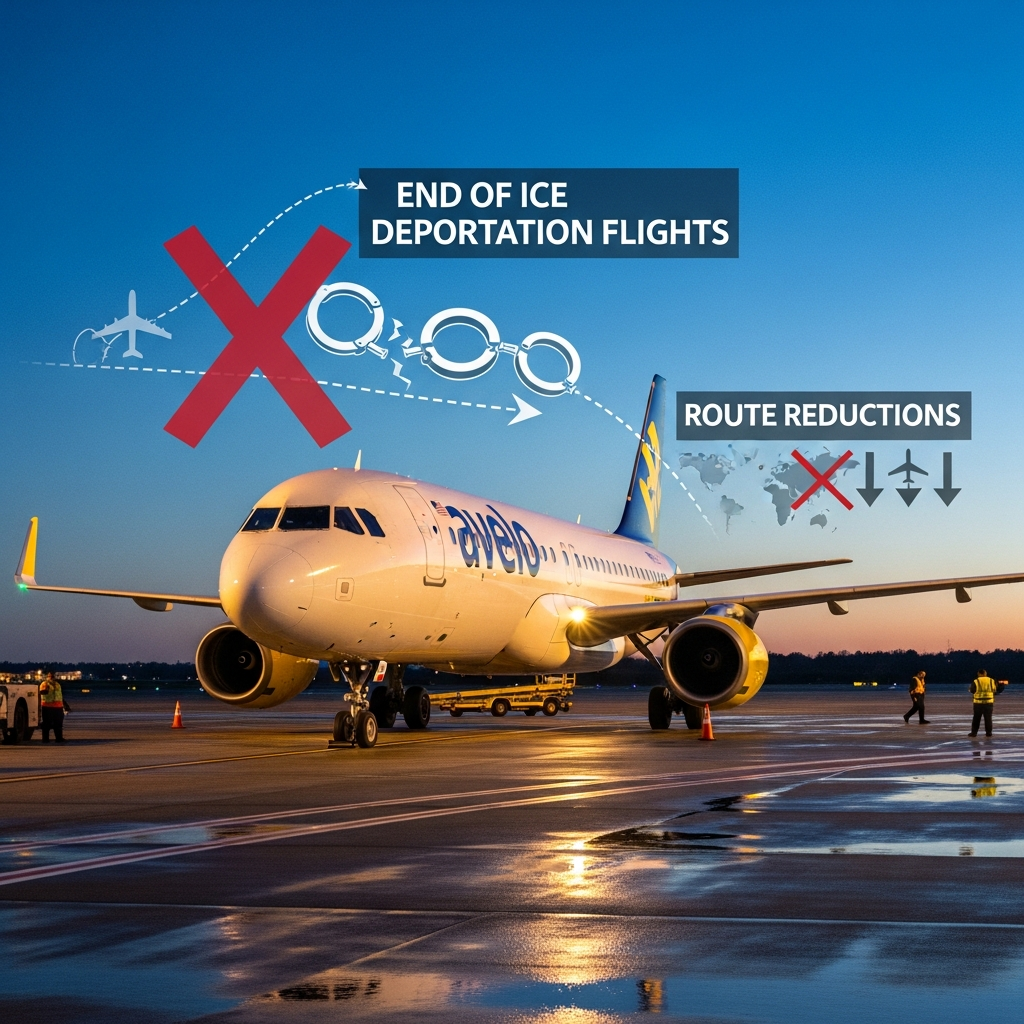
Avelo Airlines is making significant strategic shifts, announcing major route reductions and the closure of its Wilmington, NC (ILM) base as part of a comprehensive recapitalization. Crucially, the airline will also end its controversial contract for Immigration and Customs Enforcement (ICE) deportation flights, effective January 27, 2026. This bold pivot aims to streamline operations and focus on core, profitable markets for the low-cost carrier. Travelers in affected regions will experience immediate changes, while Avelo solidifies its long-term strategy in a competitive industry landscape.
Avelo Airlines’ Strategic Recalibration Revealed
In a significant announcement on January 7, 2026, Avelo Airlines unveiled a sweeping recapitalization plan designed to optimize its network and fleet. This strategic “reset” impacts several operational areas, signaling a critical phase for the young ultra-low-cost carrier (ULCC). The core objective is to streamline operations, enhance profitability, and position Avelo for more sustainable future growth. The changes reflect Avelo’s ongoing efforts to adapt its business model within the dynamic and challenging low-cost airline sector.
The airline’s spokesperson, Courtney Goff, indicated that these adjustments are part of a broader goal to refine Avelo’s fleet and concentrate resources. For any airline, especially a newer one, continuous evaluation of routes and bases is essential for long-term viability. This decision highlights the pressures of market demand and operational efficiency in the highly competitive air travel industry.
Wilmington International Airport (ILM) Faces Significant Reductions
Wilmington International Airport (ILM) in North Carolina will experience substantial service changes. Avelo, currently the third-largest carrier at ILM, is dramatically reducing its flight offerings. Starting in late January, Avelo will cease flying to 11 destinations from Wilmington. These include popular routes like Orlando, Fort Lauderdale/Miami, West Palm Beach, Fort Myers, D.C.-Dulles, New York/Long Island, Detroit, Rochester, Boston, Philadelphia/Wilmington, and the recently launched international flight to Punta Cana, Dominican Republic.
Following these extensive cuts, Avelo will maintain service to just four destinations from ILM: Nashville, New Haven, D.C./Baltimore, and Tampa. This represents a concentrated focus on a smaller, presumably more consistently profitable set of routes. Airport officials at ILM acknowledged the changes, noting that many of the discontinued destinations are still served by other carriers such as American, Delta, United, Breeze, JetBlue, and Sun Country.
Wilmington Base Closure and Employee Impact
Adding to the changes, Avelo is also closing its operational base at ILM, which only opened in April 2025. This base was initially projected to create 50 local jobs. The exact number of local layoffs is currently in flux, as some crew members may be relocated. Avelo plans to offer opportunities at its other existing bases or new growth areas like Central Florida/Lakeland and the upcoming Dallas/McKinney base.
Avelo’s spokesperson, Courtney Goff, explained that ILM is not a “protected airport.” Many of the affected routes struggled with demand, making it difficult to support multiple airlines. The inaugural Punta Cana flight, for instance, had a “slow start” and was always intended to be seasonal. Despite these immediate reductions, Goff mentioned the possibility of adding three to five seasonal destinations from ILM in the future, contingent on demand and new aircraft arrivals.
Ending the Controversial ICE Deportation Contract
One of the most significant announcements is Avelo’s decision to conclude its participation in the $151-million government contract with Immigration and Customs Enforcement (ICE) for deportation flights. This program had been a source of considerable public scrutiny, leading to protests and boycott calls from activists at various airports, including Wilmington. The airline’s involvement with the Department of Homeland Security’s charter program will officially end on January 27, 2026.
Avelo cited economic and operational reasons for this decision. While the ICE charter program offered short-term benefits, it “did not deliver enough consistent and predictable revenue to overcome its operational complexity and costs.” This indicates that despite the lucrative contract value, the specialized staffing, aircraft utilization challenges, and regulatory coordination required for these non-commercial flights proved inefficient for Avelo’s core business model. The base in Mesa, Arizona (AZA), which exclusively supported these deportation flights, is also slated for closure.
Avelo’s Network Consolidation and Future Growth Strategy
As part of its comprehensive restructuring, Avelo Airlines is consolidating its operations around five core bases in 2026. These include existing hubs at Tweed New Haven Airport (CT), Wilmington Airport (DE) — note: distinct from Wilmington, NC (ILM), Charlotte/Concord (NC), and Central Florida/Lakeland. Avelo will also establish a new base at McKinney National Airport in Dallas/McKinney, Texas, by the end of 2026. This move aligns with Avelo’s strategy of operating from smaller, less congested airports while serving large population centers.
Beyond ILM and Mesa, Avelo is also closing its crew base at Raleigh/Durham International Airport (RDU) in North Carolina. However, commercial flights from RDU will continue to New Haven and Rochester, indicating a shift from a dedicated base to a more traditional airport service model. This consolidation aims to focus resources on locations deemed strategically vital for Avelo’s long-term network growth and stability. The emphasis on Wilmington, DE (ILG) as a core base, which employs over 100 crew members, underscores its importance in Avelo’s streamlined network.
Fleet Modernization and Efficiency Drive
A key component of Avelo’s recapitalization plan is a significant modification of its aircraft fleet. The airline will remove six Boeing Next-Generation 737-700 planes from its current operations. This move suggests a strategic shift towards primarily operating the larger Boeing 737-800 model, which offers increased capacity and improved operational efficiency.
Looking further ahead, Avelo plans to introduce Embraer 195-E2s into its fleet starting in 2028. Avelo will be the first U.S. airline to fly these advanced aircraft. These new jets are heralded for their higher efficiency, promising 25% fuel savings and lower emissions. This commitment to a modern, fuel-efficient fleet aligns with broader industry trends towards sustainability and cost reduction. The shift is crucial for Avelo’s long-term sustainability and ability to compete as a low-cost carrier.
The Bigger Picture: Avelo’s Path to Sustainability
For a young airline, Avelo has demonstrated a willingness to make rapid and significant adjustments to its business model. This recent round of comprehensive changes, bolstered by a recent recapitalization, aims to simplify operations ahead of its next growth phase. Avelo asserts these strategic adjustments place it in one of the “strongest cash positions in the U.S. airline industry relative to its size.”
The competitive landscape for ultra-low-cost carriers is particularly challenging, requiring constant optimization of routes, bases, and operational costs. Avelo’s decision to streamline its fleet, consolidate bases, and exit a complex, non-core business like the ICE contract reflects a pragmatic approach to achieving consistent profitability. While disruptive in the short term for affected passengers and employees, these moves are intended to provide a more stable and efficient foundation. The future arrival of Embraer E2 jets further underscores a long-term vision for sustainable, low-cost expansion, enabling the airline to serve new markets and increase flight frequencies with better economics.
Frequently Asked Questions
What specific changes is Avelo Airlines implementing as part of its restructuring plan?
Avelo Airlines is undertaking a comprehensive recapitalization, leading to significant operational changes. These include reducing flight routes, particularly at Wilmington, NC (ILM), and closing its base there. Crucially, Avelo is also terminating its contract for ICE deportation flights, effective January 27, 2026. Other bases, like Mesa, Arizona, and Raleigh/Durham, North Carolina, are also closing, while Avelo consolidates operations around five core bases and plans a new one in Dallas/McKinney, Texas. The airline is also modifying its fleet by removing older Boeing 737-700s and introducing more efficient aircraft in the future.
Where will Avelo Airlines continue to offer commercial flights from Wilmington International Airport (ILM)?
Following significant route reductions, Avelo Airlines will continue to operate flights from Wilmington International Airport (ILM) to four specific destinations. These remaining routes are Nashville, Tennessee; New Haven, Connecticut; D.C./Baltimore, Maryland; and Tampa, Florida. All other previously served destinations from ILM, including the international flight to Punta Cana, will cease operations as of late January 2026. Travelers needing to reach other destinations previously served by Avelo from ILM can find alternative options with other carriers at the airport.
Why is Avelo Airlines ending its contract for ICE deportation flights?
Avelo Airlines is concluding its contract with Immigration and Customs Enforcement (ICE) for deportation flights primarily due to economic and operational inefficiencies. While the program offered short-term financial benefits, Avelo spokesperson Courtney Goff stated it “did not deliver enough consistent and predictable revenue to overcome its operational complexity and costs.” The specialized staffing, aircraft utilization challenges, and regulatory coordination required for these non-commercial charter flights were not aligning with Avelo’s core business model, leading to the strategic decision to terminate the program and focus on its scheduled passenger operations.
Avelo Airlines’ extensive restructuring marks a pivotal moment for the low-cost carrier. By streamlining its fleet, consolidating its operational bases, and exiting non-core business ventures like the ICE contract, Avelo aims to forge a more efficient and profitable path forward. While these changes will undoubtedly impact travelers in the short term, particularly those relying on Wilmington (ILM) routes, they represent a strategic effort to build a stronger, more sustainable airline poised for future growth. Travelers are advised to check Avelo’s official communications for specific flight information and alternative arrangements.