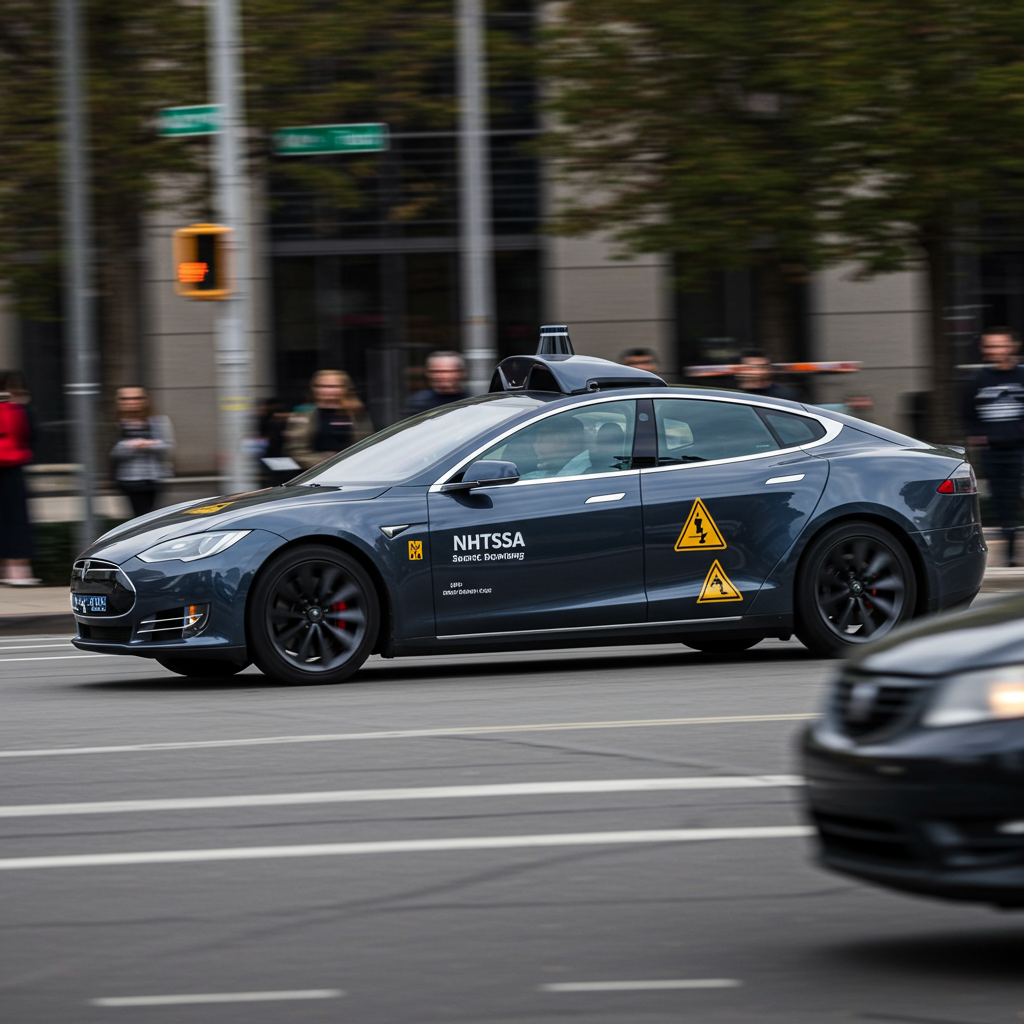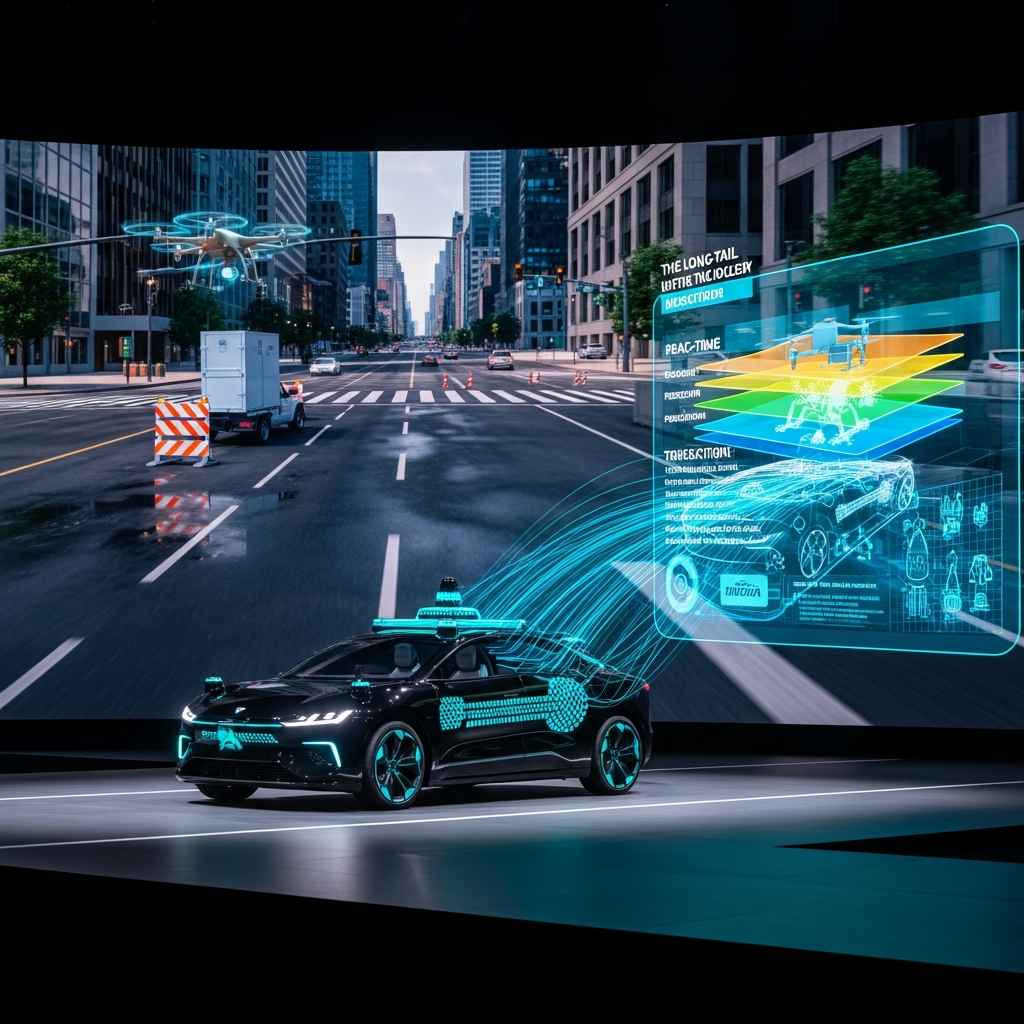
The future of autonomous vehicles (AVs) is taking a monumental leap forward with NVIDIA Alpamayo, a revolutionary family of open-source AI models, simulation tools, and extensive datasets. Unveiled at CES, Alpamayo is engineered to accelerate the development of highly safe, reasoning-based AVs. This groundbreaking initiative directly tackles the most formidable challenges in self-driving technology: the unpredictable, complex “long-tail” scenarios that have historically limited full autonomy. By fostering an open ecosystem, NVIDIA aims to empower developers and researchers to build intelligent vehicles that perceive, reason, and act with unprecedented humanlike judgment.
The Dawn of Reasoning AI: NVIDIA Alpamayo’s Vision for Autonomy
Autonomous driving promises to transform mobility, yet the journey to truly self-reliant vehicles has been fraught with difficulties. While AVs excel in routine situations, rare and complex scenarios—often termed the “long tail”—present significant hurdles. These edge cases, from unexpected road debris to intricate traffic light outages, demand far more than basic object detection and path planning. They require genuine understanding and real-time problem-solving.
NVIDIA’s Alpamayo family introduces a paradigm shift, moving beyond traditional perception-planning architectures towards a new era of “reasoning-based” autonomy. Jensen Huang, founder and CEO of NVIDIA, aptly described this as the “ChatGPT moment for physical AI.” This signifies a pivotal transition where machines begin to not just process data, but actively understand, reason, and make informed decisions in the physical world. Alpamayo is designed to be the bedrock for safe, scalable autonomy, particularly benefiting applications like robotaxis.
Tackling the “Long Tail”: Why Reasoning Matters
Traditional autonomous driving systems often compartmentalize perception and planning. This approach, while effective for common situations, struggles when confronted with novel or unusual events. The rigid separation can limit a vehicle’s ability to adapt or explain its actions when facing situations outside its training experience. This is where the long-tail problem truly manifests, requiring a more sophisticated cognitive capability.
Alpamayo addresses this by introducing “chain-of-thought, reasoning-based Vision Language Action (VLA) models.” These advanced models endow AVs with a humanlike thinking process. Instead of simply reacting, the system methodically analyzes complex or rare situations step-by-step. This capability significantly improves driving performance and, crucially, enhances explainability. Transparency in decision-making is vital for building public trust and satisfying regulatory demands for intelligent vehicles. Every decision within Alpamayo is further bolstered by NVIDIA’s robust Halos safety system, ensuring a foundational layer of security.
A Complete Ecosystem: Open Models, Simulation & Data
NVIDIA is not merely offering a new AI model; it’s delivering a comprehensive, open ecosystem built upon three essential pillars. This integrated approach allows any automotive developer or research team to rapidly innovate and build upon a solid foundation. Rather than deploying directly in vehicles, Alpamayo models function as large-scale “teacher models.” Developers can then fine-tune and distill these powerful models into optimized backbones for their specific AV stacks, tailoring them for in-vehicle deployment.
Alpamayo 1: The Brain for Intelligent Decisions
At the heart of this ecosystem is Alpamayo 1, hailed as the industry’s first chain-of-thought reasoning VLA model specifically for the AV research community. Now openly available on Hugging Face, this powerful model boasts a 10-billion-parameter architecture. It processes live video input to not only generate precise driving trajectories but also provides explicit “reasoning traces.” These traces transparently reveal the logic behind each decision, offering invaluable insight into the AI’s thought process. Developers can easily adapt Alpamayo 1 into more compact runtime models for direct vehicle integration, or use it as a foundational tool for creating advanced AV evaluators and intelligent auto-labeling systems. Future iterations of the Alpamayo family promise even larger parameter counts, more detailed reasoning capabilities, and greater input/output flexibility, with options for commercial use.
AlpaSim: Mastering Reality in a Virtual World
Complementing the AI models is AlpaSim, a fully open-source, end-to-end simulation framework for high-fidelity AV development. Accessible on GitHub, AlpaSim offers an unparalleled virtual testing environment. It features realistic sensor modeling, allowing developers to simulate various camera, radar, and lidar inputs with high accuracy. Configurable traffic dynamics enable the recreation of diverse and challenging road conditions. These scalable closed-loop testing environments are critical for rapid validation of AV policies and for refining driving behaviors in a safe, repeatable setting, especially for those elusive long-tail scenarios.
Physical AI Open Datasets: Fueling AI with Real-World Complexity
To properly train and validate these sophisticated reasoning architectures, high-quality, diverse data is indispensable. NVIDIA provides an extensive collection of Physical AI Open Datasets, also available on Hugging Face. This vast resource comprises over 1,700 hours of driving data. Crucially, this data has been meticulously collected across a wide range of geographies and conditions, specifically including rare and complex real-world edge cases. These datasets provide the essential fuel for advancing reasoning architectures, enabling models to learn from the diversity of real-world challenges.
Industry Adoption and the “Android of Autonomy” Strategy
The strategic importance of Alpamayo has garnered significant support from leading mobility innovators and research institutions. Companies like Lucid Motors and JLR (Jaguar Land Rover) recognize the growing need for AI systems that can reason about real-world behavior, not just process information. Uber, a major player in autonomous mobility and delivery, sees Alpamayo as a catalyst for accelerating physical AI, improving transparency, and enhancing safe Level 4 deployments. Academic powerhouses such as Berkeley DeepDrive also view Alpamayo as a transformative tool for research, enabling training at unprecedented scales.
NVIDIA’s decision to make Alpamayo open-source is a calculated move, positioning them as the “Android of Autonomy.” This strategy aims to integrate a wide array of startups and automakers into NVIDIA’s robust CUDA ecosystem. By providing a ready-made, open architecture, NVIDIA offers a compelling alternative to closed, proprietary systems (like Tesla’s Full Self-Driving stack), enabling legacy automakers to accelerate their autonomous development without building everything from scratch.
A concrete timeline for Alpamayo’s impact on production vehicles has already been announced. The 2025 Mercedes-Benz CLA is slated to be the first vehicle to integrate NVIDIA’s complete AV stack, featuring Alpamayo’s reasoning capabilities. This system, branded as MB.DRIVE ASSIST PRO, will offer advanced SAE-Level 2 assistance with a U.S. launch in Q1 2026, followed by Europe and Asia later in the year. While initially a Level 2+ system requiring driver attention, it lays the groundwork for progression towards Level 4 autonomous capabilities. Powering the rigorous backend training and simulation for these advanced AI models is NVIDIA’s next-generation Vera Rubin platform, ensuring continuous improvement and scalability.
Beyond Alpamayo: NVIDIA’s Broader AI Horizon
NVIDIA Alpamayo is not an isolated offering but an integral part of NVIDIA’s expansive AI and physical AI ecosystem. Developers can seamlessly leverage Alpamayo within a rich library of existing NVIDIA tools and platforms, including NVIDIA Cosmos and NVIDIA Omniverse. This allows for fine-tuning Alpamayo models with proprietary fleet data, integrating them into the robust NVIDIA DRIVE Hyperion™ architecture (which incorporates NVIDIA DRIVE AGX Thor™ accelerated compute), and thoroughly validating performance in simulation before any commercial deployment. This holistic approach ensures a powerful, interconnected development pathway for the next generation of intelligent vehicles.
Frequently Asked Questions
What exactly is “reasoning-based AI” in autonomous vehicles, and how does Alpamayo implement it?
Reasoning-based AI for autonomous vehicles (AVs) refers to an artificial intelligence system’s ability to logically analyze, interpret, and make decisions in complex, novel situations, much like a human driver. Unlike traditional AVs that rely heavily on pre-programmed rules and pattern recognition, reasoning AI can infer cause and effect, predict potential outcomes, and explain its decision-making process. NVIDIA Alpamayo implements this through “chain-of-thought, Vision Language Action (VLA) models,” which process video input and generate detailed “reasoning traces” alongside driving trajectories. This allows the Alpamayo 1 model to break down unexpected scenarios step-by-step, ensuring safer and more transparent decision-making, particularly for challenging “long-tail” problems.
Where can developers access the open-source components of NVIDIA Alpamayo?
NVIDIA has made the core components of the Alpamayo family readily accessible to foster collaborative development. The flagship Alpamayo 1 model, including its open model weights and open-source inferencing scripts, is available on Hugging Face. For high-fidelity simulation and testing, the AlpaSim framework is provided as fully open-source on GitHub. Additionally, a diverse and extensive collection of Physical AI Open Datasets, crucial for training advanced reasoning architectures with real-world edge cases, can also be found on Hugging Face. These open resources enable researchers and automotive developers to immediately begin working with NVIDIA’s latest AV AI technology.
How will NVIDIA Alpamayo impact the timeline for Level 4 autonomous vehicle deployment?
NVIDIA Alpamayo is designed to significantly accelerate the roadmap for Level 4 autonomous vehicle (AV) deployment. By providing a complete, open ecosystem that tackles the complex “long-tail” scenarios—which are major barriers to full autonomy—Alpamayo enables developers to fine-tune, distill, and test models with unprecedented safety and robustness. The ability of Alpamayo’s reasoning-based VLA models to “think through rare scenarios” and explain their decisions is crucial for building the necessary trust and meeting regulatory requirements for Level 4 systems. With industry leaders like Lucid, JLR, and Uber expressing support, and the Mercedes-Benz CLA slated for a Q1 2026 launch with an Alpamayo-powered Level 2+ system, the technology is poised to rapidly advance the industry toward more capable and widely deployed Level 4 autonomous capabilities.
In conclusion, NVIDIA Alpamayo represents a pivotal moment for the autonomous vehicle industry. By championing an open, reasoning-based AI ecosystem, NVIDIA is not only addressing the most formidable challenges of self-driving technology but also democratizing access to cutting-edge tools. The Alpamayo family, comprising powerful VLA models, a robust simulation framework, and diverse datasets, empowers developers to build safer, more explainable, and ultimately more intelligent autonomous vehicles. As Alpamayo-powered systems begin to roll out, they promise to fundamentally reshape the future of mobility, ushering in an era of truly autonomous and trusted transportation.