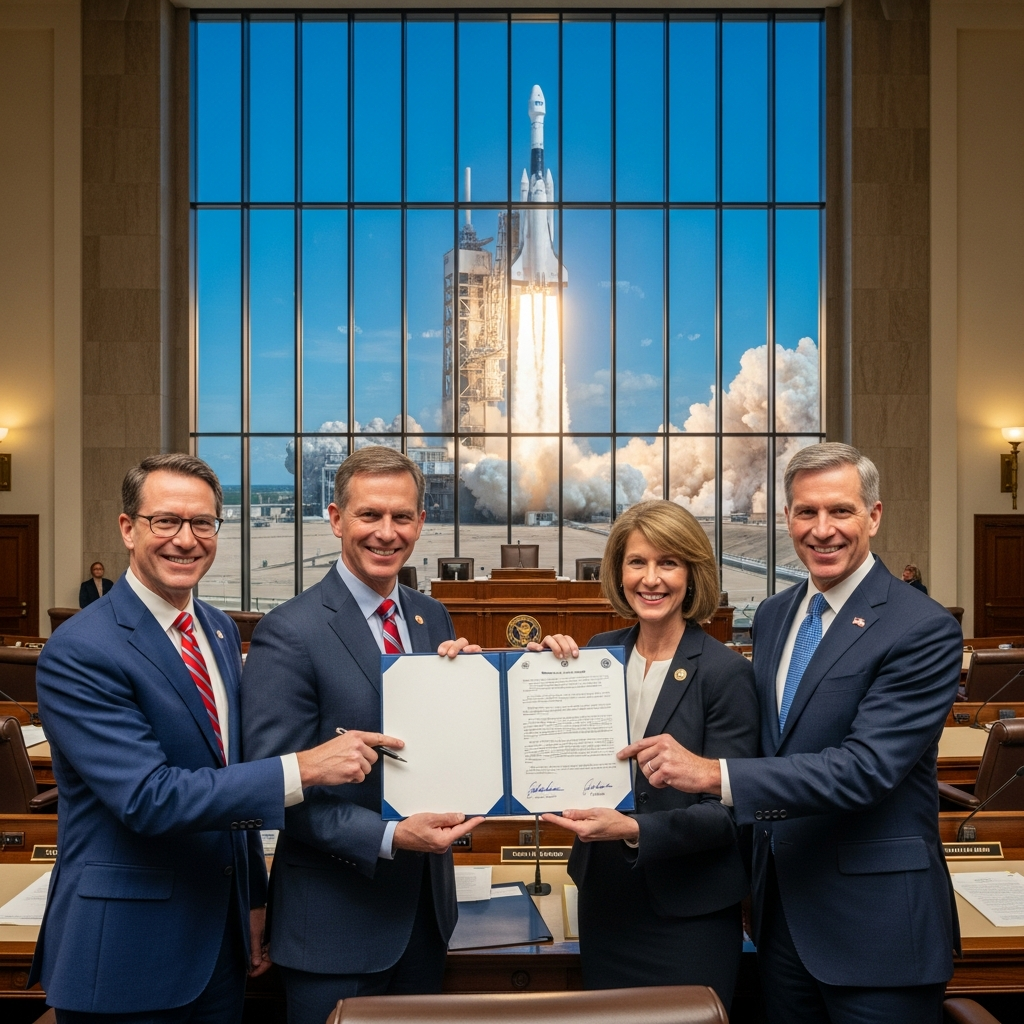
The future of U.S. space exploration just received a significant boost. In a decisive move, Congress has finalized an appropriations bill that largely rejects the deep budget cuts proposed for NASA, instead allocating a robust $24.438 billion for fiscal year 2026. This comprehensive legislative package, known as a “minibus,” signals a strong bipartisan commitment to maintaining America’s leadership in space, despite the administration’s earlier calls for drastic reductions.
This funding decision comes as a major relief to the scientific community and space enthusiasts alike. The proposed cuts, which could have jeopardized numerous missions and research initiatives, have been largely overturned, ensuring continuity and progress for critical programs ranging from Earth science to deep space exploration. The new budget reflects a clear prioritization of scientific research, technological advancement, and human spaceflight endeavors, solidifying NASA’s operational capacity for the coming year.
The Minibus Bill: A Congressional Lifeline for NASA
Released by House and Senate appropriators, the “minibus” appropriations package for fiscal year 2026 represents a crucial legislative effort. This package strategically combines three vital spending bills, including the Commerce, Justice, and Science bill, which is responsible for funding not only NASA but also the National Oceanic and Atmospheric Administration (NOAA) and the National Science Foundation (NSF). Its bipartisan nature underscores a shared understanding of the importance of federal investments in science and innovation.
The total allocation of $24.438 billion for NASA for FY2026 stands in stark contrast to the administration’s initial request of a mere $18.8 billion. This substantial increase, nearly $5.6 billion above the requested amount, effectively safeguards the agency from potentially devastating setbacks. While slightly less than the $24.875 billion NASA received in both FY2024 and FY2025 under a full-year continuing resolution, the current funding level is viewed by many as a significant victory for the space agency.
Key Funding Highlights: Defying the Administration’s Proposed Cuts
The administration’s budget proposal, released months prior, had called for nearly 50% cuts to NASA’s science and space technology divisions, alongside smaller reductions for space operations and aeronautics. Such drastic measures would have led to the cancellation of dozens of ongoing and planned missions. However, the minibus bill systematically rejects most of these proposed reductions, ensuring that vital research and development can continue.
Senator Patty Murray (D-WA), Vice Chair of the Senate Committee on Appropriations, lauded the package for countering proposals that would have jeopardized U.S. competitiveness and jobs. Similarly, Senator Susan Collins (R-ME), the committee’s Chair, emphasized the fiscal responsibility of the package while supporting essential investments in national security and scientific research. This bipartisan consensus was instrumental in securing NASA’s funding.
Deep Dive: Funding Across NASA’s Core Missions
A detailed look at the appropriations reveals targeted support for various NASA directorates, ensuring balanced progress across its diverse portfolio. Each funding decision reflects a strategic effort to sustain current operations while fostering future advancements.
Science and Space Technology: Rejection of Drastic Reductions
NASA’s Science directorate, a cornerstone of its mission, is set to receive $7.25 billion. This figure, while a slight reduction from FY2025’s $7.33 billion, is a monumental rejection of the nearly 50% cut initially proposed by the administration. This crucial funding will enable the continuity of vital science divisions, from Earth science and heliophysics to planetary science and astrophysics, restoring budgets to near or even slightly above 2025 levels in many cases. It explicitly safeguards key missions, including those targeting Venus and Uranus, the Habitable Worlds Observatory (designed to search for extraterrestrial life), and the upcoming Nancy Grace Roman Space Telescope.
Space Technology, another area targeted for severe cuts, will receive $920.5 million. This allocation is significantly higher than the administration’s proposed $569 million, although it represents a decrease from FY2025’s $1.1 billion. This funding will ensure continued innovation in critical areas like advanced propulsion, in-space manufacturing, and power systems, which are essential for future missions.
Exploration and Operations: Sustaining the Journey Beyond Earth
The Exploration directorate, which includes the ambitious Artemis program aimed at returning humans to the Moon and preparing for Mars, is allocated $7.783 billion. This figure is slightly higher than the $7.666 billion received in FY2025, demonstrating sustained investment in human spaceflight, though it falls short of the administration’s requested $8.3 billion. This funding ensures progress on lunar landers, habitation systems, and next-generation spacesuits.
Space Operations, covering critical infrastructure like the International Space Station (ISS) and support for emerging commercial space stations, will receive $4.175 billion. This is a minor decrease from FY2025’s $4.22 billion but ensures the continuous functioning of vital orbital platforms and ground support systems.
Investing in the Future: STEM and Infrastructure
The bill also addresses essential supporting accounts. While some administrative and infrastructure budgets saw minor reductions, Congress firmly rejected the administration’s proposal to eliminate NASA’s education account, known as STEM Engagement. This critical program, which inspires and educates the next generation of scientists and engineers, will maintain its FY2025 funding level of $143 million. This decision highlights the importance of fostering a diverse and skilled workforce for the future of space exploration.
The Mars Sample Return Dilemma: A Strategic Pivot
Despite the widespread rejection of cuts, one significant exception stands out: the Mars Sample Return (MSR) program. The minibus agreement explicitly states that it “does not support the existing Mars Sample Return (MSR) program.” This aligns with the administration’s budget proposal, which sought to cancel the mission due to mounting concerns over its substantial cost (estimated at over $10 billion) and schedule overruns.
However, this doesn’t mean an abandonment of Mars exploration. The bill shrewdly directs NASA to preserve work on key technologies related to MSR, allocating $110 million to a “Mars Future Missions” account. This strategic pivot allows NASA to develop essential capabilities for future Mars missions without committing to the currently embattled MSR architecture. It represents a pragmatic approach to managing high-cost, high-risk endeavors while keeping long-term Mars exploration goals alive.
Beyond MSR: Key Investments in Future Space Capabilities
The conference report accompanying the bill details several other critical investments that will shape the future of space exploration and Earth observation.
Lunar Ambitions: CLPS and Fission Surface Power
The Commercial Lunar Payload Services (CLPS) program, which leverages private industry to deliver scientific instruments and technology demonstrations to the Moon, is approved for at least $250 million. Notably, the bill endorses NASA’s plan to move CLPS from the Science directorate to Exploration, reflecting its growing role in supporting human lunar missions under Artemis.
Furthermore, $250 million is allocated for Fission Surface Power, a program aimed at developing a nuclear reactor for lunar operations by 2030. This foundational technology is vital for sustaining long-duration human presence on the Moon, providing reliable power independent of sunlight.
Commercial Space and Advanced Propulsion
Supporting the burgeoning commercial space sector, $273.2 million is provided for the Commercial Low Earth Orbit Destinations (CLD) program. This initiative aims to foster the development of privately-owned and operated space stations, ensuring a seamless transition as the International Space Station nears its operational end. This investment encourages innovation and competitiveness in the private sector.
Within the space technology budget, a significant sum—between $110 million and $120 million—is earmarked for nuclear thermal propulsion, with an additional $50 million for nuclear electric propulsion. The report mandates NASA to develop a comprehensive development strategy for both technologies and proposes moving this critical work to the Mars Campaign Office within the exploration mission directorate. These advanced propulsion systems are considered vital for reducing transit times for future human missions to Mars, making deep space travel more feasible and efficient.
Political Context and Expert Reactions
The passage of this minibus package, with its strong support for NASA, reflects complex political dynamics and strategic priorities within Congress. The legislative body faced a critical January 30 deadline to pass spending legislation and avert a government shutdown.
Bipartisan Support and Legislative Deadlines
House Speaker Mike Johnson confirmed the upcoming House vote, acknowledging that while prior House proposals were less severe than the President’s, the minibus represented a balanced, bipartisan compromise. This agreement demonstrates a rare moment of unity in Washington regarding the strategic importance of sustained investment in scientific research and space exploration. The broad support from both sides of the aisle underscores the widely held belief that NASA’s work is crucial for national security, economic competitiveness, and scientific advancement.
The Road Ahead: Enforcement Challenges
While the appropriations represent a clear congressional directive, some experts voice caution. Michael Lubell, a physicist and former director of public affairs at the American Physical Society, points out that the appropriations “only half the story.” He notes that past administrations have sometimes circumvented congressional budgets through various means, including fund reallocation or refusing to spend allocated money. This highlights a potential ongoing challenge: Congress must actively enforce its constitutional authority to ensure these budget numbers translate into tangible support for NASA’s programs. Despite these concerns, space policy analyst Casey Dreier of the Planetary Society welcomed the bills as “very good news,” reflecting a general optimism within the space community.
The FY2026 budget for NASA is more than just a collection of numbers; it’s a statement of national intent. By largely rejecting deep cuts and prioritizing critical programs, Congress has reaffirmed its commitment to exploring the cosmos, expanding human knowledge, and fostering the next generation of innovators. This robust funding ensures that NASA remains at the forefront of space exploration, driving technological breakthroughs and inspiring the world.
Frequently Asked Questions
What is the “minibus” bill and how much did it allocate to NASA for FY2026?
The “minibus” bill is a comprehensive appropriations package passed by Congress for fiscal year 2026, combining several spending bills including the Commerce, Justice, and Science bill that funds NASA. It allocated a substantial $24.438 billion to NASA, a figure significantly higher than the $18.8 billion requested by the administration. This bipartisan legislative effort largely rejected proposed deep cuts, ensuring continued investment in space exploration and scientific research.
How does the FY2026 budget impact key NASA science and exploration programs, particularly Mars Sample Return?
The FY2026 budget largely maintains strong funding for NASA’s core science and exploration programs, rejecting significant proposed cuts for areas like Earth science, astrophysics, and planetary science. For example, the Science directorate received $7.25 billion, and Exploration secured $7.783 billion, ensuring the continuity of vital missions and the Artemis program. However, a major exception is the Mars Sample Return (MSR) program, which the budget explicitly does not support in its existing form due to cost and schedule overruns. Instead, $110 million has been allocated to a “Mars Future Missions” account to preserve work on key related technologies for future Martian endeavors.
What are the broader implications of this budget for U.S. space leadership and future missions?
This budget solidifies U.S. space leadership by ensuring sustained investment across NASA’s critical missions, from deep space exploration and commercial space development to Earth observation and STEM engagement. It enables progress on advanced technologies like nuclear propulsion and Fission Surface Power, crucial for long-duration human missions to the Moon and Mars. The robust funding, despite initial calls for cuts, signals a strong bipartisan commitment to maintaining the nation’s competitive edge in space, fostering innovation, and inspiring a new generation of scientists and engineers, ultimately shaping the trajectory of future space endeavors.