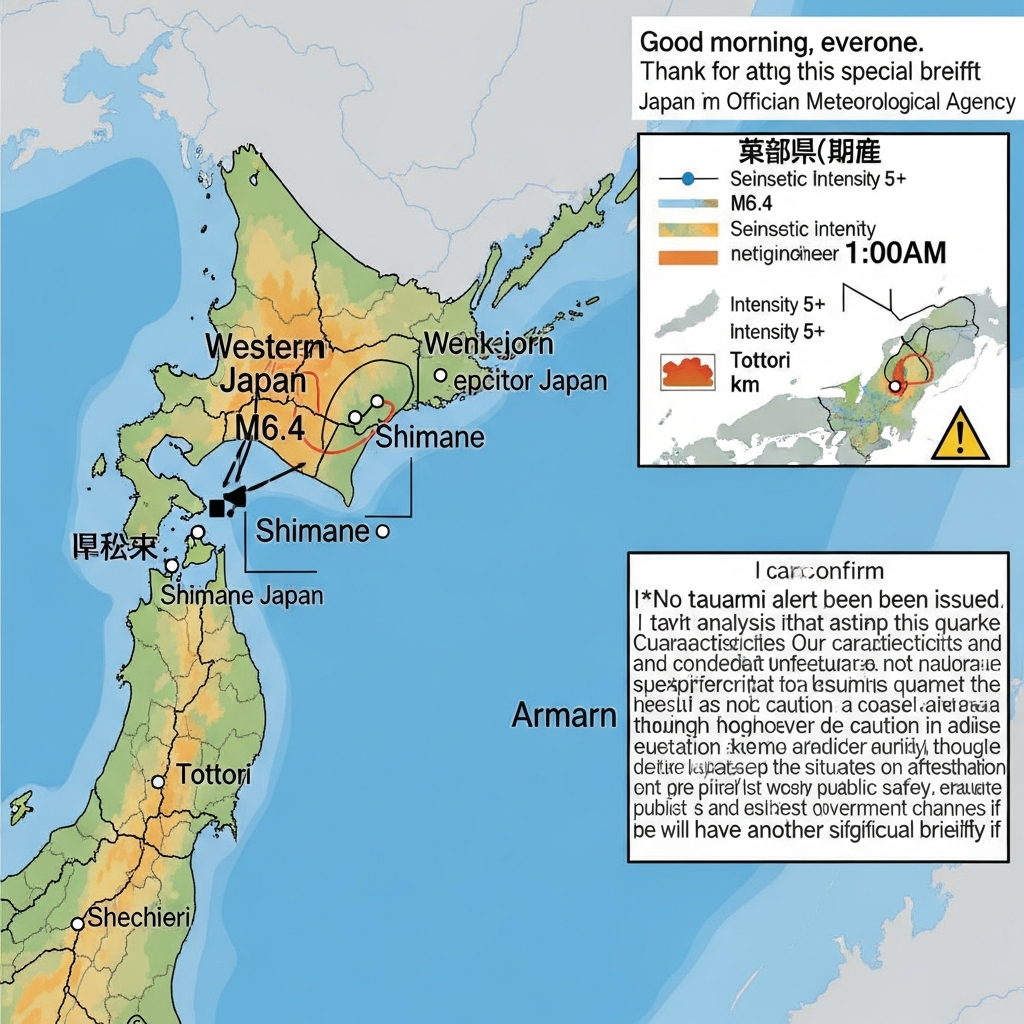
Western Japan experienced a jolt on January 6, 2026, as a powerful M6.4 earthquake struck the prefectures of Shimane and Tottori. The significant tremor, which originated at a shallow depth, prompted immediate safety checks across the region. Crucially, the Japan Meteorological Agency (JMA) swiftly confirmed that no tsunami warning was issued, providing immediate reassurance to residents. This incident highlights Japan’s ongoing vulnerability to seismic activity and its robust emergency response systems.
Western Japan Jolted: Unpacking the M6.4 Earthquake Details
The primary earthquake hit at 10:18 a.m. JST, initially reported at M6.2 but later revised to a significant magnitude 6.4. Its epicenter was located in eastern Shimane Prefecture, approximately 11 kilometers deep. This powerful quake registered an “upper 5” on Japan’s seven-point seismic intensity scale in affected areas, indicating strong shaking where furniture could topple, and it would be difficult to move without crawling.
Following the main tremor, a series of aftershocks quickly followed. These included an M5.1 quake at 10:28 a.m. and an M5.4 quake at 10:37 a.m., along with others ranging from M3.8 to M4.5. The Japan Meteorological Agency warned residents to remain vigilant for about a week. Officials cited historical precedent in the area where major quakes have often been succeeded by similar-scale tremors. Ayataka Ebita, chief of the JMA’s Earthquake and Tsunami Observation Division, underscored the brisk and ongoing seismic activity.
Immediate Impacts and Damage Assessment
While initial reports from Tottori Prefecture indicated no immediate injuries or significant property damage as of 11 a.m., a clearer picture emerged throughout the day. The Fire and Disaster Management Agency later confirmed five individuals required ambulance transport due to fall-related injuries: one in Yonago, Tottori Prefecture, and four in Matsue, Shimane Prefecture.
Localized structural damage also became evident. Photographic evidence from the region depicted a collapsed stone wall in Houki, Tottori Prefecture. In Matsue, Shimane Prefecture, a building showed a visibly damaged wall. Further reports from Yasugi, Shimane Prefecture, noted a cliff collapse behind a residential property. At Yonago City Hall, books were scattered from shelves, indicating the force of the shaking.
Ensuring Critical Infrastructure Safety
A paramount concern after any major earthquake in Japan is the safety of nuclear facilities. Operators quickly assessed the situation at the Shimane nuclear power plant in Matsue. Chugoku Electric Power Co., the facility’s operator, confirmed that no abnormalities were detected after the initial earthquake. The plant’s restarted No. 2 reactor (820,000 kilowatts) continued its normal operation, and environmental radiation monitoring posts showed no unusual readings, providing crucial reassurance to the public.
Transportation Networks Face Temporary Disruptions
The powerful tremors inevitably impacted western Japan’s extensive transportation network. Japan Railway (JR) West reported temporary halts to bullet train services on the Sanyo Shinkansen Line. This suspension occurred between Okayama and Hiroshima stations due to a power outage. Fortunately, services largely resumed by approximately 1:00 p.m., minimizing long-term travel delays. Other sections of the Shinkansen line also experienced delays.
Road travel was also affected, with West Nippon Expressway Co. announcing the suspension of sections of key routes. These included the Yonago Expressway between Hiruzen and Yonago, and a portion of the Sanin Expressway between Yonago-Nishi and Yasugi. Additionally, the Ichibata Electric Railway in Shimane Prefecture suspended all its lines, further highlighting the widespread nature of the disruption.
Swift Government Response and Regional Preparedness
The Japanese government responded swiftly and decisively to the earthquake. A dedicated liaison office was established at the Prime Minister’s Office Crisis Management Center just minutes after the initial quake. Prime Minister Sanae Takaichi addressed reporters, affirming the government’s unwavering commitment to assessing damage and providing all necessary support. Chief Cabinet Secretary Minoru Kihara also confirmed that nuclear facilities reported no abnormalities. Both the Shimane and Tottori prefectural governments established disaster response headquarters to coordinate local efforts.
The JMA’s advisory for continued vigilance for strong tremors over the subsequent week underscores Japan’s proactive approach to disaster management. This recommendation is rooted in historical data, recognizing patterns where initial significant quakes can preface further seismic events in the same region. Residents were urged to maintain a high level of preparedness.
Japan’s Seismically Active Landscape and Historical Context
Japan is one of the world’s most earthquake-prone nations, situated on the volatile “Pacific Ring of Fire” at the convergence of four major tectonic plates. The country experiences approximately 1,500 earthquakes annually, with most being minor. However, significant tremors like the recent M6.4 event are a stark reminder of this geological reality.
This latest quake marked the first time the affected area had experienced an earthquake registering an “upper 5” or higher on the seismic intensity scale since a lower 6 quake struck Tottori Prefecture in October 2016. Similarly, Shimane Prefecture last recorded an “upper 5” quake in April 2018. Beyond the directly hit prefectures, an intensity of 4 was recorded in Okayama, Hiroshima, Kagawa, and Ehime, demonstrating the wide reach of the seismic waves. Notably, western Shimane Prefecture also experienced a Class 4 long-period ground motion, a type of slow yet significant swaying capable of affecting tall buildings even far from the epicenter.
Cultural and Local Site Impact
Beyond infrastructure, the earthquake also impacted cultural and local landmarks. Matsue Castle, a designated national treasure, temporarily lost power, leading to the evacuation of tourists. Fortunately, no injuries or structural damage were reported at the historic site. Other cultural institutions like the Mizuki Shigeru Memorial Museum in Sakaiminato and Lafcadio Hearn’s former residence in Matsue also closed temporarily as a precautionary measure, highlighting the broader societal effects of the powerful tremor.
Frequently Asked Questions
What were the key details of the M6.4 earthquake that struck Western Japan?
On January 6, 2026, at 10:18 a.m. JST, a significant M6.4 earthquake (revised from M6.2) rattled western Japan, primarily impacting Shimane and Tottori prefectures. Its epicenter was located in eastern Shimane Prefecture at a shallow depth of 11 kilometers. The quake registered an “upper 5” on Japan’s seismic intensity scale in parts of the region and was followed by multiple aftershocks, including M5.1 and M5.4 tremors, indicating ongoing seismic activity.
Was a tsunami warning issued after the recent earthquakes in Western Japan?
No, despite the strong magnitude of the initial M6.4 earthquake and subsequent aftershocks, the Japan Meteorological Agency (JMA) explicitly confirmed that no tsunami warning was issued for the region. This crucial assessment provided immediate relief and allowed authorities to focus on ground-level impacts and safety measures.
What measures did authorities recommend following the Western Japan earthquake?
The Japan Meteorological Agency (JMA) advised residents to remain highly cautious, warning that earthquakes of a similar scale could continue for approximately a week, citing historical precedent for such seismic patterns in the area. The Japanese government, led by Prime Minister Sanae Takaichi, established a liaison office to coordinate an all-encompassing response. Prefectural disaster headquarters were also activated, emphasizing the importance of vigilance and preparedness among the public.
Continuing Vigilance in Japan’s Seismic Landscape
The M6.4 earthquake in western Japan on January 6, 2026, served as a potent reminder of the nation’s constant geological activity. While significant disruptions to transport and some localized damage occurred, the swift response from authorities and the absence of a tsunami warning provided critical stability. Japan’s advanced seismic monitoring and well-rehearsed disaster protocols continue to be indispensable in managing the impacts of such powerful natural events. Residents in Shimane and Tottori prefectures remain urged to stay informed and prepared for potential ongoing seismic activity, embodying the nation’s resilient spirit in the face of nature’s forces.